|
Prepared People Save Lives
Inclusive Water Preparedness: Preparedness is a team effort that works best when individuals with intellectual disabilities and autism,
along with their support networks, take an active, leading role.
Rather than waiting for a water shortage to impact your household, you can build accessible routines and understand your local environment ahead of time. You can monitor evolving, hyper-local water conditions using the U.S. Drought Monitor for Pennsylvania.
1. Proactive Preparedness for Individuals & Supports
Building routines and making water conservation a predictable, everyday habit reduces anxiety if a drought forces sudden changes in water use.
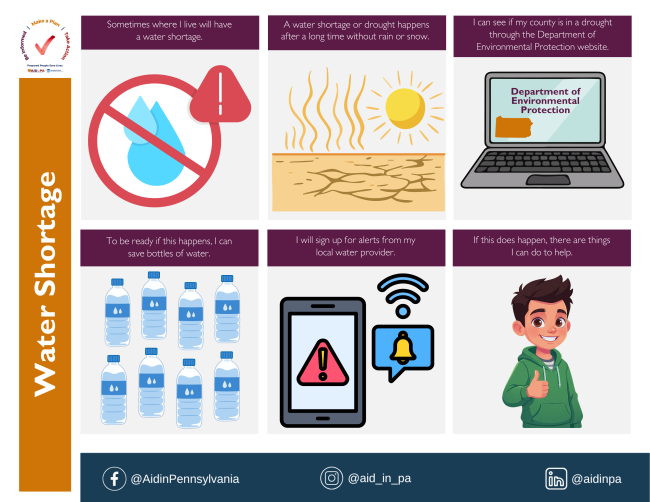
· Create Visual Conservation Schedules: Use visual aids, icon checklists, or social stories to map out simple, everyday water-saving steps. Focus on concrete actions, such as turning off the faucet while brushing teeth or timing showers with a favorite 5-minute song.
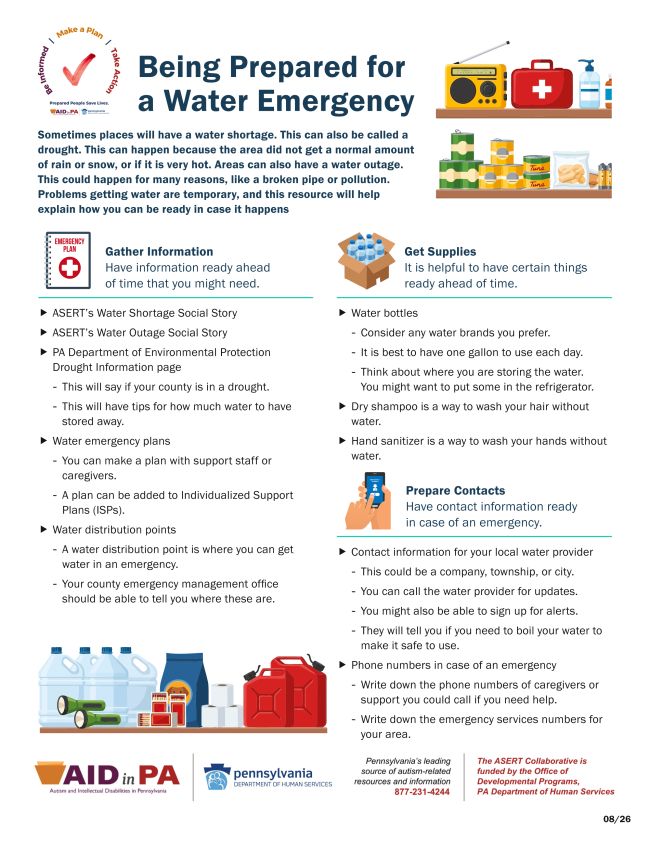
· Build Sensory-Friendly Water Storage: Emergency storage guidelines from the CDC Emergency Water Supply Guide recommend keeping at least 1 gallon of water per person per day. For neurodivergent individuals who may have strong sensory preferences for specific water temperatures, packaging types, or brands, proactively stock preferred bottled water to maintain comfort during a supply disruption.
· Practice Alternative Routines: If a drought emergency forces local water restrictions, regular routines might change. Proactively practice using water-free alternatives—like waterless dry shampoo or hand sanitizer—so these textures and smells are familiar and comfortable before they become a necessity.
· Integrate Preparedness into ISP Planning: Direct Support Professionals (DSPs) and families should explicitly build water and utility contingency plans into the individual's Individualized Support Plan (ISP). Ensure emergency contacts, local water provider alert settings, and backup distribution plans are updated annually.
2. Understanding Your Watershed & Local Conditions
Pennsylvania's water resources are managed across vast river basins. Where you live determines your primary water supply and how drought conditions impact your community.
The Ohio River Watershed (Western PA)
· What it is: This is the massive water "bowl" for western Pennsylvania.
· How it flows: In Pittsburgh, the Allegheny River and the Monongahela River meet to create the Ohio River. This water flows west out of Pennsylvania, moves into the Mississippi River, and eventually empties into the warm waters of the Gulf of Mexico.
· Why it matters for preparedness: Millions of people in western Pennsylvania rely on this system for drinking water. Because it is a hub for large commercial boats and industry, local emergency plans focus heavily on protecting this massive water supply from chemical spills, infrastructure damage, and unexpected seasonal droughts.
The Susquehanna River Watershed (Central & Eastern PA)
· What it is: This is the largest river basin in Pennsylvania, covering an enormous half of the entire state's land area.
· How it flows: The Susquehanna River starts up in New York, twists all the way down through central Pennsylvania (passing right by Harrisburg), and empties into the Chesapeake Bay in Maryland. It provides a staggering 50% of all the fresh water that enters the Chesapeake Bay.
· Why it matters for preparedness: Because this watershed covers so much farmland and agricultural valley space, it is incredibly sensitive to weather extremes. It is historically known as one of the most flood-prone areas in the country, but during dry spells, its drop in water levels directly impacts local food supply chains and power-generation plants. Support networks here must balance tracking both rapid flooding and severe seasonal drought.
The Delaware Watershed (Southeastern PA)
· What it is: This water basin shapes the easternmost border of Pennsylvania, serving major populated zones like the Allentown-Bethlehem area and Philadelphia.
· How it flows: The Delaware River flows south from the Catskill Mountains of New York, forms the border between Pennsylvania and New Jersey, and empties into the Delaware Bay and the Atlantic Ocean. Two large PA rivers—the Lehigh and the Schuylkill—drain into it. Notably, it is the longest river on the East Coast without any major dams blockading its main stem.
· Why it matters for preparedness: This system supplies drinking water to over 15 million people across multiple states. Because the lower part of this watershed is so heavily populated and urban, a water shortage here strains public water grids quickly. Preparedness in this region focuses heavily on tight conservation rules during dry spells to protect the shared water pressure and quality for millions of neighboring households.
3. Current Commonwealth Drought Status & Response
The Pennsylvania Department of Environmental Protection (DEP) tracks regional data across four key indicators: streamflow, groundwater, precipitation, and soil moisture.
The Commonwealth Drought Task Force manages active regional tiers for drought status.
4. Proactive Community Resource Mapping
Support networks should collaborate to map out local backup systems well in advance of a water emergency.
· Establish Public Water Contacts: Identify your local water provider and sign up for text or voice alerts. If the individual relies on a private well, register with local municipal emergency management to ensure you are included in emergency water distributions if the well runs dry.
· Pre-Identify Bulk Supply Hubs: Work with local community centers, county emergency management coordinators, and Office of Developmental Programs (ODP) providers to identify pre-designated water distribution points or certified bulk water haulers in your area.
· Create Emergency Mutual Aid Trees: Build a localized communication tree among families, neighbors, and DSPs. Ensure that if an individual with limited mobility or communication barriers experiences a water service disruption, a designated team member is assigned to deliver emergency supplies immediately.
|