|
Can I get Quick Access to my Legal Documents on my iPhone or Android? Yes, there is an App for that!
The American Bar Association's (ABA) Commission on Law and Aging has a mobile application called Mind Your Loved Ones (MYLO) that lets users store and distribute health care advanced directives via their smartphone. Users can print, fax, or email loved one’s information and documents stored on the app. This includes documents such as users' living wills and advanced health care directives. According to the ABA Commission on Law and Aging, "one of the biggest problems people experience in making decisions for loved ones is that needed information is not in our hands when needed-- at the right time and at the right place."
The ABA, mostly through its Commission on Law and Aging, promotes the creation and use of advanced health care directives in an individual's estate plan portfolio. Advanced directives such as a health care power of attorney authorize another person to make health care decisions for an individual, in case the individual loses the ability to make decisions, and provide instructions on how decisions are to be made. Without these important legal documents, costly legal proceedings such as a guardianship may be necessary to make decisions for a loved one who is incapacitated.
The MYLO app attempts to ensure that advanced directives are easily accessible when they are actually needed. The app gives individuals and their family members the ability to store their own and each other's advanced directives, key health information, and health care contacts on their Apple or Android smartphones. It also allows them to send advanced directive documents directly to health care providers by email or Bluetooth. (Caution: Some health care providers prohibit electronic transmissions except by fax, so get approval first from the health care provider.)
Recognizing that people are reluctant to give up control of such personal documents to a third-party, the ABA Commission on Law and Aging created the app so that the individual's smartphone itself becomes the registry, which is very handy.
For more information about the app and a link to download the app click here.
"My Health Care Wishes App." Bifocal, vol. 42, no. 5, May-June 2021, www.americanbar.org/groups/law_aging/publications/bifocal/vol-42/bifocal-vol-42-issue-5-may-june-2021/my-health-care-wishes-app/
| |
The Estate Planning Lawyer and Financial Consultant: Friend or Foe? | | |
The title of this article could have many different variations. One could also say, "The Estate Planning Lawyer and Accountant," or "The Estate Planning Lawyer and Insurance Agent."
In the world of financial management and legacy planning, a common tension exists. A client sits down with their financial advisor and hears one strategy; they meet with their estate planning lawyer and hear another. By the time they check in with their accountant or their insurance agent, they have four different "best" paths forward. This friction often leads clients to wonder: Are these professionals working together, or are they at odds?
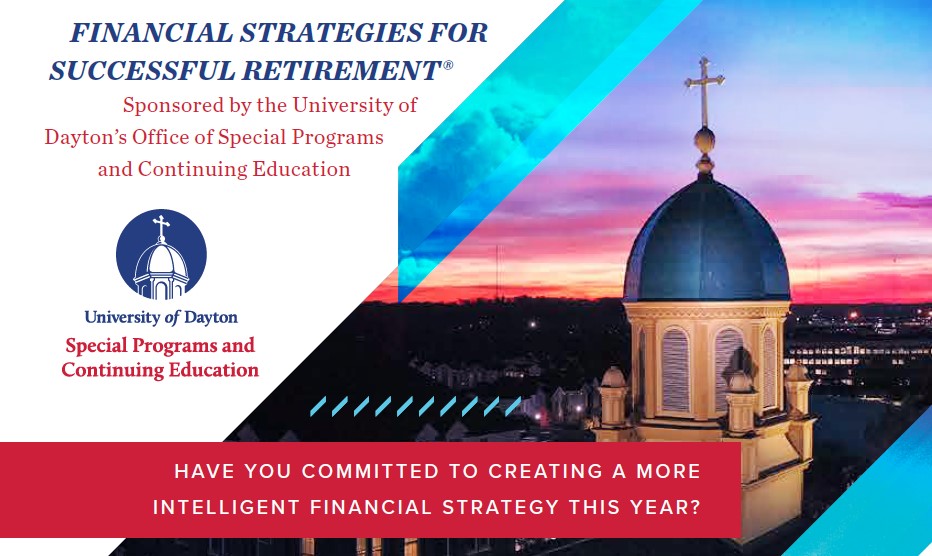
While it may feel like they are competing for the "captain" chair of your financial life, the reality is that the estate lawyer, the financial advisor, the insurance agent, and the accountant are legs of the same stool. They may offer conflicting advice at times, but that conflict is usually a result of their unique lenses and specialized strengths. To further reinforce this point of view, we have been given the honor of presenting in a financial series that includes financial advisors, accountants, and insurance agents for the University of Dayton (UD) Special Programs and Continuing Education division of UD. Our partner, Kristina Rainer, who is an OSBA Certified Specialist in Estate Planning, Trust & Probate Law, was honored to receive the invitation to be included in the series of talks at UD.
The Financial Strategies for Successful Retirement series at UD started last week, but there are six more weeks left to listen to financial professionals with many years of experience in the areas of finance management and investing, tax planning, and insurance, which are the other legs of the "stool." Kristina will present for her sessions on estate planning and asset protection on March 16th and March 18th. Click here for more information about how to register for this speaker series that is offered through UD.
In Spring 2023, Attorney Nancy Roberson was asked by The Register magazine to write an article for the publication on this topic of how finance professionals and estate planning lawyers can work together. The article was an opinion piece pertaining to a financial advisor’s role in the estate planning process, and whether estate planning attorneys and financial advisors were friends or foes. Nancy wrote an interesting perspective on the relationship between the financial advisor and the estate planning attorney, through the lens of an experienced estate planning attorney who has worked with clients’ financial advisors for over 40 years. Click here to read the article.
In closing, we were recently asked by a financial advisor for information that he could give his clients about managing the financial and legal affairs of a decedent and how to instruct a person about the next steps after a loved one dies. Because the information he requested was directly related to the area of law we practice, we were equipped to give him ample resources to share with his clients and we did just that. Before we did that, however, we thanked him for not trying to wear the "estate planning lawyer hat" and for not attempting to consult his clients in a complex area about which he didn't have a license to give advice. Bottom line: it is refreshing to work with professionals who appreciate the credentials that estate planning lawyers must possess to learn our trade.
| | A Year in Review (8 weeks late) | | |
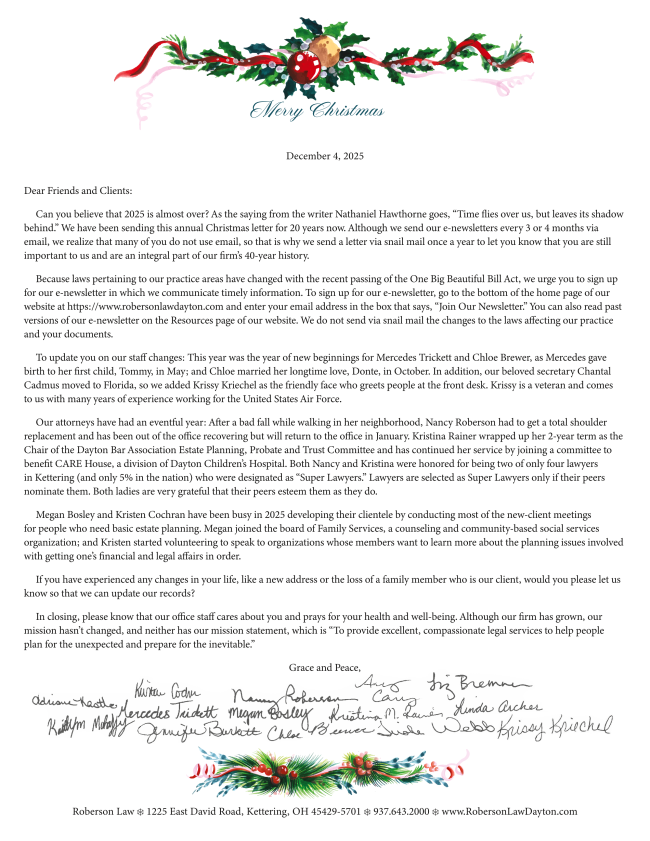
We realize that this article is potentially "stale" in the world of publication; however, we have a good excuse. As our 2025 annual Christmas firm letter (copied below) stated, our newsletter editor, Nancy Roberson, had been out of the office since December due to a shoulder replacement surgery. Nancy has returned to the office and is now trying to catch up from being gone; hence the reason why we are writing about Christmas in March.
The holiday letter we snail mail every year is done in an effort to stay connected with our past and current clients. This is a 20-year tradition in our office. The letter is mailed through the United States Postal Service to everyone in our client database for whom we have a current mailing address, and for some people, it is the only correspondence that they receive from us all year. For that reason, we have included a copy of our holiday letter in this newsletter for anyone to read who may have not received our holiday letter in the mail. If you are a client of ours and you have not received a letter in the mail from us, it is because we do not have your current mailing address, so please let us know if you have moved, and we will update your records accordingly. Read a copy of the letter here and enjoy!
While we are on the topic of Christmas, we decided to share pictures of our out-of-the ordinary office Christmas party held in a simulated game show. (Keep reading for all the gory details.)
Game Show Battle Rooms is an establishment that offers a simulated game show experience for purposes of team building. The pictures are worth a thousand words; however, in summary, the experience involved our staff being divided into two teams to battle against each other in common tv games mirroring Wheel of Fortune, Price is Right, and Family Feud.
The division of the teams was supposed to be randomly chosen by the game show employees, but the teams were suspiciously divided with all our lawyers and paralegals on one team together against everyone else. Some called the match ups: The People’s Court vs. The Partner’s Track, Order in the Court vs. Chaos in the Streets, or Suit Up vs. Show Up. Although the "everyone else" team was initially getting slaughtered, and it appeared that there may be workplace violence among 13 women in the last seconds of the game, the everyone else team narrowly inched past the lawyers and paralegals to score and become the Game Show Battle Rooms winners!
| | Is Your Will Valid if you Terminate your Marriage or Your Spouse Dies? | | | |
Are you getting divorced, obtaining a dissolution, or annulling your marriage? Has your spouse or partner died? If so, then you should consider reevaluating your estate planning documents as soon as possible.
According to Section 2107.33(D) of the Ohio Revised Code, once a person has signed a will, if he or she is divorced, obtains a dissolution, obtains an annulment, or legally separates from his or her spouse, any provisions in the will appointing the former spouse as executor will be revoked unless the will specifically states otherwise. For example, if Mary's will appoints her husband, John, as executor of her estate and then they get divorced, John's appointment of executor becomes null and void, and the next person named in the will becomes executor.
Additionally, according to Section 2107.33(E) of the Ohio Revised Code, divorced spouses will not inherit from each other based on termination of the marriage. Their property will be distributed as if they did not survive each other. For example, if Mary's will gives all of her property to her husband, John, and then to her sister, Beth, if John doesn't survive Mary, but then Mary and John get divorced, all of Mary's property will go to Beth as if John died before Mary even if John survives Mary.
If a couple remarries, the will's powers and distributions remain as if the couple never terminated the marriage. A similar law applies to beneficiary designations of payable-on-death assets, so a re-marriage will require new beneficiary designations.
Further, if a former spouse marries a new spouse, the new spouse will have rights known as statutory marital rights defined in Section 2106 of the Ohio Revised Code that allow the new spouse to obtain certain property before any beneficiaries identified in the will obtain their distributions. (This is a compelling reason to get a Prenup!)
While Ohio law automatically enforces the revocations of power and distribution, it is much easier and more efficient to update your estate plan documents to reflect your true intentions, whether or not your intentions include your former spouse.
Finally, if a couple divorces, but they want to keep each other as beneficiaries and fiduciaries of their estates, they should sign new wills. However, outside a divorce, if a spouse dies, the contingent beneficiary or successor named will be "next in line."
| | Has your Loved One's Financial Information been made Public after His or Her Death? | | |
Because Ohio has a strong open public record law, the stage is set for scam artists to take advantage of unsuspecting Ohio citizens, regardless of whether the victim is dead or alive. If probate is not avoided (probate records are public), and there is more than one beneficiary, then an accounting of all the probate assets that the decedent owned will be made public through the probate process. Most of the probate records dating back to the 1980s are online for anyone to view.
The single fact alone that a decedent's asset information could be available for anyone to access is what motivates many people to get a trust. The assets in a funded trust are not on public display because trust assets do not go through probate. Quite often we hear our clients say that they do not need a trust because they are not rich, but did you know that a huge benefit of getting a trust is to protect your family's privacy? Although there are many reasons why a person would get a trust, regardless of the amount of money in his or her bank account, one monumental reason is protecting privacy.
When a trust is used as part of an estate plan, the public probate process can often be bypassed if the trust is fully funded. By keeping your personal and financial information out of the probate court, you are protecting your family from unnecessary risks arising from easy public access to your family's personal and financial information.
We have had several instances this year where our firm and clients have been targeted by scammers due to the information that can be obtained online. A scammer often poses as an imposter, posing as someone you know or trust, and will obtain your information from public and online records and use that data to make someone who trusts you believe that they are you. Case in point: Employees at our firm often get emails from “Nancy Roberson,” but the email is not actually from Nancy. Usually, the imposter sending the email is posing as Nancy and “phishing” for information from our employees by attempting to obtain data that will assist the scammer in identity theft.
In the end, we encourage everyone to practice the “sniff test:” If the request doesn’t smell right, don’t do it. It’s always better to be safe than sorry.
| | Understanding Your Options: Palliative vs. Hospice Care | | |
Because our practice areas often bring clients to us who are experiencing a terminal illness, we see many people who are facing the decision about the next steps in the care process for a loved one with a serious illness.
When navigating a serious illness, the terms "palliative care" and "hospice care" are often used interchangeably, leading to confusion for families and caregivers. While both focus on improving quality of life and managing symptoms, they serve different roles at different stages of a health journey. Understanding these distinctions can help you or your loved one access the right support at the right time.
What is Palliative Care?
Palliative care is specialized medical care for people living with a serious illness, such as cancer, heart failure, or dementia. Its primary goal is to provide relief from the symptoms and stress of the condition—such as pain, nausea, or fatigue—to improve daily life for both the patient and their family. A common misconception is that palliative care is only for the end of life. In reality:
-
Timing: It can begin at the moment of diagnosis and continue at any stage of a serious illness.
-
Treatment: You can receive palliative care while still pursuing curative treatments, such as chemotherapy or surgery.
-
Focus: It acts as an "extra layer of support" alongside your existing medical team to help you stay stronger during treatment.
What is Hospice Care?
Hospice care is a specific type of palliative care designed for the final chapter of life. It begins when a cure is no longer the goal, and the focus shifts entirely to comfort, dignity, and peace.
Key characteristics of hospice include:
-
Eligibility: It is reserved for patients with a terminal prognosis, typically a life expectancy of six months or less, as certified by a physician.
-
Approach: Curative treatments are generally stopped so the team can focus on maximizing comfort and quality of life.
-
Support: Hospice provides a comprehensive interdisciplinary team, including nurses, social workers, chaplains, and volunteers, often in the comfort of the patient's home.
Making the Choice
Deciding between these options is not about "giving up;" it is about matching medical care to your personal goals and wishes. If you are still fighting an illness but need help with pain or stress, palliative care is a powerful partner. If the burdens of treatment have become too great and the focus is on a peaceful final journey, hospice offers the compassionate support you need. Although we have met with many clients in both situations, it is typically most wise to make changes to estate planning documents before Hospice care begins. Once began, cognitive decline is more probable, which reduces the opportunity to sign legal documents.
Google. (2026, March 2). [https://gemini.google.com/](https://apastyle.apa.org/blog/cite-generative-ai-references)
| | Widow and Widower Resources | | |
As a result of the areas of law we practice, our office assists many people who are grieving. The management of grief comes in many forms, so we have resources available to assist people with the grieving process.
The Widows Support Group meets at MCL Restaurant & Bakery, 4485 Far Hills Avenue, Kettering, Ohio 45429, from 3:00 p.m. to 5:00 p.m. on the first Friday of every month, unless the Friday falls on a holiday. You may join the group for dinner following the meeting; dinner is at your expense, chosen from the menu available. The group meets in the private meeting/dining room in the cafeteria of MCL. For more information, call Sherry Matsel at 937 878 9707 (H) or 937 581 2909 (C).
Another resource is the GriefShare program. Click on the link to learn more about this program that assists people who are grieving the loss of a loved one. Many churches offer this important program, so refer to the website to learn more about how you may be able to take advantage of this valuable resource in your community.
| | |
Lawyers get a bad rap. There is a reason why lawyers are the butt of many jokes. Occasionally, however, we will get positive feedback from a client that helps remind us why we do what we do.
If you have gotten great service from one of the ladies at Roberson Law and would like to offer a word of thanks or encouragement for that staff member, would you be so kind to click here to post your comment?
Lawyers rely heavily on public reviews for business generation because, in general, many people don't trust lawyers. Your feedback not only helps us, but it also helps other potential clients who are considering using our firm. If you cannot give us 5 stars in this link, please reach out to Amy Cary at acary@dayton-attorney.com. Amy is our Business Manager, and she has been serving our firm for 28 years to ensure a wonderful client experience.
Thank you in advance for your willingness to give us feedback and help us in our efforts to continue to maintain the excellent, high standards that have been the backbone of our reputation for over 40 years!
| | | | |