Fire Hazards and Risk Factors from Using
Household Extension Cords in Harbors and Marinas
by Malcolm Morgan
The use of non-Marine household extension cords to supply shore power to a vessel creates several hazards often overlooked until a problem occurs. The most significant problem is an increased risk of fire when using a small-gauge wire plugged into a 30 or 50 amp receptacle on the dock.
The NEC (National Electric Code) clearly defines the size & type of wiring that must be used for a given size circuit breaker, in order to ensure the breaker will trip off if there is a problem.
There are 3 main issues to consider:
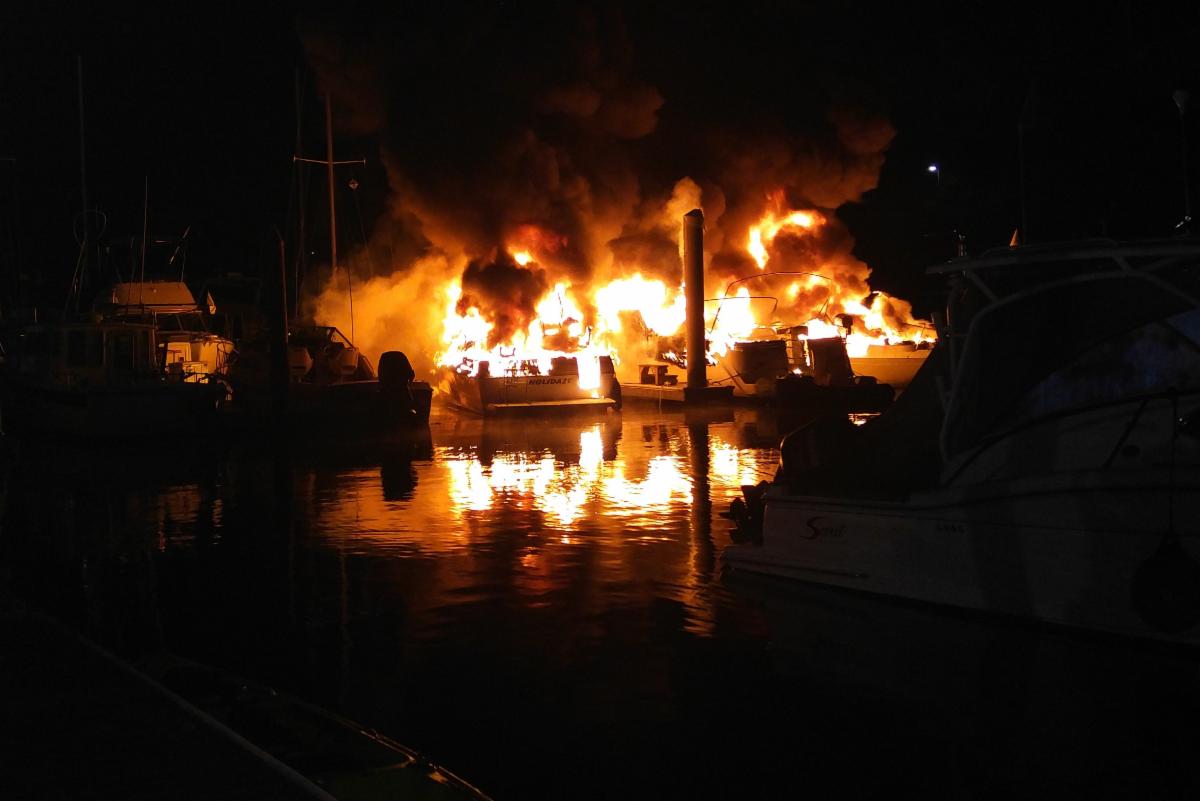
- The wire size in the cord must match the size of the circuit breaker the wire is connected to. The dock 30 amp breakers WILL NOT trip if a small 16 gauge or 18 gauge cord is plugged into it. Even with a small load like a dehumidifier or battery charger, if there is an electrical fault or short circuit at the boat end, the small cord will not carry enough current to turn off the breaker; the cord simply overheats until it catches fire. This has been documented many times as the cause of a catastrophic fire.
- The extension cords typically used are not made of corrosion proof materials, all of the prongs, receptacle blades, and even the wires are made from bare copper or plated steel, which quickly corrodes and causes excess heat to form. Even proper marine grade cord fittings suffer from corrosion, household cords fail at a much higher rate.
- Most extension cords are not rated for constant outdoor exposure, particularly the outer insulation. While the outer jacket MAY last a year or two, most typically do not, leaving the inner conductors exposed within a relatively short time.
If boat owners want to use an extension cord plugged into a 30 amp dock receptacle, the cord needs to have at least #10AWG conductors. A [30 to 15 amp] unitized 1 part adapter at the appliance end can be used to connect the 30 amp cord to the heater or charger. This is considerably safer than using a small cord plugged into a large breaker.
Another possibility for smaller vessels or race boats that do not want to use the heavy-duty cord would be to request the harbor to install a 10 or 15 amp breaker in the dock box instead of the 30 amp breaker. This would at least reduce the risk of fire and prevent overloading the small cord.
The requirement to prohibit the use of household extension cords has been forced upon both boatowners and harbors by insurance carriers in many cases. In addition, many harbors have been banning the use of [30 amp to 15 amp] or [50 amp to 30 amp] pigtail adapters, for the same reasons noted above. A 30 amp device plugged into a 50 amp breaker will overheat before the breaker trips.
The use of extension cords should be limited to temporary, attended use only, for power tools or other supervised applications, and never for unattended or long-term use in a marina.
|