|
In Moshen
The Newsletter of The Northshore's Personal Physical Therapy Practice
| | October - Physical Therapy Month | | |
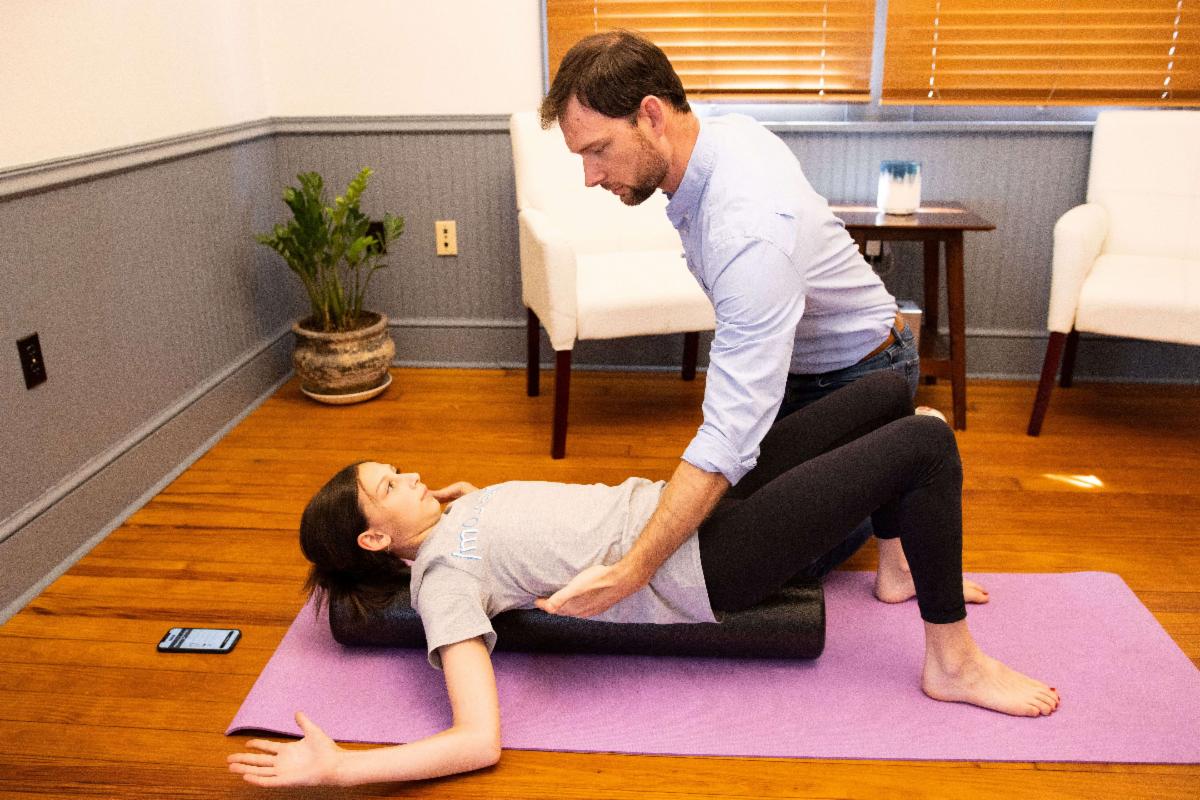
I know fall is usually the season for celebrating cooler weather, football, and PSLs, but I'd like to take this opportunity to celebrate something near and dear to my heart: physical therapy! This edition of In Moshen will focus on the profession I love, and I'd like to kick things off by telling you a little about my journey into physical therapy.
Our story starts in high school. I've always loved sports, but I was never a great athlete. I was a little better suited to the classroom than the ball field. Fortunately, Covington High School had a great sports medicine program that allowed me to get up close to the action without having to serve as a human tackling dummy.
During my third year in the program, something happened that I still recall whenever someone asks what inspired me to become a physical therapist.
We had a guest lecturer come in to discuss the importance of stretching. And this wasn't just any lecturer! She was a subject matter expert, Covington High School alumna, and local dance studio owner Lydia Pond (now Lydia Gazzo—hi, Lyd!). She had trained countless dancers in the importance of stretching and flexibility, and she was sharing some of that wisdom with our class.
Later that evening, I was serving as the student athletic trainer for the track team at the Covington Invitational Track Meet. While checking in on the athletes, a triple jumper told me he wasn't hitting his mark the way he wanted and was considering changing his starting point for his approach.
I asked him to let me try something before making any drastic changes. I had him lie down and guided him through a quick breathing and stretching routine, just like Mrs. Lydia had taught us that afternoon. Afterward, he got up and made one more practice run before the event. He was right on the money! In fact, he set a personal best that day.
That was my epiphany. There was something incredibly gratifying about taking knowledge from the classroom and applying it on the playing field to improve someone's performance. I realized that if I could make a career out of doing that, I'd love every minute of it. As it turns out, I was right. I've truly loved my journey in physical therapy, and I'm excited to share more about this incredible profession throughout this edition of In Moshen.
Here's to celebrating the profession that helps us all move better, perform better, and get back to doing what we love!
| |
The History of Physical Therapy:
From Recovery to Performance
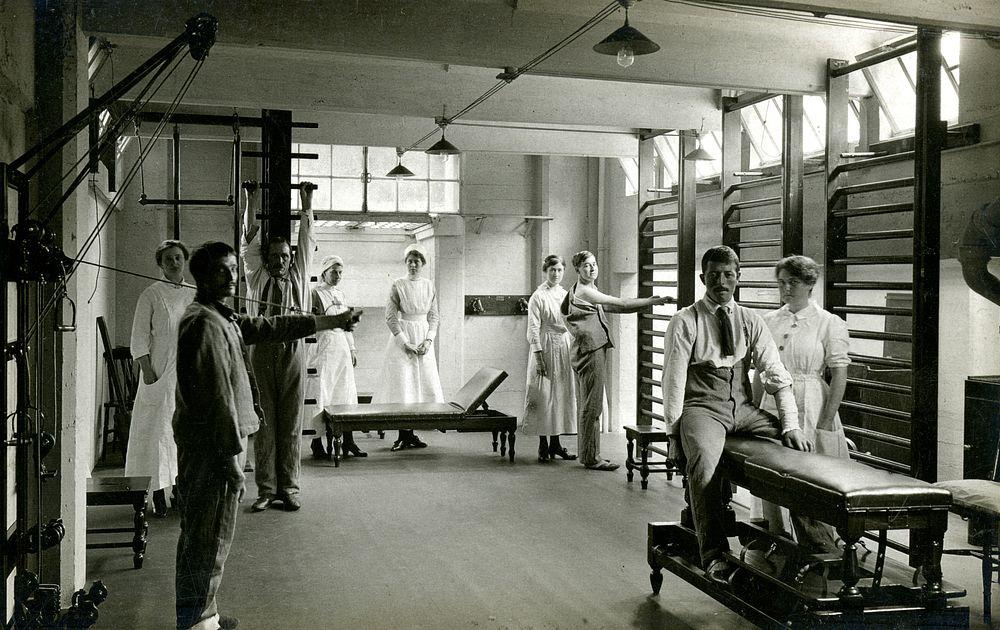
| Image credit: Albert Norman, The Massage Exercise Room, c. 1916–1918. Wellcome Collection, London. Licensed under Creative Commons Attribution 4.0 International (CC BY 4.0). | |
Physical therapy has come a long way from ancient healing practices to the science-driven, personalized care we know today.
The idea that movement promotes healing dates back thousands of years. Ancient Greek physicians, including Hippocrates, recognized the benefits of exercise and massage in treating physical ailments. Although their methods were limited by the medical knowledge of the time, they understood something we still believe today: movement matters.
Physical therapy began to emerge as a formal profession in the early 20th century. Its development was influenced by nursing, rehabilitation, and the growing recognition that patients needed specialized care to recover movement and function. During this period, nurses and other healthcare professionals helped establish early rehabilitation practices, while the profession developed its own specialized training. World War I accelerated this growth, as trained rehabilitation workers helped injured soldiers regain strength, mobility, and independence. Later, polio outbreaks further expanded the need for rehabilitation, helping establish physical therapy as an essential part of healthcare.
As the profession evolved, its focus expanded beyond restoring basic function. Advances in sports medicine and exercise science helped physical therapists develop better ways to rebuild strength, improve movement, and prepare athletes to return to competition.
Today, physical therapy is about more than getting out of pain. It's about helping people return to the activities they love, prevent future injuries, and perform at their best. From recovering after surgery to improving athletic performance, modern physical therapy combines individualized treatment with an understanding of each person's unique goals.
At Moshen, we embrace this evolution by providing personalized care that looks beyond the immediate injury. Whether you're a dancer, an athlete, or simply someone who wants to keep moving well, our goal is to help you get back to doing what you love.
| | Famous Faces, Real Recovery: How Physical Therapy Helps Us Get Back in the Game | | |
Even the world's most accomplished athletes and entertainers sometimes need help getting back on their feet. Injuries don't discriminate, and recovery often requires patience, determination, and plenty of hard work.
Here are four familiar faces whose experiences highlight the importance of rehabilitation.
Tiger Woods: One Step at a Time
In 2021, professional golfer Tiger Woods suffered severe injuries to his right leg in a car accident. His recovery involved extensive rehabilitation, and he described the process as physically demanding. Initially, his goal was simply to walk independently again.
His experience reminds us that recovery isn't always about returning to elite performance. Sometimes, the biggest milestone is regaining the ability to do something we once took for granted.
Kevin Hart: Rebuilding After a Serious Accident
Comedian and actor Kevin Hart fractured his spine in three places in a 2019 car accident. Following surgery, he underwent inpatient rehabilitation before continuing his recovery at home.
Hart spoke openly about the humbling experience and the work required to regain his abilities. His story illustrates how rehabilitation can help people rebuild strength and function after a serious injury.
Tom Cruise: The Show Must Go On
While filming Mission: Impossible – Fallout in 2017, actor Tom Cruise fractured his ankle while attempting a rooftop stunt. Known for performing many of his own stunts, Cruise faced an ambitious recovery timeline to return to filming.
He reported spending approximately 10 hours a day, seven days a week, on rehabilitation. Within weeks, he was working toward running again, although his ankle had not fully healed.
Cruise's experience demonstrates the demanding nature of rehabilitation and the importance of progressively rebuilding the physical abilities required for a specific goal.
Drew Brees: A Comeback That Changed Everything
Saints fans remember Drew Brees as one of the greatest quarterbacks in franchise history. Before his legendary career in New Orleans, however, Brees suffered a serious throwing-shoulder injury while playing for the San Diego Chargers in 2005.
The injury included extensive damage to his shoulder labrum and rotator cuff, requiring surgery. His recovery involved doctors and physical therapists working to restore his shoulder function and throwing ability. Despite concerns about whether he would return to his previous level of play, Brees made a remarkable comeback, eventually leading the Saints to a Super Bowl championship.
His story is a powerful example of how rehabilitation can help someone return to the activity that defines their career—even when the odds seem stacked against them.
What Can We Learn From Their Stories?
These individuals faced very different injuries, but their experiences share a common theme: recovery takes active participation. Medical procedures can address an injury, but rehabilitation helps people rebuild the strength, mobility, coordination, and confidence needed to return to daily life and the activities they enjoy.
You don't have to be a professional athlete or a Hollywood star to benefit. Whether you're a dancer preparing for your next performance, an athlete returning to competition, or someone who simply wants to move without pain, physical therapy can help you work toward your goals.
At Moshen, we believe recovery should be about more than getting you back to where you were. It's about helping you move forward.
| |
Bridging the Gap: An Exercise You Can Take Home
From the early days of physical therapy to the rehabilitation journeys of athletes like Drew Brees and Tiger Woods, one thing has remained constant: movement is a powerful tool for recovery and performance.
But you don't have to be a professional athlete to benefit from physical therapy. Sometimes, improving how you move starts with a simple exercise you can do right at home.
This Fall, we're highlighting the supine bridge. It's a great exercise for strengthening the glutes and improving hip control, and it can be modified to suit a variety of fitness levels.
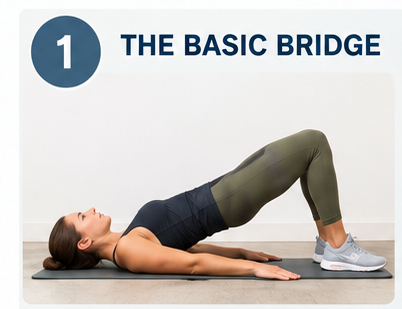
1. The Basic Bridge
Lie on your back with your knees bent, feet flat on the floor, and arms resting at your sides. Tighten your abdominal muscles and squeeze your glutes as you lift your hips until your shoulders, hips, and knees form a relatively straight line. Pause briefly, then slowly lower your hips.
Focus: Keep your ribs relaxed, avoid arching your lower back, and let your glutes do the work.
|
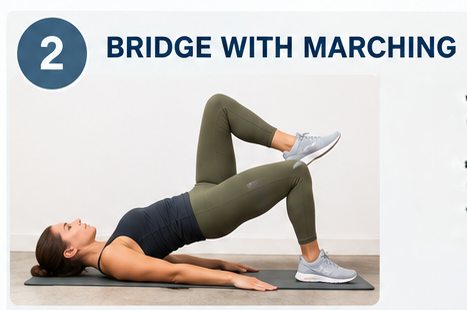
2. Bridge with Marching
Start in the basic bridge position and lift your hips. Keeping your pelvis as level as possible, slowly lift one foot a few inches off the floor, then return it and alternate sides.
Focus: Resist the urge to let your hips drop or rotate as you lift each foot.
|
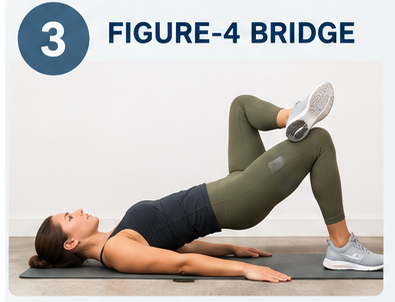
3. Figure-4 Bridge
Begin on your back and cross one ankle over the opposite thigh, just above the knee. Keep the supporting foot flat on the floor and lift your hips using the supporting leg. Lower slowly and repeat before switching sides.
Focus: Keep your pelvis level and avoid pushing through discomfort in your hip or knee.
|
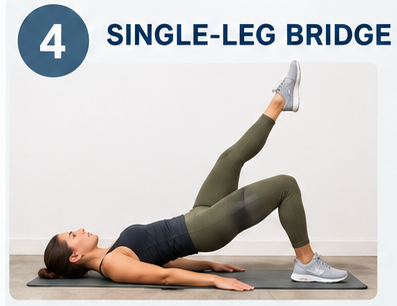
4. Single-Leg Bridge
Lie on your back with one foot flat on the floor and extend the opposite leg. Lift your hips using the planted leg, keeping your pelvis level throughout the movement. Lower with control and repeat before switching sides.
Focus: This variation demands greater strength and pelvic stability, so prioritize good technique over height.
|
Make It Work for You
Start with 8–12 repetitions of the basic bridge and choose the variation that matches your current ability. You don't need to master all four variations in one session! Quality movement matters more than the number of repetitions or the difficulty of the exercise.
If you experience pain or have an existing injury, consult a physical therapist to determine which variation is appropriate for you.
At Moshen, we believe exercise should be more than a list of movements. The right exercise, performed with the right technique and progressed at the right time, can help you build strength, improve performance, and stay active.
Your turn: Which bridge variation is your favorite?
| | |
Dear Patients,
People often ask me why I love being a physical therapist, and the answer is simple: it's because of you.
I love the science of movement, the challenge of solving problems, and the satisfaction of helping someone get stronger. But what makes this profession truly special is the opportunity to walk alongside you on your journey. Whether we're working through an injury, chasing a new goal, or finding a way to keep doing the things you love, I'm honored to be a part of your story.
I know that the road to recovery isn't always easy. It takes patience, hard work, and sometimes a little faith in the process. Getting to celebrate the victories with you, both big and small, is one of the most rewarding parts of my job. Every person who walks through our doors reminds me why I chose this profession in the first place.
Thank you for trusting me with your care, allowing me to be part of your journey, and reminding me every day how meaningful this work can be. I truly couldn't imagine doing anything else.
With Gratitude,
A. Chase Dwight, PT, DPT
| | | | |