|
Revisiting the Price Impacts of the Ground Beef Tariff Waiver
In the August 31 issue, I gave my estimates of the potential price impacts of the announced tariff waiver on lean beef imports, formally a temporary expansion of the tariff-rate quota that allows an additional 300,000 metric tons of beef to enter at the lower tariff from September 1 through November 30. I estimated that the policy would lower fed cattle prices by 1.5 to 3%, cull cow prices by 5 to 10%, and ground beef prices by 8 to 15%. I also noted that it would be difficult to isolate the effect of this policy from everything else moving cattle markets. In this article, I am attempting to do just that—isolate the impact so far.
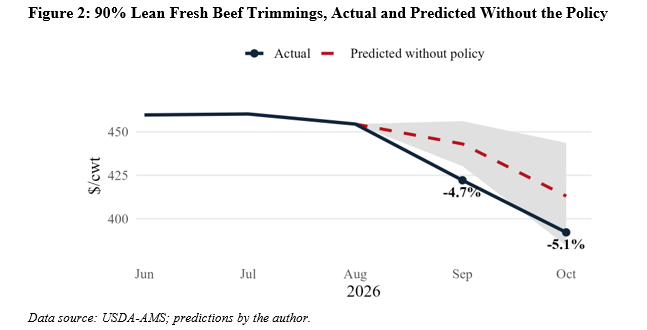
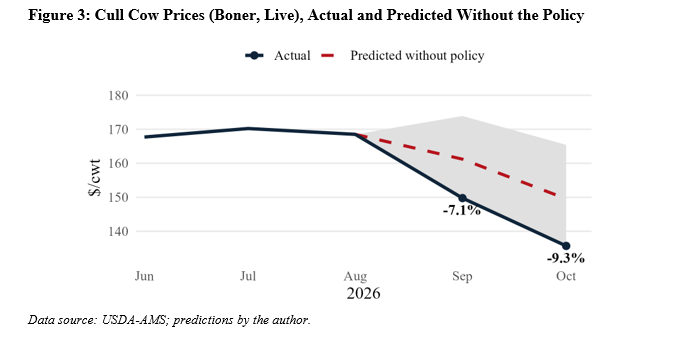
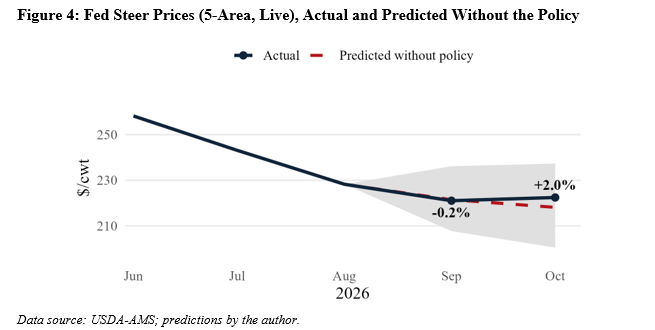
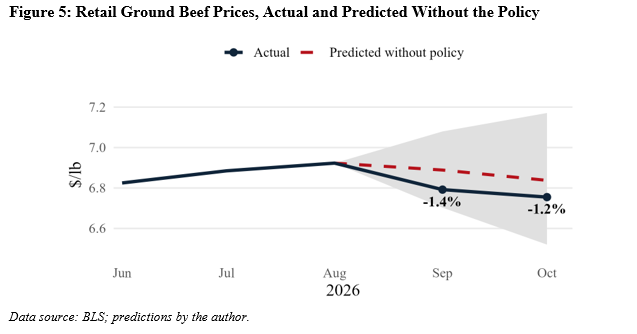
Simply comparing prices before and after September 1 would not tell us much, because many other things are also driving price changes, including seasonal price patterns. Instead, I built statistical models using data from 2003 to 2026 that predict where each price would have gone from August based only on other factors: cattle on feed, beef production, feed costs, beef demand, etc. The gap between the actual price and that prediction is my estimate of the policy’s effect. Some predictions include only September because of data availability.
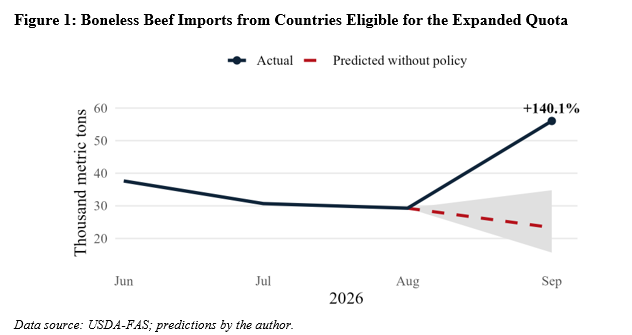
In each of the figures below, the solid line is the actual price, and the dashed line is what the model predicted without the policy. The shaded area is an 80% error range. When the actual price falls outside the shaded area, the gap is larger than ordinary market noise and likely reflects the policy. When it falls inside, a smaller effect may still be present, but we cannot say so with much confidence.
The first question is how much additional beef actually arrived. Imports of boneless beef from countries eligible for the expanded quota, mostly Brazil and Paraguay, were 56,000 metric tons in September, compared with about 23,300 tons predicted without the policy (Figure 1). That is roughly 33,000 tons of additional beef in one month. Customs data show 37,486 tons entered under the first 100,000-ton tranche, so most of the quota beef appears to be new beef rather than beef that would have arrived anyway. As I thought in August, the additional beef was below the announced volume. However, it was even lower (33%) than my “low” scenario (40%).
|