|
Check in on the Choice-Select Spread
Over the last few weeks, the choice-select spread has become a topic of discussion in my market outlooks. The Choice–Select spread directly reflects the market value of quality, signaling how much buyers are willing to pay for cattle that grade USDA Choice versus Select. When the spread is wide, cattle that grade choice capture higher carcass prices and grid premiums, making quality-focused production more profitable. Conversely, a narrow or negative spread reduces incentives for higher-quality graded carcasses. If the spread remains narrow or inverts for extended periods, it can pose financial risk by prolonging cattle feeding or incurring higher costs without a clear payoff. Because the spread responds to consumer demand, beef supplies, and economic conditions, it also serves as a decision-making indicator for marketing timing, feeding strategies, and risk management. In short, in the short-term, the Choice–Select spread links consumer preferences back to the feedlot, shaping both profitability and production decisions.
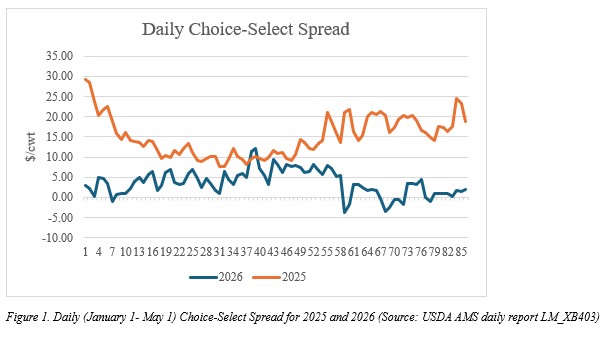
Below is the daily choice-select spread for 2025 and 2026 through the first of May. This figure shows clear differences in both the level and volatility of the daily Choice–Select spread between 2025 and 2026. In 2025, the spread began near the upper $20 range, before declining through the early part of the year (end of February) and then recovering to consistently higher values in the mid‑to‑upper teens and low $20s in March and April, indicating a generally strong premium for Choice beef. In contrast, the 2026 spread began the year much lower and more variable, hovering mostly between zero and $10 and even turning negative at several points, which signals periods when Choice carcasses commanded little to no premium over Select.
|