View as Webpage

X Share This Email
LinkedIn Share This Email

nhsManagers.net

30th March 2026

Be in The Loop

Join the Institute of Health and Social Care Management, here.


News and comment from

Roy Lilley


In charge...

_____________

Short on time? Get yer ears-on and listen to Roy Lilley read this morning's eLetter... free!

Our great leader has decided to reopen one of the founding arguments of the NHS.


Back in 1948, Aneurin Bevan insisted the service must be national. Funded, controlled and accountable at the centre. To end the unfairness of what we later called postcode care. 


Herbert Morrison wanted local government to run it.


An interesting historic note; Peter Mandelson is the great-grandson of Herbert Morrison, and of course we have since learned about Streeting's connection to Mandleson.  


Mandelson was part of a Sunday supper party… regular guests included Wes Streeting and a small circle of personal friends around Mandelson, with social gatherings and political discussion 


Other accounts describe 'kitchen cabinet' style Sunday evening meetings involving the same network.


From Morrison’s great-grandson’s dining table to the Department of Health, the argument about who should run the NHS looks to have come full circle. 


Morrison was a towering figure in post-war Labour politics and, the chief advocate for local government control of the NHS.


Bevan won.


Streeting now wants to run the experiment again.


In Greater Manchester and South Yorkshire, mayors like Andy Burnham and Oliver Coppard will gain real influence over NHS priorities, budgets and strategy. 


Alongside this, NHS-led integrated health organisations will be asked to run whole-place budgets in a more traditional way.


Two models. One system. Let’s see what works.


At one level, it’s a sensible question.


Health is not made in hospitals. It’s made in homes, jobs, schools and streets.


Councils control housing, planning, environmental health, transport and much of social care. 


If you want to prevent illness, not just treat it, those levers matter far more than another outpatient clinic.


There's also a democratic argument.


Most people couldn’t name their ICB chair if you paid them. It's likely they can name their mayor. If services fail, voters know where to point the finger.


So far, so logical, but…


… scratch the surface and the problems start to stack up.


First, accountability.


Streeting says there will be two politicians overseeing the system; himself and the mayor. That sounds neat, but...


... in practice it is a recipe for muddle. 


  • When waiting lists rise, who is responsible? 
  • When money runs out, who decides?
  • When priorities clash, who wins?


The NHS already struggles with blurred lines of control. This doesn’t fix that. It compounds it.


Second, inequality.


Some places have strong leadership, stable institutions and the analytical muscle to manage complex systems. Others don’t. 


Devolution in England has never been even. Handing more control to local areas risks widening the gap between the best and the rest. 


The postcode lottery didn’t disappear. It was designed out. This risks designing it back in.


Third, capability.


Local government has been through a decade of austerity that has hollowed out public health and left social care threadbare. 


Councils are not sitting on spare capacity, waiting for more responsibility. Many are struggling to meet what they already have. You cannot devolve what no longer exists.


Fourth, timing. 


This is being layered onto a system already in upheaval; ICB cuts, NHS England’s abolition, workforce churn, financial pressure.


The service is being reorganised while it is still trying to recover from Covid and the last reorganisation.


That is not reform. It is movement without direction.


And then, there is the biggest problem of all: this is being framed as an ‘experiment’.


Health systems are not laboratories. You cannot control the variables. You cannot run clean comparisons.


By the time outcomes are visible, the structures will have changed again. 


What you get is not evidence. You get interpretation… usually shaped by whoever is in charge at the time.


So what is really going on?


The NHS is being asked to do something it cannot do on its own… improve population health. 


The drivers of health sit outside its control. So the answer is to move power closer to those who hold those levers.


The instinct is right, but…


… the execution risks creating a hybrid system, half national, half local, and wholly unclear.


Bevan chose clarity.


Morrison chose locality.


Streeting is trying to combine both.


In the NHS, that usually ends the same way.


Everyone has a say. 


No one is in charge.

_____


In todays’ new podcast, Niall dickson and I talk to Andy Burnham about this and his whole integration menu in Manchester. It's a cuppa-builder's listen!!


Latest

Podcast

Listen Free

Greater Manchester Mayor

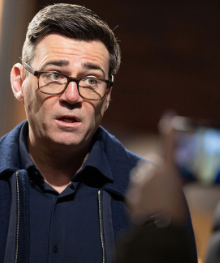
Andy Burnham


... ... reveals that the government has agreed to appoint a new Health Commissioner who will be jointly accountable to the Mayor and to the government for health and social care services. 


“I'm really excited about that.” he says. “Finally it feels to me we're getting close here to (an integrated) model of commissioning, priority setting and direction setting.” 


In a wide ranging discussion with Niall and Roy, Andy Burnham says we will never know whether he could have won the Gorton and Denton bye-election, but insists he would never have asked to stand unless he thought he had a good chance, and he rejected the idea that if he had won, the Mayor role would have been at risk. 


Instead he suggests that if he had won the bye-lection that would have created a positive momentum for Labour in any Mayoral election.


Among many insights in the podcast, Andy reflects on how he began to move away from the New Labour health agenda while serving as a minister in the Blair administration in the mid-2000s. 


As for the current government, he commends them for starting to get a grip on the challenges facing the NHS but laments the delay in tackling social care. 


“How much longer can we keep flinching from that challenge? It’s got to be faced. There will no marked improvement until they grasp the nettle of social care reform.” 


There is also a frank assessment of the state of current services, in which he points to the vast number of older people trapped in hospital beds, to their and everyone else’s detriment. 


Andy’s father has dementia and he talks about his frustration at a care system which seems determined to dial 999 at every opportunity and send his father into A&E, when that is the last place where he should be going. 


He claims his ‘LiveWell’ revolution in Greater Manchester will mean doing prevention in a way that has never been tried before, diverting significant resources into voluntary and community organisations and letting them be first port of call. 

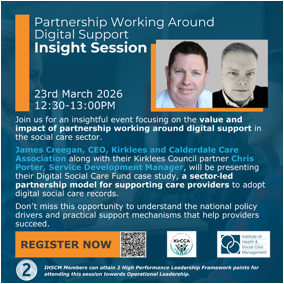
There is a free information session on the 1st July.


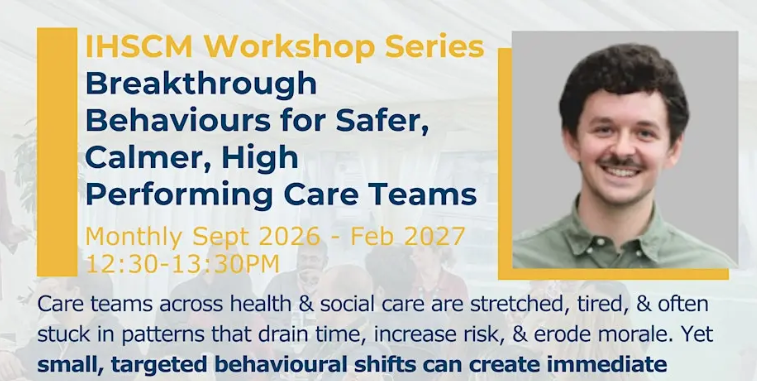
IHSCM Members and Non-Members can sign up for the full series, taking place from September.


Series Overview


Care teams across health and social care are stretched, tired, and often stuck in patterns that drain time, increase risk, and erode morale. Yet small, targeted behavioural shifts can create immediate improvements: fewer delays, fewer mistakes, calmer shifts, and stronger team culture.


This six‑part interactive workshop series tackles the most common behavioural patterns that hold teams back.


It is ideal for managers, deputies, senior carers, team leaders, and anyone responsible for shaping culture, safety, and team wellbeing.

For all the previous

In the Loop

podcasts with

Nichola Ranger

ChEx Gen Sec RCN

Tom Dolphin

Chair BMA

David Gregson

founder of BeeWell

Dr Charlotte Refsum

Tony Blair Institute

Rob Webster

ICB CHEx

Sarah Woolnough

CEO of the King's Fund

Sir Jim Mackey

Dame Jennifer Dixon

Lord Darzi

Professor Tas Qureshi

Dr Penny Dash,

chair NHSE

Richard Meddings,

former chair NHSE,

Sir Jeremy Hunt,

Sir Andrew Dilnot,

Paul Johnson IFS

CLICK HERE


-oOo-


Probably, the most listened to

Podcast in the NHS!

FREE!

Want to contact Roy Lilley?

Please use this e-address

roy.lilley@nhsmanagers.net 

-----------

Know something I don't

email me

in confidence.

Leaving the NHS, changing jobs - you don't have to say goodbye to us!

You can update your Email Address from the link you'll find right at the bottom of the page,

up-date-your-profie,

and we'll keep mailing.

----------

GDPR

We don't sell or give access to your email address to any third parties.

You can unsubscribe at any time.

Click on the link right at the bottom of the page

---------

Disclaimer

... yes, 60 countries listen

to Roy Lilley's podcast, free.

You can, too.

Just click here

Dr Paul Lambden


The Celestial Bed


'... A large mirror hung from the ceiling. The headboard was connected to an electrical generator.'


News and Other Stuff

---

>> CEOs of struggling trusts are worth their salaries, says health secretary - looks like someone has had a word in his 'shell-like'.

>> Together for Public Health - a powerful voice for the health system...news from NZ.

>> Racism in NHS - affecting "fabulous" nursing staff.

>> Fake NHS vans used to smuggle class A drugs - across Newport

Alternative European Healthcare Perspectives April 2026

Roger Steer


'All roads come back to Trump. I collated a number of European countries’ economic plans in recent editions of this newsletter that described how governments were doing as they have been pressured by Trump; to increase their defence budgets, to buy US missiles to attack Russian forces, which has been funded by decreasing spending on health and social care.'

Improving UTI diagnosis by introducing a UTI triage and clean catch MSU process


This is what I'm hearing, unless you know different. In which case, tell me, in confidence

__________


>> I'm hearing - MRI scans might get a bit tricky? The world's largest producer of liquified helium is in Qatar and is shut off. There are indications that supply for the year will be at least cut in half.

More News

----

>> Leadership void is blocking tech investment - NHSE.

>> Poor communication between private clinics and NHS GPs could put patients at risk of receiving “duplicate prescriptions” for medicines - coroner.

>> Great Ormond Street Hospital to reduce bed and theatre capacity -

Iran war means Middle East countries are pausing overseas referrals to NHS

Twitter  
Managers Logo