In the Lane
Bike Santa Cruz County Newsletter
June 2026 - Issue #16
| |
| |
In this Issue:
- Bicycle Film Festival Comes to Santa Cruz, Sat 6/6
- Bike Santa Cruz County is Excited to Host Our First Annual Santa Cruz Cycle Fair, Sat 6/13
- Upcoming BSCC Volunteer Opportunities
- Capitola to Develop it's First Active Transportation Plan
- Final Month: Help Us Get a Better Picture of Biking in Santa Cruz County!!
- What Canberra and Australia Can Teach Us About Bikes, Paths, and Public Space
| | | | June is here! Read on for the latest Santa Cruz County bike advocacy updates, upcoming events, and ways you can help support our mission to make our streets safer and more bike-friendly. | | |
Bicycle Film Festival Comes to Santa Cruz, Sat June 6th
Bicycle Film Festival was launched in 2001 as a touring cinematic catalyst celebrating the bicycle through film. It has become a major inspiration for the international bike movement, with events held in over 100 cities worldwide and involving an accumulated audience of over 1 million people. And on June 6, BFF returns to Santa Cruz!
BFF Santa Cruz will present international short film programs that appeal to film connoisseurs, avid cyclists, and everyone in between. Curated narratives, animations, documentaries, award-winning directors, and emerging talents all share equal billing. The Festival will be presented at the Colligan Theater at the Tannery Arts Center, 1010 River St, Santa Cruz, on Saturday, June 6. The Festival consists of three programs: Cinematic Shorts (4 PM), Urban Bike Shorts (6 PM), and Adventure Shorts (8 PM). Individual program tickets at $22, and a full festival pass can be had for $35. Children under 10 are free. Bike Valet services are provided in part by Bike Santa Cruz County.
Tickets & details on film programming are here:
| | |
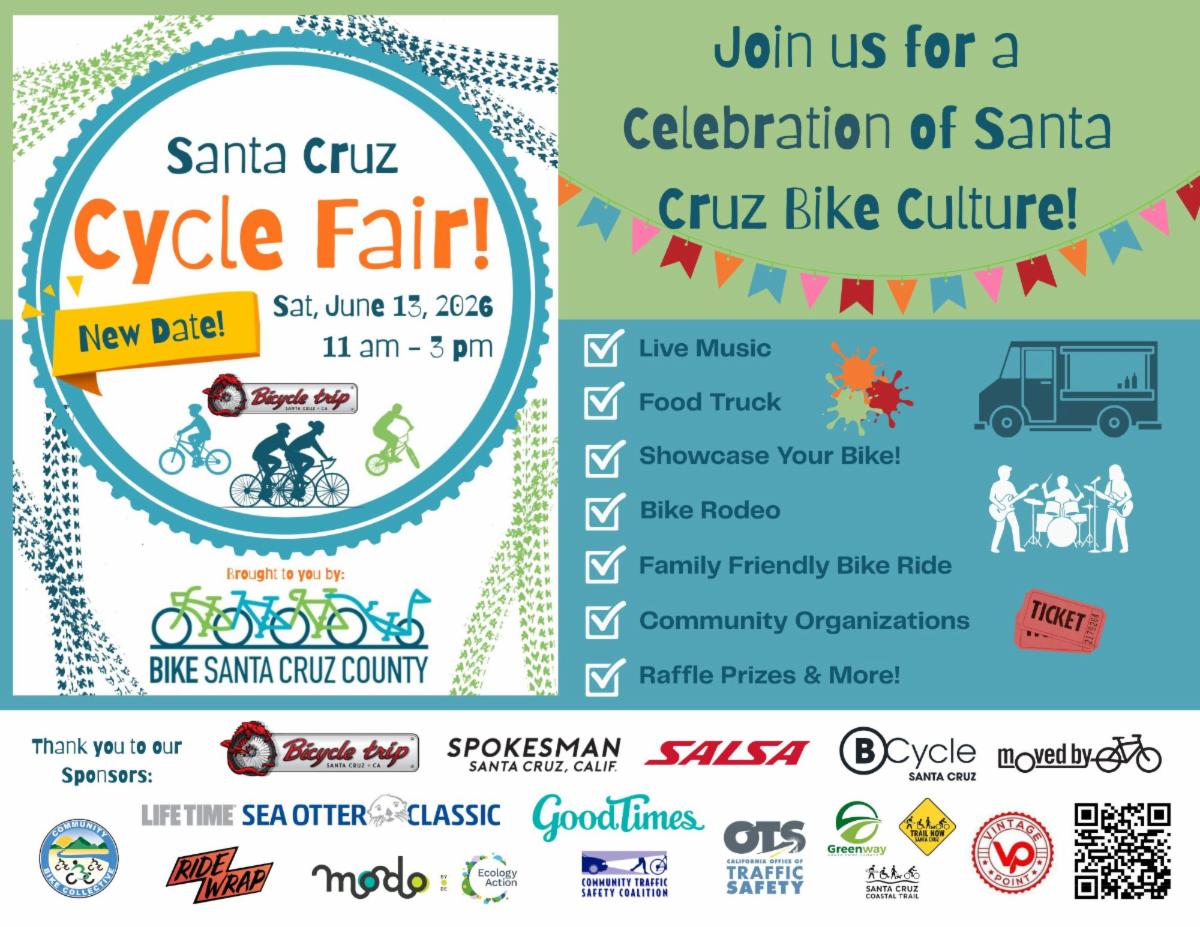
Bike Santa Cruz County is Excited to Host Our First Annual Santa Cruz Cycle Fair!
The event is designed to bring together the entire Santa Cruz County bike community in all its diversity, and will showcase the power of bikes and biking to enhance quality of life.
All are welcome! The event is intentionally designed to reach beyond traditional “bike people,” inviting families, kids, seniors, students, and everyday riders to see themselves reflected in Santa Cruz’s bike culture.
We will have live music, family bike activities, community bike ride, bike rodeo, a food truck, giveaways, raffle prizes and more!
Santa Cruz Cycle Fair is generously sponsored by our friends at the Bicycle Trip, BCycle, California Office of Traffic Safety, Community Bike Collective, Community Traffic Safety Coalition, Ecology Action/Modo, Friends of the Rail Trail, Greenway/Trail Now Santa Cruz County, Good Times, Life Time Sea Otter Classic, Moved by Bikes, Ride Wrap, Santa Cruz Mountain Trail Stewardship, Salsa Cycles, Spokesman, Terranova Ecological Landscaping, The Bike Church, and Vintage Point.
For more information, visit https://www.bikesantacruzcounty.org/events.
| | |
Upcoming BSCC Volunteer Opportunities
-
Saturday, June 6th: Volunteer for Bike Valet at SCMTS National Trails Day Afterparty: Sign-up Sheet
-
Saturday, June 13th: Volunteer for Santa Cruz Cycle Fair: Sign-up Sheet
-
Sunday, July 5th: Volunteer for our Watsonville Community Bike Ride: Sign-up Sheet
| | |
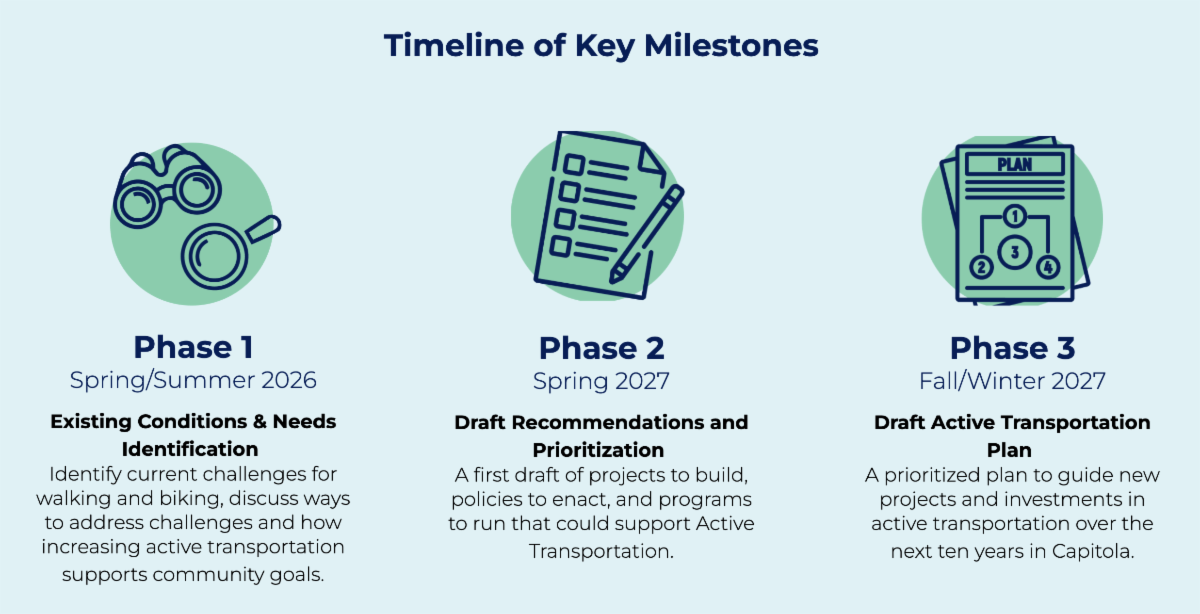
Capitola to Develop it's First Active Transportation Plan
On the heels of the April adoption by the City of Santa Cruz of a major update to that city's Active Transportation Plan, or ATP, the City of Capitola is developing its first ATP. ATPs have become essential public policy tools that enable local governments to secure grants to fund street infrastructure redesigns that benefit all forms of human-powered transportation. The Capitola ATP project is itself funded by a grant from the Caltrans Sustainable Transportation Planning program.
Like other ATPs, the Capitola plan is driven by a goal of creating a livable city—one where people of all ages and abilities can move safely, conveniently, and enjoyably. Well-designed active transportation infrastructure not only encourages healthier lifestyles, but also reduces car dependency and greenhouse gas emissions, creates vibrant public spaces, and strengthens social connections. BSSC board members Anthony Duran and Stephen Svete will be serving on the Technical Advisory Committee during the course of the 18-month project.
Capitola is encouraging community input on the ATP, and you can participate in the initial map-based information gathering survey below.
| | | |
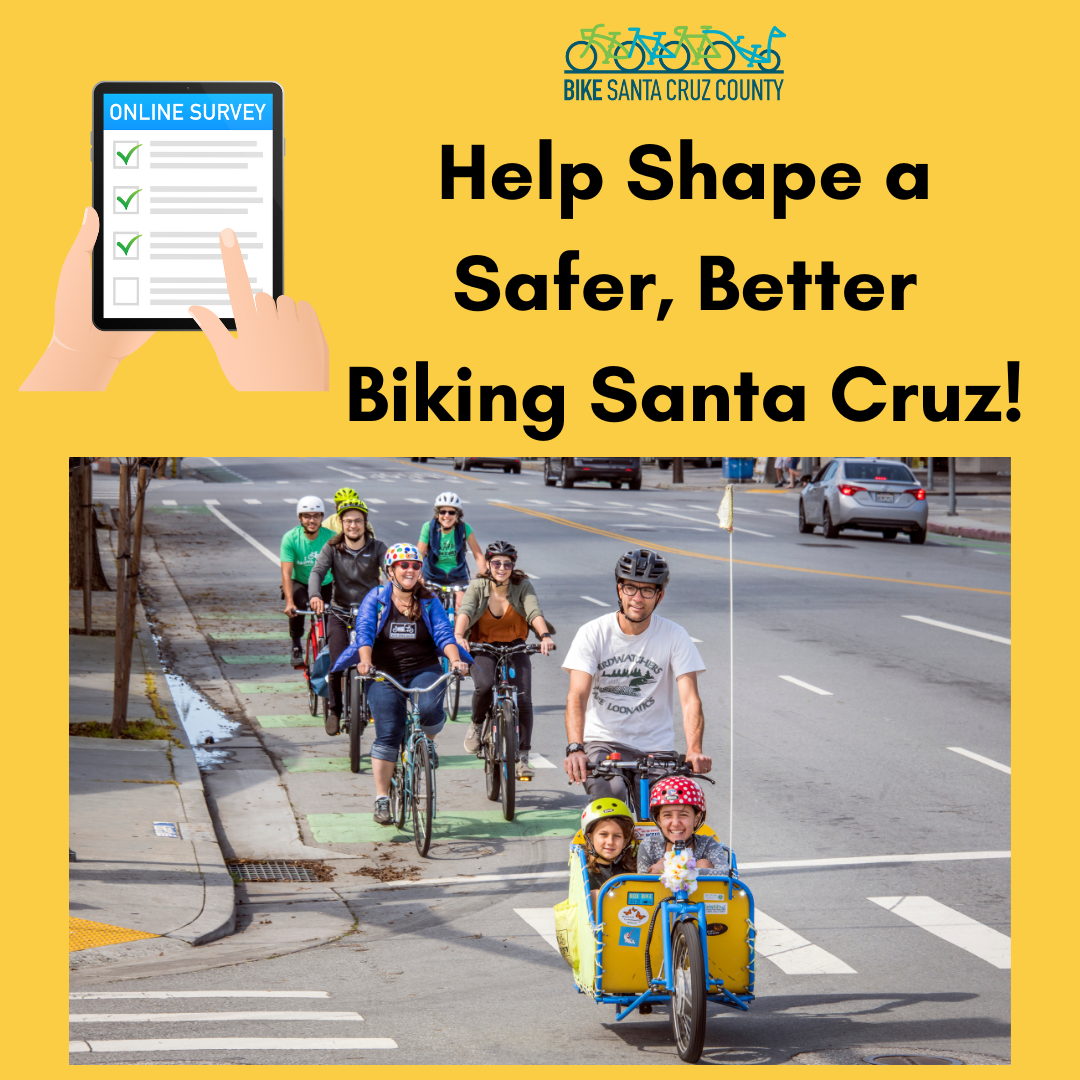
Final Month: Help Us Get a Better Picture of Biking in Santa Cruz County!!
Our annual bike survey is open through the end of June, and this is the final push.
If you bike anywhere in Santa Cruz County, every day, once in a while, on an e-bike, with your kids, to work, or just for fun we want to hear from you. Your input helps us take a data-driven approach to improving biking across the county by showing what riders are actually experiencing on the ground.
We use the survey to advocate for safer streets, better infrastructure, and smarter public investments with city leaders, County Staff, Public Works, and transportation agencies. Local government agencies are also using our findings to support grants for bike infrastructure. The more responses we get, the more useful and representative the results will be.
The survey is available in both English and Spanish.
Please take a few minutes to fill it out and share it widely.
| | |
What Canberra and Australia Can Teach Us About Bikes, Paths, and Public Space
I spent part of this May in Canberra, Australia, visiting family. Canberra is the capital of Australia, and in some ways it feels like a cross between Washington, D.C. and Sacramento: a planned capital city, orderly, civic-minded, and landlocked several hours inland from the ocean.
As I tend to do in almost any city I visit, I found myself looking for the bike lanes. I like seeing how other places think about transportation, what they make easy, what they make hard, and how much room they are willing to give people who are not inside cars.
It took me about 3 days to make heads or tails of traffic because of the whole left-hand driving thing. But once I got past that, what stood out was how normal biking felt.
Canberra is not Amsterdam. It is still a car-oriented city. But biking is clearly part of the culture. The city has an extensive network of off street paths, on-road bike lanes, and quieter streets that make it possible to move through large parts of the city without constantly mixing with fast traffic.
My family there has two kids, and they bike to school and work with minimal interaction with cars. The part that stuck with me most is that kids are getting places, and parents not having to drive every trip, and biking feeling like a practical part of family life.
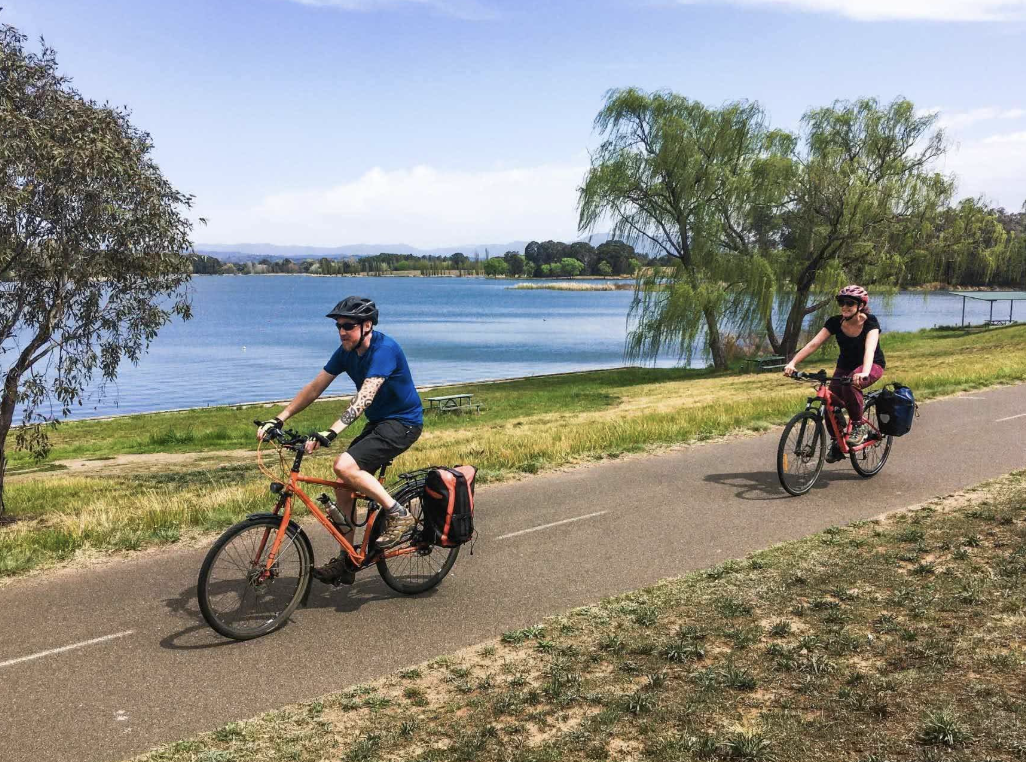
The paths around Lake Burley Griffin, the large lake at the center of Canberra, show the potential of a connected public path system. They connect parks, museums, government buildings, neighborhoods, nature reserves and public spaces. People walking, riding, commuting, exercising, and sightseeing all overlap. It’s beautiful, and you are likely to see kangaroos boinging around the trails, alongside rainbow parrots, squawking cockatoos, and many species of eucalyptus in their natural habitat.
I learned about Australia’s rail trails from my family’s elderly neighbor. He and his wife of course still bike around town. After establishing that our political viewpoints aligned, then there’s no need to discuss the war, he told me about the former rail corridors across the country that have been turned into long-distance walking and biking routes. The Great Victorian Rail Trail runs about 134 kilometers through Victoria’s High Country. The Brisbane Valley Rail Trail in Queensland is about 161 kilometers. The Northern Rivers Rail Trail in New South Wales is being built out in stages, with the open Tweed section through villages, farmland, bridges, and tunnels. These rail trails are integrated public access projects, tourism projects, heritage projects, and rural economic development projects. They preserve the public corridors and turn them into integrated experiences for tourists and practical travel for locals.
Canberra’s bike paths and Australia’s rail trail network showed me how connected paths can change what is possible. A bike path that gets you from point A to point B is a nice amenity. A connected network is transportation that links neighborhoods, schools, parks, businesses, and towns. It becomes part of how people move through a place and it also can invite visitors and tourists to experience these places at their own pace on a bike or hike.
What can my experience bring back to our beautiful Santa Cruz County? We have our own debates, geography, constraints, and opportunities. However, the basic principle is the same. When we build safe, connected, low-stress routes, more people can bike: kids, parents, older adults, commuters, visitors, and people who would never describe themselves as “cyclists.” Biking can be an ordinary activity woven into daily life. And Australia’s rail trails show the inspiring possibilities when rail corridors are treated as civic assets.
-Mikey Cohen, BSCC Board Chair
| | | | | |