In the U.S. , Wall Street banks tell Big Law :

"Cut your fees! AI is doing all the work!"

___________


Project Counsel Media is a division of Luminative Media. We cover the areas of cyber security, digital technology, legal technology, media, and mobile technology.


About Luminative Media: our intention is to delve deeper into issues, at greater length and with more historical and social context, in order to illuminate pathways of thought that are not possible to pursue through the immediacy of daily media. For more on our vision please click on our logo:


________________


Wall Street’s biggest financial institutions are officially pushing back against skyrocketing Big Law fees, arguing that generative AI makes traditional hourly billing unsustainable.


In a coordinated squeeze, heavyweights like Goldman Sachs, Morgan Stanley, and Citigroup have demanded that law firms cut costs because artificial intelligence now automates the routine "gruntwork" that junior associates used to bill for by the hour.


Banks are saying AI must overturn the financial model at the heart of the legal industry.


________________

_________________

BY:


Casey Newton

Attorney

Legal Affairs Reporter


Alexander Dumont

Legal Technology Reporter


Members of the Project Counsel Media team


__________________


7 September 2026 (New York, NY) - Wall Street banks are pushing large law firms to cut fees, arguing that the business model that has enriched top lawyers for decades is not sustainable in an era of AI.


Morgan Stanley and Citigroup have told major law firms they want to set up new payment arrangements that would save them money.


Goldman Sachs had asked law firms how much the technology was saving them and expected to share in those benefits, according to people aware of the move.


The pressure from some of Big Law’s most valued clients could help overturn the financial model at the heart of the legal industry. Under the so-called leverage model, firms maximise profits for equity partners by billing hourly for work done by large numbers of more junior lawyers, often working late into the night at rates that far outstrip the cost of their salaries.


Much of that work, such as research, document review, assessing contracts and trawling through litigation discovery, can now be done far more quickly using AI. Adam Meshel, global head of legal at Citigroup, said:


“If the number of hours they’re working on a matter has come down because of AI, then our expectation is for costs to come down significantly per transaction”.


He said the bank had amended its existing bidding process for law firms by asking those law firms to explain during the process how much they were saving using AI.


A “different working model” based on that approach would probably be in place within a year, Meshel said, adding that he wanted it to be worked out collaboratively so that it would work for both the bank and its outside lawyers.


Eric Grossman, Morgan Stanley’s general counsel, said:


"Top lawyers have for a long time been compensated on the foundation of associates billing for long hours. The ability to complete tasks more quickly marks a fundamental altering of the revenue foundation for these mega firms. Their compensation model is now extraordinarily unstable".


Grossman said the bank was willing to continue to pay large sums for the judgment and talent of the best lawyers, but that by the end of this year most external legal work would now be tendered through competitive bidding processes and paid for using alternative arrangements such as fixed fees. The bank has had a competitive bidding processes for some matters.


That should cost the bank less, he said, but law firms could remain as profitable as before if they use AI to work on more matters and reduce costs.


Goldman Sachs asked law firms for information about how much more efficiently they were able to complete tasks because of AI, people with knowledge of the matter said. The bank declined to comment to several journalist requests.


Hourly fees at top law firms have surged in recent years, in part to finance a war for talent in which they have poached rivals’ star partners with eye-watering pay packages.


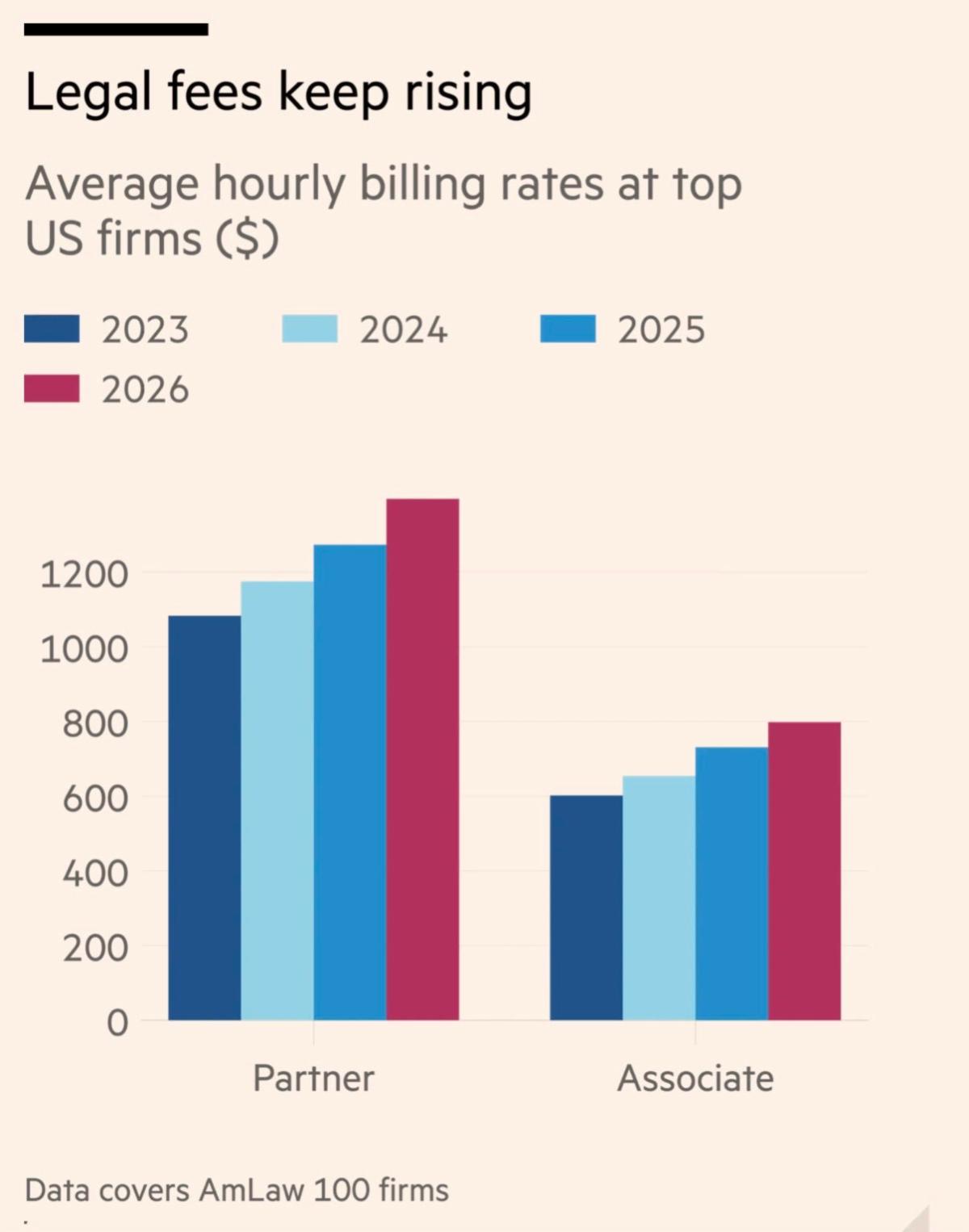
Average hourly billing rates for associates at the largest US law firms hit $798 this year, up 33% since 2023, according to the legal technology company Persuit. The rate for partners has risen 29 per cent in the same period.


A chart from a recent report put together by Persuit and the Financial Times:

Wall Street banks are among Big Law’s most important clients because of their scale and the range of tasks for which they need legal advice, from navigating the close regulation of the banking industry to dealing with everyday financing transactions, litigation, white-collar investigations and M&A.


Almost half of large law firms said AI had already affected their pricing model, according to a survey carried out this year by Citi’s law firms group, a unit of the bank that serves lawyers and firms. Said Gretta Rusanow, head of advisory services for the law firm group:


"So far, it’s around the edges. We’re not yet seeing a formalized, firm-wide shift towards alternative fee arrangements, but it is likely to come. We’re likely to see more of a hybrid approach with fixed fees for routine work and the billable hour for more complex work".


Some law firms have already started hiring fewer new graduates. 47% saw a smaller intake of summer associates - the entry ticket to Big Law jobs - this year than last, the Citi survey found, and 49% will have a smaller class next summer than this year.


However, some law firms expect associates to continue working long hours on matters despite the use of AI. Sam Newhouse, global vice-chair of Latham & Watkins’ M&A and private equity practice:


“Some tasks are low-hanging fruit, you can do them more quickly now. But what do you do when you’ve done that? A lot of our sophisticated clients are using the extra time and the extra data to their strategic advantage. If you’ve got a chance to go through every merger agreement that ever existed and work out what position have people taken it helps them strike better deals".


Concerns about legal bills in a world of AI have rippled out into other industries too.


Steven Croley, Ford’s general counsel, said the carmaker was hiring more in-house lawyers and doing more legal work internally in circumstances where AI makes it cheaper to do so, reducing its use of outside law firms. He said:


"While law firms are using AI, it’s not showing up in billing relief or greater efficiencies that are obvious to us as their clients. But I think AI will upend Big Law’s business model. The pyramid economic model of law firms cannot stand. Yes, it will be a shock, it will be a shift of the tectonic plates. But it will happen".


We suspect it will not be as cut and dried as all this. AI is still not yet sophisticated enough to replace a lot of the intensive hand-wringing and iteration after iteration of writing and rewriting, for instance the marketing materials and documentation required for securities offerings - never mind distributing them.


And demanding a discount for speculative AI efficiency gains is like expecting a discount because lawyers replaced typewriters with word processors in the 1980s, or transitioned from faxes to email in the 1990. "What? You have Google now? We want a discount!"


There are obviously some areas such as due diligence, and the summary of document troves (if checked 🤓) where AI can significantly reduce time and personnel spent on a matter, or it can go deeper into it.


But this is not a panacea for everything. If it were, the banks should invest in AI and take legal fully in-house and assume legal risk as well.


* * * * * * * * * * * * * * * 


For the URL link to this post, please click here.


If this post was forwarded to you and you'd like to subscribe.

please email us at luminative.media@gmail.com


* * * * * * * * * * * * * * *