CHIBE logo

The Healthy Nudge

Welcome to CHIBE's Healthy Nudge newsletter. Each month, we'll get you up to speed on the latest developments in policy-relevant health behavioral economics research at CHIBE. See our top stories below.

Incentives help boost sleep and academic performance 

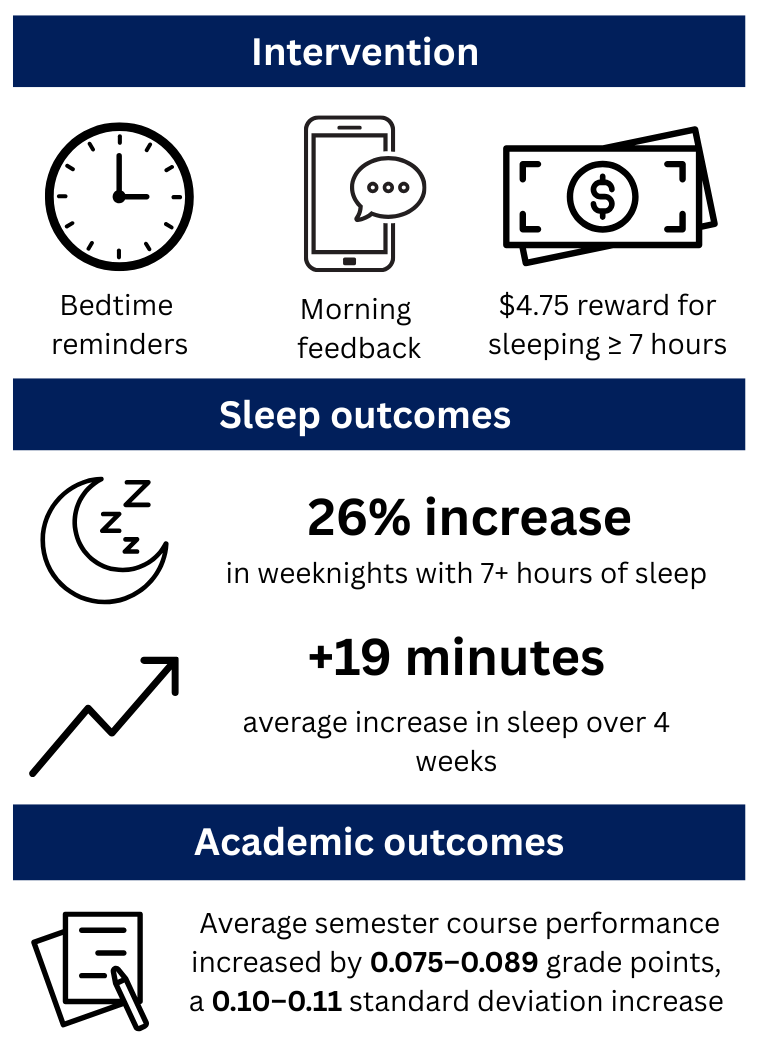
infographic showing sleep incentives and feedback can improve sleep and academic performance
  • What they tested: Researchers looked at bedtime reminders, morning feedback, and immediate rewards ($4.75) for sleeping at least 7 hours on weeknights.
    
  • The sleep impact: The intervention raised the share of weeknights with 7+ hours of sleep by 26% and average sleep by 19 minutes during a 4-week treatment period.
    
  • The academic impact: Average semester course performance improved by 0.075–0.089 grade points, a 0.10–0.11 standard deviation increase.
    
  • What else they learned: "Immediate incentives outperformed delayed incentives and reminders/feedback alone during treatment but had no distinguishable impacts posttreatment."

Read the paper here >

SNAP and antiretroviral therapy adherence among adults with HIV

  • Key takeaway: In this study, medication adherence to antiretroviral therapy improved after people received their SNAP benefits, then declined toward the end of the monthly benefit cycle.


  • Behavioral economics component: "This pattern is consistent with habit formation: adherence rises gradually as automaticity builds after scarcity is alleviated, then erodes as scarcity returns," the study authors write.
    
  • Impact: "With upcoming SNAP policy changes expected to reduce participation, these results underscore the importance of poverty alleviation for chronic disease outcomes," they write.

Read the paper here >

Identifying effective strategies for changing behavior

  • The details: Want to change behavior? This review looks at high-quality evidence to find key strategies and seeks to explain when and why behavior change interventions succeed.


  • The framework: The study authors find that successful behavior change happens over 3 phases: (a) building motivation, (b) following through on intentions and (c) forming durable habits.
    
  • Key quote: "The present review identifies effective interventions suggesting that behavior change is challenging, yet achievable."


Read the paper here >

Tackling the alcohol epidemic

martini_drink.jpg

The details: STAT interviewed CHIBE's Dr. Kit Delgado about recent research showing that nudges to emergency department providers to talk to patients about alcohol and naltrexone (a medication that reduces cravings) led to an increase in prescriptions.


Key quote: "We had already done that with prescribing buprenorphine for opioid use disorder, "Dr. Delgado said. "It kind of dawned on us … alcohol is something that we see so much more commonly.”


Impact: The analysis showed a 2.9% greater absolute increase in naltrexone prescribing among intervention hospitals.


Read the article here >

Farewell Joelle, Welcome Wendy

joelle
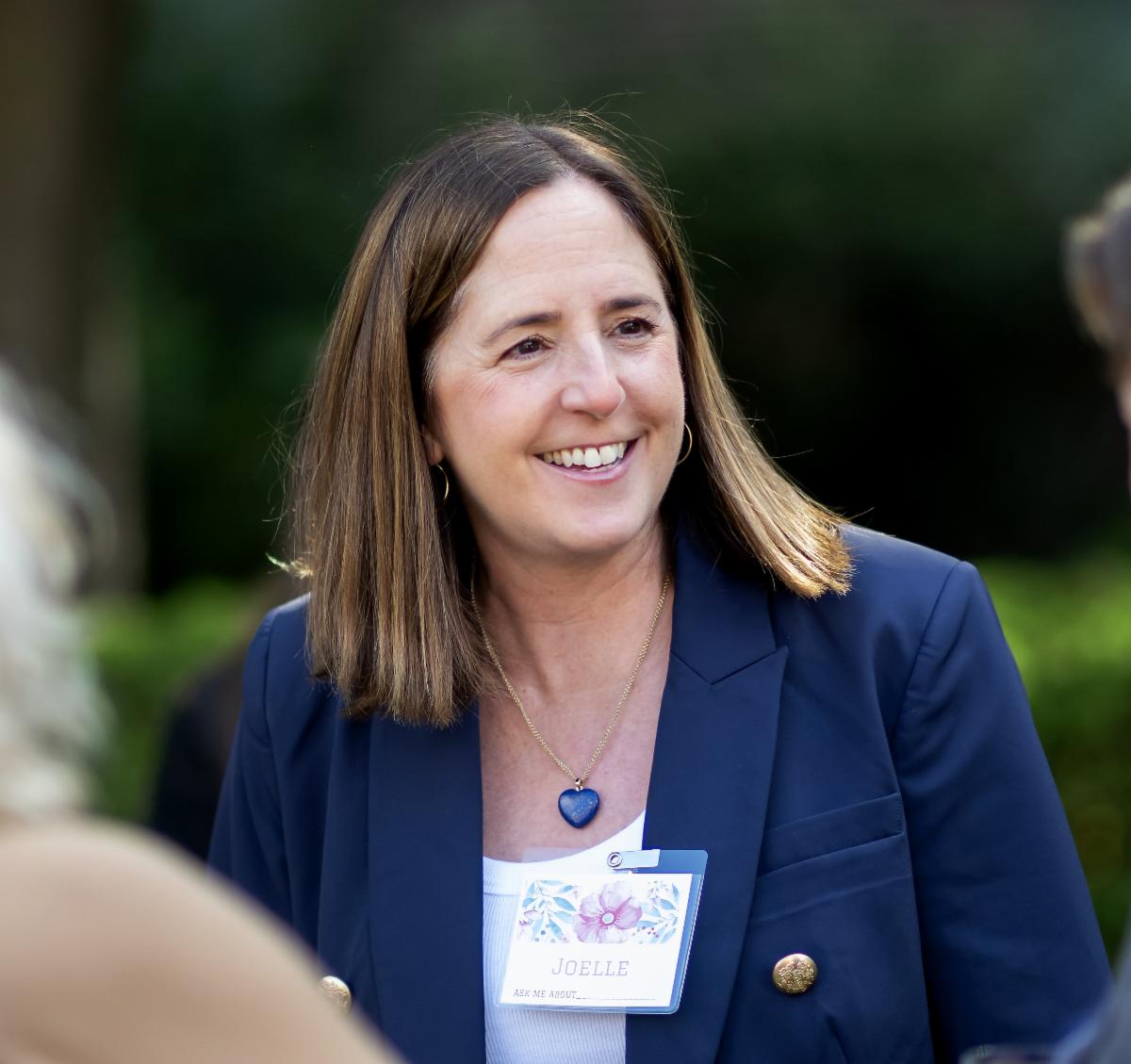
  • Best wishes to Joelle Friedman: After 16 years of distinguished service as CHIBE’s Managing Director, Joelle Friedman, MPA, decided to move to Kentucky with her family.
    
  • Contributions: Joelle played a pivotal role in many of our signature initiatives over her time at CHIBE including the creation of the Horizon BCBS consortium, the development of the Humana Simplicity health insurance plan, the Vitality partnership, and the successful management of 3 NIA Roybal P30 Center grant renewals.
wendy
  • Welcome: We are happy to announce that CHIBE has hired Wendy Voet, MPH, as our new Managing Director.


  • Background: Wendy is a non-profit and public health leader with more than two decades of experience driving program innovation, strategic growth, and organizational leadership across global and domestic settings. Most recently, Wendy served as Principal Program Advisor for New Program Development at Jhpiego Corporation, a Johns Hopkins affiliate, where she led grant writing and program design for high-impact, health system focused proposal teams. 


Read the story here >

CHIBE's Book Talk

September 30 from noon to 1 PM


Join us for a thought-provoking discussion with Dr. Damon Centola about his new book: “Goodthink: The New Science of Collective Intelligence.”


For decades, we’ve been taught that social influence inevitably leads to groupthink, resulting in conformity, polarization, and poor decision-making. Drawing on dozens of groundbreaking studies, Dr. Damon Centola challenges this widely held belief and reveals a surprising new science of crowd wisdom, showing that when people are connected through the right network structures, social influence becomes a powerful source of collective intelligence.


Learn more here. Registration is required to attend. Please register here.

More News and Publications

The Center for Health Incentives and Behavioral Economics (CHIBE) at the University of Pennsylvania conducts behavioral economics research aimed at reducing the disease burden from major public health problems.