|
| |
|
|
|
Indiana-ACC Newsletter, February 2017
|
|
|
Raymond E. Dusman, MD, FACC
|
|
Dear Indiana-ACC Colleague,
I had the opportunity to attend the ACC's Cardiovascular Summit last month. It was certainly eye-opening to find out how ill-prepared many felt they are for MACRA. The good news is that there is plenty of information to help us along at the ACC MACRA Hub. Our own Dr. Edward Fry wrote an excellent piece entitled MACRA: How to Prepare For the Unknown.
"In 2017, most cardiovascular professionals will participate in the Merit-Based Incentive Payment System (MIPS) track of the Quality Payment Program as opposed to the Advanced Alternative Payment Model (APM) track. Reporting is at the center of MIPS and the 2017 transition year provides an opportunity to make sure you’re performing well on the Quality, Improvement Activities, Advancing Care Information and Cost categories before things really kick into gear in 2018. Cathleen Biga, MSN, RN, recommends aiming for 70 points for MIPS in 2017 in order to get access to extra reimbursement. Otherwise, you are taking a cut or staying close to neutral.
Here are some tips for success in MIPS:
- Start by looking at how you are doing in the Physician Quality Reporting System, Electronic Health Record (EHR) Incentive Program (Meaningful Use) and the Value Modifier.
- Ensure you know how your EHR is creating data points and how you are going to report (through the EHR or through a registry like PINNACLE).
- Dashboard 15 Quality metrics and benchmark them to national deciles with a plan to narrow these down to your best six (remember never to report poor performance).
- Attempt to report for the full year as opposed to the other three “Pick Your Pace” options for 2017 – you get a bigger denominator and more power.
- Understand the Cost category even though it does not count this year and make sure you are correctly categorized in PECOS.
- Review the Advancing Care Information base measures and performance measures, and plan to attest with proof that you really did them.
- Look at the 94 options for the Improvement Activities category and get at least one provider in your group to do enough of these activities to accumulate 40 points (four medium, two high or a combination)."
Because MACRA is so important for our members, we will include this topic on our agenda at our Indiana-ACC Annual Meeting on October 21, 2017. It should be meaningful as we will be 10 months into the reporting year at that point.
Contact Us
If Gwen Goldfarb, our executive director, or I can be of assistance in providing additional information regarding the above topics, connection to the appropriate resources within our Chapter or the national ACC, or topics not represented here that are foremost on your mind and/or of concern, please let us know.
Sincerely,
Ray
|
|
|
Mary Norine Walsh, MD, FACC
to Become ACC President
|
|
|
You Are Invited to Honor
DR. MARY NORINE WALSH
as she becomes
President of the American College of Cardiology
at the
American College of Cardiology's 66th Annual Convocation
and the
President's, New Fellows' and Associates' Reception
on
Sunday, March 19, 2017
6:30 - 9:00 p.m.
at the
Walter E. Washington Convention Center
801 Mt Vernon Pl NW, Washington, D
|
|
|
|
|
Indiana-ACC Legislative Day on February 14
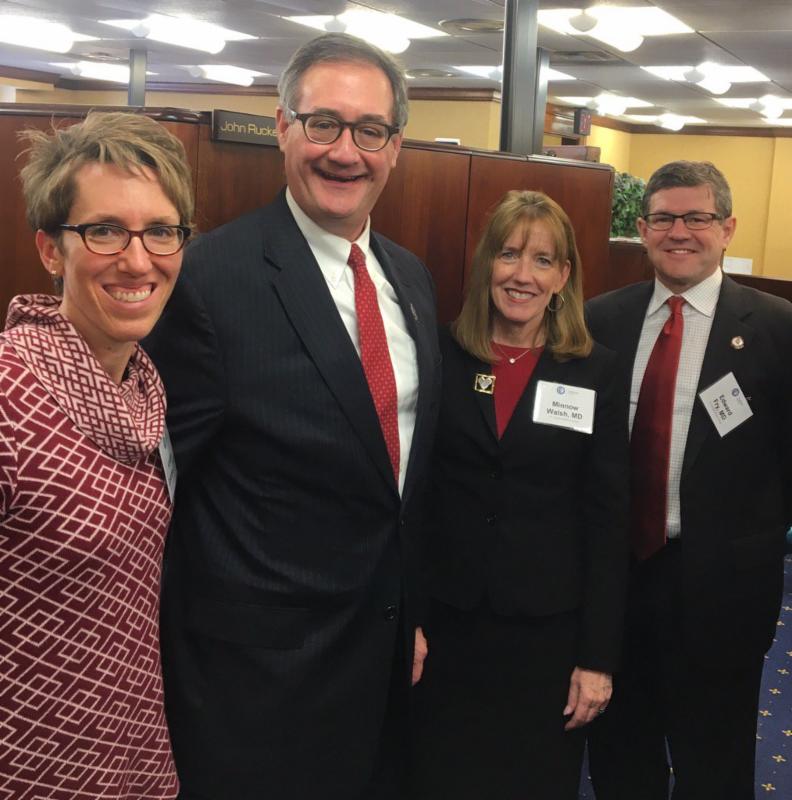
The Indiana-ACC held our annual Legislative Day in Indianapolis on Valentine's Day. Members visited their Indiana representatives and senators to introduce them to cardiology issues facing them and their patients. Building relationships with state lawmakers helps to ensure that the Indiana Legislature remains informed about issues facing providers and patients.
We addressed the Cigarette Tax & Smoking Age (House Bill 1578) and the Healthy Food Initiative Program (Senate Bill 277). (Talking Points)
If you receive a legislative alert from us regarding these issues, please respond to make our voices heard. We look forward to your participation at our Legislative Day next year! You can also attend the ACC Legislative Conference in Washington, DC, on September 10-12, 2017.
|
|
|
Sen. Donnelly's District Office
|
|
State Sen. Ed Charbonneau
|
|
|
State Rep. Joe Taylor with the Westerhausens
|
|
State Sen. John Ruckelshaus
|
|
|
Council Election Coming Up &
Bylaws Amendment
|
|
|
Council Elections
The Indiana-ACC will hold Council elections soon. We have had a great response for nominations. However, we still need representation from Southern Indiana.
Please email indiana.acc@gmail.com if you are interested in this opportunity.
Bylaws Amendment - PASSED
Members eligible to vote recently received a notice about a bylaws amendment; the amendment was approved.
Rationale:
- In order to garner input from our entire membership, we proposed changing our bylaws so that all Indiana-ACC chapter members can vote in chapter elections.
- Our bylaws had stated that only Active members (Fellows, Associate Fellows, Affiliates, Distinguished Fellows and Honorary Fellows of the American College of Cardiology residing or working in Indiana) may vote in chapter elections.
- With this change, affiliate-in-training members, emeritus members, cardiovascular team members, and cardiovascular administrator members will now be able to vote in chapter elections.
|
|
|
New Prior Authorization Reporting Tool
|
|
|
The new ACC Prior Authorization Reporting Tool (www.acc.org/PARtool) is open and available to collect members’ data on inappropriate cardiovascular testing and procedure request denials by insurers and prior authorization vendors. The PARtool is open to all members and their staffs. Please participate to make this successful.
The PARTool will primarily serve as a process for ACC to monitor and identify inconsistent denials by region, payer, prior authorization vendor and modality. Additionally, there will be a focus on “test substitution”- denying an appropriate test request to require another appropriate test.
The 12-question tool will gather information about the practice requestor, payer, prior authorization vendor, de-identified patient indication, modality/procedure requested and overall prior authorization experience. It is important to remember that the tool is NOT collecting patient specific/identifiable information rather details surrounding the prior authorization request. ACC staff will monitor the data on a regular basis to review and identify trends and problem areas for members.
The PARtool will provide an opportunity for ACC to directly see the prior authorization hassle and burdens experienced by cardiologists across the country. With this data, we aim to influence payers and national and state policymakers to improve the prior authorization process, criteria and member experience and delaying in patient care.
Of course, the PARTool’s success is contingent on high member engagement and participation.
|
|
|
|
|
|
|
|
|
|