Primary Freight continues to provide you with this week's summary of the key industry events, thus allowing you the time to advantageously manage your supply chain and work through some of the ongoing pressure points, all to lessen the impact on your business. We are here to assist, anytime.

Weekly Newsletter


ILWU/ILA, INSURANCE, FMC, WAR, & STRIKES

Updates: Primary Freight will provide immediate updates to any news related to the ILA contract issues on the East and Gulf coasts.


The ILA and the USMX have not confirmed the reports, but many believe that talks are set to resume on January 7th. That would be just nine days before the end of the master contract for all the longshoremen handling containers and vehicles at the E/C and Gulf ports. The two sides extended the deadline as part of an agreement on wage increases struck in October to end a three-day walkout. The deadline is midnight on January 15 with the union having threatened to resume the strike on January 16, just four days before the inauguration of Donald Trump as the next U.S. president.


Ocean common carriers must file documented export strategies with the Federal Maritime Commission beginning March 1, 2025, and at least annually every following year.


Filings must include information on services offered, markets served, pricing strategies, and equipment provisioning. The submissions must be prospective in nature, providing clear information to the FMC about how ocean carriers will serve the U.S. export market. Multiple filings in a year are permitted if circumstances warrant. 


The recently proposed Bi-Partisan Ships for America Act or Ships Act could lead to a major new shipbuilding mobilization here in America if Congress moves expeditiously to enact the measure and ensures sufficient funding. On December 19thnthe “SHIPS for America Act of 2024,” was introduced in the U.S. Congress. The legislation is an ambitious effort to increase the U.S. merchant marine in the international trade and the U.S. shipyard industrial base after a long period of U.S. government neglect. The legislation is designed with the following provisions:


Coordinate U.S. maritime policy by establishing the position of Maritime Security Advisor within the White House, who would lead an interagency Maritime Security Board tasked with making whole-of-government strategic decisions for how to implement a National Maritime Strategy.


The bill also establishes a Maritime Security Trust Fund that would reinvest duties and fees paid by the maritime industry into maritime security programs and infrastructure supporting maritime commerce.


Establish a national goal of expanding the U.S.-flag international fleet by 250 ships in 10 years by creating the Strategic Commercial Fleet Program, which would facilitate the development of a fleet of commercially operated, U.S.-flagged, American crewed, domestically built merchant vessels that can operate competitively in international commerce.


Enhance the competitiveness of U.S.-flagged vessels in international commerce by establishing a Rulemaking Committee on Commercial Maritime Regulations and Standards to cut through bureaucracy and red tape within the Coast Guard that limits the international competitiveness of U.S.-flagged vessels(crewing for one), requiring that government-funded cargo move aboard U.S.-flag vessels, and requiring a portion of commercial goods imported from China to move aboard U.S.-flag vessels starting in 2029. Ouch!


Expand the U.S. shipyard industrial base, for both military and commercial oceangoing vessels, by establishing a 25 percent investment tax credit for shipyard investments. 


Accelerate U.S. leadership in next-generation ship design, manufacturing processes, and ship energy systems by establishing the U.S. Center for Maritime Innovation, which would create regional hubs across the country. We are a decade behind China.


Make historic investments in the maritime workforce by establishing a Maritime and Shipbuilding Recruiting Campaign, allowing mariners to retain their credentials through a newly established Merchant Marine Career Retention Program.


It’s about time.

Transpacific Trade

Ocean rates out of the Transpacific overall trended up slightly to end the year, but with Lunar New Year approaching and a range of January transpacific GRIs announced, prices could face upward pressure to start 2025. A seasonal decrease in demand post-LNY should see rates decline, though Red Sea diversions will keep them elevated well above normal.


Pre-LNY demand should be stronger and the post LNY dip likely less pronounced than usual as many importers continue to frontload ahead of expected tariff increases.


Mexico has raised tariffs on apparel imports from China to as high as 35% and essentially closed the INMEX duties exemption for pass-through imports of certain textiles and apparel, challenging importers using Mexico as a lower-cost channel into the US market.


Asia-US West Coast ocean prices increased 8%. Asia-East Coast prices increased 3%.

Ocean rates out of Asia overall trended up slightly to end the year, but with Lunar New Year (LNY) approaching and a range of January GRIs announced for the transpacific, container prices on these lanes could face upward pressure to start 2025. A seasonal decrease in demand starting later in February should see rates ease on the ex-Asia lanes, though Red Sea diversions will keep them elevated well above long term averages just as they were through 2024.


Pre-Lunar New Year demand will combine with higher than normal import volumes for this time of year. The post LNY dip in volumes will likely be less pronounced than usual too as many US shippers continue to frontload ahead of expected tariff increases, with this pull-forward already reflected in record November volumes at the port of LB.


Since the 2017 start of the US - China trade war, Chinese imports to the US have fallen while Mexican imports increased. But at the same time, Chinese investment in and trade with Mexico surged. And with Mexican tariffs usually lower than US duties, the USMCA facilitating low-barrier trade between Mexico and the US, and the INMEX program allowing many imports destined for the US to enter Mexico duty-free, many of these Chinese imports were arriving in Mexico as a channel to the US market. Last week though, Mexico’s President Sheinbaum signed an act that immediately raised tariffs on apparel imports from countries including China to as high as 35%. The act will also essentially close INMEX to certain categories of textiles and apparel, challenging importers who had relied on these methods to reduce their exposure to US duties, including e-commerce sellers for whom INMEX was key to their decisions to import via Mexico.


In January, the government will also start enforcing stricter reporting requirements for B2C e-commerce imports.


President-elect Donald Trump’s second Presidency promises to bring with it another set of possible large tariff changes. Trump already has threatened Mexico and Canada with 25% tariff increases, while China could be subject to tariffs of 60%, which would greatly accelerate sourcing diversification trends already well under way. Are these threats or merely negotiating tactics, or actually intentional policy change? Our industry’s professionals are all closely watching the situation unfold. Will it make importing from Asia less desirable, accelerate sourcing to nations beyond China, or drive a North American manufacturing renaissance? Will Mexico and Latin America reap the benefits of the new trade focus?

Ports Worldwide

In other recent trade war-related developments, Panama rejected President-elect Trump’s recent accusation that China exerts control over the Panama Canal.


Global Liner Report by Sea-Intelligence, which covers 34 global trade lanes covering over 60 container lines, showed a 4.1 percentage point improvement in November 2024 month-on-month to hit 54.8% - the highest level for the year. Schedule reliability in 2024 was impacted by the disruption caused by Houthi attacks on shipping the Red Sea and subsequent diversions. Schedules were hit by the rerouting of vessels via the Cape of Good Hope, the front loading of cargoes by shippers and port congestion at major transshipment hubs.


Schedule reliability has largely remained within the 50%-55% range in 2024. In November, all 13 of the largest container lines recorded an improvement in schedule reliability in terms of month-on-month, although only one – Yang Ming – improved in terms of year-on-year reliability. Singapore-headquartered Pacific International Lines (PIL) was the most improved in November with an increase of 14.6% percentage points. The most reliable carrier was Maersk with a 61.9% reliability rating for November 2024, although this is still far below its stated aim of 90% under the Gemini Cooperation with Hapag-Lloyd which starts next month.


The least reliable of the top 13 lines in November 2024 was Taiwanese carrier Wan Hai Lines with rating of 47.5%.

Rail

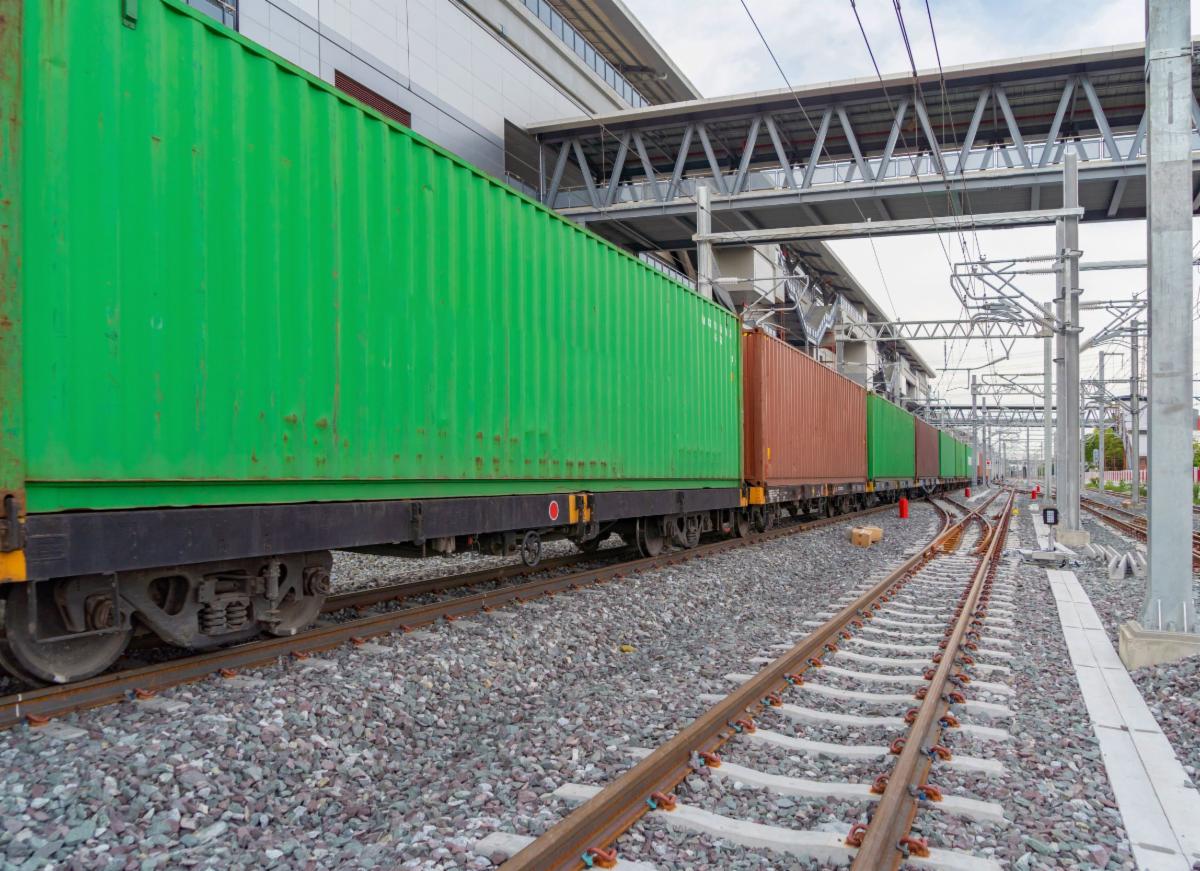
The Association of American Railroads (AAR) today reported U.S. rail traffic for the week ending December 28th was 389,700 carloads and intermodal units, up 5.1 percent compared with the same week last year. Total carloads for the week ending December 28 were 184,028 carloads, up 1.1 percent compared with the same week in 2023, while U.S. weekly intermodal volume was 205,672 containers and trailers, up 9.0 percent compared to 2023.


For the first 52 weeks of 2024, railroads reported cumulative volume of 11,336,412 carloads, down 2.9 percent from the same point last year.


Inland ports are rising. Naturally, inland ports have always been a fundamental feature of the American port system — whether those ports are located on the Mississippi-Missouri rivers in the center of the country, or the Great Lake ports in the north or the hundreds of ports located in bays and estuaries on the coasts. But a new version of the inland port is rising, and it is based on rail and road connections to the sea. Inland ports are transitioning into a multi-dimensional gateway which augments other facets of the supply chain, building resilience into the system. In a sense the new inland ports are industrial or logistics parks but with keener connection to the “port” structure itself.

Airfreight

E-commerce has indisputably become air cargo’s golden egg in recent years to a point where it is no exaggeration to suggest that cross-border traffic is fast-becoming the sector’s leading commodity surpassing general cargo. Its climb has put a squeeze on the capacity available to other verticals, driving up rates across the entire sector. The online purchasing boom for consumer goods showed few if any signs of slowing in 2024 and it is very likely that this will continue to be the case in 2025. The sheer size of airborne cross-border e-commerce traffic can be gauged from the reports earlier this year estimating that just two of the Chinese online marketplaces, Temu and Shein, alone were flying 4,000 tons and 5,000 tons daily respectively and one can safely assume such volumes have increased since. For a number of air carriers operating on routes from Asia Pacific to the U.S. and Europe, cross-border e-commerce now absorbs up to 80% of their capacity out of the region. This is said to be driving a wedge between airlines and forwarders, the former leaning towards direct collaboration with major e-commerce players and their logistics partners with the signature of block space agreements. 


The Freightos Air Index data show that transpacific rates eased to $5.67/kg last week from highs of around $7.00/kg earlier in December as peak season for air closes. China - Europe prices came down to about $4.25/kg after surpassing the $5.00/kg level earlier in the month and transatlantic prices are down to $2.30/kg from an early-December high of $3.16/kg.


The U.S. Transportation Department has imposed a $2 million penalty on JetBlue Airways for operating four chronically delayed flights on domestic routes - the first time it has imposed such a fine on an airline for the prohibited scheduling practice. USDOT said on Friday that as part of a consent agreement with the airline, JetBlue will pay a $1 million fine, and the remainder will go to compensate customers affected by its chronic delays or any future disruptions within the next year.

Domestic Trucking

Trucking activity contracted in November after an October increase, as the freight market continues to show instability. The ATA For-Hire Truck Tonnage Index decreased 1.8% to 112.5 in November from 114.6 in October. The index is down 1% compared with November 2023. The frustratingly choppy freight environment continued in November,” ATA Chief Economist Bob Costello said. “Since hitting a low in January of this year, tonnage is up a total of 1.1%, but the path has been fraught with nice gains one month only to come back down the next. The good news is that the overall trend this year is up, albeit at a slow rate.”

Visit our Website