|
|
|
Infant & Toddler
Connection of Virginia
August 2025
| |
| |
Test your Knowledge with our Poll Feature
Pick your answer and scroll below to find the correct answer and explanation!
| |
| Which of the following is considered a family reason for services starting beyond 30 days? | | | | |
We are excited to welcome Brenda Ayala
to our state early intervention team!
Brenda started work on July 25, 2025 and will work part-time helping with Medicaid-EI benefit enrollments and discharges and providing back-up support for some other administrative functions, like certifications, phone coverage and/or transition notifications to the Virginia Department of Education.
Brenda has extensive customer service experience and is familiar with and has experience in Medicaid programs, managed care organizations and the Medicaid MMIS data system.
Brenda’s youngest son has received early intervention, so she also knows first-hand about the work we do in early intervention. She feels a strong personal commitment to work that benefits these programs (Medicaid and early intervention) and their consumers.
| | |
Child Outcomes: Using TRAC-IT to Evaluate Data Completeness
Children in the early intervention system for six months or longer (measured from initial assessment to discharge) are required to have Child Outcome Summary (COS) statements entered into TRAC-IT at both entry and exit. This serves as a key metric for evaluating progress within the system. Using the Child Outcomes (Indicator C3) report in TRAC-IT, it’s easy to monitor which children meet the 6-month criteria and to identify those who have (or do not have) entry and exit scores.
Unlike some states, Virginia has elected not to evaluate program performance directly using COS statements (scores), focusing instead on expected patterns in progress categories and data completeness. The underlying assumption here is that if COS processes are uniformly followed (i.e. engaging families in COS discussions, using the Decision Tree, documenting a child’s progress while receiving services, etc.), the numbers do, in fact, tell the story!
The state's confidence in the data reported to the Office of Special Education Programs (OSEP) hinges on: Find Out and Read More- GSM Monthly Update 8.2025
So: Why is this the topic for this month’s monitoring update?
Because the Part C monitoring team will be generating each locality’s child outcomes report on Monday, August 11, 2025, at 9:00AM. We will use the scores on that report to evaluate a) data completeness and b) data anomalies.
As a reminder, MCOP calls are held on the first Wednesday of each month beginning at 3:00PM. Our next call will be held on September 6th. ITCVA MCoP calls are open to anyone who is interested in the topic(s) being covered.
Calls are recorded for those who are unable to attend. Please visit the Monitoring Community of Practice page of the ITCVA website for a list of upcoming topics, the Microsoft Teams meeting link and session resources.
UPCOMING MCOP CALLS:
August 2025
NO CALL – SUMMER BREAK
September 2025
POSM: Lessons Learned
October 2025
Determination Report Copy 2 of 2
| | SUPPORTING POSITIVE SOCIAL-EMOTIONAL SKILLS | |
Tell me more about ASQ:SE-2
ASQ:SE-2 is a set of questionnaires with a deep, exclusive focus on social-emotional development. There are 9 ASQ:SE-2 questionnaires for use with children from 1 month to 6 years old. Here are the seven important areas of development that each questionnaire looks at:
| | |
- Autonomy: A child’s ability or willingness to self-initiate or respond without guidance (moving to independence).
- Compliance: A child’s ability or willingness to conform to the direction of others and follow rules.
- Adaptive functioning: A child’s success or ability to cope with bodily needs (sleeping, eating, toileting, safety).
- Self-regulation: A child’s ability or willingness to calm or settle down or adjust to physiological or environmental conditions or stimulation.
- Affect: A child’s ability or willingness to demonstrate their own feelings and empathy for others.
- Interaction: A child’s ability or willingness to respond to or initiate social responses with parents, other adults, and peers.
- Social-communication: A child’s ability or willingness to interact with others by responding to or initiating verbal or nonverbal signals to indicate interests, needs, or feelings.
The “Overall” section asks open-ended questions about your child’s social-emotional development and lets you weigh in with any concerns.
| | |
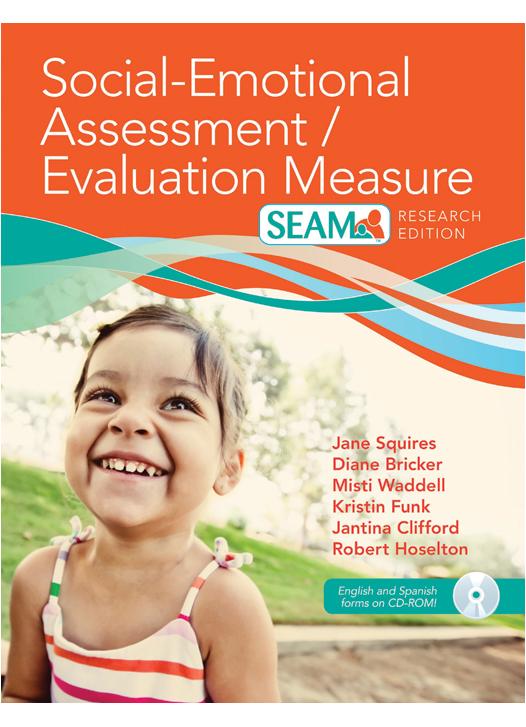
Tell me more about the SEAM
The SEAM (Social-Emotional Assessment/Evaluation Measure) assesses 10 key child benchmarks that are crucial for social-emotional competence in infants, toddlers, and preschoolers. These benchmarks are evaluated across the three age-based intervals of the SEAM Tool (infant, toddler, and preschool).
| | | |
Here's a breakdown of each benchmark:
- Child participates in healthy interactions: This benchmark assesses a child's ability to engage in positive and reciprocal interactions with peers and adults, such as initiating play, responding to invitations, and showing appropriate social behaviors.
- Child expresses a range of emotions: This evaluates the child's capacity to recognize, express, and communicate various emotions, both verbally and non-verbally.
- Child regulates social-emotional responses: This assesses the child's ability to manage and control their emotional and behavioral responses to different social situations and stimuli, including self-soothing and adjusting behavior as needed.
- Child begins to show empathy for others: This benchmark examines the child's budding capacity to understand and respond to the emotions and feelings of others, like showing concern or offering comfort.
- Child attends to and engages with others: This assesses the child's ability to focus attention on others, actively participate in shared activities, and engage in joint attention and play.
- Child explores hands and feet and surroundings (for infants)/demonstrates independence (for toddlers/preschoolers): This benchmark reflects the developmental progression of self-directed exploration in infants (examining their bodies and environment) evolving into displays of autonomy and self-reliance in toddlers and preschoolers (like self-feeding or choosing activities).
- Child displays a positive self-image: This evaluates the child's developing sense of self-worth and confidence, including expressing positive feelings about themselves and their abilities.
- Child regulates activity level: This assesses the child's ability to adjust their activity and energy levels to fit the demands of different situations and environments.
- Child cooperates with daily routines and requests: This benchmark measures the child's willingness to follow instructions, cooperate with routines, and participate in daily tasks, like cleanup or transitions.
- Child shows a range of adaptive skills: This assesses the child's ability to adapt to new situations and demonstrate flexibility in their behavior and problem-solving, including developing coping mechanisms for challenging circumstances.
These benchmarks provide a comprehensive framework for understanding and supporting the holistic social-emotional development of young children.
| |
Pyramid Model Framework
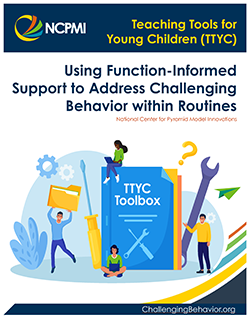
Using Function-Informed Support to Address Challenging Behavior within Routine
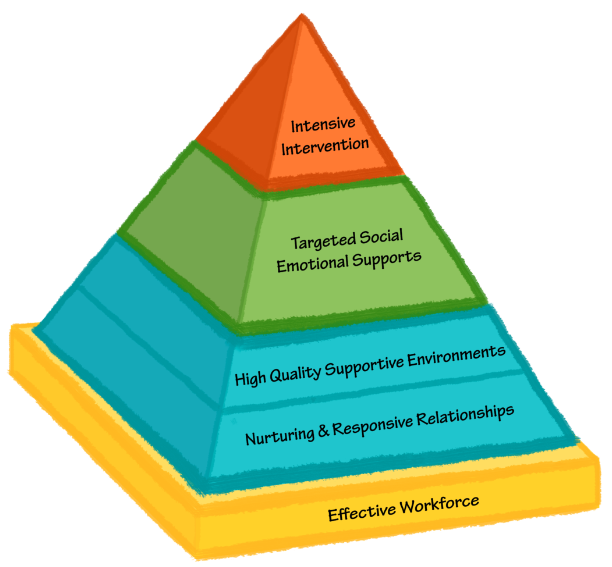
This resource from the Teaching Tools and the Pyramid Model TTYC is designed to be used in environments where practitioners actively implement the Pyramid Model and have a strong foundation of universal practices. When practitioners have nurturing and responsive relationships and high quality environments paired with a focus on teaching children social-emotional skills, very few children will have behavior problems that exceed what is developmentally expected
| | | | | |
However, for the few children who might need additional support (e.g., tier two targeted social-emotional supports), Teaching Tools is a resource that can help guide the identification of those strategies.
Teaching Tools can be used when:
- A child has difficulties in routines and activities beyond what is developmentally expected and is not responsive to the universal Pyramid Model practices.
- The function of the child’s behavior is evident, and the implementation of a comprehensive functional assessment may not be necessary.
- The child’s behavior can be addressed by modifying the environment and using individualized social and emotional teaching strategies.
| | |
Upcoming Webinar:
Teaching Tools: Addressing Challenging Behavior in Everyday Routines
Sometimes you know the meaning of the behavior, but you’re unsure what to do. We have a wonderful guide that can assist you – Using Function-Informed Support to Address Challenging Behavior within Routines. Join this call to learn how to use the updated guide to develop and implement a support plan for children exhibiting behavior that challenges adults in everyday routines and activities (e.g., snack time, large group activities, outdoor play, centers).
Date: Aug 20, 2025
Time: 3:00 PM - 4:00PM (Eastern Time Zone)
| | |
Register Here- no cost to attend
I hope to see you online for this informative session!
| | |
View Here: https://www.youtube.com/watch?v=yps1c_3Ut38
| | A GEM YOU MIGHT HAVE FORGOTTEN? | | WHAT YOU MIGHT HAVE MISSED? | | | |
Quick Reference Guides
These quick reference guides provide easy access to important information about VA’s early intervention process. Check out the recently updated versions!
| | We now have 4 videos in the Heartwired series! The latest one is titled, "Compassionate Conversations for Early Interventionists: Guiding Caregivers through Autism Concerns." | | Talks on Tuesdays will kick off again on September 2nd with a panel discussion and resource share focused on supporting families with children with sensory disabilities. Keep an eye out for the registration announcement! | | RESOURCES FOR PROVIDERS AND FAMILIES | | |
Pediatricians Get Updated Guidance On Diagnosing Developmental Disabilities - Disability Scoop
The nation’s pediatricians are getting new guidelines for how to go about evaluating children who present with global developmental delay or intellectual disability.
Doctors should use genetic testing to assess children early, according to a clinical report from the American Academy of Pediatrics published recently in the journal Pediatrics.
“Genetic neurodevelopmental disorders are common in the pediatric population, and establishing a specific diagnosis early provides multiple benefits,” the guidance states, noting that such information can help guide treatment and therapy decisions, provide access to support networks and clinical trials and inform reproductive decisions, among other things.
Learn more at the link above.
| | |
The correct answer is “b”. While it is commendable to try to accommodate family scheduling preferences, the local system must offer a time within 30 days and document the offer and the family’s response, even if it is not at the preferred time. Documentation of offers made to the family and declined due to family scheduling preferences shows the local system’s capacity to meet the 30-day timeline.
Please see the article in last month’s update to learn more July 2025 Update.
| | |
The Employment Opportunities page on the ITCVA website
receives nearly 5,000 visits each year!
Practitioners: Early intervention needs you! Influence the future of infants and toddlers with developmental delays or disabilities and their families by putting your skills and expertise to work today! Please visit the Employment Opportunities page on the ITCVA website for links to current job openings.
LSMs and local contracted agencies: Let us help connect you to qualified applicants! Are you a Local System Manager (LSM) or the director of an agency that contracts with one or more local early intervention systems in Virginia? Are you looking to find qualified applicants to fill vacant positions? Please visit our Employment Opportunities page for instructions on how to submit a job posting.
| | |
| INFANT & TODDLER CONNECTION OF VIRGINIA | Looking for the most up-to-date version of the Part C Practice Manual...upcoming meeting dates...or even a new career opportunity? You'll find plenty of helpful information on the Infant & Toddler Connection of Virginia's early intervention website! Be sure to visit and bookmark itcva.online. | | |
| |
EARLY INTERVENTION CERTIFICATION
For questions about certification of practitioners, contact Anne Brager- 804-664-2462.
For questions related to completing the online application, contact VATRACITsupport@ssg-llc.com or from 8AM-5PM ET by calling 804-508-7229.
| | | | |
Infant & Toddler Connection of Virginia is part of the Department of Behavioral Health and Developmental Services
https://itcva.online/itcva-staff/
1220 Bank Street, 9th Floor, P.O. Box 1797, Richmond, Virginia 23219-1797
Main Office: (804) 786-3710 • Main Fax: (804) 371-7959
| | Do you have colleagues who aren’t getting the Monthly Part C Update? Ask them to check their spam folder. If they're still not receiving it, have them email anne.brager@dbhds.virginia.gov. | |
DMAS Early Intervention Support
For specific Medicaid questions related to billing and supports for Early Intervention, please use these emails:
EarlyIntervention@dmas.virginia.gov
CCCPlusEarlyIntervention@dmas.virginia.gov
| | |
1220 Bank Street
Richmond, VA 23219
(804) 664-2462
| |
| | | |