|
|
|
Infant & Toddler
Connection of Virginia
December 2024
| |
|
|
Test your Knowledge with our Poll Feature
Pick your answer and scroll below to find the correct answer and explanation!
| |
| If Part B can’t attend the Transition Planning Conference in person, what do you do? | | | |
|
State Systemic Improvement Plan (SSIP)
As we wrap up our third year implementing our new SSIP, focused on positive social-emotional skills and social relationships, we have several accomplishments to celebrate. Those include, but are not limited to, the following:
- Based on recommendations submitted by multiple stakeholder groups, we developed draft screening and assessment practice recommendations and requirements to identify and meet the social-emotional needs of infants and toddlers in early intervention and their families;
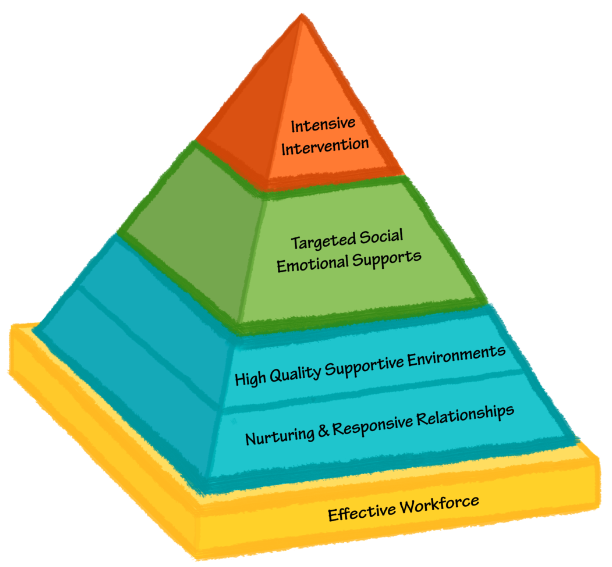
- We launched statewide implementation of the Pyramid Model Framework with a webinar and followed up with at least eight different tools and resources to support local implementation;
- We went live with full implementation of required fields in TRAC-IT and are building the body of data necessary to more fully understand our child outcome results and identify targeted improvement strategies;
- We provided at least 5 professional development activities designed to ensure all practitioners know they have a role in supporting positive social-emotional development and a nurturing caregiver-child relationship and have the training and tools to do that; and
- We completed pilot projects to embed reflective supervision in two local systems.
The State Leadership Team met in November to review specific progress on each SSIP activity and evaluate whether revisions to the plan are needed. The leadership team determined that we are on a good course and should continue with planned activities. A few new activities were added as well. State Leadership Team meeting notes are posted on our website.
| |
|
Monitoring Update
State Performance Plan (SPP)/Annual Performance Report (APR)
Each state must submit to the U.S. Department of Education a State Performance Plan/Annual Performance Report (SPP/APR) that specifies our annual performance on a set of federally required Part C of IDEA indicators. The next SPP/APR is due to the Office of Special Education Programs (OSEP) on February 3, 2025. A draft of this year’s report will be available by mid-December for review (in the “About ITCVA” section of our website; see Public Reporting). The SPP/APR data will be discussed with the Virginia Interagency Coordinating Council prior to posting it, and we will be accepting any additional written comments through December 31, 2024.
Please submit any comments you have on the SPP/APR to Richard Corbett at richard.corbett@dbhds.virginia.gov.
December 2024 Update: Periodic Oversight of Systems and Methods (POSM)
POSM is now officially underway! Thanks again to our POSM pioneers for their enthusiasm and cooperation as the Part C monitoring team launches this updated cyclical review process. The POSM protocols can be found on the GSM Framework page of the ITCVA website. In the coming months, as additional pioneers come on board, and as we wrap up our POSM activities with the earliest pioneers next spring, we will share information about our findings and the methodologies used to reach our conclusions—which will no doubt be modified and refined as we move along. The monitoring team appreciates your patience and support!
| |
|
Navigating Intra-Family Conflict
Early Intervention Service Providers and Service Coordinators, the Center for Appropriate Dispute Resolution in Special Education (CADRE) has a new resource offering strategies to support families working through conflict. Occasional conflict is part of day-to-day family life but prolonged conflict between parents can have a detrimental effect on the child. Please visit the link on their website to learn more about how you can help.
Navigating Intra-Family Conflict | CADRE
| |
|
Register Now!
Registration closes Wednesday, December 11th @ 5 p.m. EST
December 16, 2024, 10:00 AM – 11:30 AM
Tackling Transition and Related TRAC-IT Documentation
DESCRIPTION:
Join Kyla Patterson for a webinar covering Virginia’s transition requirements and practices in the context of TRAC-IT data entry. This webinar will be especially relevant for local system managers and service coordinators. It will be recorded for those unable to attend and for reference.
| |
|
Supporting Children, Families, and Caregivers in Virginia- Using the Pyramid Model Framework
Save the Date:
January 23rd, 2025
9:00 AM - 12:00 PM EST
Registration open soon!
Description:
The Pyramid Model provides the framework for understanding children’s social-emotional development and how professionals and practitioners support families. The three tiers of the Pyramid Model include Promotion, Prevention, and Intervention and understanding how children’s social-emotional skills can be strengthened and their families empowered in each tier benefits all early intervention providers. During this workshop, practitioners will develop knowledge of family systems theory and core concepts of social-emotional development including co-regulation, attachment, behavior, and understanding grief and trauma. This workshop will allow participants to ask questions, engage collaboratively, and further their knowledge of social-emotional practices in early intervention.
| |
|
|
|
Roadmap to Effective Intervention Practices Family-Focused Interventions for Promoting Social-Emotional Development in Infants and Toddlers with or at Risk for Disabilities
This document is part of the Roadmap to Effective Intervention Practices series of syntheses, intended to provide summaries of existing evidence related to assessment and intervention for social-emotional challenges of young children. The purpose of the syntheses is to offer consumers (professionals, other practitioners, administrators, families, etc.) practical information in a useful, concise format and to provide references to more complete descriptions of validated assessment and intervention practices. The syntheses are produced and disseminated by the Office of Special Education Programs (OSEP) Technical Assistance Center on Social Emotional Intervention for Young Children (TACSEI).
| | | |
A GEM YOU MIGHT HAVE FORGOTTEN? | |
WHAT YOU MIGHT HAVE MISSED? | |
|
|
Download this VEIPD handout connecting you (and families) with 3 organizations in Virginia that assist families with young children with disabilities during the EI years and beyond:
https://veipd.org/main/pdf/Supporting_Families_In_EI.pdf.
| |
If you missed November’s Talks on Tuesdays - Gestalt Language Processing: What’s the Buzz? - you can now find the recording and handouts here. | |
Save the date now for the next ElevatED EI workshop: Supporting Children, Families, and Caregivers Using the Pyramid Model Framework on January 23rd from 9am to noon. Registration coming soon! | |
POLL ANSWER AND EXPLANATION | |
|
The correct answer is d – both b and c.
Transition Planning Conferences help families make informed decisions about where their child will transition and when. The local Early Intervention system is required to offer a Transition Planning Conference to all families whose child is potentially eligible for early childhood special education. The Transition Planning Conference and the meeting to develop the transition plan may be combined into one meeting.
If a family approves the Transition Planning Conference, required participants include the family, a Part C representative (usually the Service Coordinator) and a representative from the local school system. School Systems may participate in person, by phone or by other electronic means. If a representative is unable to attend, the parent is provided with contact information for who to speak to at the local school system. If the family is interested in learning about other community options, the service coordinator will offer to invite representatives from these programs to attend the transition planning conference if the family agrees. Transition Planning Conferences can also be held for children not potentially eligible for Part B with representatives from other programs the family is interested in.
To learn more, visit Chapter 8 of the Practice Manual page 34.
| | |
|
EMPLOYMENT OPPORTUNITIES
The Employment Opportunities page on the ITCVA website receives nearly 5,000 visits each year!
Practitioners: Early intervention needs you! Influence the future of infants and toddlers with developmental delays or disabilities and their families by putting your skills and expertise to work today! Please visit the Employment Opportunities page on the ITCVA website for links to current job openings.
LSMs and local contracted agencies: Let us help connect you to qualified applicants! Are you a Local System Manager (LSM) or the director of an agency that contracts with one or more local early intervention systems in Virginia? Are you looking to find qualified applicants to fill vacant positions? Please visit our Employment Opportunities page for instructions on how to submit a job posting.
| | |
|
INFANT & TODDLER CONNECTION OF VIRGINIA | Looking for the most up-to-date version of the Part C Practice Manual...upcoming meeting dates...or even a new career opportunity? You'll find plenty of helpful information on the Infant & Toddler Connection of Virginia's early intervention website! Be sure to visit and bookmark itcva.online. | | |
|
|
EARLY INTERVENTION CERTIFICATION
For questions about intial certification of practitioners, contact Anne Brager- 804-664-2462.
For questions about re-certification of practitioners, contact David Mills • 804-317-7776
For questions related to completing the online application, contact VATRACITsupport@ssg-llc.com or from 8AM-5PM ET by calling 804-508-7229.
| | |
|
|
Infant & Toddler Connection of Virginia is part of the Department of Behavioral Health and Developmental Services
https://www.itcva.online/itcva-staff-1
1220 Bank Street, 9th Floor, P.O. Box 1797, Richmond, Virginia 23219-1797
Main Office: (804) 786-3710 • Main Fax: (804) 371-7959
| |
Do you have colleagues who aren’t getting the Monthly Part C Update? Ask them to check their spam folder. If they're still not receiving it, have them email anne.brager@dbhds.virginia.gov. | | |
1220 Bank Street
Richmond, VA 23219
(804) 664-2462
| |
| | | |