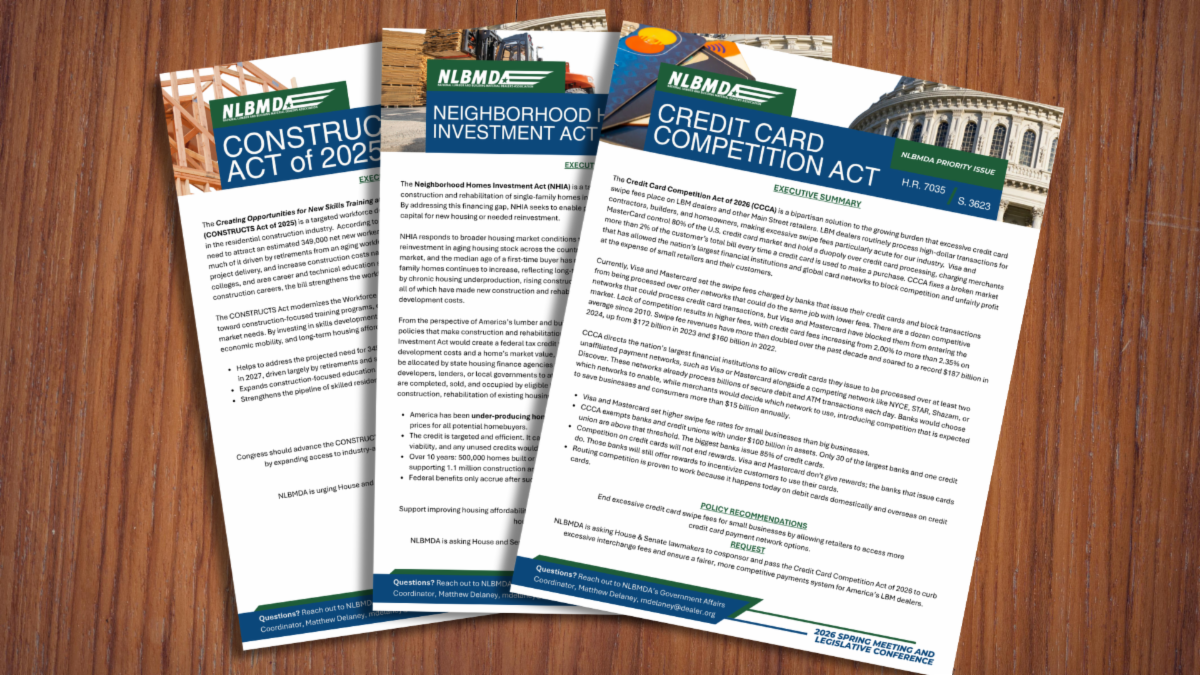
Inside the Issues: Legislative Priorities for NLBMDA’s 2026 Fly-In | | Join us March 17-18 in Washington, DC! | | Save $100 off Regular-Priced Registration with our Early Bird Discount! | | This year, NLBMDA updated its briefing materials with a refreshed look and clearer messaging. Each issue brief not only explains the policy at hand but also provides important context on its relevance and impact for LBM dealers. | | At NLBMDA’s 2026 Spring Meeting and Legislative Conference, members will engage on the policy priorities shaping the future of the lumber and building material dealer industry. Guided by NLBMDA’s Government & Regulatory Affairs Committee, this year’s agenda will focus on expanding housing supply and affordability, advancing workforce development solutions, and addressing excessive credit card swipe fees that increase costs for dealers and consumers alike. | | |
1. Expanding Supply & Improving Housing Affordability:
As suppliers to the residential construction sector, addressing the nation’s housing supply shortfall remains a top priority for NLBMDA in 2026. NLBMDA members will advocate for bipartisan legislation that cuts red tape, modernizes zoning and permitting practices, and incentivizes new home construction and rehabilitation.
The House and Senate are advancing separate but parallel, bipartisan housing bills aimed at reducing regulatory barriers and promoting pro-growth housing policies at the local level. The Senate’s ROAD to Housing Act (S. 2651) includes more than 40 provisions to cut federal red tape, improve transparency, and incentivize state and local zoning, permitting, and development reforms that expand housing production. The House has advanced the Housing for the 21st Century Act (H.R. 6644), a comprehensive bipartisan package that addresses many of the same structural challenges that ROAD to Housing addresses.
While the proposals differ in organization and scope, they share substantial common ground, with roughly half of the House provisions aligning with or closely mirroring elements of the ROAD to Housing Act. NLBMDA members will advocate that Congress should take swift bicameral action to reconcile the ROAD to Housing Act and the Housing for the 21st Century Act into a unified, bipartisan housing package that reduces regulatory barriers and meaningfully accelerates housing production nationwide.
Complementing these structural reform efforts, NLBMDA will also advocate for passage of the Neighborhood Homes Investment Act (NHIA). The bipartisan bill would establish a new, state-administered federal tax credit to address the financing gap that often prevents new single-family construction in neighborhoods throughout the country.
| | |
2. Improving Workforce Development Opportunities
The construction industry continues to face a severe and persistent workforce shortage that is constraining housing supply, delaying project delivery, and increasing construction costs. According to Associated Builders and Contractors, the industry will need to attract an estimated 349,000 net new workers in 2026 and an additional 456,000 workers in 2027 to meet anticipated demand, driven largely by retirements from an aging workforce and acute shortages in skilled trades and high-growth regions.
The bipartisan CONSTRUCTS Act of 2025 would help address these challenges by strengthening the residential construction labor pipeline. The legislation expands access to construction-focused education, training, and outreach programs through community colleges, career and technical education schools, and other eligible providers. In 2026, NLBMDA will urge Congress to advance the CONSTRUCTS Act and advocate for workforce development reforms that connect more workers to in-demand construction jobs, an essential step toward increasing housing supply, controlling construction costs, and improving housing affordability.
| | |
3. Reigning in Excessive Swipe Fees
Swipe fees continue to be an increasing operational cost for lumber and building material dealers of all sizes. Credit card swipe fees, or interchange fees, are transaction charges paid by merchants to card-issuing banks each time a customer uses a credit card. In the United States, Visa and Mastercard control roughly 80 percent of the credit card market, giving them outsized influence over interchange fee schedules and network rules while leaving merchants little ability to negotiate. This lack of competition has driven steady fee increases, with average swipe fees rising from about 2.0 percent in 2010 to more than 2.35 percent today, and interchange revenues more than doubling over the past decade to a record $187 billion in 2024.
Despite the existence of multiple competitive payment networks that successfully process debit and ATM transactions, dominant card networks restrict credit card routing to preserve a closed system that sustains excessive fees. The bipartisan Credit Card Competition Act would restore competition by requiring large banks to enable at least two unaffiliated payment networks on credit cards they issue, allowing retailers to route transactions over the most cost-effective option. This reform is projected to save businesses and consumers more than $15 billion annually. The White House’s recent endorsement of the legislation has injected significant momentum into efforts to advance the bill this year. In 2026, NLBMDA will urge Congress to advance and enact the Credit Card Competition Act, advocating for reforms that reduce excessive swipe fees, lower operating costs for LBM dealers, and deliver meaningful savings to consumers.
| | |
NLBMDA Policy Briefing Webinar & Advocacy Training
You do not need to be a policy expert to advocate on behalf of your business or the industry at large. NLBMDA’s Washington, D.C.–based government affairs staff provides pre- and post-meeting support with congressional offices, offering policy context and answering questions on legislation. The greatest value you bring is your personal story, sharing real-world experience and explaining why congressional action matters.
For both new and returning attendees, NLBMDA offers a policy briefing webinar that provides an in-depth overview of this year’s selected bills and distills them into clear, effective messaging for meetings with lawmakers and staff. On March 17, attendees will also hear from policy thought leaders and receive a final briefing from NLBMDA’s government affairs team. Whether it’s your first visit or your tenth, NLBMDA is here to support you every step of the way and ensure your time on Capitol Hill is as productive as possible.
Already registered? Keep an eye out for an email with details on our policy briefing webinar.
| | |
First Time Attending LegCon?
Apply for the Dealers to D.C. Advocacy Grant!
| | |
Are you considering attending the 2026 Spring Meeting & Legislative Conference for the first time? NLBMDA wants to make sure your voice is heard on Capitol Hill—and we’re here to help.
Through the Dealers to D.C. Grant Program, NLBMDA provides financial assistance to increase dealer participation in our annual Legislative Fly-In. This program ensures a broader range of member voices are represented in Washington, particularly from dealers who have not recently attended or operate in states not typically represented.
Ten dealer members will be selected to receive a $750 reimbursement to help cover eligible expenses. Advocacy Grants are designed to reduce barriers to participation and strengthen NLBMDA’s collective voice in federal policy discussions.
This is your chance to step into the conversation, gain confidence as an advocate, and make a lasting impact on the future of our industry.
| | |
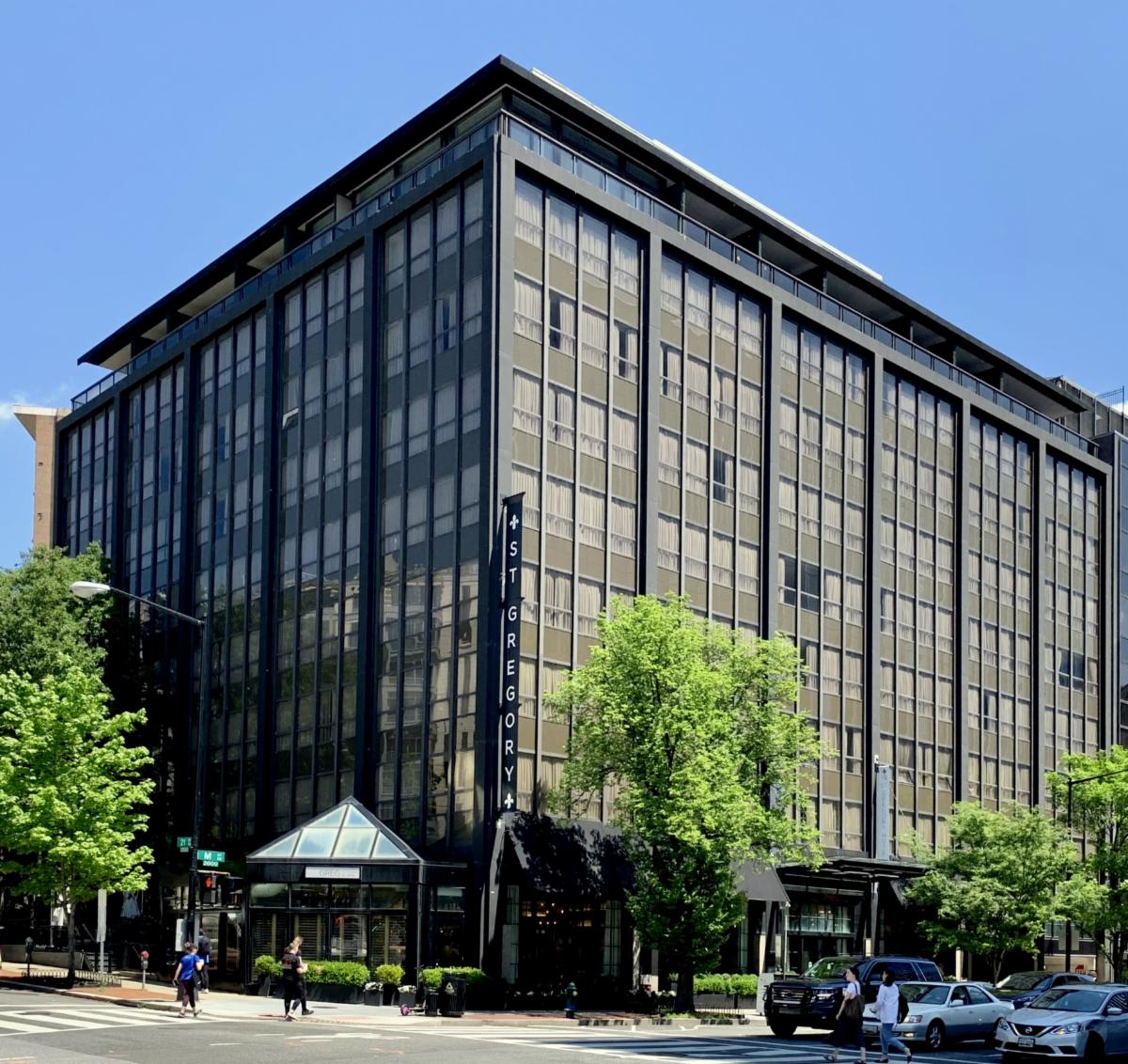
Book Your Stay at the
St. Gregory Dupont Circle Georgetown
| | |
The St. Gregory Hotel is ideally situated at the intersection of Dupont Circle, the West End and Georgetown. Blending elegant design with sophisticated amenities, including a restaurant and bar, the St. Gregory Hotel brings a refined hotel experience to one of the most coveted areas of the nation's capital. Walking distance to the National Mall, Embassy Row and boutique-filled Georgetown, the St. Gregory Hotel is one of the best-located hotels in Washington, DC.
| | |
The St. Gregory Dupont Circle Georgetown
2033 M Street NW
Washington, D.C. 20036
Phone Number: (202) 688-0756
Discounted Room rate: $259
| | Use the promo code NLBMDA to secure your discounted room rate or book via phone at (202) 688-0756 and let them know you're with NLBMDA. | | Thank You to Our Sponsors! | | | | |