|
American artist Jean-Michel Basquiat was born in Brooklyn, New York, to immigrant parents from Haiti and Puerto Rico. Throughout his childhood, his mother encouraged him to explore art as a junior member of the Brooklyn Museum of Art. He showed early interest in cartoons and street art, whose influence is clear in his later-developed style. Basquiat's early life was traumatic. From a car accident at the age of 7, to his mother being institutionalized when he was 10 years old, to running away from home briefly at 15, the young artist had a lot to deal with before his entrance into the art scene. All of this, combined with his existence as a young Black man in 1960s America, gave Basquiat much to process through his artwork.
Basquiat became close friends with other artists such as Keith Haring and Andy Warhol. Outside of fine art, he had a variety of connections to pop culture icons, including Madonna, Debbie Harry, John Sex, and Allen Ginsberg. Basquiat sadly passed away at the age of 27 from a drug overdose. Despite his connections, his work was not as widely known or appreciated during his life as it was after his death.
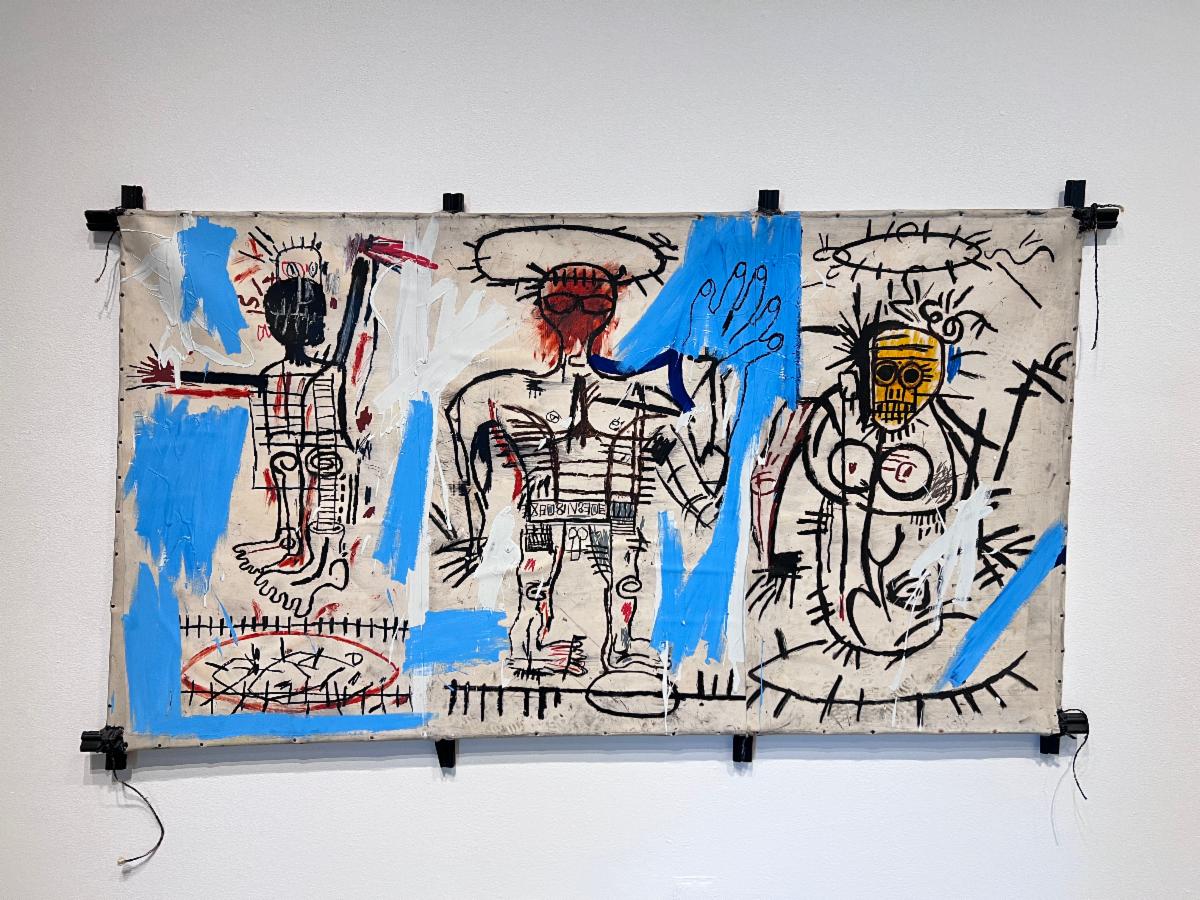
Currently, in the Main and Entry Galleries, two pieces by Jean-Michel Basquiat are on display. A smaller piece, Sans titre (Beisbol) (1981), is placed in the Entry across from the work of Rick Bartow and Willem de Kooning, whose styles complement the sharp neo-expressionism of Basquiat. Sans titre (Beisbol) uses athletics as a social commentary because, in the 1980s, sports were considered one of the few ways African-Americans could gain fame and recognition. This piece uplifts the Black baseball player, while challenging society by declaring that there is more to Black joy and recognition than commercial sports. In the Main, we have Baby Boom (1982), a prominent work of Basquiat's that has been confirmed to be a portrait of himself and his parents, Gerard and Matilda. Baby Boom, pictured above, is a larger piece on a canvas that was handmade by the artist. It is crafted out of a thin canvas fabric that has been stretched and tied over what appears to be chair railing. In addition to its personal iconography, Baby Boom is also a remarkable example of the unique structures Basquiat often adopted as his supports. From his earliest days as a street artist, he had sequestered a wide range of objects and materials to use as surfaces for his paintings: from walls and wooden doors to more unusual surfaces such as radiators and refrigerators, the artist embraced any and every surface as a place to make his mark. It is a visceral piece, one that brings viewers to imagine the physical passion with which it was created. In some places, you can see Basquiat's shoe prints, leading us to imagine him in his studio pacing and considering what to add to the piece next. The lines that make up the three figures are rough and sharp, in alignment with Basquiat's signature style, but in the context of it being a family portrait, this may imply something deeper. Considering Basquiat's rough childhood, it is possible that representing his family and himself in this way was a way to process his emotions regarding his early life. Childhood is a complex thing for everyone, so the way Basquiat depicts his parents in this work is an element that makes it timeless. He reveres them in this piece, and by dividing the canvas support into three sections, he recalls the altarpieces of the European Northern Renaissance.
Read more about Baby Boom here. This work has been exhibited at internationally known museums, including the Brooklyn Museum, Gagosian Gallery, and the Museum of Fine Arts. It can now be viewed at the Schneider for free!
|