|
By Jamie Hendrix-Chupa, Exhibition Interpreter and Content Manager
SOU Theatre Class of '27
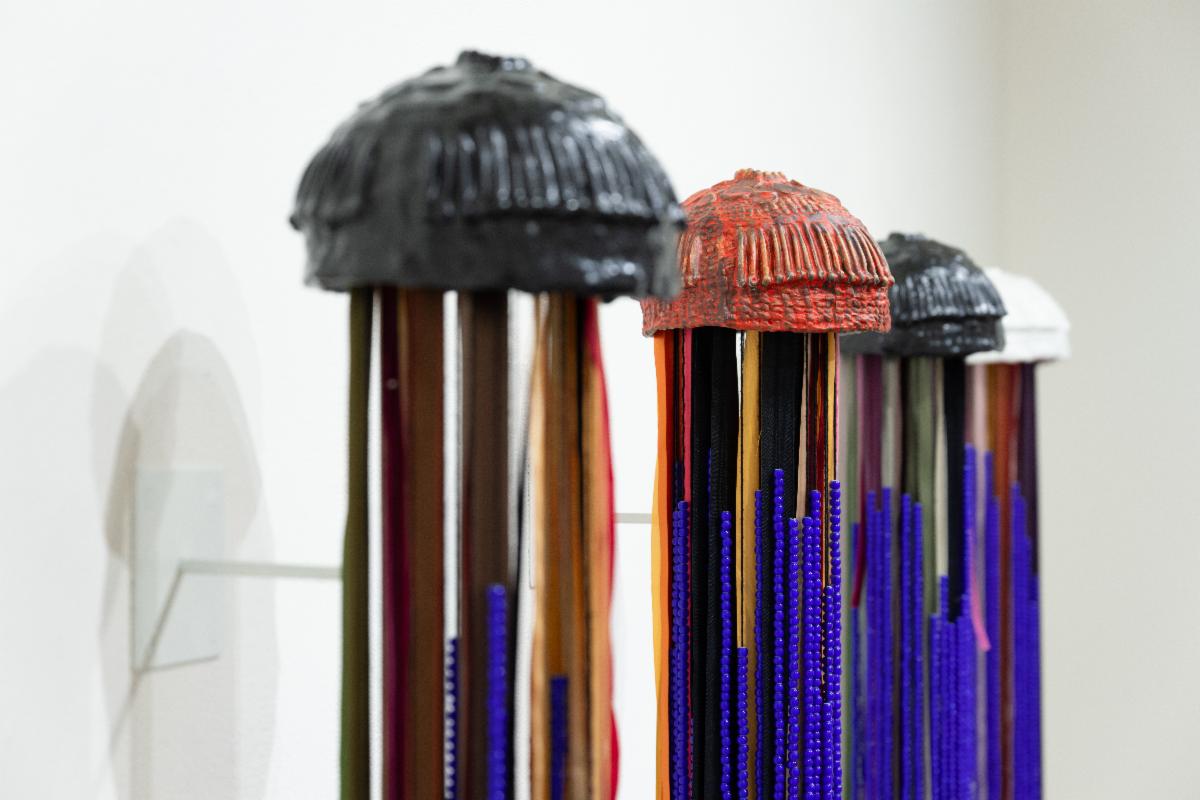
| | Sara Siestreem (Hanis Coos) | | Sara Siestreem (Hanis Coos), fiesta, forever (blue nights and rattlesnakes), 2025, four slip cast ceramic dance caps, acrylic paint, acrylic glazes, Abalone buttons, plastic buttons, Czech White Hear beads, cotton thread, Japanese Indigo (Linton) dyed and woven industrial cotton, canvas and thread, commercial ribbon., 72" x 92" x 11"; courtesy of the artist and Elizabeth Leach Gallery. | | |
Sara Siestreem (Hanis Coos) is a multidisciplinary artist from Oregon. Her body of work includes painting, photography, printmaking, weaving, beading, and large-scale installations. Through her artwork, Siestreem maintains a connection with her heritage using both traditional techniques and contemporary modes and materials. Her work deals with topics of social and ecological justice, education, and Indigenous feminism. In 2011 after beginning to study the weaving culture of her tribe, Sara Siestreem created a self-sustaining weaving program for the Coos, Lower Umpqua, and Siuslaw Indians called the Hanis Coos Traditional Weaving Research and Education Project. As a part of "Eons: Unraveling Time", three of Siestreem's works are featured that all involve an element of indigenous culture. Weaving and bead work are featured heavily in the piece featured above, fiesta, forever (blue nights and rattlesnakes), and another piece of hers, skyline, is comprised of seven baskets made from ceramic, to preserve the weaving form in a solid material. Both skyline and fiesta, forever (blue nights and rattlesnakes) can be found in Heiter Gallery. Her piece foxes on the moon, featured in the Main Gallery, incorporates collaged lithographs and Xeroxed photo transfers of extinct Indigenous oyster shells, which recently surfaced from eroding middens adjacent to traditional village sites in the Coos Bay estuary. These ancient oyster beds and communities were irrevocably altered due to colonization that intensified in the 1800s. Visit the Schneider to see these works by Sara Siestreem (Hanis Coos), on view until March 13th, 2027.
The Hanis Coos people are from the Oregon coast, where they lived in villages along Coos Bay, the Coos river, and Tenmile Lake. Their resources mainly came from the water, such as fish, shells, shellfish, and marine mammals and waterfowl, though they also hunted and foraged for edible plants on land. They were disrupted and their land was taken by settlers in the 1850s, and the Hanis Coos population was diminished due to separation, disease, and starvation. Now, the tribes of coastal Oregon are working together to reclaim their history and culture. Read more about the Hanis Coos and other tribes from the Oregon Coast on the Confederated Tribes of the Coos, Lower Umpqua, and Siuslaw website, https://ctclusi.org/history/.
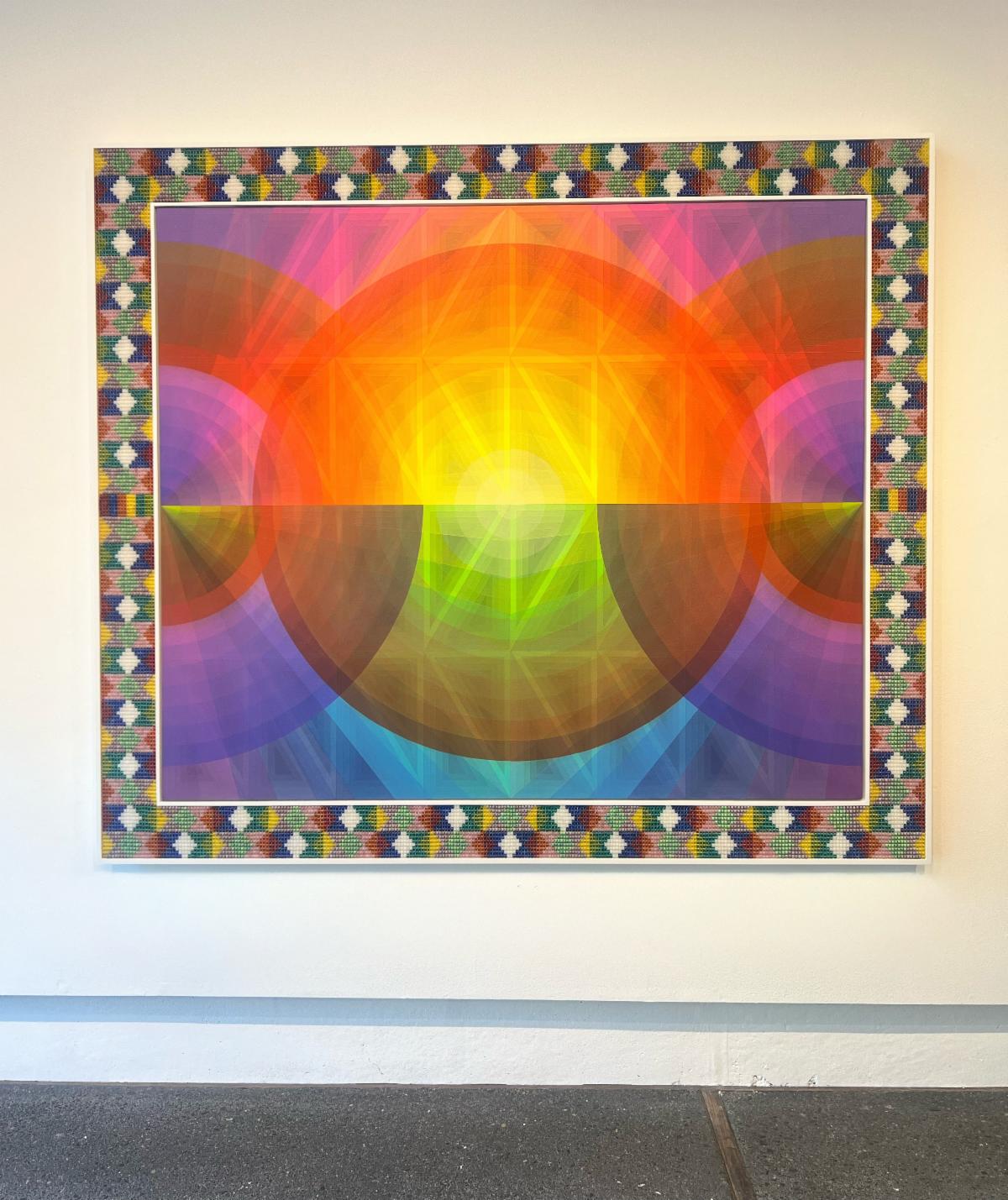
| | Jeffrey Gibson, Sunset Parhelia, 2026, Acrylic on canvas, glass beads, artificial sinew, inset to custom wood frame; Courtesy of private collection | | |
Indigenous artist Jeffrey Gibson draws inspiration from his cultural background, combining Native American art techniques with modern creative tools for his unique artistic style. The traditional media he uses includes beadwork and weaving, as well as fringe and jingles which are both used as decorations for indigenous powwow regalia. He combines these with oil and acrylic paint, spray paint, and airbrushing. Gibson's body of work mainly deals with issues of identity and labels. Gibson is a part of the Cherokee Nation and the Mississippi Band of Choctaw Indians, who unlike the Hanis Coos, are native to the Central and Eastern regions of North America. He was the first Indigenous artist to represent the United States with a solo exhibition at the Venice Biennale titled "The Space in Which to Place Me", which was named in reference to a poem by Indigenous poet Layli Long Soldier. Gibson has been involved in the creation of multiple books that highlight other Indigenous artists, including An Indigenous Present (2023) and The Space in Which to Place Me (2025), which both include work by Sara Siestreem (Hanis Coos), who was discussed above and who is featured in "Eons: Unraveling Time".
The work on view in the Entry Gallery, Sunset Parhelia, is a colorful representation of an intriguing natural occurrence. A parhelion, also known as a sun dog, is an atmospheric optical phenomenon that consists of one or more bright spots on the sides of the Sun. It is a type of halo that is caused by light reflecting off of ice crystals in the atmosphere. Some of Gibson’s other recent works also explore the celestial bodies, such as Light Flares – The Sun is Calling (2025) and Lunar Halo (2025). The earth and sky are important to Gibson in his artistic creation. As the artist himself says, "...the animals will tell us, the wind will tell us, the sun will tell us, the land will tell us, and we will tell each other that our very existence in the present tense is a logical culmination of all that has come before us."
The Cherokee people held dominion over a sprawling territory comprised of much or most of the modern states of West Virginia, Kentucky, Virginia, North Carolina, Tennessee, South Carolina, Georgia and Alabama. The Mississippi Choctaw people, as the name suggests, are native to the region of the Mississippi, though during colonization many relocated to the Oklahoma region. These tribes are widespread, and each have a rich history. We invite you to learn more about the Cherokee and the Mississippi Band of Choctaw Indians at https://www.cherokee.gov/ and https://www.choctaw.org/.
| | |
Discover More!
Tuesday Tours
Sign up for our FREE Tuesday docent-led tour, every week at 12:30pm to learn more about our current exhibition. Register now!
Inside the Museum Archive
Visit our archive to read past editions of Inside the Museum!
Subscribe to our YouTube Channel
Both the Schneider Museum of Art and the Oregon Center of the Arts now have YouTube channels. Subscribe now to see what's going on in SOU's world of art!
| |
Thank you to our Celebrating 40 Years Sponsors!
| |
Legacy Sponsors
Cindy Barnard & Jerry Kenefick
Kumar & Roberta Bhasin
Sandy Friend, Pam Leandro-Notch, & Vivian Stubblefield
Frieda & Bob Golding
Judy Howard & Steven Dewey
Carole Kehrig & Karen Sue Smith
MaryBeth & Terry Limpert
| | |
Thank you to our 2025-2026 sponsors!
Kumar and Roberta Bhasin
Jeannie Taylor
| | | | |