Health, Wealth, and Happiness | |
|
Premium Exclusive
Our Tuesday analyst newsletter is exclusive for Premium subscribers.
| | |
|
|
Inside the New (Old) Stablecoin Bill
by Steve Walters
| |
|
Last Saturday, the U.S. House of Representatives Finance Committee posted a draft stablecoin bill. It was quickly noted by crypto observers that the 73-page bill, which is currently unnamed, is the same bill that was leaked last September, yet somehow, it feels different this time around.
Since that leak, we’ve had several impactful events that are likely to craft the narrative around cryptocurrencies and stablecoins. For example, the failure of FTX and several crypto-friendly banks, which also led to a depegging of USDC and USDT. These events are sure to come up in conversations when Congress discusses the bill.
That discussion is not far off. Tomorrow, the House Finance Subcommittee on Digital Assets, Financial Technology and Inclusion will host a hearing entitled “Understanding Stablecoins’ Role in Payments and the Need for Legislation.” Tune into the livestream tomorrow on YouTube at 10:00 AM EST. Here's a breakdown of the bill in its current form.
| |
|
It’s almost certain the draft bill will come up during the hearing, which is slated to include a broad cross-section of witnesses. Though this is an early hearing, it could dictate the direction the bill will take in the coming months. Witnesses invited to speak at the hearing include:
-
The Honorable Adrienne A. Harris, Superintendent, New York State Department of Financial Services
-
Mr. Dante Disparte, Chief Strategy Officer and Head of Global Policy, Circle
-
Mr. Austin Campbell, Adjunct Assistant Professor of Business, Columbia Business School
-
Mr. Jake Chervinsky, Chief Policy Officer, the Blockchain Association
-
Delicia Reynolds Hand, Director, Financial Fairness, Consumer Reports
The discussion is likely to be as spirited as the participants are divided in their thoughts on crypto.
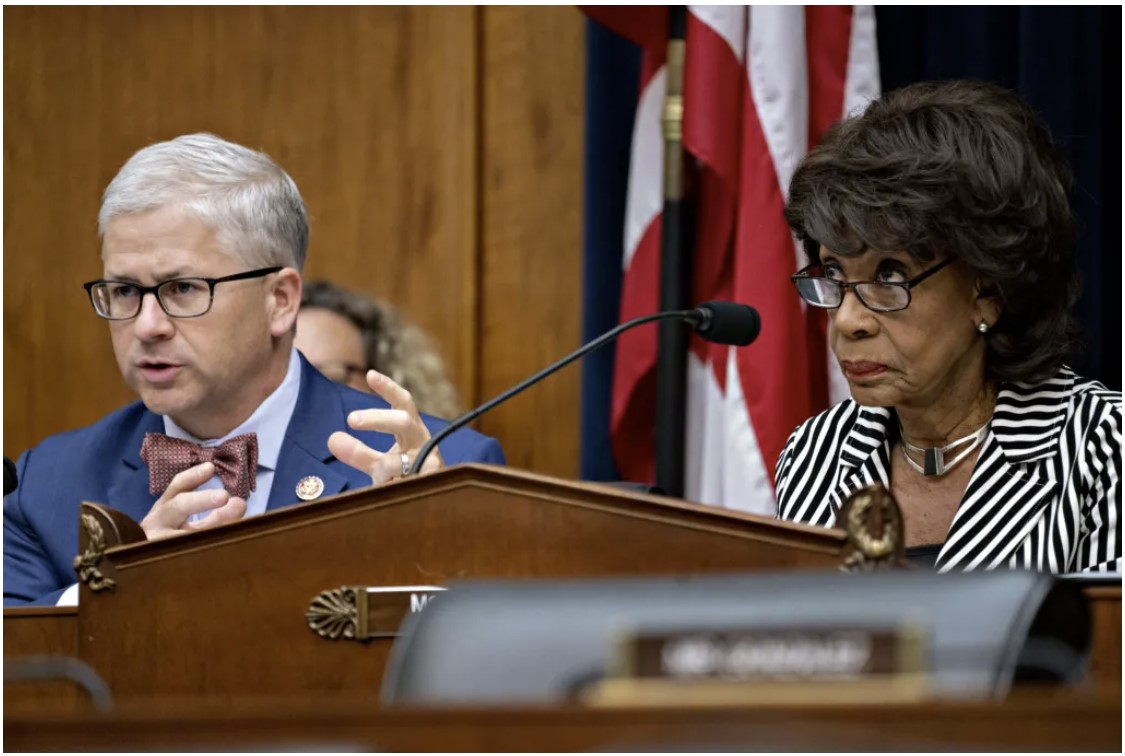
On the solidly pro-crypto side, Dante Disparte, Austin Campbell, and Jake Chervinsky are strong proponents of blockchain technology and stablecoin usage. All have strong connections to crypto and are likely to support the continued use of stablecoins in the U.S. They're joined by Patrick McHenry, the current Financial Services Committee chair and another strong proponent of the crypto industry.
On the other side we have Adrienne Harris, who as the superintendent of the New York DFS, is one of the most powerful regulators in the crypto industry. While SEC chairman Gary Gensler gets most of the press regarding crypto regulation (or at least crypto lawsuits), Ms. Harris has long been active in actually regulating the industry through the New York DFS BitLicense. While she isn’t necessarily against crypto, she has a long history working in the fintech industry and enforcing stringent regulations.
One interesting note: Ms. Harris is the one who choreographed the closure of Signature Bank and its subsequent turnover to the FDIC. That closure has been questioned as a direct attack on crypto-friendly banks, and the Blockchain Association has filed a number of Freedom of Information Act requests to the NYDFS, looking for potential clues that the closures may have been motivated by the desire to de-bank the crypto industry.
Perhaps right in the middle of the discussion is Delicia Reynolds Hand, whose role at Consumer Reports not only favors regulation, but also focuses on financial inclusion. She has been a proponent of innovative financial technologies in the past, understanding they're likely key to revolutionizing the financial industry and bringing financial fairness and freedom to all.
|  | |
|
Representative Patrick McHenry (R - NC) discussing the stablecoin regulation bill back in October. Image via American Banker.
What’s in the Bill?
There's a lot in the bill as you might guess from its length. After several pages of definitions, the bill begins on page 8 in section 102 with the “Requirement to be a Payment Stablecoin Issuer.”
The first section of the bill makes it illegal to issue a payment stablecoin in the U.S. unless the entity complies with the rules laid out later in the bill. It goes on to specify a criminal penalty for doing so, which is set at fines of up to $1 million or imprisonment for up to five years (or both).
It then goes on to specify what payment stablecoins are allowed. Specifically, there are two types of payment stablecoin issuers that will be allowed under the bill:
- A subsidiary of an insured depository institution that has been approved to issue payment stablecoins, or
- A licensed nonbank entity.
In both cases, the application process is the same. After the application is filed and notice given to the public, the regulatory board will say if the application is complete within 45 days, and rule on the acceptance or denial of the application within 90 days. If no ruling is made within 90 days, the application is approved by default.
Given what we already know about the speed (or lack thereof) in regulatory agencies, I believe some adjustments will be made to these timeframes.
There are several factors highlighted for the decision-making process like:
- The ability of the entity to maintain 1:1 reserves backing the payment stablecoin;
- The financial resources, managerial or technical expertise, and governance of the applicant;
- The expected benefit to the public of the proposed stablecoin;
- The stability of the U.S. financial system;
- The needs of the user community;
- The issuer’s plans for financial inclusion.
It should be noted the reserve requirements are limited to holdings of U.S. fiat currency, Treasury bills with a maturity of 90 days or less (or certain repurchase agreements), or central bank reserve deposits. These are all acceptable stable assets to help ensure the financial stability of the issuer.
I'm not sure how stablecoin issuers can ensure the “stability of the U.S. financial system,” but I presume the bill is asking issuers not to take down the government. I understand the inclusion of this requirement, but it seems as if it could be used to block non-bank entities from gaining approval to issue their stablecoins.
I also found it interesting that financial inclusion was added as a requirement. It's a worthy objective however, and I’m happy to see it be part of the bill.
Regulation of Stablecoin Issuers
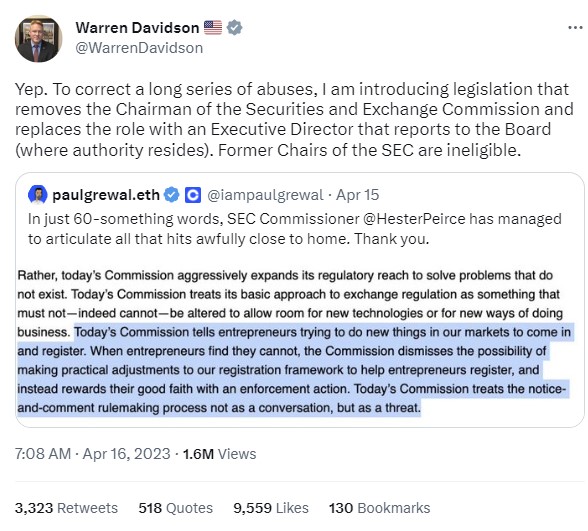
The regulation of stablecoin issuers is one of the most important parts of this bill. The industry has long needed the clarity that regulation brings. The current scenario, where the SEC has basically been claiming de facto rights to regulate the blockchain industry, has been unsatisfactory at best. It’s gotten so bad that U.S. Representative Warren Davidson is proposing legislation that would remove Gensler from his position as the chairman of the SEC.
"To correct a long series of abuses, I am introducing legislation that removes the Chairman of the Securities and Exchange Commission and replaces the role with an Executive Director that reports to the Board (where authority resides)," Davidson tweeted.
| |
|
Via Twitter
Representative Davidson’s tweet comes just two days after SEC chairman Gensler amended a proposed rule to bring crypto exchanges and DeFi platforms under the SEC’s regulatory framework, requiring them to register with the regulator.
Since then, Gensler has gone even further, charging Bittrex with operating an unregistered exchange, broker, and clearing agency. I believe the move oversteps the boundaries of SEC oversight given the rule change is still only proposed. Also, the SEC tried to amend this rule back in April 2022 (almost exactly a year ago) and faced massive backlash including the claim that such regulation was unconstitutional. But I digress...
The House bill kicks off the regulatory section by saying, “The appropriate Federal payment stablecoin regulator may issue orders and the Federal payment stablecoin regulators shall issue regulations as may be necessary to administer and carry out this section, including to establish conditions, and to prevent evasions thereof.”
Note that it does not specify what agency will be responsible for regulation. A bit later, it refers to regulators in the plural, indicating there could be more than one agency involved in stablecoin regulation. Indeed, as you get further into the bill, it becomes clear regulation will come from multiple agencies. It does give us a timeline, however, stating regulations for the stablecoin industry must be published no more than 180 days after the enactment of the bill into law.
Included in the section are requirements for stablecoin issuers to keep the ruling board informed regarding its financial condition, systems for monitoring and controlling risk, and its compliance to existing rules and regulations. It also allows the board to conduct investigations to determine the risks, safety, and stability of non-bank entities.
It also specifies that such non-bank entities will be considered financial institutions for the purposes of title V of the Gramm-Leach-Bliley Act. This act, in the words of the FTC, “requires financial institutions – companies that offer consumers financial products or services like loans, financial or investment advice, or insurance – to explain their information-sharing practices to customers and to safeguard sensitive data.”
The section also requires any stablecoin regulator to consult with FINCEN regarding the application of the Bank Secrecy Act to any proposed regulation, and to consult with the States “regarding licensing and consumer protection matters.”
All this seems standard, but the missing element is who will be the regulating agencies? Will it be the SEC, the CFTC, or some completely new agency?
| |
|
The good news is the bill includes a requirement for regulatory requirements to be tailored to the unique differences seen in the stablecoin industry when compared with existing financial entities. That would go a long way in reining in the SEC’s definition of crypto as securities as a new framework would have to be developed.
Reserves
Considering recent bank failures (including those from 2007-2008), it makes sense that the bill defines reserve requirements. The composition of the reserves was detailed above, and this section reiterates those requirements. It also prohibits the stablecoin issuer from reusing those funds with the exception of creating liquidity.
It will require stablecoin issuers to publish monthly attestations of their reserves much in the way Circle already does here. It also requires the issuers to create redemption processes that detail the timely redemptions of any outstanding stablecoins. It also specifies limitations on activities by stablecoin issuers as such:
- Issue payment stablecoins
- Redeem payment stablecoins
- Manage related reserves (including purchasing and holding reserve assets)
- Provide custodial or safekeeping services for payment stablecoins or private keys of payment stablecoins
- Undertake other limited functions that directly support the work of issuing and redeeming payment stablecoins
Also, it restricts mergers and acquisitions to those approved by the stablecoin regulator and specifies the application process. It allows for an exemption to this restriction in the case where immediate action is required to prevent the failure of a stablecoin issuer or the probable failure of the insured depositary institution of the stablecoin issuer.
Rules to carry out this restriction will be made by the stablecoin regulator and should follow the established process currently used in evaluating and approving any change of control for an insured depository institution. So, basically, they'll use existing banking regulations to create rules around mergers and acquisitions.
Some Loose Guidelines
The bill goes on to provide loose requirements regarding liquidity, risk management, capital requirements, customer protection, and fund segregation. Basically, they all defer to the (presently unnamed) regulator in creating such rules.
It’s worth noting the bill provides an exception to its segregation and commingling customer protections. That exception applies to hardware and software that facilitates custody or safekeeping of stablecoins or private keys. In essence, this protects wallet providers (whether software or hardware-based) from coming under this legal and regulatory framework.
| |
Access to the Federal Reserve
Part of the bill is dedicated to the Federal Reserve programs and services that would be available to stablecoin issuers.
It gives the issuers access to the same discount and borrowing privileges banks enjoy. It also allows for yield to be earned on deposits with the Federal Reserve. All this would give stablecoin issuers unprecedented access to liquidity and could have major impacts on the overall DeFi landscape.
Of course, with greater privileges also come greater responsibilities. Stablecoin issuers would be held accountable to the Bank Holding Company Act of 1956, the Bank Secrecy Act, and the USA PATRIOT Act.
A downside in the bill is stablecoins wouldn't be included in the FDIC insurance program, nor would they be backed by the full faith and credit of the U.S. government, guaranteed by the U.S. government, or subject to share insurance by the National Credit Union Administration. All this must be clearly communicated by the stablecoin issuers to the public.
Enforcement
Obviously, there's enforcement for all these regulations, which boils down to the stablecoin issuers' licenses being suspended or revoked. Regulators would also be able to remove any officer of a stablecoin issuer if they violate existing statutes. This is to keep criminal activity from the C-suite of any stablecoin issuer.
The enforcement process is similar to what's already in place at the SEC:
Notice – This includes the facts around the alleged violation and a time and place for a hearing to be held within 30 days from the issuance of the notice.
Hearing – To establish the facts of the case and allow the stablecoin issuer the chance to provide a defense.
Decision – To be handed down within 90 days of the hearing.
Of course, cases aren't necessarily finished after the decisions, as the bill will allow for appeals processes beginning with the appropriate court of appeals jurisdiction and going all the way up to the Supreme Court.
The section also allows for temporary cease-and-desist orders, which would specify the activities that need to halt while allowing stablecoin issuers to continue operating.
The civil penalty for violating regulations or for failing to be approved or licensed is set at up to $100,000 per day. Such penalties will be served and collected by the stablecoin regulator(s).
Stablecoin issuers can request hearings to defend against the alleged violations, but any findings and penalties from such hearings don't have appeal processes. The bill also puts a statute of limitations of six years on bringing a suit forward for any violations.
Interoperability Standards
This short section indicates that several federal and state organizations may prescribe standards for interoperability and compatibility between stablecoin payment systems or with other payment systems. I presume they're referring to either the SWIFT system or any future CBDC system.
Algorithmic Stablecoin Moratorium
Presumably, lawmakers remember the implosion of the algorithmic stablecoin UST, and they're looking to protect against a repeat. The bill places a two-year moratorium on the creation or issuance of “an endogenously collateralized stablecoin not in existence on the date of enactment of this Act.”
Translation: No more algorithmic stablecoins. Only fully-collateralized stablecoins will be allowed.
During the moratorium, the Treasury Department, in consultation with the stablecoin board and the SEC, will carry out a study of such stablecoins. It's tasked with reporting these findings within a year of the enactment of this bill:
- the categories of non-payment stablecoins, including the benefits and risks of technological design features
- the participants in non-payment stablecoin arrangements
- utilization and potential utilization of non-payment stablecoins
- nature of reserve compositions
- types of algorithms being employed
- governance structure (including aspects of decentralization)
- nature of public promotion and advertising
- clarity and availability of consumer notices disclosures
|  | |
Creation of a CBDC
Notably, the bill concludes with a section requiring research into the creation of a central bank digital currency (CBDC). This joint study will be carried out by the Board of Governors of the Federal Reserve, FINCEN, and any organizations deemed to be stablecoin regulators. The study is tasked with looking into the following 11 potential impacts of creating and issuing a CBDC in the U.S.:
- the potential impact on the Board of Governor’s monetary policy tools and decision-making
- the potential impact to the U.S. financial system and banking sector including implications for financial stability
- the potential impact to the U.S. payments and cross-border payments ecosystems
- a comparison to the FedNow service
- the potential impact to the privacy rights and civil liberties of Americans
- the potential impact to the stablecoin market including any impact on competition, innovation, and interoperability between other digital assets and payments systems
- the potential impact on compliance with existing law and regulations related to the Bank Secrecy Act (as defined under section 101), other federal anti-money laundering laws, sanctions, fraud, and other financial crime
- the potential impact on the efficacy of U.S. economic sanctions programs and the status of the U.S. dollar as a reserve currency
- the potential impact on financial inclusion, in particular for unbanked and underbanked residents of the U.S.
- the potential impact of a failure to act or act swiftly given the speed at which other nations are engaging on this topic
- the potential impact of engagement by the U.S. in global forums like international organizations or through international financial institutions on the central bank digital currency issue, on issues including technical, legal, and ethical standards that may be applied to the development, use, and interoperability of central bank digital currencies and their technology, whether domestic or international.
It’s quite a list! I was particularly taken by #10, which should be included in nearly every aspect of the blockchain and crypto ecosystems, where the U.S. seems to be woefully behind other leading nations.
The report on this study is to be delivered no later than 365 days after the act's enactment. Also, within 180 days of the enactment, the Treasury Secretary is to report on the development of international standards related to CBDCs. Both reports will be delivered to the Committee on Financial Services of the House of Representatives and the Committee on Banking, Housing, and Urban Affairs in the Senate.
Investor Takeaway
If the bill can get passed into law quickly, the U.S. may not fall behind the rest of the world, but when the bill was last circulated in September, it faced massive opposition from democrats, the Biden administration, and Federal Reserve officials. Objections ranged from how the bill handled digital wallets to potential risks to the global financial system. Given the recent handling of crypto in the (mostly negative) Economic Report of the President, expect a spirited debate.
The debate around this bill matters a lot. If the bill passes, stablecoins become part of the global financial system. That opens the door to the rest of crypto, DeFi, and Web3. If the bill gets gridlocked, expect the crypto winter to continue.
Hopefully lawmakers can find common ground this time...
| |
Health, wealth, and happiness,
Steve Walters
BMJ Market Analyst
| | |
|
ICYMI
In Case You Missed It
| | |
|
Share This Meme
Copy, paste, and post
| |
Share the Love
Grow our crypto investing community.
| |
Bitcoin Market Journal is a daily newsletter that makes you a better crypto investor. It's created by John Hargrave, Nick Marinoff, Steve Walters, Anatol Antonovici, Matthew Du, Daniel Joel, and Preetam Kaushik.
Both free and Premium subscribers get content to build them into better investors.
| | | | |