A note from the road, the clinic, and the heart of our community | |
Welcome to Developmental FX Learning Journeys' Insights newsletter, designed especially for clinicians. We are so happy you are here, in a space where like-minded colleagues can learn from one another’s insights and
collectively elevate our important work. | |
Reflections from Tracy...
What’s in a Word?
Integration. Integrative.
Words matter.
Not simply because of their definitions, but because of the worlds they create around them.
| | | In occupational therapy, few words have carried as much meaning, impact, debate, and evolution as the words sensory integration. For decades, these words have helped us understand children whose experiences, actions, emotions, and participation did not fit neatly into behavioral explanations alone. Dr. A. Jean Ayres gave us a profound framework for understanding how the nervous system organizes sensation for use in everyday life. | | Yet perhaps one of the unintended consequences of language is that over time, the word sensory has become commonplace and yet no longer carries the depth of meaning that Ayres originally intended. | | Indeed, in many spaces, the word itself has become both ubiquitous and oddly diluted. | | Today, “sensory” is everywhere: sensory bins, sensory corners, sensory breaks, sensory toys, sensory friendly, sensory rooms. | | In some ways, this widespread language has opened important doors. Families, educators, and communities are more aware that nervous systems matter. More children are being understood with greater compassion and curiosity. The word sensory has helped many people move beyond shame and blame. That matters deeply. And yet, there is also a paradox. | | |
As the word has become more common, it has often become less precise.
Too often, “sensory” has become shorthand for dysregulation, preference, stimulation, distraction, or behavior management rather than a thoughtful understanding of neurodevelopment, adaptive functioning, and nervous system organization. Interventions can become disconnected from the very neuroscience that should ground our clinical reasoning and treatment planning.
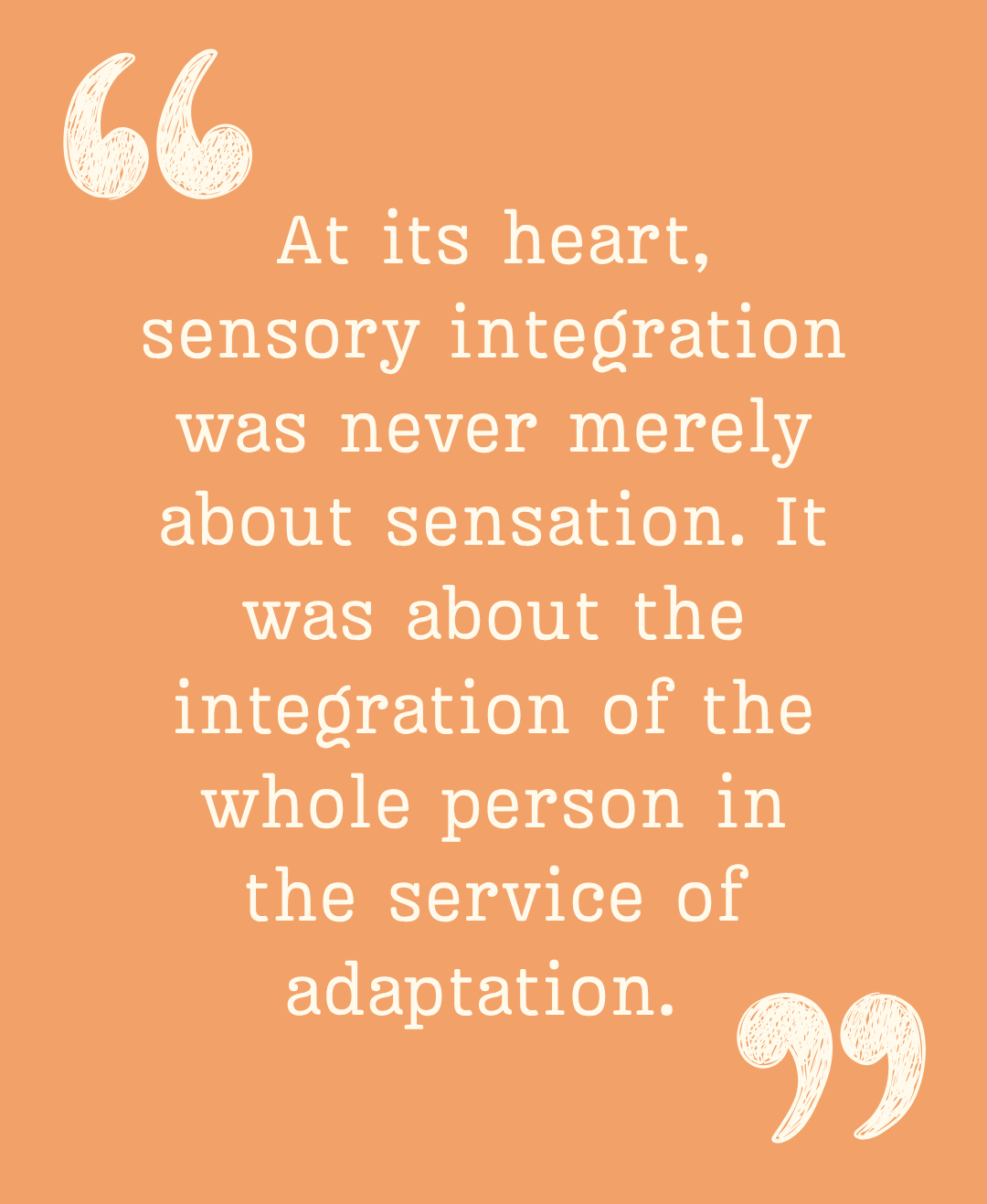
| | At its heart, sensory integration was never merely about sensation. It was about the integration of the whole person in the service of adaptation. It was about how sensation supports movement, emotion, relationship, participation, and the development of adaptive capacities within real-life experiences. Because sensory integration was never meant to be reduced to activities, tools, or inputs alone. Ayres’ work was always far more expansive, from an integrated center. | | | | |
Integration itself is a powerful word.
To integrate means:
- to bring parts into relationship
- to organize for function
- to connect systems in meaningful ways
- to create coherence from complexity
Human development is integrative by nature:
- Sensation integrates with affect.
- Affect integrates with movement.
- Movement integrates with intention.
- Experience integrates with meaning.
- Relationship integrates with regulation.
None of these occur in isolation.
| | |
This is one reason I have increasingly been using and encouraging the use of the phrase sensory integrative processing in my teaching, writing, and advocacy. Not to replace Ayres Sensory Integration®, but to deepen our understanding of the ongoing dynamic integrative processes involved in adaptation.
The word integrative shifts us toward the dynamic nature of what is really happening. It reminds us that integration is not a static achievement or a fixed trait within a child. It is an ongoing, state-dependent, relational, embodied process shaped by context, experience, neurobiology, and participation.
When we think integratively, we move beyond asking, “What sensory system is involved?” And instead begin asking, “How are sensory, affective, motor, relational, and environmental experiences being organized for the purpose of adaptation?”
My ‘trademark’ question lands this thinking - for the purpose of what?
- Protection?
- Connection?
- Exploration?
- Participation?
- Belonging?
- …?
Perhaps this is where the enduring brilliance of Ayres still guides us. She did not simply study sensation. She studied adaptive action and human capacity. She studied how human beings organize themselves through experience to engage with the world.
Her legacy feels profoundly relevant today. Especially as neuroscience increasingly confirms what clinicians, families, and individuals have always known: human functioning is complex, embodied, relational, emotional, contextual, and deeply integrative.
Words shape worlds. I’m grateful for this community wherein we continue to explore them together.
| | |
Warmly, and in reflection,
Tracy
| | This month in the Learning Journeys Community... | | This month we are sharing a mini-lecture from Tracy on sensory integration and sensory integrative processing, with an invitation for collaboration as we continue to develop thinking in this field. We will also be sharing a recorded SpIRiT© case processing that will allow us to have our live call this month focus on processing through the STEPPSI©! You can join us live on May 28th at 2pm MT (find your time here), or catch the recording the following week in the community. | | | |  |
Live LJ Community Events: Spring/Summer 2026
- May 28: Case processing -STEPPSI
- June 25: Community Forum
LJ Community Forums are
at 2:00pm MT
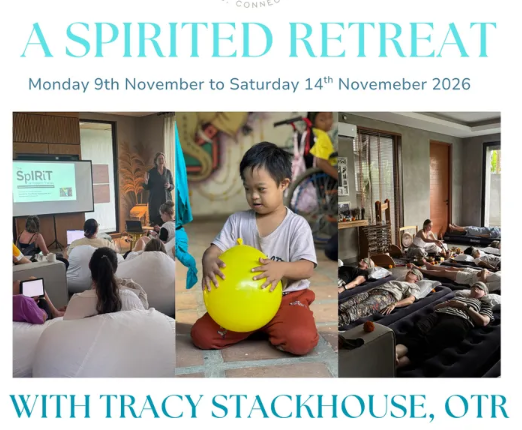
| | | In November 2026, CPD Retreats is hosting Tracy for a second time as she leads “A Spirited Retreat” - an immersive learning experience in Bali, Indonesia focused on the SpIRiT© model. Retreat participants will take the online SpIRiT course and then join together for a week of in-person, in-depth application of the tool in small groups. We are frequently asked for more opportunities to learn how to use the SpIRiT in practice, and this is an incredible opportunity to do just that! The retreat is appropriate for learners of all levels that are looking to deepen their practice, but spots are limited. Learn more here. | | |
DFX Learning Journeys Opportunities:
-
A SpIRiT cohort will be launching in Fall 2026 - this is an opportunity to pace your learning with a group of colleagues and have live meetings with Tracy and the Learning Journeys team to consolidate learning. We’ll keep you posted here when we announce dates!
-
If you have a group that would like to set up a private cohort for either the STEPPSSI or SpIRiT, reach out to us at learningjourneys@developmentalfx.org!
Other Ways to Join Us:
-
On October 2nd, JFK Partners is hosting an annual conference tailored for clinicians, school personnel, community providers, and parents. Tracy will be the keynote speaker at the Autism Spectrum Disorder Conference. Check the JFK Partners Education Page for the specific 2026 event dates.
-
On October 25th, Tracy will share an intro the Sensory-Affective-Motor (SAM) capacities that support a deep understanding of individual differences related to the DIR Floortime model at the ICDL International DIRFloortime® Conference - an online event - check it out here.
-
Earn your Polyvagal-Informed Certificate in this in-depth exploration of the Polyvagal Theory and its applications to our personal and professional lives.
| | | | |