A note from the road, the clinic, and the heart of our community | |
Welcome to Developmental FX Learning Journeys' Insights newsletter, designed especially for clinicians. We are so happy you are here, in a space where like-minded colleagues can learn from one another’s insights and
collectively elevate our important work. | This fall, DFX Learning Journeys is introducing a new way to learn the SpIRiT© with our Study Group model. Scroll down for more information! | | August 2026: FROM SENSATION TO MOVEMENT AND BACK AGAIN | | Kapp invites us to shift the center of gravity in how we understand autism. Instead of beginning only with visible social-communication differences, we can become curious about the sensory and movement differences that may be present from the earliest moments of life and how they shape development over time. | | |
What a person can show us is not always the same as what they know, understand, intend, or feel. Looking, reaching, grasping, gesturing, speaking, imitating, starting, stopping, and shifting all require movement. And movement depends on sensory information.
When this process is effortful or unpredictable, a person’s intention can become harder for others to recognize.
-
A child may turn away in order to listen.
- Speech may become unavailable even when language and inner experience remain.
-
A delayed response may reflect the time needed to take in sensation and prepare an action—not a lack of interest, understanding, or capacity.
When we look through this lens, behaviors that once seemed confusing may begin to make sense. A skill may be present but inaccessible under current sensory, motor, emotional, relational, or environmental conditions. Instead of asking, “Why won’t this person do what they know how to do?” we might pause and wonder:
- What is their sensory system working to take in and organize right now?
- What is their nervous system managing?
- How much conscious effort is this action requiring?
- What is the environment asking of them?
- Could their intention be expressed in a way we have not yet learned to recognize?
| | |
This pause to look beneath what is immediately observable, question our assumptions, and consider theory-informed possibilities is the heart of clinical reasoning. It allows us to ask what may be shaping what we are seeing and what support might make a meaningful difference.
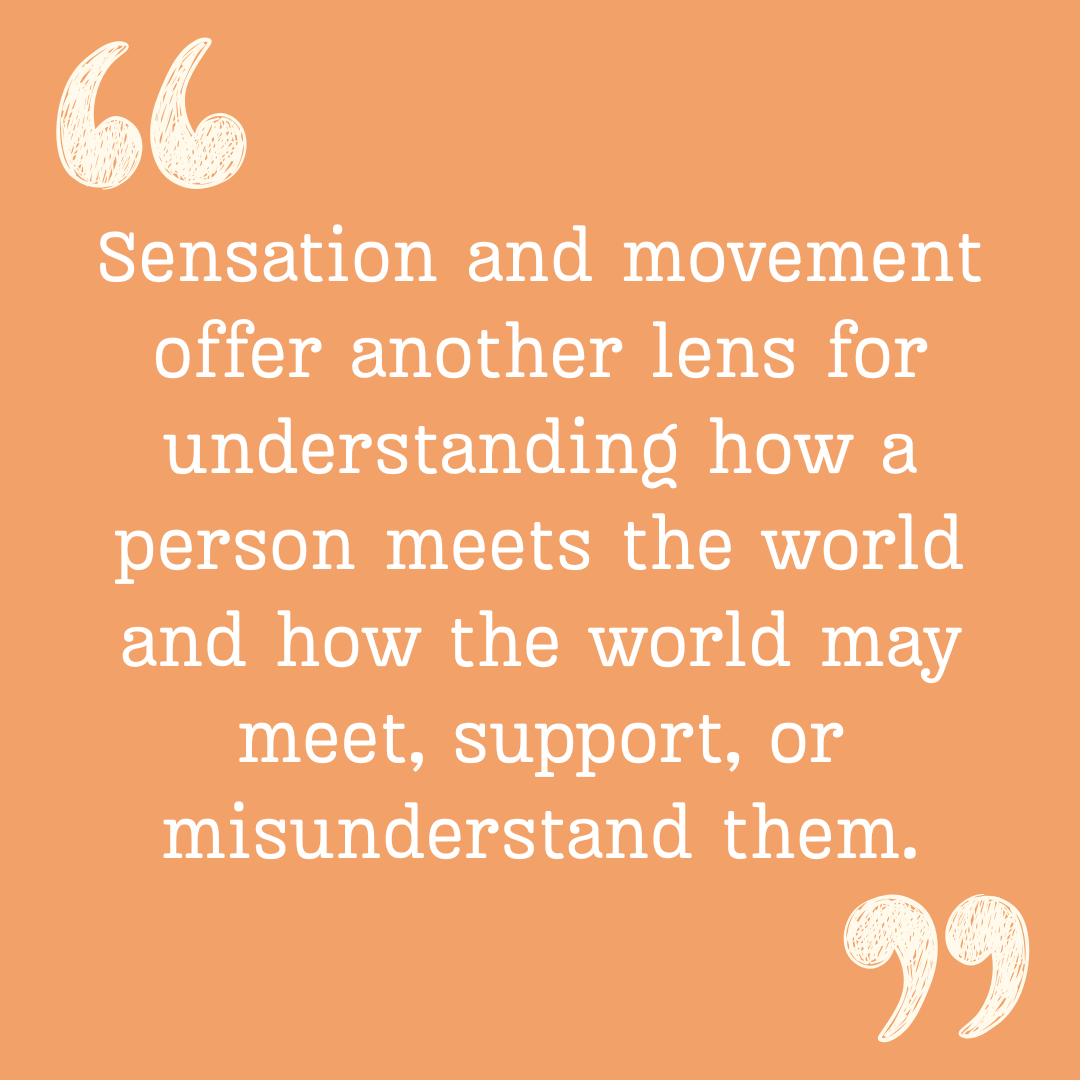
This way of clinical reasoning does not reduce autism to sensation and movement. Affect, relationship, context, culture, meaning, and occupation remain essential. Sensation and movement offer another lens for understanding how a person meets the world and how the world may meet, support, or misunderstand them.
Perhaps the question is not simply, “Can this person do it?” Perhaps it is:
“What sensory, motor, relational, and environmental conditions will help this person feel supported enough to show us more fully who they are, what they know, and what they intend?”
| | |
Warmly, and in reflection,
Tracy
| | This month in the Learning Journeys Community... | | We will be gathering together this month for a live discussion, on August 27th at 2pm MT (find your time here). All community members can watch the recording of our live sessions when it is posted the following week. That means if you join now, you’ll have access to an entire year’s worth of live forum recordings! | | | |  |
Live LJ Community Events: Fall 2026
-
Live Discussions will occur on September 24th, September 27th, October 22nd, and November 19th
LJ Live Discussions are
at 2:00pm MT
| | | |
Our most frequent request has been for more opportunities to see video cases and walk through the SpIRiT clinical reasoning tool, so we have added more of these to this learning experience. If you sign up now for the self-paced course, you will also get access to:
-
The Learning Journeys Community, through the end of the year, which includes a year’s worth of case processing and forum discussion recordings;
-
A private discussion board in the community that will be actively moderated by the Learning Journeys team to respond to questions as you progress through the course; and
-
TWO live case processing opportunities facilitated by Tracy Stackhouse! We will watch a video case and then see the entire SpIRiT clinical reasoning process in action.
*If you have already taken courses with us, you are eligible for a discount - email us at learningjourneys@developmentalfx.org to learn more!
| |
DFX Learning Journeys Opportunities: | | Self-paced versions of the SpIRiT© and STEPPSI© are always available to support your learning. | | If you have a group that would like to set up a private cohort (5+ people) to work through either the SpIRiT© or STEPPSI© courses, reach out to us at learningjourneys@developmentalfx.org!
| | |
Other Ways to Join Us:
-
In September, the Learning Journeys team of Tracy Stackhouse, Kelsey Forbringer, and Hannah Burke will be hosted by Diepistimoniko Kentro Ipeirou in Athens, Greece, where they will teach the third and final module of “SIP Therapy That Fits: A Developmental Approach to Sensory Integrative Processing”.
-
Also in September you can catch Tracy in Spain at the 2026 PVI International Gathering - she will be presenting at the post-conference workshop day for clinicians about “Sensory Integrative Interventions: Portals to Possibility.”
-
On October 2nd Tracy will be giving the keynote address at the 2026 JFK Partners Autism Conference in Aurora, Colorado.
-
ICDL’s 2026 International DIRFloortime® Conference is live online October 18 - 27. You can catch Tracy’s introduction to S-A-M (sensory-affect-motor) on October 25. This is a great place to start if you haven’t yet taken the SpIRiT© course, as SAM is the foundation of this clinical reasoning tool!
-
Mind 2 Mind Courses is hosting Tracy in Sydney, Australia - join Tracy for a two day course (October 30-31) focused on praxis, “Sensory Integrative Processing Treatment Approaches for Praxis Capacities: From Sensory DIscrimination to Skillfullness.”
-
In November 2026, CPD Retreats is hosting Tracy for a second time as she leads “A Spirited Retreat” - an immersive learning experience in Bali, Indonesia focused on the SpIRiT© model. Retreat participants will take the online SpIRiT course and then join together for a week of in-person, in-depth application of the tool in small groups. We are frequently asked for more opportunities to learn how to use the SpIRiT in practice, and this is an incredible opportunity to do just that! The retreat is appropriate for learners of all levels that are looking to deepen their practice, but spots are limited. Learn more here.
| | |
Curious about integrating your pediatric practice with current neuroscience?
Join the Learning Journeys Community to engage and learn!
| | | | |