Visual 1st Perspectives


January 7, 2026


Instagram’s Adam Mosseri: 
Authenticity Is Becoming Infinitely Reproducible


And what does this mean for all of us?


When Adam Mosseri speaks, it is worth paying attention – even when delivered via an at-times confusing epistle ("Looking forward to 2026, one significant interesting is that authenticity is becoming infinitely reproducible") that captured headlines on the final day of 2025.


Recall Mosseri’s 2021 proclamation that Instagram was no longer a photosharing app, followed by his "doubling down on video" missive, and a pivot from follower-based Instagram feeds to AI-recommended content designed to maximize watch time, much like TikTok’s For You Page?


Despite intense backlash from the community at that time – including celebrities like Kim Kardashian who urged Meta to "Make Instagram Instagram Again"– Mosseri and his team forged ahead. The result? Reels, a video module with negligible revenue in 2021, reached a $50 billion annual revenue run rate last year – surpassing the annual revenues of YouTube, TikTok, and even global giants like Coca-Cola and Nike.


Last week Mosseri shared his perspective on the challenges posed by hyper-realistic GenAI, admitting that “there will be much more content created by AI than captured by traditional means in a few years time.” For 2026, he expects a fundamental shift in user behavior: a move from "default belief" to "default skepticism" when viewing online content.

Photo: Meta


Breaking down his thinking

(To improve readability I use the term “image” rather than “image and/or video”)


“Just as AI makes polish cheap, phone cameras have made professional-looking images ubiquitous – both trends cheapen the aesthetic.”

Smartphone cameras democratized professional imagery, and GenAI is now accelerating that trend; together, they “cheapen the aesthetic”. The traditional Instagram aesthetic of polished feeds (“lots of make up, skin smoothing, high contrast photography, beautiful landscapes”) “is dead”. Even portrait mode, which artificially blurs backgrounds to mimic the shallow depth of field of a fixed lens, has become commonplace. “It looks good, and we like to look good,” says Mosseri.


“But flattering images are cheap to produce and boring to consume. People want content that feels real.”

We are entering an era of the "raw aesthetic". Savvy creators are leaning into unproduced, explicitly unflattering imagery. In a world of digital perfection, imperfection serves as a vital signal. Rawness is no longer just a stylistic choice – it is a defensive way of signaling: this is real because it is imperfect.


However, GenAI is evolving rapidly “to create any aesthetic you like, including an imperfect one that presents as authentic”.

“Authenticity is fast becoming a scarce resource, which will in turn drive more demand for creator content, not less.”

Successful creators will be those who maintain their essence regardless of the technology they adopt. The barrier to entry has shifted: the question is no longer "can you create?" but rather "can you make something that only you could create?".


Mosseri's Solution: “Shift our focus to who says something instead of what is being said.”

Social media platforms face increasing pressure to identify and label AI-generated content. “We, as an industry, are going to need to surface much more context about not only the media on our platforms, but the accounts that are sharing it in order for people to be able to make informed decisions about what to believe”.


You’re confused too? What is it?

  • We want to view images that look good vs. we prefer images to be raw and imperfect?
  • Image authenticity is infinitely reproducible vs. image authenticity is becoming scarce?
  • Image imperfection proves the visual is authentic vs. GenAI could also create imperfect images?
  • To serve creators, Instagram must build "the best creative tools, AI-driven and traditional" vs. creators compete with content created by AI tools?

Photo: Mikkel Aaland


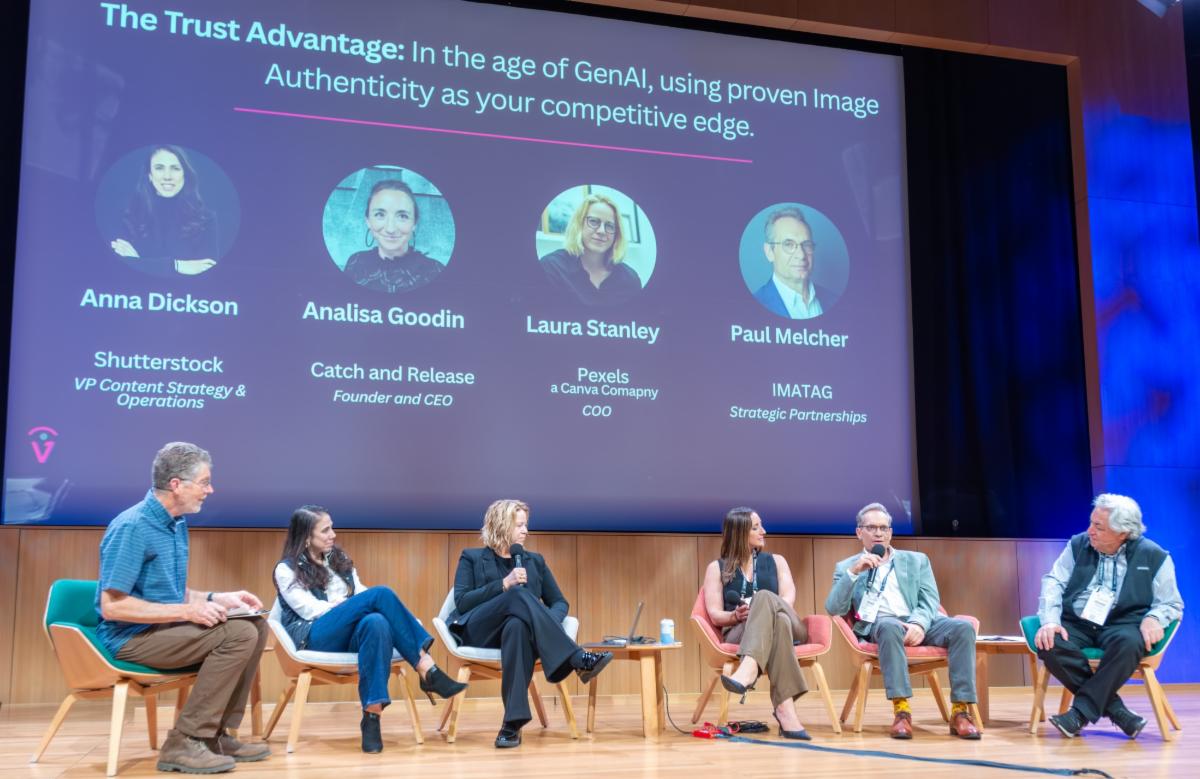
The cause of this confusion? The concept of “authentic imagery” carries multiple meanings, as the esteemed speakers in our The Trust Advantage panel at Visual 1st emphasized.


"Authentic imagery" could mean images that ...:


  • Are camera-captured rather than AI-generated.
  • Provide a truthful display of reality (so you don’t show 2 pyramids closer to each other than they are in reality).
  • Show aesthetics that are not overly polished, smooth or flattering.
  • Display real-looking people in real-looking situations (rather than posed stock photos).
  • Provide verifiable provenance: the viewer can check who generated or edited the image.


Determining whether an image is authentic, or how we could safeguard authentic images, or how we respond to the avalanche of AI-generated imagery all depends on which meaning of authentic imagery you had in mind.


My take


Embedding provenance data is important but certainly not enough: Simply identifying how an image was generated or tying it to the creator’s social graph – which BTW happens to be in the hands of Meta for most of us – is not the panacea for all the ills we associate with he avalanche of inauthentic imagery.


The good news: True creativity will continue to thrive. Ultimately, GenAI is no match for true creativity. Much like fine dining has thrived despite the ubiquity of fast food, talented photographers and artists will continue to find new ways to express themselves. They navigated the transition to digital and smartphone cameras, and they will continue to define the aesthetics in our new GenAI era.


Happy New Year!


Hans Hartman


And a few more things...


Captura & Studio Source. Acquisition. High-volume photography platform provider Captura announced its acquisition of Studio Source Yearbooks (SSY), a provider of studio support, yearbook production guidance, and operational execution. By combining Captura’s technology with Studio Source’s operational experience, the goal is to provide studios with a more connected and streamlined way to manage their yearbooks, from setup through delivery.


xAI. Grok going NSFW. "Moving fast and breaking things" is not really the strategy to follow when it involves non-consensual imagery. Over the last week, Elon Musk’s xAI Grok chat bot has been under fire for allowing X users to "digitally undress" people, flooding the platform with sexualized, deepfake imagery of women, children, and even world leaders.

While X scrambled on Saturday to ban the generation of sexualized images of minors, a report from Axios yesterday suggests the guardrails are still more like a suggestion – users are still successfully pumping out suggestive "bikini" edits. Musk, meanwhile, seems more focused on bragging about X’s record-breaking traffic than the ethics of his bot's output.


Splat. Personalized Coloring Books. Retro (the photo-sharing app built by Instagram vets) just launched Splat, an app that takes your personal photos – the trip to Paris, the kitty on the couch – and converts them into high-quality, kid-friendly line art. Your kids can color them in on your screen or you can print them out for a physical coloring book experience.


Pic-Time. AI Curation for Life’s Big Moments. Gallery platform Pic-Time has upgraded its AI-powered engine to streamline wedding and event photography. The new search capabilities allow users to scan through hundreds of files using specific prompts – ranging from physical details like "rings" and "shoes" to abstract moments like "a kiss" or "a toast."


Waldo. Offline Selfie Stations for Seamless Onboarding. Event photography platform Waldo has launched an Offline Selfie Station for iOS. Designed for remote locations with no connectivity, the station allows event organizers to register guests via a selfie upfront. Once the event is over, Waldo’s facial recognition matches those selfies to the professional gallery and delivers personalized photos directly to each attendee’s iPhone.

Mark your calendar: join us for our Photo Print Innovation Trends Visual 1st Spotlight webinar on February 25, 7:30 - 8:30 am Pacific Time (16:30 - 17:30 CET). Stay tuned for more info! Check out our previous Spotlights.


Meet me at Photo Imaging CONNECT 2026, March 1-2 in Las Vegas!

Romangic Labs. AI-powered Camera Coach. Powered by the Nano Banana Pro model, WayShot Super Camera acts as a real-time photography coach and creative director. The app provides a "dot-and-circle" alignment grid to help photographers find the perfect composition, while "Wayla," an AI creative assistant, gives voice-guided posing tips to the subject—such as, "Place your hand on your hip for a more relaxed pose."


VSCO. Bringing Video to VSCO Capture. VSCO has introduced video recording to its VSCO Capture iPhone app. The update allows users to apply over 50 of the brand’s signature presets and a new film grain function to video footage. While the feature is currently capped at 1080p and lacks the manual controls available for still photography, it offers a cohesive aesthetic for creators who want their videos to match their photo galleries.


Archive & Subscribe | Share your news with us | Connect on LinkedIn