|
Daily Transportation News
April 23, 2026
| | | Insurance Tops National Limousine Association Issues at Day on the Hill | |
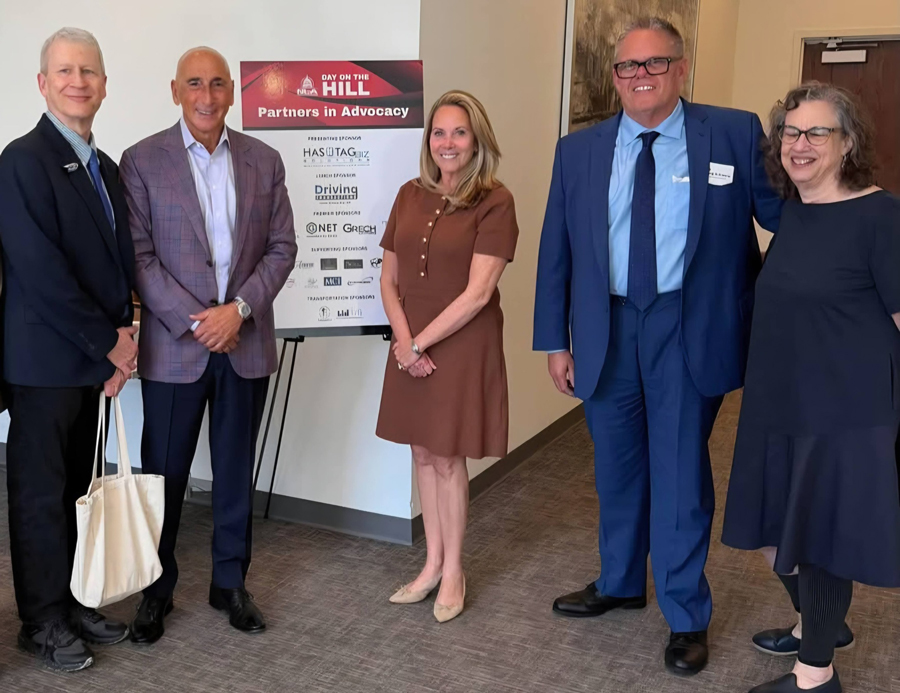
N.Y. Representative Laura Gillen (center) with (L to R) Jeff Rose of Attitude New York, NLA President Brett Barenholtz of Above All/Maine Limousine, NLA Director Doug Schwartz of Executive Transportation, and Rosina Rubin of Attitude New York | |
More than 70 members representing dozens of states convened in Washington, D.C., to speak with officials on Capitol Hill as part of the National Limousine Association’s (NLA) Day on the Hill this past April 14-15. This annual two-day event, which was also attended by CD President Chris Weiss, is the association’s flagship advocacy effort that includes members.
Day one was spent building a foundation for attendees, including examining core issues impacting the industry. Working in conjunction with its longtime lobbying firm, Cornerstone Government Affairs, the NLA identified several legislative priorities that are affecting operators nationwide to discuss during their Congressional meetings. Of course, skyrocketing insurance rates continue to be a major pain point.
Among the event’s top priorities:
Insurance, Insurance, Insurance: The NLA highlighted the crisis in affordable insurance driven by fraud, staged accidents, litigation costs, and regulatory inefficiencies, which threaten small operators’ viability despite strong safety records. The association supports the Staged Accident Fraud Prevention Act to criminalize staged crashes (especially commercial vehicles where companies have larger policies).
Passenger Safety and Industry Integrity: Concerns over sexual assaults involving TNC drivers have prompted calls for federal oversight, transparency, and safety standards. The NLA advocates for a federal framework to improve passenger safety, building on Sami’s Law to establish enforceable safety standards and accountability measures for for-hire and app-based transportation providers.
Tax Policy and Business Support: The NLA emphasized the importance of tax policies, including the No Tax on Tips policy, to aid workforce retention and recruitment, and urged the expedited issuance of clearer guidance from the IRS. Additionally, the NLA called for enhancements to Section 179 deductions, allowing small businesses to fully deduct vehicle purchases to encourage investment in safer, modern vehicles essential for industry competitiveness.
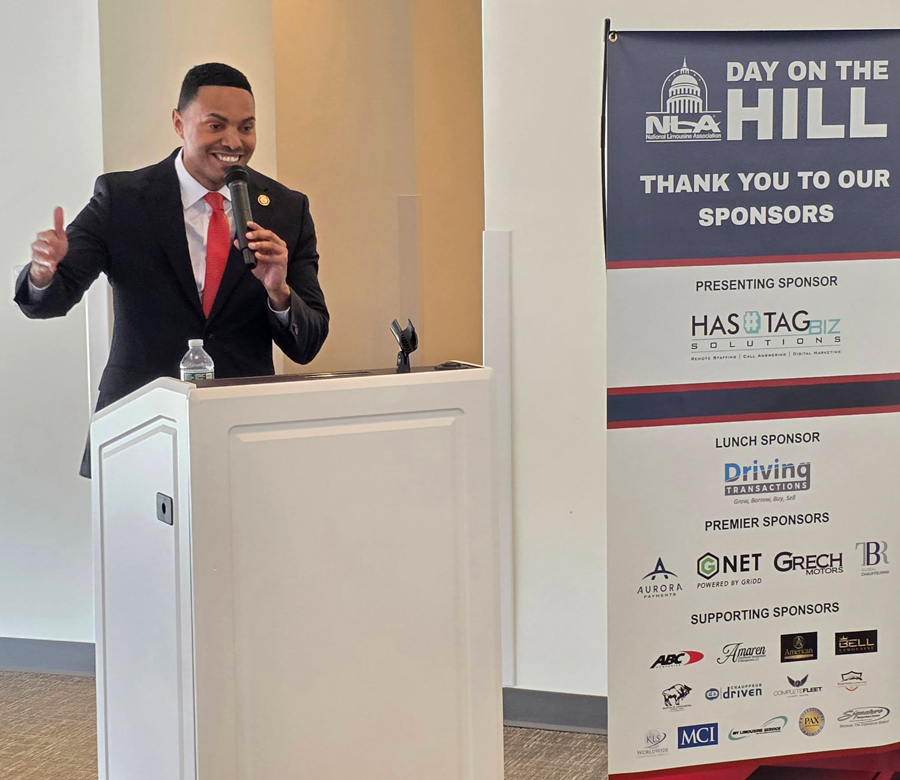
| Representative Richie Torres addressed attendees | |
Cornerstone staff also provided updates on the upcoming 2026 midterm elections—where all House representatives and 35 Senators are up for reelection or replacement—as well as the latest progress on the Tax and Surface Transportation Reauthorization Act and other political rumbles on the Hill. They also offered tips on how to lobby Congress, as the meetings were scheduled for the following day. NLA members also heard directly from Reps. Richie Torres (N.Y.-15) and Laura Gillen (N.Y.-4), who both expressed their support for the industry and listened as members voiced their concerns.
“We had the opportunity to educate lawmakers and staff on the unique role our industry plays in local economies, public safety, tourism, and business travel,” wrote NLA President Brett Barenholtz of Above All/Maine Transportation in his weekly President’s Letter. “The initial response from these meetings was very encouraging. We heard thoughtful questions, saw genuine interest, and received positive feedback on our professionalism and preparedness. Many offices expressed a willingness to continue the conversation and explore ways to support issues important to our members.”
Source: Chauffeur Driven
Click Here to Read More
| |
The NLA and the University Transportation Research Center have continued to elevate the industry’s insurance crisis through their September 2025 report, Curbing the Limousine Insurance Crisis, authored by Matt Daus. The report’s findings reinforce what operators conveyed on Capitol Hill, documenting widespread premium increases despite strong safety records and limited claims activity. Drawing on national survey data, it highlights how rising costs - driven by fraud, litigation, and regulatory inefficiencies - are placing disproportionate strain on small and mid-sized operators.
The report also outlines a comprehensive path forward, combining near-term operational strategies with longer-term regulatory and legal reforms to stabilize premiums and restore balance to the market. Its continued visibility in national and trade media reflects a coordinated effort by the NLA and its partners to translate industry concerns into actionable policy solutions, positioning the report as a roadmap for preserving the viability and competitiveness of the chauffeured transportation sector.
Click Here to Read the Full Report
| | Port Authority Cops Lean on New Surveillance Center to Catch Taxi Scammers | |
|
From a command center at JFK Airport, the Port Authority Police Department watches everyone who comes and goes through the busy terminals.
Officers monitor dozens of screens displaying camera feeds capturing the arrivals and departures areas, 24 hours a day, seven days a week. The center opened last year, and is among a number of surveillance upgrades the Port Authority is using to crack down on illegal taxi scammers who plague the airport.
The new tech in the command center include license plate readers that track every car in the airport’s footprint. The tech will soon become even more sophisticated through a $100 million Port Authority investment in an initiative called “Operation Legal Ride,” which will use artificial intelligence to help police the scammers at the airport.
Scot Pomerantz, the Port Authority Police commanding officer of JFK Airport, recently gave Gothamist a tour of the command center. Photographs were prohibited due to security concerns.
Pomerantz has been with Port Authority police for 24 years. Much of that time has been dedicated to chasing the airport hustlers.
“This isn’t something that we want here at the airport,” he said. “It’s not safe for our passengers. We take our enforcement extremely serious.”
The scammers, known as “hustlers,” have operated at New York City’s airports for decades. They coax unsuspecting tourists into unlicensed taxis — and charge them astronomical fares for their rides into the city. Gothamist reported earlier this year on a scammer who charged a married couple from Kenya $800 for a ride from JFK Airport to Midtown.
Port Authority data shows the new tech and command center has coincided with a crackdown at JFK. The police department issued 2,602 summonses for illegal taxi solicitation in 2025, nearly double the year prior.
| |
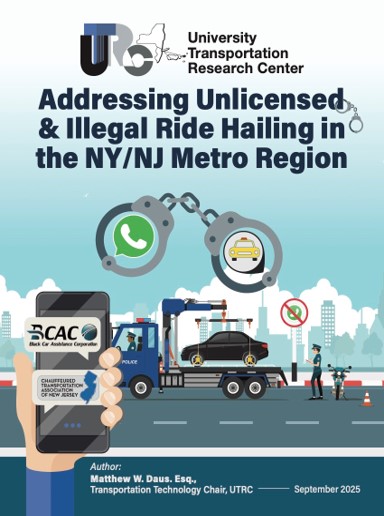
These enhanced enforcement efforts by the Port Authority align with the findings and recommendations of a recent report authored by Matt Daus at the University Transportation Research Center (UTRC), in collaboration with CTANJ and the Black Car Assistance Corporation (BCAC), titled Addressing Unlicensed and Illegal Ride Hailing in the NY/NJ Metro Region.
The report examines the persistent challenges of illegal ride-hailing and taxi solicitation in major transportation hubs like New York’s airports. The report highlights the safety risks, consumer protection concerns, and regulatory gaps that allow these operations to persist, while outlining a range of practical enforcement and policy solutions. As the Port Authority advances initiatives like “Operation Legal Ride,” it is clear that the agency is listening to these concerns and moving toward a more coordinated, technology-driven enforcement strategy.
“The Port Authority’s investment in smarter enforcement tools and data-driven strategies is a critical step in protecting passengers and supporting legitimate operators,” said Matt. “By combining strong on-the-ground enforcement with modern technology and clear regulatory frameworks, we can meaningfully reduce illegal activity and restore confidence in the airport ground transportation system.”
Source: Gothamist
Click Here to Read More
| | |
Florida Backs Vertiport Network as US eVTOL Push Accelerates
Florida has become the latest US state to back eVTOL infrastructure with public money, after Governor Ron DeSantis signed legislation allowing the Florida Department of Transportation (FDOT) to fund a network of public vertiports for advanced air mobility operations. The bill, HB 1093, was passed unanimously by both chambers of the Florida legislature before receiving the governor’s signature. Under its provisions, FDOT may fund up to 100% of project costs at public vertiports if federal funding is unavailable. Where federal funds are available, the state may cover up to 80% of the non-federal share. The measures take effect on 1 July 2026.
Click Here to Read More
Virginia Launches Cross-State Bus Service
The state-supported Tidewater Current route links 10 cities from Virginia Beach to Harrisonburg, with a stop at Richmond International Airport.
Click Here to Read More
Why a July 4 of Soccer, Sailors and Swift Already Has New York Officials on Edge
New York Gov. Kathy Hochul and New York City Mayor Zohran Mamdani are both trying to get their arms around a summer of major events that were largely committed to by previous administrations but left up to them to pull off.
Click Here to Read More
| |
Report: EV Incentives, High Gas Prices Make an Overnight Difference in Short- and Long-Term EV Savings
The Electric Vehicle Affordability Program (EVAP), introduced in February, offers $5,000 incentives for BEVs with a transactional price of $50,000 or less. According to the Clean Energy Canada (CEC) study titled Back in the Race, this has two positives.
Click Here to Read More
Toronto’s Green P EV Charging Enters a New Phase of Rapid Expansion
Municipal-owned network will have easier payments, added chargers and a new partner that could quadruple the network from 2027 onward.
Click Here to Read More
Increased ZEV Sales in February Reflected in Surge of Canadian Web Searches
According to Statistics Canada (StatsCan) data, 12,626 ZEVs were sold in February 2026, a rise of 47.2 per cent over the same month last year. Overall, ZEVs made up 10.2 per cent of the 124,004 total vehicle sales in February. That is less than the 11.2 per cent market share of ZEVs from the last quarter of 2025, though it is considerably more than January’s sales at 8,672.
Click Here to Read More
| |
Istanbul to Overhaul Taxi System with Singapore-Style Model
Istanbul is preparing to introduce a major overhaul of its taxi system by adopting a Singapore-style model aimed at improving efficiency and reducing long-standing issues such as finding a cab and idle cruising.
Click Here to Read More
Lyft Acquires Gett UK Operations for $55 Million in European Expansion Push
Gett’s UK operations span major cities, including London, but have been unprofitable for most of the past several years. Even before completing the acquisition, the new owners agreed that the UK activity should be sold, allowing the company to focus on its profitable Israeli operations.
Click Here to Read More
More than 150 Violent Offenders Granted Taxi Licences in Midlands City Last Year
The Guardian obtained data via a freedom of information request that revealed 438 people with criminal convictions were last year granted taxi and private hire driver licences by the West Midlands local authority – which has issued far more taxi licences than any other authority. This included 158 people convicted of violent offences, 61 convicted of drug offences, 36 of drink offences and four of sexual offences. The council said 16 drivers had convictions in two of the requested categories.
Click Here to Read More
| |
Kirkuk Taxi Drivers Protest Fuel Shortages amid Prolonged LPG Disruption
Taxi drivers in Kirkuk staged a protest on Wednesday, over continued shortages of liquefied petroleum gas (LPG) and limited gasoline supplies, warning of mounting pressure on their livelihoods. Drivers said government-run stations have not distributed gas for more than 20 days, forcing them to rely on insufficient gasoline allocations and limited supplies from private stations.
Click Here to Read More
Shenzhen, China Pioneers ‘Near-Zero Carbon Communities’
Shenzhen now requires 40% of new parking spaces to include EV chargers — well above previous standards. But part of the city’s goal is to reduce car trips entirely by prioritizing pedestrian-friendly streets and car-free areas. Houhai has built a 2-kilometer elevated walking corridor that connects more than 10 commercial complexes, cultural landmarks and parks. Since opening in September 2025, the corridor has quickly become part of daily routines. Commuters use it to access metro stations without crossing busy roads. Families enjoy a safe walking path, free of vehicle traffic. And users highlight its practical impact: Some report saving up to 800 RMB ($117) per month on taxi fares by choosing to walk to work.
Click Here to Read More
Vietnam's GSM Taxi Plans to Hold IPO in 2028
Vietnam’s ride-hailing taxi Green & Smart Mobility JSC, which is owned by the country’s richest man, plans an initial public offering in the second half of 2028, according to founder Pham Nhat Vuong.
Click Here to Read More
| | Women Take the Wheel in NYC’s For-Hire Vehicles, Even As Male Drivers Predominate | |
|
As Midori Valdivia takes the wheel of the New York City Taxi & Limousine Commission, she is encountering an industry with other women in key leadership roles — and where the number of trips with females in the driver’s seat is growing.
Valdivia is the fourth woman to serve as commissioner and chair in the 55-year history of the TLC and her arrival comes as agency data shows that female operators complete 6% of all monthly trips by the more than 178,000 TLC-licensed drivers who ferry passengers for livery bases, yellow taxis, green cabs and app-centered ride-hailing services such as Lyft and Uber.
That is a marked increase from just over a decade ago, when there were more than 140,000 TLC-licensed operators across the various for-hire vehicle classes as app-based services were in their infancy.
“The hours are so long and the conditions can be dangerous and risky,” said Bhairavi Desai, executive director of the New York Taxi Worker Alliance. “All of that makes it more difficult for women.”
According to the 2016 TLC Factbook, agency-licensed female operators completed 4% of trips by for-hire vehicles, which offer pre-arranged services through licensed bases, with 3% completed by women driving for the apps. For yellow taxis, female drivers completed not even 1% of all trips, a number that, a decade later, stubbornly remains in the same range.
“Everybody was like, ‘Oh my god, a woman cab driver!’” recalled Dorothy Leconte, who has been a yellow taxi driver since 1987. “Until today, I still hear that.”
“But years ago, it was more often like people were surprised that they had been living in New York for 20 years and this was the first time they had ever had a woman cab driver.”
Industry leaders said the changes to the industry are striking as female drivers account for a higher share of all rides, while also acknowledging that their numbers are still dwarfed by those of their male counterparts.
“It shows how much we have moved forward — that would have been impossible 20 years ago,” said Cira Angeles of the Livery Base Owners, an association that represents more than 300 bases and close to 20,000 affiliated drivers. “It was a man’s industry and it really still is.”
As Valdivia settles into her second week as head of the agency that regulates New York City’s taxi and for-hire vehicles, the new TLC head said she admires the “hard work and strength” of women who succeed in the industry.
“You can see that intrepid and independent spirit in many of our female licensees,” said Valdivia, who served as TLC deputy commissioner of finance and administration under Meera Joshi, who led the agency during Bill De Blasio’s two terms as mayor. “They make up some of the safest drivers and most conscientious base operators out there, a mighty force who deserve our respect and support.”
Source: The City
Click Here to Read More
| |
|
Message from IATR President Matthew W. Daus
At the International Association of Transportation Regulators (IATR), our regulators are at the forefront of addressing both the challenges and opportunities facing the mobility paradigm. Our IATR members, partner organizations, and regulated industries will continue on our shared quest to fulfill the mission of our non-profit educational organization - to bring about Multi-Modal Mobility Innovation for All! This mission can best be accomplished through information sharing, collaboration, identifying and promoting best practices, and educating our membership. These educational updates and electronic media clips are affectionately known as “IATR snips” and endeavor to cover all aspects of mobility around the globe - especially news and developments involving safety, technology innovation, multi-modal integration, automation, sustainability, electrification, accessibility, regulatory modernization, and equity.
If you would like more information about the IATR, you can visit our website at www.iatr.global. Current members can renew their memberships when you log in to your IATR portal on the top right-hand side of our website, or click here. If you forgot your membership password, please email our Membership Director, Eric Richardson, at erichardson@iatr.global.
| | | | | |
|
RENEW YOUR MEMBERSHIP FOR 2026:
Weekly news snippets
Access to the membership database
Videos and files from recent conferences
Discounted rates for future conferences, and more!
Renew your membership at http://www.iatr.global or email info@iatr.global for any questions!
| | | | |