| |
Celebrating 25 Years
of Middle Market
Investing
| | | | FROM EXQUISITE TO ATTRITABLE: HOW THE PENTAGON’S PROCUREMENT SHIFT IS RESHAPING DEFENSE INVESTING | | |
Ironwood Capital has a twenty-year history of investing in businesses across the aerospace and defense ecosystem, with a particular focus on precision manufacturers and mission-critical suppliers. Our patient junior capital (subordinated debt and minority equity) supports financial sponsors and business owners in properly capitalizing their companies for growth, adaptability, and long-term success.
Ironwood’s A&D investments have included over ten platforms and numerous add-on acquisitions through multiple market cycles and administration changes. This experience provides a firsthand perspective on how shifts in defense strategy can ripple through the supply chain. As the Department of War’s (i.e., Department of Defense, “DOW”) procurement priorities continue to evolve, Ironwood is focused on identifying and supporting the next generation of defense innovators.
The DOW budget request approaches $1.0 trillion for 2026, a 13% increase year over year. How these funds are allocated is changing dramatically. For decades, defense procurement has prioritized exquisite platforms and legacy models. These tend to be highly sophisticated systems that are individually costly but engineered for long service lives and operational effectiveness. Though this model has worked historically, recent conflicts are demonstrating the effectiveness of alternative procurement approaches, and DOW spending priorities are beginning to reflect this shift (White House OMB, May 2025).
The ongoing conflict in Ukraine illustrates this dynamic clearly. Ukraine adopted an alternative strategy that has proven to be effective. Instead of spending billions of dollars on fighter jets or tanks (legacy models), Ukraine has leveraged high volumes of low-cost, disposable drones and missiles that, in aggregate, have proven to be as effective as legacy systems but at a fraction of the cost.
This shift towards commoditized and attritable systems is increasingly reflected in the Pentagon’s budget allocation as Pete Hegseth (U.S. Secretary of War) ordered an 8% reallocation ($50 billion) away from legacy efforts toward new priorities (Breaking Defense, 2025).
| |
The Exquisite-to-Attritable Continuum
The shift in defense procurement is not about replacing existing systems but rather rebalancing the mix of capabilities. This transition is often described as movement along a three-tier procurement continuum, ranging from exquisite systems at the top, to commodity in the middle, and attritable at the bottom.
-
Exquisite Systems include platforms such as stealth fighters, nuclear submarines, and aircraft carriers. These systems require significant long-term investment and typically result in limited production volumes.
-
Commodity Systems are a middle ground. Rather than building entirely bespoke systems, the DOW buys standardized, off-the-shelf technologies and adapts them to its needs.
-
At the bottom of the continuum are Attritable Systems, the newest and most disruptive tier. These are systems that are designed to be expendable, requiring minimal customization or unit-level investment. Attritable systems include cheap drones and loitering munitions that often act as one-way attack platforms that are difficult to counter and frequently single-use.
The pace of technological innovation also supports this shift in focus. Technologies are becoming obsolete more quickly than in previous defense cycles. A multi-billion-dollar system that takes 20 years to develop is becoming increasingly impractical when battlefield technology is iterating in months.
This shift is already underway in the U.S. and is backed by dedicated programs and significant funding. The DOW's Replicator initiative aims to field “all-domain, attritable autonomous systems” at a scale of multiple thousands (CRS, Report IF12611). Furthermore, the Drone Dominance Program is reportedly targeting 300,000+ small drones over the next several years (Military.com, Dec 2025). While $500 autonomous drones will never replace a $13 billion aircraft carrier, when deployed alongside carrier strike groups, they can meaningfully expand operational capabilities.
| |
Winners and Losers in the FY2026 Budget
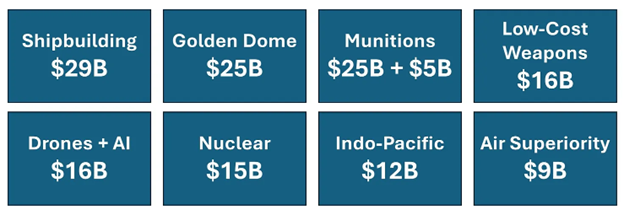
The reallocation of defense spending is already visible in the FY2026 budget, with clear winners and losers emerging. Broadly, the changes can be understood through two lenses: where funding is increasing and where it is being reduced.
| |
Where the money is going:
- $25 billion is being allocated to a “Golden Dome” missile defense initiative similar to Israel’s Iron Dome system but sized for a significantly larger scale of deployment (GovConWire, June 2025). This funding is the tip of the iceberg, with CBO estimating a high-end space-based interceptor architecture (Golden Dome or equivalent) could cost $542 billion (CBO, May 2025) and the American Enterprise Institute citing a price tag of $3+ trillion (AEI, Sep 2025).
- Significant investments are being made in the Drone Dominance Program, which targets production of 300,000+ drones by 2027, beginning with 30,000 drones by July 2026 (Military.com, Dec 2025).
- The DOW requested $142 billion in base RDT&E funding, rising to $179 billion with reconciliation (CRS, Report R48860), signaling substantial investment in next-generation capabilities.
Where the money is leaving:
- In FY2025, Congress funded 74 F-35s across all three variants, but the Pentagon has since requested funding for only 47 aircraft (Defense News; Air & Space Forces, June 2025).
- The A-10 is expected to be retired over the next decade. Additionally, the unit cost of the E-7 Wedgetail increased from $588 million to $724 million and was previously planned for cancellation. While the program has since been revived, this uncertainty still reflects shifting defense budget priorities (Defense Magazine, June 2025) & (Breaking Defense, Mar 2026).
- Lastly, executive orders call for the review and potential cancellation of programs that are 15%+ over cost or behind schedule (FTI Consulting, 2025).
Not only is the DOW changing where it spends its money, but it is also changing how it spends its money. In November 2025, the DOW announced the Acquisition Transformation Strategy, which represents a fundamental overhaul of how the Pentagon procures capabilities. The strategy shifts from traditional FAR-based contracting to a more flexible OTA and commercial-first approach, significantly reducing the compliance burden and barriers to entry for smaller contractors. This change allows smaller companies that previously lacked the infrastructure to navigate traditional FAR requirements to now compete for contracts and sell to the Pentagon (DOD, Nov 2025).
Taken together, these trends underscore the restructuring of the U.S. defense budget away from legacy, exquisite systems and toward the next generation of scalable, rapidly deployable capabilities.
| |
Conclusion
The procurement shift from exquisite to commodity to attritable carries meaningful implications for investors in the aerospace and defense industry. Companies tied exclusively to legacy platforms will face headwinds, while smaller manufacturers and tech providers aligned with this new wave of attritable systems likely stand to benefit. That said, Congress recently added $5.2 billion in FY2026 to procure additional munitions, addressing some of the replenishment gaps caused by Ukraine and other conflicts. Additionally, NATO Allies agreed in 2025 to a new goal of spending 5% of GDP on defense and security-related investments by 2035, up from the previous 2% benchmark, which should increase demand for U.S.-made defense products (NATO, June 2025). Not all legacy programs are at risk, as evidenced by the $2.7 billion being allocated to expanding submarine manufacturing capacity (Senate Appropriations Committee, 2026).
As DOW procurement continues to evolve, Ironwood remains committed to identifying and supporting domestic manufacturers positioned to meet the next generation of defense demand.
| | We are excited about the opportunities we see in the aerospace & defense industry and are actively evaluating investments aligned with this thesis. To learn more, please visit our website and reach out to one of our team members. | |
The information contained herein has been obtained from sources believed to be reliable, but the accuracy of such information cannot be guaranteed. Views expressed are as of the date provided. Ironwood is under no obligation to update this information or to advise on further developments relating to the investments discussed herein. References to a particular investment is not a recommendation to buy or sell such investments. The information contained in this document is prepared for general circulation and is circulated for general information only. Past performance is no guarantee of future results. Any investment contains risk including the risk of total loss. There is no assurance that the investment objectives will be achieved or successful. Please refer to the Firm’s Form ADV 2A Brochure for more information about the Firm, services and fees on file with the SEC, www.adviserinfo.sec.gov. Firm CRD #321642. You may also contact us at 860-409-2100 or visit our website for a complete list of investments at www.ironwoodcap.com. | | |
Sources
1 - Executive Office of the President. “The President's Budget for Fiscal Year 2026.” Office of Management and Budget, May 2, 2025. https://www.whitehouse.gov/wp-content/uploads/2025/05/Fiscal-Year-2026-Discretionary-Budget-Request.pdf.
2 - Breaking Defense Staff. “As DoD Shifts $50B in Spending, Can an Old Playbook Protect Legacy Programs?” Breaking Defense, February 21, 2025. https://breakingdefense.com/2025/02/as-dod-shifts-50b-in-spending-can-an-old-playbook-protect-legacy-programs/.
3 - Congressional Research Service. “DOD Replicator Initiative: Background and Issues for Congress.” CRS Report IF12611. https://www.congress.gov/crs-product/IF12611.
4 - Military.com. “300,000 Drones: What Hegseth's Drone Build-Up Means, and What We Still Need to Know.” Military.com, December 5, 2025. https://www.military.com/feature/2025/12/05/300000-drones-what-hegseths-drone-build-means-and-what-we-still-need-know.html.
5 - GovConWire. “DOD Unveils $961.6B Fiscal Year 2026 Budget Request.” GovConWire, June 27, 2025. https://www.govconwire.com/articles/dod-fy-2026-budget-request-golden-dome-nuclear-triad.
6 - Congressional Research Service. “FY2026 Defense Budget: Funding for Selected Weapon Systems.” CRS Report R48860. https://www.congress.gov/crs-product/R48860.
7 - Insinna, Valerie. “Air Force F-35 Buy Would Be Cut in Half Under Pentagon Spending Plan.” Defense News, June 12, 2025. https://www.defensenews.com/air/2025/06/12/air-force-f-35-buy-would-be-cut-in-half-under-pentagon-spending-plan/.
8 - Air & Space Forces Magazine. “How the 2026 Budget Shapes the Future Air Force Fighter Fleet.” Air & Space Forces Magazine, June 27, 2025. https://www.airandspaceforces.com/2026-budget-air-force-fighter-fleet/.
9 - Defense Magazine. “U.S. Air Force Overhauls 2026 Budget: Full A-10 Retirement, E-7 Cancelled, F-35 Cuts, and Major Shifts in Modernization Strategy.” Defense Magazine, June 27, 2025. https://www.defensemagazine.com/article/us-air-force-vverhauls-2026-budget-full-a-10-retirement-e-7-cancelled-f-35-cuts-and-major-shifts-in-modernization-strategy.
10 - FTI Consulting. “2025: Defense Dealmaking in the Year of Disruption.” FTI Consulting, December 3, 2025. https://www.fticonsulting.com/insights/articles/2025-defense-dealmaking-year-disruption.
11 - U.S. Department of Defense. "Acquisition Transformation Strategy: Rebuilding the Arsenal of Freedom." November 7, 2025. https://media.defense.gov/2025/Nov/10/2003819441/-1/-1/1/ACQUISITION-TRANSFORMATION-STRATEGY.PDF.
12 - U.S. Senate Committee on Appropriations. "Senate Committee Approves FY 2026 Defense Appropriations Bill." 2026. https://www.appropriations.senate.gov/news/majority/senate-committee-approves-fy-2026-defense-appropriations-bill.
13 - Marrow, Michael. “Following Congressional Rebuke, Air Force Awards E-7 Contracts.” Breaking Defense, March 13, 2026. https://breakingdefense.com/2026/03/following-congressional-rebuke-air-force-awards-e-7-contracts/
14 - Congressional Budget Office. “Effects of Lower Launch Costs on Previous Estimates for Space-Based, Boost-Phase Missile Defense.” May 5, 2025. https://www.cbo.gov/publication/61237.
15 - Harrison, Todd. “Build Your Own Golden Dome: A Framework for Understanding Costs, Choices, and Tradeoffs.” American Enterprise Institute, September 2025. https://aei.org/wp-content/uploads/2025/09/WP-Estimating-the-Cost-of-Golden-Dome.pdf.
16 - North Atlantic Treaty Organization. “The Hague Summit Declaration.” June 25, 2025. https://www.nato.int/en/about-us/official-texts-and-resources/official-texts/2025/06/25/the-hague-summit-declaration.
| | | | |