| |
Celebrating 25 Years
of Middle Market
Investing
| | | | |
ENVIRONMENTAL SERVICES M&A TRENDS: CONSOLIDATION, INFRASTRUCTURE CONSTRAINTS,
AND REGULATORY DRIVERS
| | |
In this post, we discuss Ironwood’s perspective on M&A activity in the environmental services (“ES”) industry. Environmental services businesses continue to benefit from nondiscretionary demand, recurring revenue characteristics, and durable regulatory, infrastructure, and sustainability-driven tailwinds. Those attributes have continued to support investor interest heading into 2026: Waste Dive reported in January 2026 that the waste and recycling industry has become a “safe harbor” for investors seeking stable returns over the last five years, while in February 2026, it reported that the major public waste companies collectively spent nearly $3.3 billion on M&A in 20251. In an environment characterized by broader macroeconomic uncertainty, investors have continued to focus on businesses providing essential services with recurring revenue models.
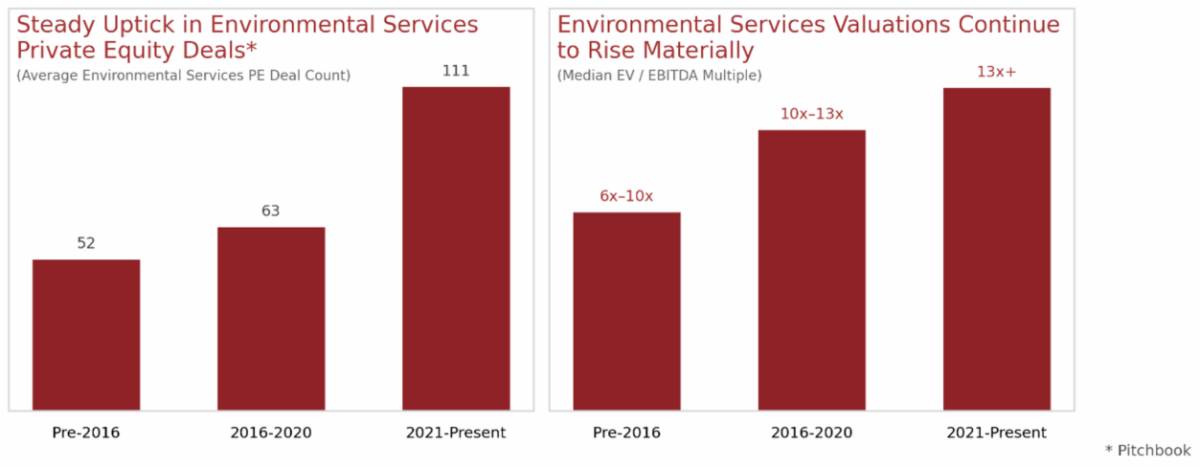
Over the past decade, investor participation in the sector has expanded meaningfully. According to Harris Williams’ Opportunities in Environmental Services – Q3 2025 report, average private equity deal count increased from 52 transactions pre-2016 to 111 transactions in the 2021–present period, while median EV/EBITDA multiples expanded from 6x–10x to 13x+ over the same timeframe2.
| |
The increase in transaction activity and valuation levels over multiple cycles reflects a broadening buyer universe that now includes public strategics, traditional private equity firms, and infrastructure-focused investors that value the attractive characteristics that ES companies offer.
Ironwood has been an active investor in environmental services for two decades, completing 19 transactions across three major verticals: i) Traditional Collection & Disposal, ii) Recycling & Resource Recovery, and iii) Specialty Waste.
Based on our experience in the sector, several industry dynamics are shaping environmental services M&A activity heading into 2026 and beyond.
| |
Robust M&A Activity Driving Continued Industry Consolidation
While specific sub-verticals within environmental services remain fragmented (e.g., portable sanitation, liquid waste management, environmental remediation), much of the industry has seen significant consolidation over the past decade, especially among municipal solid waste ("MSW") and construction and demolition ("C&D") hauling and disposal end-markets. Strategic consolidators (WM, GFL, Casella) and financial sponsors continue to pursue acquisitions to expand geographic density, broaden service offerings, and build vertically integrated capabilities.
Strategic consolidators continue to allocate a significant amount of M&A spend to support growth, with public company disclosures highlighting the continued depth of acquisition activity across the sector. For 2025, Republic Services invested approximately $1.1 billion in acquisitions, Waste Connections invested approximately $818 million, and GFL invested approximately $718 million1. Private equity add-on activity has also remained active as sponsors pursue buy-and-build strategies to expand regional platforms, benefiting from synergies associated with route consolidation and internalization of hauling volumes.
Recent transactions from financial sponsors illustrate the continued use of platform expansion strategies across the sector to build large regional businesses. A good example of this is the recent merger that Kinderhook Industries completed in January 2026, combining two of its existing collection and post-collection waste platforms (Live Oak Environmental & CARDS Recycling) into one vertically integrated waste management platform covering the Mid-South called Ecowaste Solutions (“Ecowaste”)3. Kinderhook has continued to grow its Ecowaste platform through targeted acquisitions of regional haulers, reinforcing sponsor-led consolidation strategies focused on route density and operational scale.
At the same time, large public waste companies, including Waste Management, Waste Connections, and Casella Waste Systems (“Casella”), among others, have remained active acquirers as they pursue tuck-in acquisitions that strengthen regional footprints and vertically integrated operations. Casella’s April 2026 acquisition of former Ironwood portfolio company Star Waste Systems illustrates this strategy well, adding a scaled Eastern Massachusetts and Southern New Hampshire platform with collection operations and a C&D processing/transfer asset, underscoring continued buyer appetite for high-quality regional operators4.
| |
Limited Disposal Capacity Driving Strategic Value of Landfill Assets
Another factor influencing consolidation across environmental services is the limited availability of landfill capacity in many regional markets. Permitting new landfill facilities is a lengthy and complex process that can take years due to environmental reviews, zoning restrictions, and community opposition. As a result, existing disposal assets have become strategically important infrastructure within the waste management value chain.
Operators that control collection routes, transfer stations, and disposal facilities often benefit from greater operational flexibility and improved cost management relative to businesses that rely solely on third-party disposal options. Ownership of landfill assets can also enhance route economics and allow operators to capture additional value across multiple stages of the waste management process.
Recent transactions highlight the strategic importance of landfill ownership. In January 2026, TXP Environmental, a portfolio company of NMS Capital, acquired the Diamond Back Recycling and Sanitary Landfill in Odessa, Texas. The facility is permitted to accept both municipal solid waste and construction and demolition materials and represents a key disposal outlet in the West Texas region. The acquisition further expands TXP’s vertically integrated waste platform and reflects the strategic value landfill assets can provide to regional operators seeking to control multiple stages of the waste management process5.
In regions where landfill capacity is constrained, operators have also explored alternative waste management solutions, such as waste-by-rail transportation, waste-to-energy facilities, and recycling or diversion programs to reduce reliance on landfills.
| |
Circular Economy Policies Driving Recycling Infrastructure Investment
State-level circular economy legislation is also influencing investment priorities across recycling and waste diversion infrastructure. Extended Producer Responsibility (“EPR”) packaging laws are expanding across the United States, shifting portions of the financial and operational responsibility for packaging waste management from municipalities to producers.
Industry analysts have identified EPR implementation, organics diversion mandates, and recycling infrastructure investment as key themes shaping the waste and recycling industry in the coming years6.
These policy developments are contributing to increased investment in Materials Recovery Facilities ("MRFs"), recycling processing capacity, and organics infrastructure. Municipalities and private operators are evaluating new collection, processing, and recycling systems to comply with evolving policy requirements and sustainability objectives.
A recent example of this trend is Circular Services’ acquisition of Atlas Organics in November 2025, which expanded the company’s organics processing capabilities through the addition of eight composting sites across the country. Following the acquisition, Circular Services now operates over 35 recycling and organics processing facilities nationwide, underscoring continued investor interest in scaling infrastructure that supports organics diversion, recycling capacity expansion, and broader circular economy objectives7.
For strategic buyers and financial sponsors, these developments may create opportunities to acquire or scale recycling and processing platforms positioned to support circular economy initiatives.
| |
Conclusion
Environmental services continue to attract sustained interest from both strategic and financial buyers. Historical transaction data indicate increased private equity participation and valuation expansion over the past decade2, while recent activity reflects continued consolidation across regional and national platforms.
At the same time, circular economy policies and landfill capacity dynamics are influencing how operators invest and grow within the sector.
As these dynamics evolve, consolidation, disposal constraints, and circular economy policies are expected to remain central themes shaping environmental services M&A activity in 2026 and beyond.
Ironwood continues to evaluate opportunities across Traditional Collection & Disposal, Recycling & Resource Recovery, and Specialty Waste as we seek to partner with management teams and sponsors navigating this evolving industry landscape to support their near-term growth and professionalization initiatives.
| | We are excited about the opportunities we see in the environmental services industry and are actively evaluating investments aligned with this thesis. To learn more, please visit our website and reach out to one of our team members. | |
The information contained herein has been obtained from sources believed to be reliable, but the accuracy of such information cannot be guaranteed. Views expressed are as of the date provided. Ironwood is under no obligation to update this information or to advise on further developments relating to the investments discussed herein. References to a particular investment is not a recommendation to buy or sell such investments. The information contained in this document is prepared for general circulation and is circulated for general information only. Past performance is no guarantee of future results. Any investment contains risk including the risk of total loss. There is no assurance that the investment objectives will be achieved or successful. Please refer to the Firm’s Form ADV 2A Brochure for more information about the Firm, services and fees on file with the SEC, www.adviserinfo.sec.gov. Firm CRD #321642. You may also contact us at 860-409-2100 or visit our website for a complete list of investments at www.ironwoodcap.com. | | | | |