Over 20 Years of

Middle Market

Investing

IRONWOOD CAPITAL PERSPECTIVE: NAVIGATING THE LABOR CRUNCH IN FACILITIES SERVICES

Facilities services providers play a crucial role in maintaining operational continuity across nearly every commercial sector, ensuring that buildings are clean, systems function, and grounds are maintained. The labor force supporting these behind-the-scenes services has declined in recent years due to aging demographics, shrinking pipeline of labor, and post-COVID dynamics. Labor management will define operational success and failure in the industry over the coming years. In this article, we discuss labor concerns, operational impacts, and the countermeasures that firms can take to maintain delivery, profitability, and long-run stability.


What is Driving the Labor Shortage?


Several systemic labor dynamics are contributing to shortages in the facilities services sector including an aging workforce depleting supply, insufficient pipeline to backfill demand, and exogenous factors such as immigration policy and the COVID-19 pandemic aftereffects shifting dynamics in the industry.


Aging Workforce

Many facility services jobs are in the skilled trades, which are currently filled with older employees. The International Facilities Management Association (IFMA) estimates that 40% of existing facilities managers will retire by 20261. As tenured technicians and managers retire, they leave behind both labor gaps and institutional knowledge.


Low Pipeline of Skilled Labor

While the existing workforce has aged, the pipeline of new talent has not been replenished by the next generation. Pre-pandemic, from 2017 to 2020, trade school enrollment declined at a CAGR of ~0.8%. A cultural shift favoring four-year degrees and white-collar work has created social stigmas against manual trades. Additionally, a lack of visibility into upward career paths can deter young people from pursuing vocational and technical fields. However, since 2020, there has been a modest reversal: between 2020 and 2023, trade school enrollment grew at 1.6% CAGR2.


Immigration Policy Dynamics

Foreign-born labor has historically played a critical role in facilities services, particularly in building cleaning and maintenance (39% foreign born, includes landscaping and janitorial) and construction (36%)3. The combination of stricter control of visas as well as increased immigration enforcement has changed the landscape of this labor market. Based on the Pew Research Center, undocumented workers contribute 4.8% of the workforce in the facilities services sector, but this is not spread evenly between industries, as niches such as landscaping services (18% of workers undocumented) and roofing/drywall installation (33%) have a particularly high share of undocumented employees4. Deportation efforts have meaningfully impacted labor levels in the industry. 


Pandemic Aftereffects

COVID-19 accelerated the retirement of older workers and spurred a reassessment of job stability and working conditions particularly in high-risk, low-wage fields like janitorial services. At the same time, demand for cleaning and sanitation services increased, straining an already reduced workforce5. 

High Touch Services are Feeling the Strain


High touch services with physical labor demands are particularly experiencing the impact of the labor supply challenges. Examples are discussed below.  


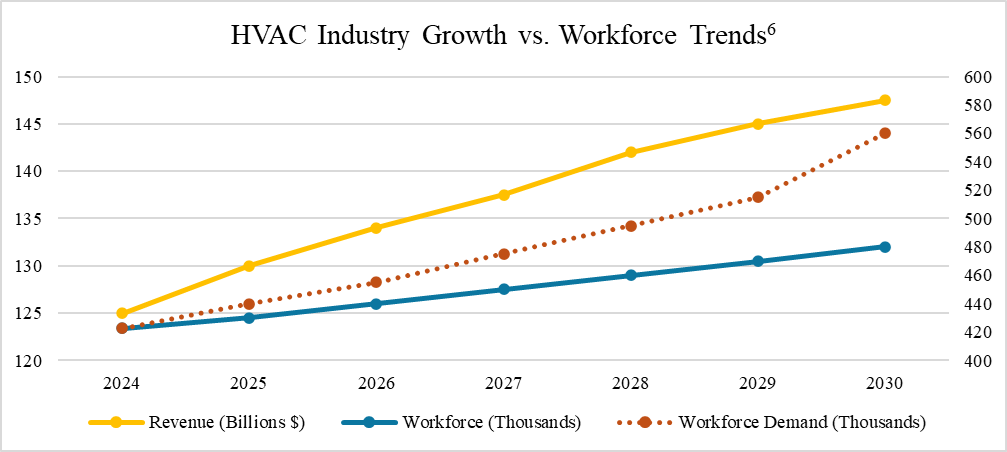
  • Plumbing & HVAC – Projections indicate a potential shortfall of ~80,000 HVAC technicians by 2030 which could constrain capacity for maintenance providers6. Certification barriers, an aging workforce, and limited talent replenishment are contributing to this shortfall. Reduced supply has started to create increased wage competition, pushing firms to offer higher wages and flexible terms to remain competitive3.
  • Janitorial – Hiring and retention remain problematic in janitorial work; this trend existed prior to the pandemic but was accelerated after 2020. Turnover drives increased reliance on less experienced labor, raising quality concerns in a post-COVID environment that demands elevated standards7.


  • Landscaping – Job vacancy rates remain high in landscaping services at 14% in 2024. Firms are challenged to recruit and retain labor due to the physical nature of the work, seasonality, and exposure to harsh outdoor conditions8. 

Implications for Operators and Investors


Constraint on Organic Growth – Persistent labor shortages limit providers’ ability to expand service lines or take on new accounts, even if demand is strong. Growth could be capped by workforce availability, not customer needs, creating a ceiling on organic growth if not proactively addressed.


Pricing Pressures – With wages rising, companies are forced to pass costs through to customers. However, in price-sensitive industries, it is not always feasible, putting pressure on margins.


Retention and Burnout – Employee retention remains a key challenge for facility services managers following the COVID-19 pandemic. Remaining industry employees face heavier workloads increasing the risk of burnout as they try to cover the responsibilities of fewer colleagues. Employee turnover increases onboarding costs and weakens consistency of services.


Service Reliability – Insufficient staffing levels lead to delays in routine tasks and preventative maintenance. Understaffing may impair a company’s ability to meet peak-season or emergency demand, impacting customer satisfaction and reputation.


Strategic Responses


Workforce Development and Strategic Recruiting - Successful firms are proactive, creating their own workforce instead of waiting for one to develop for them. They are investing in upskilling programs for current employees to equip the workforce for evolving needs such as technology adoption. At the same time, they are building strong recruiting pipelines through partnerships with trade schools and vocational programs through which they offer hands-on internships to attract future talent9,10.


Compensation Modernization - Today’s employers need to look beyond wages to acquire the best employees. Flexible scheduling and paid time off coupled with retirement, health, and wellness benefits can create compelling compensation packages9,11.


Technology and Automation - Firms willing to embrace automation will be able to bridge labor gaps. AI-powered scheduling systems optimize cleaning schedules based on building occupancy, peak usage times, and staff availability. Predictive maintenance software can reduce downtime and unexpected repair costs, adding value to customer relationships. Workforce management platforms can improve employees’ communication, shift planning, and engagement9.


Outsourcing - While it may be less cost efficient, providers can turn to subcontractors or staffing agencies to flex capacity and fill immediate labor gaps. Outsourcing creates execution risk but can reduce fixed hiring expenses12.


Value Creation in Strategic Labor Management


Labor shortages across facilities services are becoming a structural challenge for the industry that requires strategic adaptation from providers to remain competitive. As investors evaluate opportunities in the sector, understanding how operating companies address workforce constraints should be a critical component to underwriting. Business owners should continue to consider their investment in workforce development, compensation structure, and technology utilization as levers to capture margin, deliver consistent service, efficiently scale, and ultimately drive value creation.


Ironwood is committed to staying ahead of evolving labor trends, driving innovative solutions, and backing our portfolio companies in the facilities services sector. Ironwood has invested in several facilities services businesses across its history, and we remain eager to identify and partner with leading providers across the U.S.


For a complete list of Ironwood Capital’s investment experience, please visit our website: www.ironwoodcap.com/portfolio.

We are excited about the opportunities we see in the facilities services industry and are actively evaluating investments aligned with this thesis. To learn more, please visit our website and reach out to one of our team members.


The information contained herein has been obtained from sources believed to be reliable, but the accuracy of such information cannot be guaranteed. Views expressed are as of the date provided. Ironwood is under no obligation to update this information or to advise on further developments relating to the investments discussed herein. References to a particular investment is not a recommendation to buy or sell such investments. The information contained in this document is prepared for general circulation and is circulated for general information only. Past performance is no guarantee of future results. Any investment contains risk including the risk of total loss. There is no assurance that the investment objectives will be achieved or successful. Please refer to the Firm’s Form ADV 2A Brochure for more information about the Firm, services and fees on file with the SEC, www.adviserinfo.sec.gov. Firm CRD #321642. You may also contact us at 860-409-2100 or visit our website for a complete list of investments at www.ironwoodcap.com.

Works Cited


1 - ARC Facilities. Navigating Retiring Workers and Labor Shortages. IFMA Knowledge Library. https://s3.us-east-2.amazonaws.com/knowledgelibrary.ifma.org/KL_Documents/eBook-Navigating Retiring Workers and Labor Shortages-ARC Facilities-1.pdf.


2 - Validated Insights. Trade Schools Report. October 2024. https://www.validatedinsights.com/wp-content/uploads/2024/11/Trade-Schools-Report-Oct-2024.pdf.


3 - Bureau of Labor Statistics. “Employed Foreign-born and Native-born Persons by Occupation.” U.S. Bureau of Labor Statistics. https://www.bls.gov/news.release/forbrn.t04.htm.


4 - CBS News. “Trump’s Deportation Efforts Could Impact These Industries and States That Rely on Undocumented Workers.” CBS News. January 28, 2020. https://www.cbsnews.com/news/trumps-deportation-efforts-could-impact-these-industries-and-states-that-rely-on-undocumented-workers/.


5 - Encompass Onsite. “The Post-Pandemic Labor Shortage in Facility Management.” Encompass Onsite. March 15, 2024. https://www.encompassonsite.com/post/the-post-pandemic-labor-shortage-in-facility-management.


6 - Chill Brothers. “The Future of HVAC Installations: Revenue & Employment Forecasts in the U.S.” The Chill Brothers. https://thechillbrothers.com/the-future-of-hvac-installations-revenue-employment-forecasts-in-the-u-s/.


7 - American Recruiters. “How the Labor Shortage Is Impacting the Cleaning Industry.” American Recruiters. February 27, 2025. https://www.americanrecruiters.com/2025/02/27/how-the-labor-shortage-is-impacting-the-cleaning-industry.


8 - IBISWorld. “Landscaping Services in the US—Employment Statistics.” IBISWorld. https://www.ibisworld.com/united-states/employment/landscaping-services/1497/.


9 - International Facilities Management Association (IFMA). “Unlocking Success Strategies for Employee Retention, Labor Shortages, and Technology Integration.” IFMA Knowledge Library.

https://knowledgelibrary.ifma.org/unlocking-success-strategies-for-employee-retention-labor-shortages-and-technology-integration.


10 - FieldEdge. “Partnering with Trade Schools for Field Service Businesses.” FieldEdge. https://fieldedge.com/blog/partnering-with-trade-schools.


11 - Team Software. “How to Solve Labor Shortage Issues.” Team Software Blog. https://blog.teamsoftware.com/how-to-solve-labor-shortage-issues.


12 - Servi-Tek. “Insights from the U.S. Labor Market: What It Means for Facility Maintenance.” Servi-Tek. April 2024. https://servi-tek.net/insights-from-the-u-s-labor-market-what-it-means-for-facility-maintenance.


13 - Halpin Staffing Services. “Addressing the Skilled Labor Shortage.” Halpin Staffing Services. February 12, 2025. https://www.halpinservices.com/2025/02/12/addressing-the-skilled-labor-shortage

Ironwood Capitalcropped.jpg

For more information, please visit: ironwoodcap.com

LinkedIn