Is Supply Chain Disruption a Good Thing?
“For the times they are a-changin"
--Bob Dylan
The past half-decade has been literally riddled with supply chain disruptions. We have seen change in the form of new products, processes, companies, and concepts. In fact, change is moving at nearly an exponential rate, especially with the advent of Artificial Intelligence (AI). In the post-Covid world, supply chains find themselves in a constant state of flux, which many refer to as VUCA (volatile, uncertain, complex, ambiguous).
While many disruptions are caused by change, they can be caused by other factors as well. Disruptions can also be the result of the actions of people, market forces, politics, or nature. Their effects can be classified as low, meaning that they can be resolved in just hours or days; medium, where they may take weeks or months to solve; and high, where they can have significant long-term effects to stock prices, profitability, or even on the company itself. Let’s take a closer look.
People can cause everything from fires, cyber or security attacks, to just plain human error. They can be deliberate or totally accidental. Market force disruptions can impact financial and company viability, transportation, or logistics. Political disruption can cause wars, coups, and other forms of geopolitical instability that can render countries or whole regions unsuitable for conducting business. Finally, natural disasters such as earthquakes, floods, wildfires, and pandemics can totally disrupt supply chains for protracted periods of time.
The effects of disruptions vary from slight to severe. Disruptions can cause late arrivals and work stoppages. More serious disruptions may result in price increases and inflation, store and factory closures, and unemployment. At their most severe, supply chain disruptions can be a threat to a nation’s security.
A case in point is Taiwan. Taiwan is the world leader in the manufacture of computer chips. They make more chips and more advanced chips than any other nation. Taiwan is also only about 100 miles from the People’s Republic of China (PRC or mainland China), They have made it clear that they wish to annex Taiwan at some point, and its computer chip industry is an enticing incentive.
Of course, this does not sit well with the United States and other western democracies who rely on Taiwan for computer chips. This is a major reason why the US passed the CHIPS and Science Act of 2023, which earmarked $280 billion in incentives to fund research and build computer chip factories in the US. The US is taking the step to re-shore computer chip manufacturing as it sees it as a national security issue.
Many organizations that are presently doing business in China or have seen how vulnerable their supply chains are because of Covid-19, the war in Ukraine, the instability in the Mideast, and other causes of disruption, are also revising their strategies. Some are regionalizing and reshoring critical parts of their supply chains. Others are finding alternative suppliers for their key materials or are adding capacity to existing operations to ease bottlenecks. Still others are building inventories of critical material. All of these actions allow organizations to be more resilient. In addition, many are investing in transformational planning initiatives and implementing AI to add visibility and flexibility so that they will be better able to adapt to a VUCA world.
Many organizations are investing in business continuity planning. A business continuity plan allows the organization to continue to operate and deliver products and/or services to customers at pre-defined acceptable levels of service following a disruption. It may include plans to run the operation in a manual mode during periods of computer outage. It may include plans to make deliveries during inclement weather ahead of hurricanes, floods, or major blizzards. Such plans can mean the difference between staying in business or being roadkill.
Risk will always be with us, so taking a proactive stance is the smart thing to do. How our organizations deal with risk and disruption will determine whether they will be winners or losers. Risk should be a major consideration in virtually every supply chain decision made. When we are aware of disruptions and risks, we can plan for their consequences. We can diversify our supply chains and sourcing strategies, develop plans with multiple solutions that are flexible and can be implemented rapidly. So, while disruption may not be a good thing, it is a catalyst for change and is a fact of business life. It is a reality of the modern world, and preparing for it is just being smart.
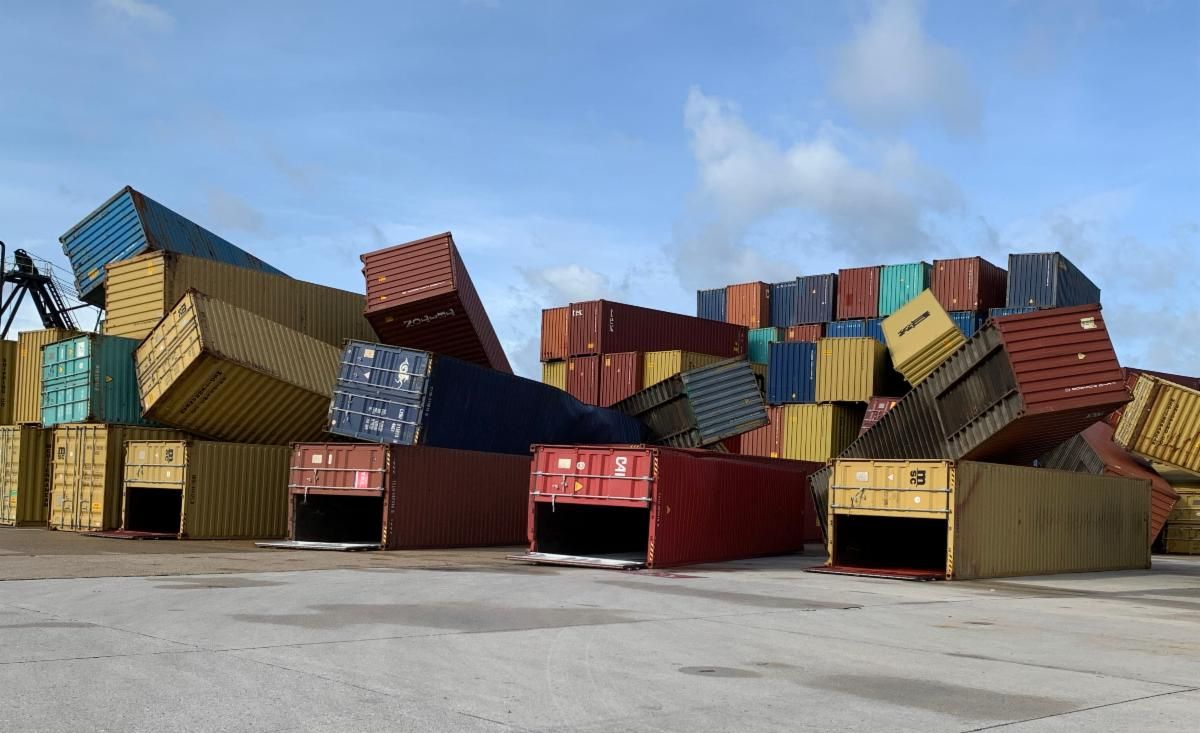
Photo: CBP Photography, Public domain, via Wikimedia Commons
Gary welcomes your comments and feedback. You can email him at garys@supplychainmavens.net.
|