Click here to read this email as a page in your web browser


STAY INFORMED – TALKING POINTS – ACTIONS – VOICES – STORIES MAKING NEWS

Israelis of Every Faith Voted as Palestinian Leaders Delayed Elections Again


As Americans were casting their votes in the high-profile midterm elections, Israel’s journey to form a government – following its very recent election – is only beginning. With no party close to a majority after Oct. 27, Arab parties may hold the key to Israel’s next government. Israel is an island of democracy in a region filled with dictatorships. Most Arabs across its borders – including Palestinians ruled by the Palestinian Authority and Hamas – have no say in who governs them.


Counting to 61


Unlike in the U.S., Israel is a parliamentary democracy – one of dozens, from Mexico to the UK – where Israelis do not directly elect a prime minister. The whole country votes as one district and every ballot goes to a party rather than an individual candidate. The 120 seats in the Knesset – Israel’s parliament – are divided according to each party’s share of the vote.


Eleven parties cleared the minimum threshold to win seats. Several are alliances of smaller parties that ran together ranging from the far left to the far right and include Jewish, Arab and joint Jewish-Arab parties. National voter turnout was 77.9%, the highest since 1999.


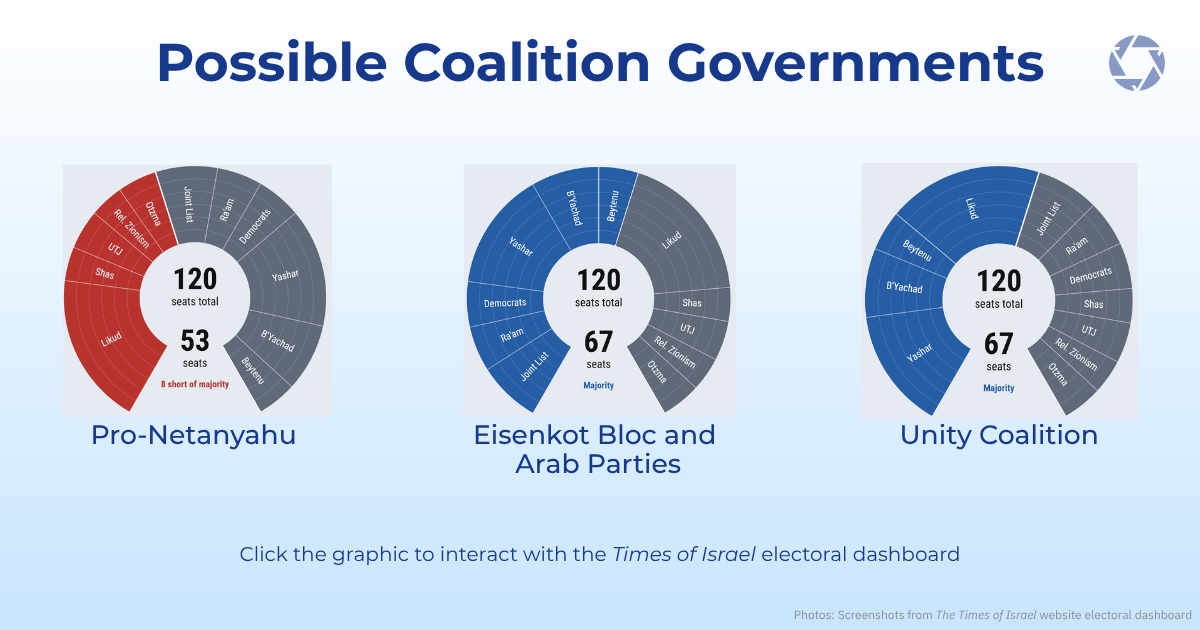
To form a ruling government parties must secure majority support among 61 Knesset members. No single party in Israel’s history has ever won a majority of seats, so every government is a coalition of several parties – often including rivals that campaigned against each other. The recent election results gave Prime Minister Benjamin Netanyahu’s current coalition 53 seats, the opposition bloc led by former military Chief of Staff Gadi Eisenkot 48 and the Arab parties 19. Neither bloc can reach 61 without partners from outside its bloc. Negotiations to build a majority are underway and until a new government is formed, the current one led by Netanyahu remains in office.


The new Knesset reflects Israel’s diversity:


  • 47 are first-time members, including Yonatan Shalev, 24, the youngest ever
  • 33 are women, a record high
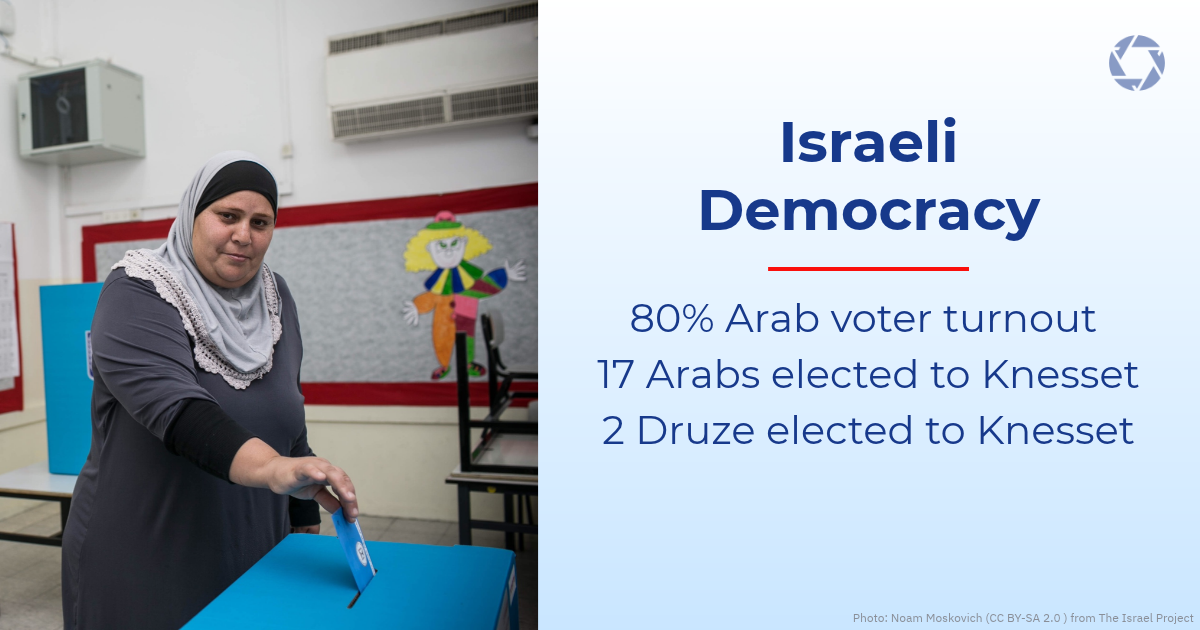
  • 17 are Arab
  • 3 are from the LGBTQ community
  • 2 are Druze

Photo: Voting in 2013 Israeli Elections. Noam Moskovich (CC BY-SA 2.0) from The Israel Project

‘A Future for Our Children’


Israeli Arab voters lined up in record numbers at polling places from northern Galilee to the southern Negev Desert.


Muslim Arab Bedouin voters in a Negev village gave Netanyahu’s party a majority in the past two elections. This time turnout nearly doubled and they backed Ra’am, an Islamist party. Volunteers went door to door in Bedouin villages to encourage women to take part.


Ra’am’s party includes incoming Knesset member Yoav Segalovitz, a Jewish former police official. He said he joined the party to symbolize Jewish-Arab political partnership and demonstrate that secular Jews and religious Arab citizens can govern together. In 2021, Ra’am became the first Arab party to join a governing coalition, winning new funding for Arab towns and legal status for Bedouin villages.


Arab voter turnout reached 80% – higher than the Jewish vote. The two Arab-led slates, Ra’am and the Joint List, won 19 seats, passing the previous record of 15. The highest turnout anywhere, 87%, was in the northern Arab town of Sakhnin. Both slates campaigned on fighting local crime and securing more investment for Arab communities.


“We want to live, we want a future for our children and we want a future for ourselves,” Awni Zoabi, 52, said after voting in Nazareth. Many voters said they turned out to replace the government – a choice any citizen of a democracy is free to make. “We should now translate that result into making real improvements in our lives,” stated Amir Hajj Yahya, 30, in Taibe.


Palestinians in Gaza and Judea and Samaria (the West Bank) are not Israeli citizens. Under the 1990s Oslo Accord peace agreements, they have their own government and their own elections – but have been denied a vote for parliament or president in two decades. Palestinian Authority President Mahmoud Abbas is in the 22nd year of a four-year term and recently postponed elections again.


Khaled Abu Toameh, an Israeli Arab journalist, described the contrast: Arab citizens of Israel “can organize and compete for office, while Palestinians living under the Palestinian Authority or Hamas have no freedom or influence over their future.”


‘An Open Heart’


The next move belongs to Israel’s president, Isaac Herzog. Breaking with tradition, he will hear from the smaller parties first, so every option is examined before the largest ones weigh in. Herzog will then ask one lawmaker to try to build a majority, with up to six weeks to succeed. He has urged party leaders to come with an “open heart” and to avoid another round of elections. In 2019 and 2020, Israelis went to the polls three times in 11 months to break the political deadlock.


There are two likely ways out of the deadlock this time. First, Eisenkot’s bloc could bring the Arab parties into a coalition or lead a minority government that relies on their votes from outside it. Another option is for Netanyahu and Likud to team up with Eisenkot and other parties to form a unity government – leaving out the Arab parties.


The newly elected 26th Knesset will be sworn in on Nov. 10. Parties opposed to Netanyahu hold a majority of its seats and can use it before any government is formed. They are already moving to replace the Knesset speaker, a Likud politician who presides over its sessions.

1. Every Arab ballot in Israel refutes the ‘apartheid’ lie


Israel’s Arab citizens have voted and won seats in the Knesset since the country’s first election in 1949. Arabs make up more than a fifth of the population and serve in senior posts in health care, education and law. In this year’s election, Arab turnout outpaced the Jewish vote and Arab-led parties won a record 19 seats. This result could give them the balance of power in forming Israel’s next government. The vote clearly disproved Antizionist claims of Israeli 'apartheid.' Arab journalist Khaled Abu Toameh put it bluntly: “So much for the sweeping claim that Israel is an ‘apartheid state.’”


2. Israel guarantees its Arab citizens a free vote denied across the Middle East


An Arab citizen of Israel can help decide who leads the country – something most Arabs across its borders cannot do. Palestinian Authority President Mahmoud Abbas governs by decree and Hamas has not let Gazans vote since seizing the territory by force in 2007. Anyone who blames Israel because Palestinians cannot vote is blaming the wrong government. In Lebanon, generations of Palestinians born in the country still cannot become citizens or vote. Jordan’s king appoints the prime minister and can dissolve parliament. Royal families rule Saudi Arabia, Kuwait and Qatar. The same rulers who condemn Israel deny their own people a free vote.


3. Israelis answered years of war with their highest turnout in decades


For three years, Israel has fought a war on many fronts at once – from Gaza and Lebanon to Yemen and Iran. Families buried soldiers, waited two years for hostages to come home and spent nights in bomb shelters. Through all of it, Israelis kept their democracy running. In this year’s elections, soldiers cast ballots at military polling stations and – because Israel has no absentee voting – an estimated 67,000 to 80,000 Israelis living abroad flew in. Israel’s enemies spent years firing missiles at its cities. Israelis answered by lining up to vote.


Champion Israel’s democracy: When someone questions Israel’s democracy and the contributions of its Arab citizens, ask where else in the Middle East an Arab citizen can help decide who governs. If they bring up Palestinians in Gaza or Judea and Samaria (the West Bank), point out that Palestinian leaders have not let their own people vote in two decades. Then answer calmly, using facts in this edition and these resources:


Call for free Palestinian reforms and free elections: Mahmoud Abbas has postponed Palestinian elections again and the U.S. plan for Gaza keeps his Palestinian Authority from taking over there until it completes its reform program. Urge your U.S. Representative and Senators to back those reforms and free elections in which every candidate must renounce terror and recognize Israel – the same conditions the U.S. and its partners set after Hamas won in 2006.


Why a Stanford Protester Changed Her Mind About Israel


Taryn Thomas is a Stanford student and former anti-Israel activist. She now speaks internationally on Black-Jewish solidarity and campus antisemitism and serves as an ambassador for the Nova Music Festival Exhibition. Excerpts from her essay:


“Thirteen days. That’s how long it took for the ‘Sit-in to Stop Genocide’ tent to go up at Stanford after Oct. 7. Israel hadn’t launched its ground invasion, yet somehow, Stanford students had become genocide scholars overnight. And I was one of them.


“I just watched and copied. I learned to say ‘Of course October 7 was horrible, but…’


“Months later, someone sent me an email blast. An invitation: non-Jewish students, come witness an exhibit in LA about the Nova Music Festival massacre. My finger hovered over delete. Then I decided to go. Somebody had to fact-check it.


“Then I came across a recording I still can’t forget. A young man, calling home on a dead woman’s phone. He’d just killed her. ‘Dad, I killed ten Jews with my own hands!’ He didn’t say he was freeing Palestine. He said ‘Jews.’ Not soldiers, not settlers, not Zionists. Just Jews.


“So I went to meet them.


“Face down on the stones near a Ramle market, hands locked behind my neck. Somewhere above me, a piece of technology was trying to intercept a missile from Yemen. I had spent two years calling for the divestment of the very system I was now praying would work.


“I boarded my flight home. When I landed, I checked my phone. My best friend had blocked me without a word. Another texted to ask me to scrub any photos of her from my Instagram."

Stories of Resilience


Stories Impacting American Jews


Stories Impacting the U.S. and Israel


Stories from Around the World


CLICK BELOW TO ACCESS ADDITIONAL FOCUS PROJECT RESOURCES:

STAY INFORMED

SPEAK UP

TAKE ACTION


Want to Read More of Our Talking Points?

Did you miss a recent edition of The Focus Project? No need to search your inbox. Our most recently published editions are available on our website. Click below to continue reading.

The Focus Project develops and distributes news, background, history and weekly talking points on timely issues to inform individuals and organizations about issues affecting the American Jewish community and Israel, and help readers speak with more consistency and clarity. The editions also provide potential responses for addressing incidents of antisemitism and anti-Zionism. With input from a spectrum of major American Jewish organizations, we focus on that which unites us, rising above political and individual agendas.


Recognizing that hatred of Jews comes in many forms and directions, we strive to address all sources as they arise, and educate our growing audience on topics ranging from inter-religious relations to relevant international developments. From week to week, we may focus on issues arising from the political left, university campuses, from the political right and from institutions, government, and corporations. We don’t try to address all issues in each edition. We hope you will find this information useful in your writing and/or speaking. We are always open to your feedback: info@focus-project.org.

Copyright © 2026 The Focus Project, All rights reserved.

www.focus-project.org