Click here to read this email as a page in your web browser


STAY INFORMED – TALKING POINTS – ACTIONS – VOICES – STORIES MAKING NEWS

Israelis Vote in First Election Since Oct. 7


Background


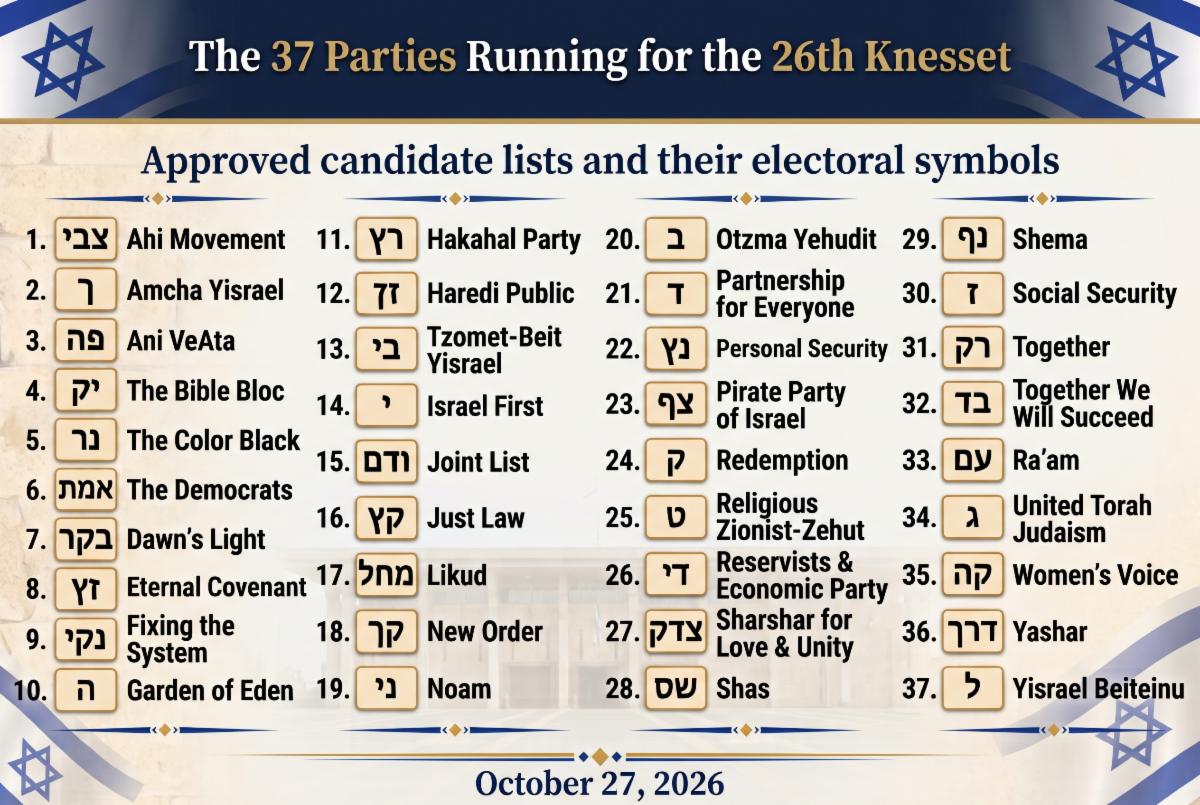
Israelis go to the polls in the nation’s first election since the Hamas massacre of Oct. 7, 2023. Many Jews – in Israel and around the world – view these elections as a referendum on the Netanyahu government and its policies. In the country’s complex parliamentary process, 37 parties compete over 120 seats in the Knesset, but that’s just the beginning of forming a new government. Who officially becomes Prime Minister will depend on their ability to form a majority coalition.

37 Flavors: The Negotiations Begin on Election Night


Israelis will enter a polling station on Oct. 27, choose a slip of paper with a party’s name on it and drop it in the ballot box. Unlike in U.S. elections, there is no direct election of the prime minister.


Israel is a parliamentary democracy with a 120-seat legislature – the Knesset. This year, 37 parties or alliances are running – and many will not even win seats. A party must reach a four-seat minimum threshold – or it gets nothing. The whole country votes as one district, so Israelis do not have a local representative the way Americans have a member of Congress. A party that wins 10% of the vote claims about 10% of the seats.


Leading parties in the polls are Likud, led by Bejamin Netanyahu, Yashar, led by Israel's former IDF Chief of Staff Gadi Eizenkot and B'Yachad led by former Prime Minister Naftali Bennett. No party is currently polling at more than 20%. To govern, a prime minister must assemble a coalition government of multiple parties, including some that the PM campaigned against.


No party in Israel’s history has ever won a majority of the seats in an election. Israel has had 37 governments – only three completed a full four-year term. The current government is the first to serve its full term since 1992. Netanyahu has been prime minister for most of the past two decades.


When asked what matters most in choosing a party, Jewish Israelis rank security and cost-of-living as top concerns. Arab Israelis name crime in their own communities and the cost of living. Foreign affairs are less of a concern for both groups.


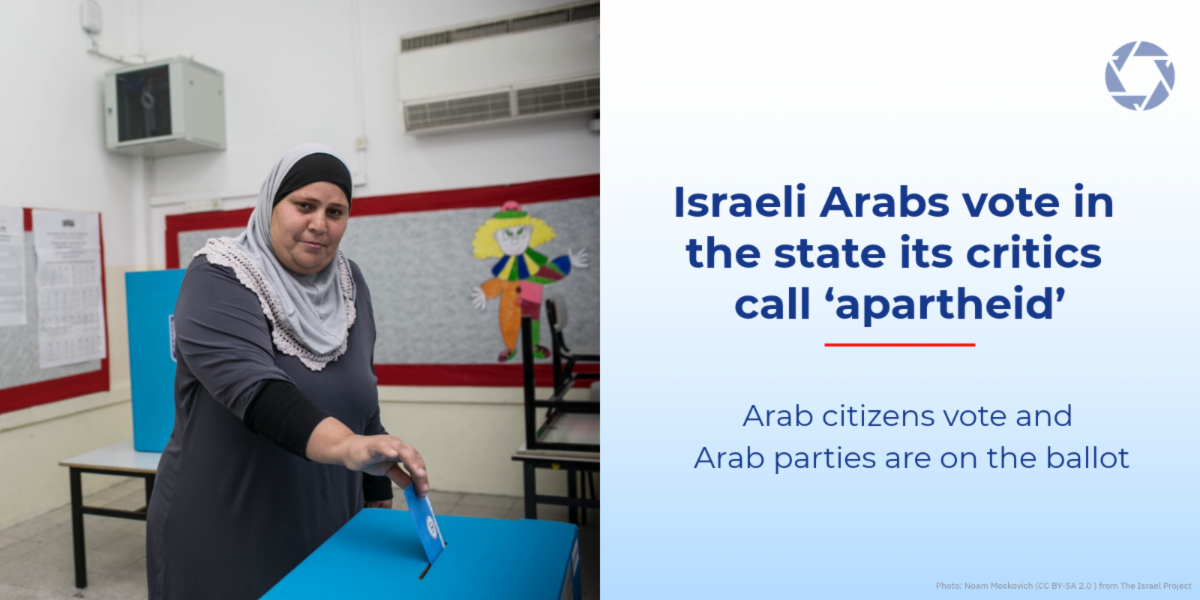
Israel’s Arab citizens vote as equal partners in Israel’s democracy. The Joint List – an alliance of three Arab-majority parties – and the Islamist Ra’am are both on the ballot, running against each other. In 2021, Ra’am became the first Arab party to join an Israeli governing coalition. Many analysts suggest that the Arab parties might again decide Israel’s next prime minister.


Israel has identified intentions by Iran and its terrorist proxies to launch attacks. The Israeli Defense Forces have placed the military on its highest alert level and voting locations are preparing for possible emergencies.

Photo: Voting in 2013 Israeli Elections. Noam Moskovich (CC BY-SA 2.0) from The Israel Project


Israel’s Neighbors Cancel, Skip or Rig Their Elections


Across Israel’s borders, the governments that call it a criminal state do not hold elections at all.


Palestinian Authority President Mahmoud Abbas is currently serving his 22nd year of a four-year term. He recently postponed legislative elections again, citing security issues. Australia, Canada, France, the UK and the European Union pressed him to hold the vote anyway and some countries were set to provide election monitors. 


Qatar is ruled by a monarchy. The Al Thani family rules absolutely – funding the anti-American Al Jazeera network, the social media machinery that carries its messaging worldwide and pours in money to influence American education.


Iran holds elections that decide little to nothing. The Guardian Council screens candidates before voters ever see a ballot, and the supreme leader – who outranks every elected official – is chosen by a clerical body of Islamic scholars. Ayatollah Ali Khamenei served as supreme leader from 1989 until his death this year. The government kills its own citizens in the street by the tens of thousands when they protest for their rights and demand different leaders. Russia and China are its closest partners, and neither allows its citizens to freely vote.


Israelis Abroad Returning to Vote


Israel has no absentee ballot. The only exceptions are for Israeli officials and their families living abroad, as well as soldiers in combat outside Israel. Every other Israeli citizen must be physically present at a polling station in Israel on Oct. 27.


Voter turnout in Israeli elections has historically been high. Israeli diplomats and their families posted abroad have already turned out – nearly 87% of those eligible. The IDF is overseeing hundreds of stations for soldiers to vote early. More than 50,000 Israelis living abroad – in a country of 7.3 million registered voters – are expected to fly to Israel, many citing their opposition to or support for the current government. Liran Naaman spent $900 on a flight for a ballot that takes 60 seconds to cast.


Americans Vote a Week Later


Americans go to the polls one week after Israelis. Both electorates are very divided and have been told the entire future of their country rides on the result and that the elections are a referendum on their leaders. For all Israelis and Americans, regardless of religion and ethnicity, both democracies will be tested in the weeks to come.

1. A free election is the cornerstone of a democracy


The right to choose your own government is one of the basic rights a free nation has – Israelis have never surrendered it. They have voted through wars, terror campaigns and a pandemic. They will vote again on Oct. 27. Israel has had 37 governments – and only three ever finished a full four-year term. Prime ministers often govern with partners they disagree with and fragile coalitions do not always hold – sending Israelis back to the polls. No matter how ugly the election campaign, this is what a parliamentary democracy looks like.


2. The regimes attacking Israel refuse to hold fair elections


Mahmoud Abbas has spent two decades demanding that the world recognize a Palestinian state. He has not stood for election since 2005 and called off the upcoming Palestinian vote weeks before election day. In Iran, a clerical council decides which candidates citizens may choose from – and the supreme leader never appears on a ballot. Qatar, Russia, China and Cuba are all among governments that regularly condemn Israel – and even criticize its democracy. None of them offer free speech, freedom of religion or even the freedom to vote in democratic elections. They are the antithesis of democracy.


3. Changing Israel’s government will not stop attacks on Jews


Attacks on Jews were happening long before the State of Israel was established and were rapidly accelerating before Oct. 7, 2023. They surged after the Hamas massacres. For the anti-Israel activists whose goal is the destruction of Israel, no Israeli prime minister will ever be acceptable short of one who surrenders to Hamas. If Netanyahu is replaced, the activist rhetoric, Islamist propaganda and Hamas attacks will continue. The Jews attacked in Washington, DC, Boulder and Melbourne did not vote in any Israeli election. Antisemites will always find an excuse to attack Jews – the Israeli election is just the latest justification.

Learn about Israel’s elections: Check out these voter guides to learn more about the parties running, as well as technical terms like the electoral threshold and excess-vote agreements. They also include background on the election process and history. Election polls are usually unreliable for determining the outcomes of individual parties but are better at showing voter trends.


Follow American Jewish and Israeli news sources for election coverage.


American Jewish News sources:


Israeli News Sources (in English):


VOICE OF RESILIENCE


‘I Stand for Something Far Bigger Than Myself’


Israeli Raz Hershko won a bronze medal at the World Judo Championships. She dedicated the medal to Yonatan Gutin, a 20-year-old IDF officer killed Oct. 7, 2023, in the battle for Kibbutz Be’eri. Quotes excerpted from a JTA article.


“Representing Israel has always been something that moves me, but at this moment, it carries so much more meaning. At the end of the day, I step onto the mat alone, but I feel like I have an entire country behind me.


“Knowing that I was able to give people back home even a few moments of happiness, a smile, a sense of pride – that means so much to me. Especially during the times we’re going through, these are the moments that remind me why I do what I do.


“Everything has felt different since Oct. 7. Before that, I would go into competitions feeling immense pride in representing my country. Today, that pride is even stronger. I’m much more aware of what the flag I wear represents, and of the fact that I stand for something far bigger than myself.”


Stories of Resilience


Stories Impacting American Jews


Stories Impacting the U.S. and Israel


  • Israel arrests 10 Israeli extremists suspected of attack on U.S. WaPo journalist, EU diplomat in Judea and Samaria
  • Palestinians hurl massive rock through window of car with former Jerusalem deputy mayor
  • Iran created fictitious journalists to push anti-U.S., anti-Israel hoaxes
  • Netanyahu accuses Russia of aiding Iran and acting against Israeli interests
  • Iran giving Houthis targeting intelligence for Saudi attacks
  • Netanyahu warns Israel could face hostile U.S. after Trump leaves office
  • Israel steered Qatari payments to Gaza
  • DSA targets JFK workers in plot to block military shipments to Israel
  • Larry David satirically dons keffiyeh, joins the Democratic Socialists of America


Stories from Around the World


CLICK BELOW TO ACCESS ADDITIONAL FOCUS PROJECT RESOURCES:

STAY INFORMED

SPEAK UP

TAKE ACTION


Want to Read More of Our Talking Points?

Did you miss a recent edition of The Focus Project? No need to search your inbox. Our most recently published editions are available on our website. Click below to continue reading.

The Focus Project develops and distributes news, background, history and weekly talking points on timely issues to inform individuals and organizations about issues affecting the American Jewish community and Israel, and help readers speak with more consistency and clarity. The editions also provide potential responses for addressing incidents of antisemitism and anti-Zionism. With input from a spectrum of major American Jewish organizations, we focus on that which unites us, rising above political and individual agendas.


Recognizing that hatred of Jews comes in many forms and directions, we strive to address all sources as they arise, and educate our growing audience on topics ranging from inter-religious relations to relevant international developments. From week to week, we may focus on issues arising from the political left, university campuses, from the political right and from institutions, government, and corporations. We don’t try to address all issues in each edition. We hope you will find this information useful in your writing and/or speaking. We are always open to your feedback: info@focus-project.org.

Copyright © 2026 The Focus Project, All rights reserved.

www.focus-project.org