|
Dear Students,
We hope that your fall is going well. You are in that midpoint place where winter break is not quite here but the newness and adrenaline of the new year is long gone. As we turn the clock back and your circadian rhythm is thrown off, it is a good time to reevaluate the year so far. What is working? What was working and now you are not doing it as much as it would be helpful? Are there ways that you can be more deliberate with your time?
As you do this evaluation, do it with compassion for yourself. This reflection should not be an opportunity to beat yourself up for all the things you haven’t done. Make sure you talk to yourself the way you would a friend who is reflecting with you and asking for advice. We are quite sure that you wouldn’t berate them for all the ways they didn’t get their to-do list done. You would tell them how amazing they are for what they have accomplished so far and have an honest conversation about what can be improved.
Be good to yourselves,
Dr. Z and Dr. D
| |
Kira Zwygart MD, FAAFP
Associate Dean, Student Affairs
| |  |
Deborah DeWaay MD, FACP
Associate Dean, UME
| | |
In this section we share changes made based on your feedback! | |
|
Independent Student Analysis
The Independent Student Analysis was written in November 2021 to summarize a student survey done by your leaders for the upcoming LCME site visit. One of the recommendations in the analysis was to better align the preclinical curriculum with learning objectives with national board examination standards. One of the ways we have actualized this feedback was to implement Scholar Rx/USMLE Rx into our curriculum. We have purchased this product for course directors so that the medical science course directors can integrate the questions that most students were using to study for their step exams into their courses as formative quizzes.
| | |
|
|
Meeting with Collegia Faculty Advisors
MS 1 students should be actively meeting with their Collegia Faculty Advisor member to complete the following items in their Career Advising Box-Folder: MCOM Student CV and Career Advising Roadmap.
All Morsani College of Medicine students are required to meet with their Collegia Faculty Advisor a minimum of 3 times a year. If a student does not know who their Collegia Faculty Advisor is, they should go to the Career Advising Canvas site.
New Scholars Guide to Success - Required Curriculum
New Scholars Guide to Success (NSG2S) Curriculum is a requirement for all MSI students. Located in the SCC (BMS6991) and SELECT 1 (BMS6890) courses, it involves viewing the material and answering the associated quiz questions. The deadline for completion is December 16.
Summer Scholarly Award Experience (SSAE) - Core Students
RISE presentation on SSAE to Core students in MDD 240 on Tuesday Nov 29th 9am-10:30am. If a Core student accepted the SSAE, the project must be presented at USF Health Research Day. For submission visit here. Deadline is January 10, 2023.
| | |
|
|
AAMC Year 2 Questionnaire (Y2Q)
You have received emails to fill out the AAMC's Y2Q. We know that you are really busy. Please fill out this important survey that gives us information on your class and allows us to make important programmatic changes.
Prometric Scheduling for Step 1
Are you worried about selecting your preferred date for Step 1? Don’t be! During the early stages of applying to take Step 1, you may find limited date selections at the Prometric Testing Centers. For example, in May 2023 there are no dates at the Tampa location and only 3 dates at the Sarasota location available to schedule. This will not remain this way! As we get closer to your exam dates, more dates will open by Prometric based on demand. Prometric outlines their process for scheduling and rescheduling, as well as their current availability calendar. Please refer to their website as well as last year’s Step 1 Presentation located on your ASC Canvas page for more information. Be sure to attend this year’s Step 1 Presentation on December 1 from 3pm-4pm in MDD 230.
| | |
|
|
Financial Aid Disbursement is Nov 21
Allow 3-5 business days for refunds to be generated by the University Controller's Office (UCO). You can still sign up for E-deposit to avoid delays with receiving a refund check via mail.
Tuition Due Date for Term 2
Year 3 Core and SELECT due date for tuition is Dec 9th.
| | |
|
|
Financial Aid Disbursement is Nov 21
Allow 3-5 business days for refunds to be generated by the University Controller's Office (UCO). You can still sign up for E-deposit to avoid delays with receiving a refund check via mail.
Tuition Due Date for Term 2
Year 4 Core and SELECT due date for tuition is Dec 9th.
Virtual Residency Interviews
Rooms in MDD are available for you to conduct your virtual residency interviews. Please submit requests in 25 Live titled "Residency Interview - (Your Name)". On the day of your interview stop by the Student Affairs office (4th floor) and ask Aaron for an "Interviewing - please do not disturb" sign. OSDE has ring lights you might wish to use as you set up space - you can check the light out from Aaron when you pick up the sign. If you are having issues finding a room, please reach out to Aaron.
| |
All Class Years
Join the Financial Aid Canvas Course
Reminder to join the Financial Aid Canvas Course ”Financial Aid Fundamentals and Debt Management” and participate in the November Debt Management Reduction Scholarship Challenge
Collegia Faculty Advisor Meetings
All MD students are required to meet with their Collegia Faculty Advisor a minimum of 3 times a year. If a student does not know who their Collegia Faculty Advisor is, they should go to the Career Advising Canvas site.
Collegium Advising Hours
MD Career Advising is hosting Collegium Advising Hours on a designated Friday once a month. During this time, MD Career Advisors make themselves available for in-person walk-in appointments within their collegium rooms. All students receive outlook invites to serve as reminders
- Nov. 4 – Lower, Osler & Paracelsus
- Nov. 11 – Bourne, Debakey, Farmer, Galen, Hippocrates, Koch
| |
|
Nominate an Exceptional Educator
Have a faculty, physician, resident or fellow who impacted you in a significant way? Please submit your stories on exceptional educators. We will highlight nominees in newsletters, on our website, and social media.
| |
|
GME Culture Champion Award - Nominations Due by Nov 17th
Nominations are now being accepted to award 2 trainees that Make Life Better for our community and patients. Nominations must include how the Resident or Fellow demonstrated professionalism or humanism in enhancing the function of the team, patient care outcomes, or the clinical learning environment. Award winners will be announced Nov 30th. Click to nominate a current USF MCOM resident or fellow.
| |
|
Class of 2026
11/21 – Course 2 Test 2
Class of 2025
11/14 – Course 6 Test 2
Class of 2024 - SELECT
11/10 – Primary Care Mid-Term NBME
11/17 – Psychiatry and Obstetrics NBME
11/18 – Internal Medicine, Surgery, Neurology and Pediatrics NBME
Class of 2024 - CORE
11/17 – Neurology and Obstetrics NBME
11/18 – Primary Care, Internal Medicine, Pediatrics, Surgery and Psychiatry NBME
11/18 – Surgery GYN Exam
| |
|
Pass/Fail Grading System
There have been requests for USF MCOM to move to a pass/fail grading system. We would like to take an opportunity to explain why we are not moving in this direction.
| |
|
In the early 2010’s there were a few publications noting that going to a pass/fail system may improve student wellness without detriment to academic performance. In response, the curriculum committee moved the pre-clinical phase of the curriculum to a pass/fail system for several years - until we discovered that the MCOM experience did not match the experience articulated by the small studies that were published.
Academic performance diminished, and the Step 1 pass rate and mean score subsequently fell as well, without a demonstrable improvement in student wellness. In response, the curriculum committee reinstated the tiered grading system in the pre-clinical phase of the curriculum. However, when the tiered grading system was reinstated, it was significantly improved. The cut offs had previously been set numbers that often left few students getting honors. Instead, now all cut offs are based upon previous years’ data. The cut offs are set so that had they been applied to the previous year, 50% would pass, 25% PC, 25% H. All students have the potential for honoring, and thus diminish competition amongst a class.
| |
|
We are currently in a huge state of flux when it comes to medical education.
- Step 1 has just gone pass/fail.
- The match has become increasingly competitive.
Despite a lot of anecdotal stories and word of mouth, it remains extremely unclear how residency programs will handle this change. At this point in time, with the move of step 1 to pass/fail we do not believe it is in the best interest of students to move to a system that gives residency programs less information about student performance. In addition, how students perform first and second year determines how they do on Step 1 & 2 and on their shelf exams 3rd year. We are very reluctant to change a system that is setting you up to do well on your exams throughout medical school. We have been and will continue to be very transparent during the admissions process that we are a tiered grading system so that students who wish to go to a pass/fail school can make that choice.
Please know that we realize there are very differing opinions on this topic. We very much respect your right to disagree with the choices the curriculum committee has made. However, we hope this helps you understand why MCOM has made the choices it has, and that they come from a place of trying to do what is best for students
| |
|
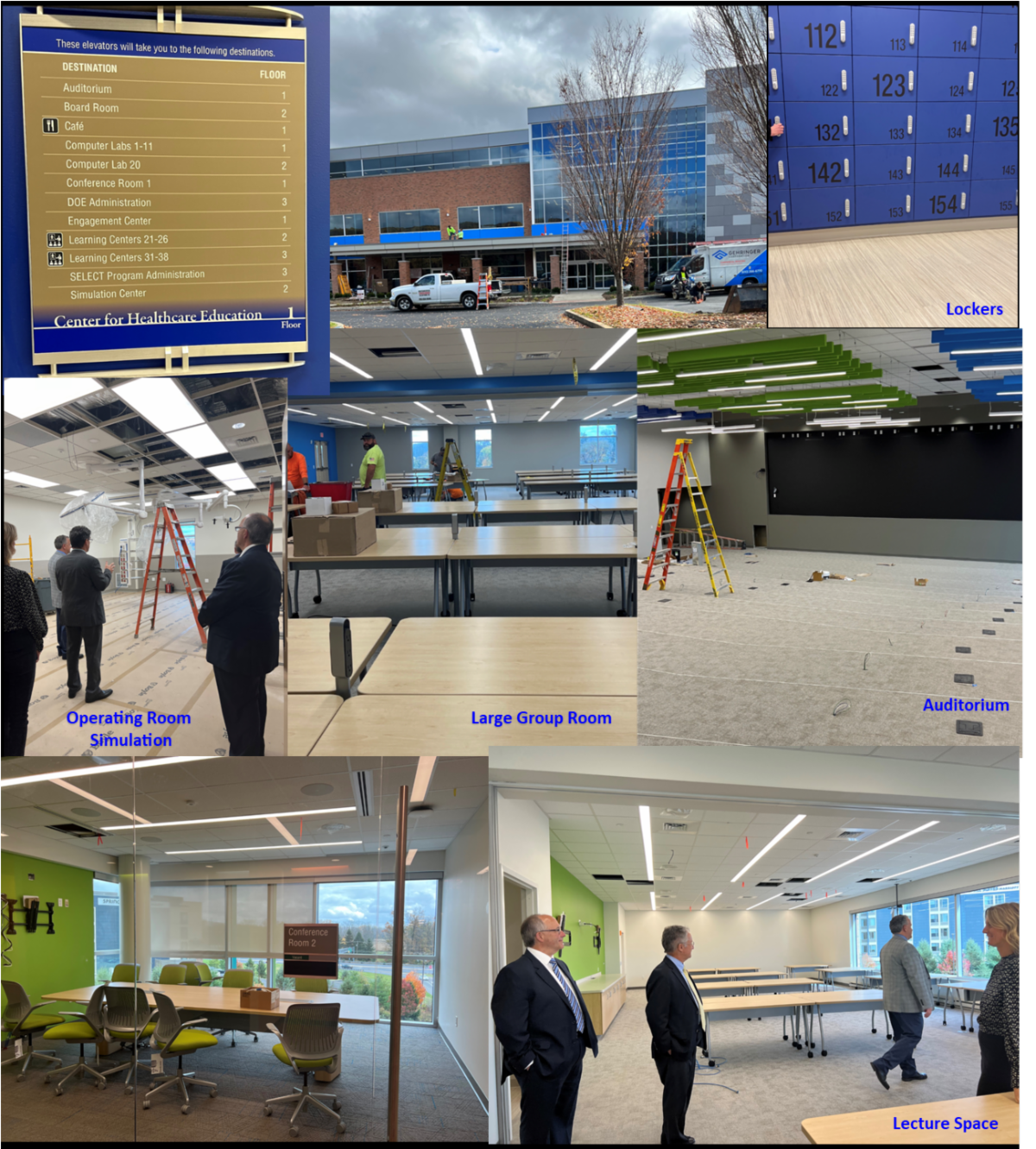
New Center of Excellence for Education Set to Open Feb 2023!
SELECT students on the USF-LV campus will soon have a new facility to enjoy.
Highlights include: outside covered seating; refrigerators to store lunch and microwaves; lactation rooms with sinks; computer labs (no more MACK building on exam days); dedicated SELECT space with small group rooms to facilitate ALP and coaching; improved Sim space (inpatient and OP); lounge space; outside walking space.
It is at 3900 Sierra Circle, Center Valley PA (almost equidistant from Muhlenberg campus and Cedar Crest).
| |
It's Elemental! Spotlight on 11.1 - Academic Advising | | |
|
|
LCME Standard 11, Element 1 (a.k.a. 11.1) requires that “a medical school has an effective system of academic advising in place for medical students that integrates the efforts of faculty members, course and clerkship directors, and student affairs staff with its counseling and tutorial services.”
| |
The Academic Support Center (ASC) provides a variety of academic supporting services to all students with the goal of preparing them for the academic rigors of medical school. The Director of ASC is Dr. O’Callaghan, a learning skills specialist with over 2 decades of experience counseling and advising medical students. All advising is confidential, individualized, and can be on-going from matriculation to graduation. Sessions are offered in-person or via Teams and can be scheduled through Archivum, which allows direct access to Dr. O’Callaghan’s calendar. In addition to individualized advising, the ASC also facilitates individual and group tutoring. In addition, sessions focusing on time management, study skills, and more can be accessed through the ASC. | |
For more information or any questions about the Academic Support Center, email Emily Pernas at epernas@usf.edu. | | |
|
|
Show Me DeWaay - Question the Story You Are Telling Yourself
Our brains love to make up stories about facts. Fact, you got a 78 on a test. The story your brain makes up can range from “I passed, I think I can do this medical school thing” to “I am never going to match and my life is terrible.” Notice the fact for both stories is exactly the same.
The reason it is important to question the stories we tell ourselves is because they shape the experience of our lives. In addition, the story we tell ourselves often dictates what actions we will take next. Our brains love to tell us that the stories we are telling ourselves are fact. Most of the time they are not.
| |
So that begs the question, is the story you are telling yourself helpful or harmful? | |
|
If you get a score or a grade that was less than what you were hoping for, and you tell yourself that now “I am never going to match”, I imagine the emotional result of that is pretty negative. If this leads you to ruminate on how you are never going to match (which is not a fact), there is no way that you are putting your best foot forward on the work that is now in front of you.
Please hear me, I am not saying that the story you tell yourself should be falsely positive. Also, it can be difficult to change the story that our brain is offering. The place to start is simply questioning the story. What is fact and what is the story? This exercise creates a space for you to trying to come up with a better story, perhaps one that soothes, motivates and helps you be a better problem solver. If we are making up stories, let’s at least make it a good one.
| | | | | |