Special Issue: Alaska Election Results | |
- Alaska’s Final Four Elections system is confirmed for a third time by voters – at by far the largest margin yet.
- Mary Peltola is close to an official victory in the U.S. Senate race – despite controversy over a decoy Dan Sullivan.
- Media coverage of Final Four Elections in Alaska is often inaccurate.
- The cast vote record allows a more thorough analysis – especially with elections using instant runoffs.
| | |
Attempt to Repeal Final Four Elections Has Failed Again, By a Much Wider Margin
With approximately 97% of the vote counted, Alaska voters have affirmed their preference for the Final Four Elections (FFE) system for the third time in six years.
The system was approved in a voter initiative in 2020 by 3,781 votes. An attempt to repeal Final Four in 2024 was rejected by 743 votes. A second attempt at repeal, Measure 2, trailed on election night, and the gap has widened. After the Alaska Division of Elections added nearly all absentee and early ballots by the night of Nov. 14, “no” votes (against repeal) had 53.6% of the total and led by 19,467 votes.
Elon Musk, the world’s richest man, donated $1.5 million in July to the Aurora Action Network, a Wisconsin-based political action committee that in turn directed contributions to the repeal effort, according to Alaska Public Media, which added that the network had “collected contributions from numerous billionaire megadonors, including Dick Uihlein, Jeff Yass, Timothy Mellon and Hilcorp owner Jeffery Hildebrand.”
Still, opponents of Measure 2 outraised supporters. According to Ballotpedia, opponents of repeal contributed $13 million; those favoring repeal contributed $2.8 million.
| |
Animosity toward Final Four was widespread among supporters of President Trump, who called the Final Four system “stupid” and commented last month on Truth Social, “We have the Corrupt Ranked Choice System of Voting, which shouldn’t be allowed in our Country and will, hopefully, be repealed in the November Vote.”
Some observers expected the repeal vote to win more support after a scandal erupted over a U.S. Senate candidate with the same first and last names of the incumbent Republican, Sen. Dan Sullivan (see below).
Measure 2 may have suffered because it would not just end ranked choice voting but also reinstate party primaries and because, according to its text, “It would remove limits and disclosure rules under current law, including for digital ads, out-of-state donations, undisclosed donations, and the true source of donations. It would change the meaning of a campaign expenditure and remove some fines.”
|
| |
Despite Controversy Over Two Dan Sullivans, Senate Challenger Peltola Nears Official Victory
Meanwhile, Mary Peltola, a Democrat who lost her bid for a second term as a member of the U.S. House of Representatives in 2024, is almost certain to become Alaska’s next U.S. Senator, defeating Republican Dan S. Sullivan, the incumbent.
As of counting by Nov. 14, Peltola led Sen. Sullivan by 11,213 votes, or 49.94% to 45.96%. Only about 3% of ballots remain to be counted.
The lead is significant “because the Trump administration in October sued to pre-emptively block ‘any election result that may be impacted by voter confusion,’” reported Alaska Public Media, which added that the threshold claimed by the Department of Justice “would be met if Sen. Sullivan lost to Peltola by fewer votes than went to the other Sullivan. A District Court judge dismissed the case but the Trump administration is appealing.”
At this point, Peltola’s lead easily exceeds the total vote of Dan J. Sullivan, the similarly named decoy candidate, who had only 4,652 at last count. Peltola is highly likely to win a majority of votes on the first or second round of counting, making her the victor.
Final Four Elections is a system with two parts. First, a primary, or preliminary round, open to voters and candidates of all parties plus independents. Second, a general election in which the four top vote getters from the primary contend. The winner is chosen by an instant runoff process. Voters pick a majority victor without going back to the polls.
In Alaska, instant runoff, the most common form of ranked choice voting (RCV), involves voters ranking up to four candidates. If no candidate receives a majority of first-place votes, then voters whose number-one choices finish fourth in the initial count have their number-two picks distributed to the remaining candidates. The process continues until a candidate has a majority.
Alaska counts slowly, as we explained in our Newsletter No. 26, to give far-flung voters the time to get their ballots to election officials. Alaska, like 13 other states, also forbids any ballots being counted until after the polls close.
On its website, the Alaska Division of Elections explains the schedule. The deadline for receiving domestic ballots (that have to be postmarked by Nov. 3) is Nov. 13; for overseas ballots, the deadline is Nov. 18. On that day, the official instant-runoff tally will be announced.
Peltola is being swept into office on a massive Democratic wave. If she wins, Democrats will have beaten six sitting GOP Senators and won three seats vacated by retiring Republicans. All nine flipped seats are in states that Donald Trump won in 2024. Democrats also took seven governorships held by Republicans, including in Alaska, where Jonathan Kriess-Tomkins will become the first Democrat to lead the state in two decades. As of Nov. 14, he had 50.9% of the vote against three Republicans; CNN called the race for him two days earlier.
But Peltola’s evident victory is controversial.
The New York Times reported on Oct. 28 that Democrats aligned with Peltola recruited a retired schoolteacher, Dan J. Sullivan, to run against Sen. Dan S. Sullivan.
The goal of picking a decoy candidate, reported the Times, was that “the confusion could cost the senator crucial votes on the state’s unusual, four-person ballot.”
An attempt to bar the decoy candidate was rejected by the Alaska Supreme Court, and the general election ballot lists Sen. Dan as “Sullivan, Dan S. (Registered Republican/Incumbent).” The other Sullivan is listed simply as “Sullivan, Daniel J. Jr.” with no party affiliation. Here is a reproduction of the sample ballot where Sen. Dan is listed first (Alaska rotates the names on the ballot throughout its 40 state House districts).
But the mystery is why the ploy was cooked up in the first place. It might have had an effect if used under a traditional voting system, such as the one that advocates of Measure 2 want to reinstate in Alaska.
In that case, the decoy candidate could skip the party primaries and run as an independent. Under Final Four, only the top four vote getters in the open primary can participate in the general, but prior to 2022, a petition with about 3,000 signatures would allow an independent to qualify.
The decoy candidate would then be able to siphon votes from the similarly named party primary winner, and, because only a plurality was required to win, possibly deny that candidate a victory.
But under Final Four voting, where a majority is required and RCV is used, a decoy candidate has little or no chance to determine the outcome. In other words, whoever was response for the ploy did not even understand the system that brought Peltola to the U.S. House two years before.
One of the advantages of the Final Four system is its resistance to cynical gaming. A classic example of how such manipulation works under traditional systems occurred in the U.S. Senate race in Missouri in 2012. The incumbent, Democrat Claire McCaskill, would later write in a Politico article, “I had successfully manipulated the Republican primary so that in the general election I would face the candidate I was most likely to beat.”
A month before the primary, McCaskill’s campaign placed $1.7 million in “dog whistle” ads that painted the opponent she wanted to face as a far-right extremist. McCaskill’s research showed that the ads would give the candidate, Todd Akin, a better chance to win a plurality in the primary against two more moderate Republicans but would lose the election to her.
That is what happened. Akin won the primary with 36%. His opponents, businessman John Brunner and former State Treasurer Sarah Steelman, scored 30% and 29%. McCaskill easily won the general election, 55% to 39%.
Other examples of manipulation – including running similarly named candidates to draw off votes of a strong opponent-- have been used many times (such as Rodriguez vs. Rodriguez in Florida in 2020). Alaska’s Final Four Elections system (FFE), however, makes manipulation more difficult for three reasons.
- First, because four candidates enter the general election, blocking strong opponents that someone like McCaskill does not want to face (such as the two Republicans moderates) is impossible. Under FFE, she would probably have faced all three -- Akin, Brunner and Steelman -- in the general election. Of course, in the general election, McCaskill could distort the record of a competitive opponent, but doing so might cause some Republicans to back Brunner or Steelman, putting McCaskill in jeopardy.
- Second, while it is possible for a similarly named candidate (say, Claire McCrystal) to draw minimal votes from the incumbent in the first round, that decoy candidate would not keep Sen. McCaskill from qualifying as one of the four general election candidates.
- Third, in the general election itself, anyone confused between McCrystal and McCaskill could vote for both and thus have her votes distributed from the decoy to the real incumbent in later rounds.
The decoy candidate in the Alaska Senate race could not possibly have drawn enough votes to prevent Sen. Sullivan from becoming one of the final four general election candidates. The Senator received 41.4% of the August first-round votes, second to Peltola’s 49.5%. the other Sullivan received just 2.5%.
Again, voters who were confused about the two Dan Sullivans could vote for both (as many did). If the decoy were ranked first in those cases, then the voters’ second-place ballots would probably go to the Senator after the decoy was eliminated.
It is possible that some voters truly preferred Dan J. Sullivan, the retired schoolteacher. Alaskans have a strong independent streak. In the race for the state’s single U.S. House seat, Eric Hafner, a prisoner in New York state with 10 years still to run in his sentence, received 3.8% of the vote in the primary – half-again as much as Dan J. Sullivan. Alaska voters were no stranger to Hafner. He had run in at least three other statewide races.
In addition, the cast vote record (CVR: see below) showed that, as of Nov. 14, Peltola was the favored second-place choice for voters who ranked the decoy candidate first. She was ranked second by 29.1% of Dan J. Sullivan voters. Sen. Dan was ranked second by 15.8%.
These choices indicate that many voters picked the decoy knowing full well who he was. Perhaps they wanted a retired schoolteacher in the Senate or wanted to cast a protest vote.
If some Senate voters were bamboozled by the Peltola campaign’s ploy, they might have voted only for the decoy, not ranking anyone second. Such voters made up 36.6% of the Senate total, accounting for 1,722 votes as of Nov. 10, far short of Peltola’s margin over the incumbent Senator. Her margin far exceeds all the votes cast for the decoy candidate.
| | |
Dismal Media Coverage of Final Four Persists
Media coverage of Final Four Elections has often been inaccurate. One common meme, which we discussed in our last newsletter, is that ranked choice voting (RCV) is responsible for Alaska’s delayed count.
In fact, with scanners, it takes no more time than a traditional ballot – about one minute per race. A study by FairVote, a national election-reform organization, found that nationwide 79% of the 39 jurisdictions that use RCV released results within 24 hours of polls closing.
(For analytical pieces on the timing of counts in the Alaska system and others -- and suggestions for improvement -- see this article, “Final Five Without the Wait” by Katherine Gehl, the originator of the voting system, as well as this Talking Points article, “Alaska’s Vote Will Take Time,” on the website of the Institute for Policy Innovation.)
Two former Alaska voting officials, with 30 years of experience between them, wrote in an opinion piece in the Anchorage Daily News on Sept. 27:
Claims that ranked choice voting causes delays in reporting election results are being amplified. We can say unequivocally that this is not the case. Ranked choice voting does not extend the timeline for counting votes under Alaska law, nor is it to blame for delays in receiving results on election night.
The organization Repeal Now made the claim on its website that “RCV takes too long to declare a winner. Elections should be settled on Election Day. With Ranked Choice Voting and multiple ballots, getting a result is no longer a straight-forward process. Declaring a winner may take weeks.”
Similar criticisms about delays have been voiced by Kim Strassel of the Wall Street Journal and others. Repeal Now is right that “declaring a winner may take weeks.” But the reason is not RCV. Delays were common long before the advent of the Final Four system because Alaska accepts ballots postmarked by election day even if they come in much later.
For example, in 2020, the last election under the old system, the Associated Press did not call the Alaska Senate race until Nov. 11, eight days after the election, even though Republican Dan Sullivan ended up winning easily, by 13 points.
Or consider the current election. Measure 2, the attempt to repeal FFE, requires just a simple yes or no vote (no ranking, of course). But the result has still not been announced as this is written, 13 days after the election.
Among many examples, a CNN piece on Oct. 31, republished by KCRA and other Hearst stations, strongly implied that RCV was a reason for delay, quoting a political science professor saying that, “while vote counting in Alaska has always been slow, ranked choice voting ‘certainly exacerbates the issue.”’ No it doesn’t.
A Nov. 5 article in the Epoch Times, a right-leaning platform with a large readership, said “ranked choice can add delays in a close race.” That’s inaccurate.
CBS News on Nov. 4 reported that “the count in Alaska could stretch on” and then immediately talks about the mechanics of RCV, implying that ranked-choice voting is the reason.
The CBS report says that “the process could drag on for weeks if one candidate does not secure more than 50% of first-place support on the ballot,” again implying that if Alaska simply used only first-place ballots, like all the other states, it could get a faster result. That isn’t true. The late ballots, under Alaskan law, still have to arrive and get counted.
An inaccurate piece of a different sort was reported by Lars Hanson of Newsweek on Nov. 4 with the headline, “Forget the Second Dan Sullivan. Eric Hafner Was Alaska’s Bigger Spoiler,” a reference to the New York prisoner we cited earlier who ran for the state’s lone U.S. House seat.
As we noted above, Hafner, a Democrat, received 3.8% of the vote in the open primary, finishing fourth behind the incumbent Republican, Rep. Nick Begich III, at 44.6% and Bill Hill, a retired educator with Democratic support, at 32.5% and Democrat Matthew Schultz, 8.1% (Schultz later dropped out).
Again, if the primary had been the general election under a traditional plurality system and if all but a few of Hafner’s votes had gone to Hill, then Begich would have prevailed. But, certainly, Hafner had the potential to be a traditional spoiler.
But Hafner can’t be a spoiler under Final Four because, if no one has a majority after the first and second rounds, Hafner’s votes will be distributed in the third round of the general election (a Libertarian, Jim McDermott, who moved into Schultz’s slot, will be eliminated first). As of the evening of Nov. 14, the votes in the general had Begich at 47.7%; Hill, 41.7%; Hafner, 7.8%; McDermott, 2.6%.
In his piece, Hanson seems to understand that. But Hanson claims that with Final Four there is a catch: a ballot moves only when its candidate is eliminated, and the counts stops once someone passes 50%. So a minor candidate’s voters may “never be heard from again.” From that, Newsweek makes the headline claim that Hafner, who can’t win, is Alaska’s biggest spoiler.
The problem with this claim is there’s no catch here – just simple math. Once a candidate has more than 50%, no one else can catch up. Even if every remaining ballot moved to the runner-up, the runner-up would still be behind. That’s not a loophole; it is what a majority means.
In the table it included with the piece, Begich has 105,647 votes (49.6%); Hill, 86,023 (40.4%); Hafner, 15,550 (7.3%); and McDermott, 5,789 (2.7%)
Newsweek's scenario is that McDermott's ballots push Begich past 50%. If that happens, Hill plus every single Hafner ballot still adds up to less than Begich. Hafner's second choices can't change the outcome, so Hafner isn't a spoiler. A spoiler is a candidate whose presence changes who wins. By that definition, under instant runoff there is no spoiler when you run all the rounds, and no spoiler when you stop at 50%.
Hanson’s mistake is one of logic: The truth is that Final Four Elections is a system that prevents spoilers from affecting outcomes.
There is a fair point buried here. The Institute for Political Innovation argues that election officials should run every round to the final two and publish the full results, as a matter of best practice. Alaska's official tally stops at a majority. Running every round shows how much the winner won by, not just who won. But it never changes who the winner is.
Because Alaska publishes its cast vote record (see below), anyone can run the rest of the rounds and see every voter's choices. Under instant runoff, there are no spoilers, whether the count runs all the rounds or stops at 50%.
| | |
The Value of the Cast Vote Record
Alaska is one of only a few states that provide the public with a cast vote record (CVR) of election results. A CVR gives an electronic record of all votes cast in an election, but without the names of the voters attached.
Analyzed by an artificial intelligence application like Anthropic’s Claude, a CVR can offer important information to academics, campaign consultants and other election researchers, as well as private citizens. CVR is especially useful in discovering voting patterns in jurisdictions with ranked choice voting.
For example, in Alaska, a CVR analysis on Nov. 14 using Claude found that 56% of voters who ranked Democrat Mary Peltola first in the U.S. Senate race ranked no one else second, third or fourth while 54.6% of Dan Sullivan’s ranked no one second. In other words, Republicans in this case were slightly more invested in the Final Four system than Democrats. The CVR also found that only 36.1% of voters cast ballots for the decoy Sullivan candidate and ranked no one else.
Among those who did, the standout result was that nearly twice as many of decoy Sullivan’s second-place votes went to Peltola as went to Sen. Sullivan.
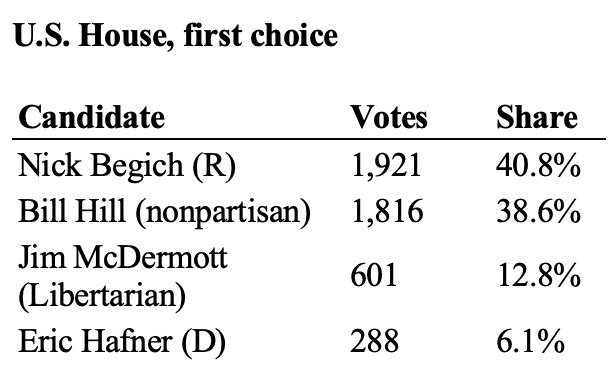
Using CVR and Claude, we found that voters for the decoy Sullivan gave the plurality of their first-place votes to Republican incumbent Rep. Nick Begich III in the House race (see below). Those same voters gave a remarkable 12.8% of their first-place votes to the Libertarian, Jim McDermott, an indication that many decoy Sullivan voters are contrarians, perhaps with a tendency to choose someone such as a retired schoolteacher on purpose rather than in confusion.
| |
Charles Stewart, a political science professor who directs the MIT Election Lab, concluded, “Mostly, it looks like supporters for Dan Sullivan Jr. (of Petersburg) are protest voters, one way or the other,” Stewart said. “Just unable to give a first ranking to the Democrat, or unwilling to give a vote to any of the candidates, but nonetheless wanting to express an opinion about the election.”
There’s a strong overlap in support for Democratic U.S. Senate candidate Mary Peltola and Daniel J. Sullivan Jr. of Petersburg. Nearly 30,000 Peltola voters ranked him second. By contrast only about 3,000 of Republican Sen. Dan Sullivan’s voters ranked him second.
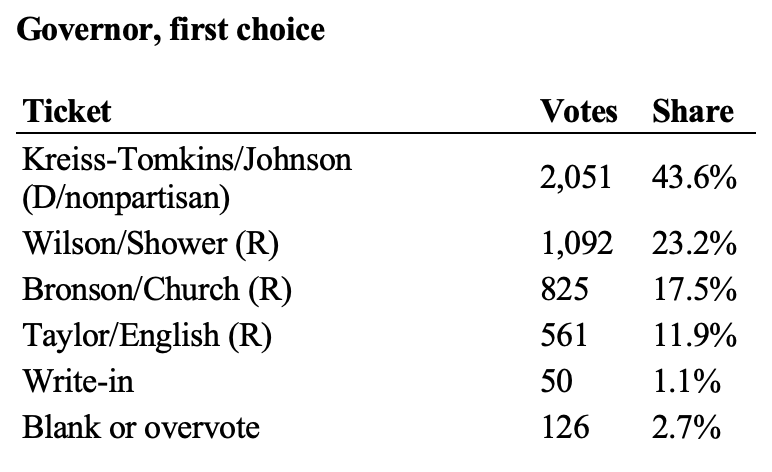
Also, the decoy Sullivan’s backers gave a higher proportion of their votes than Alaskans overall to the three Republicans in the race for governor (see below): 52.4% vs. 49.7%.
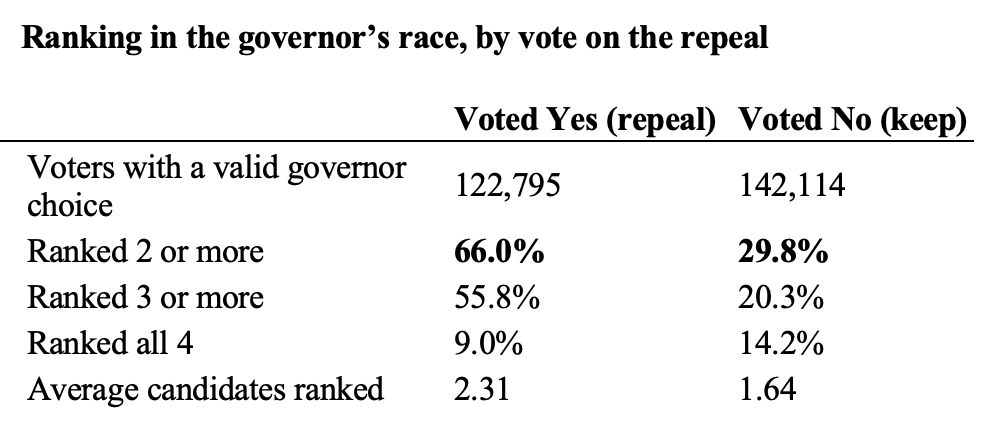
| The cast vote record data also discovered that twice as many voters who favored a repeal of ranked choice voting (RCV) made use of RCV in the governor’s race than voters who opposed repeal (see below). Part of the reason, almost certainly, was that three Republicans and just one Democrat were on the general election ballot, but clearly these voters were comfortable with RCV. | | |
The CVR can also be used to project the outcome of races. The New York Times, just two days after the vote used CVR data in an analysis that found that “Mary Peltola is likely to keep her lead in the Senate race in part because of ballots she’d accumulate in ranked-choice tabulation from supporters of the other Dan Sullivan.”
According to an academic paper in 2025 by Shiro Kuriwaki of Yale and colleagues, other states that release CVRs include “Georgia and Maryland as well as the counties of San Francisco, California, El Paso County, Colorado, Leon County, Florida, Ada County, Idaho, Tarrant County, Texas, and Dane County, Wisconsin.”
The paper adds that “many other election officials have prohibited the release of ballot records. For example, election officials in Indiana, Missouri, and South Carolina have all denied requests for ballot records, and the North Carolina legislature recently turned back a legislative effort to publish them.”
Maine, a state that uses ranked choice voting in general elections, also releases CVRs. But because Maine uses RCV without an open primary to choose four or five finalists for the general election, ranked choice voting is nearly meaningless in that state.
In the critical race for U.S. Senator in Maine, for instance, only two candidates appeared on the ballot.
The cast vote record is a valuable tool for anyone doing serious election analysis – especially in races with instant runoffs.
| | |
Election Solutions Bulletin is a project of The Institute for Political Innovation. | | | | | |