|
Join Our List
|
 |
|
Please Like Us On Facebook!
|
 |
|
|
A wonderful way to feel the energy of Hawaii, strengthen the mind-body connection, gently tone your body and your core, and enjoy dancing to beautiful Hawaiian music. No experience necessary. Men, Women age 15 years and older welcome!
Tuesdays
11 am - 12 noon
Saturdays
11 am - 12 noon
Age 5 - 10 years old. Boys & girls welcome. Learn basic hands and feet motion and the stories of Hawaii.
Mondays
August 1, 8, 15
3 - 4 PM
Kahiko or classical hula is dance to Hawaiian chanting. It's a deeper dive into the stories of the dance, the translations and application to life. Prerequisite -
2 months Beginning Hula Classes or permission of
Kumu.
Age 16
years and older
Men and Women welcome
Wednesdays
8 - 9 pm
Dance to the melodic songs of Hawaii.
Men, Women aged 16 years and older
2 months experience or
Wednesdays
7 - 8 pm
All classes are held at our
sister organization:
38 Lake Street
Oak Park, IL.
For more information call 708-297-6321
or
email
Check our
for the most current
Schedule of Classes
|
4 Tahitian Beginner Classes
with Lori Murphy
Sept. 15, 22, 29 and Oct. 6th
7 - 8 pm
38 Lake St.
Oak Park, IL
|
|
|
|
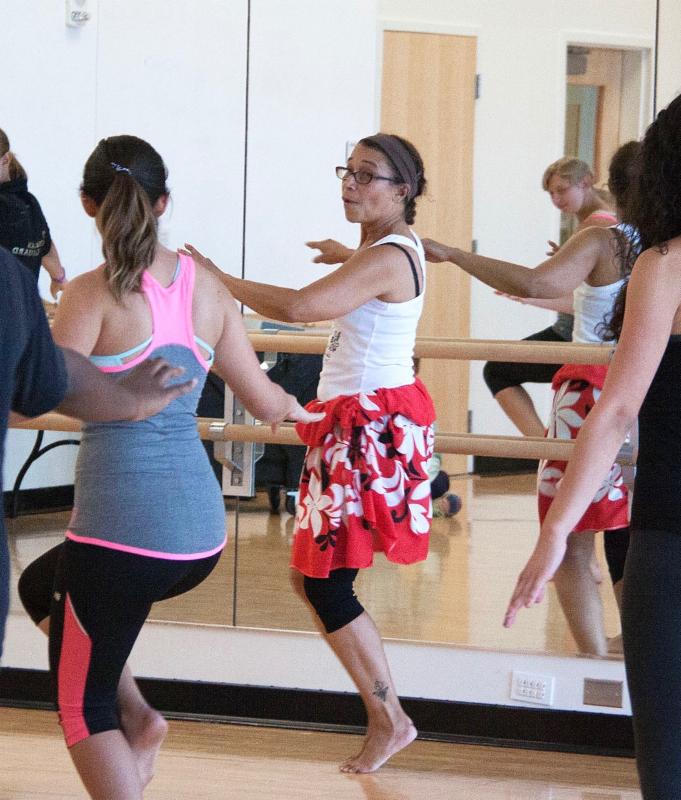
Lori Murphy teaching Tahitian at Purdue University last year
|
Join Lori Murphy for 4 Beginner Tahitian Classes! Youʻill learn basic fundamentals of Ori Tahiti (Tahitian dance) and practice routines that are age appropriate and fun! Youʻll learn Tahitian culture and history. Be prepared to get a good workout and have fun!
Instructor: Lori Murphy has been studying dance since college. She turned to Bellydance over 20 years ago and has been studying and performing Polynesian Dance since 2007.
Ages 15 and older. Dress comfortably.
4 Classes ONLY
Sept. 15, 22, 29 and Oct. 6, 2016
Cost $15/class or $50 for 4 classes
|
|
SAVE THE DATE!!!
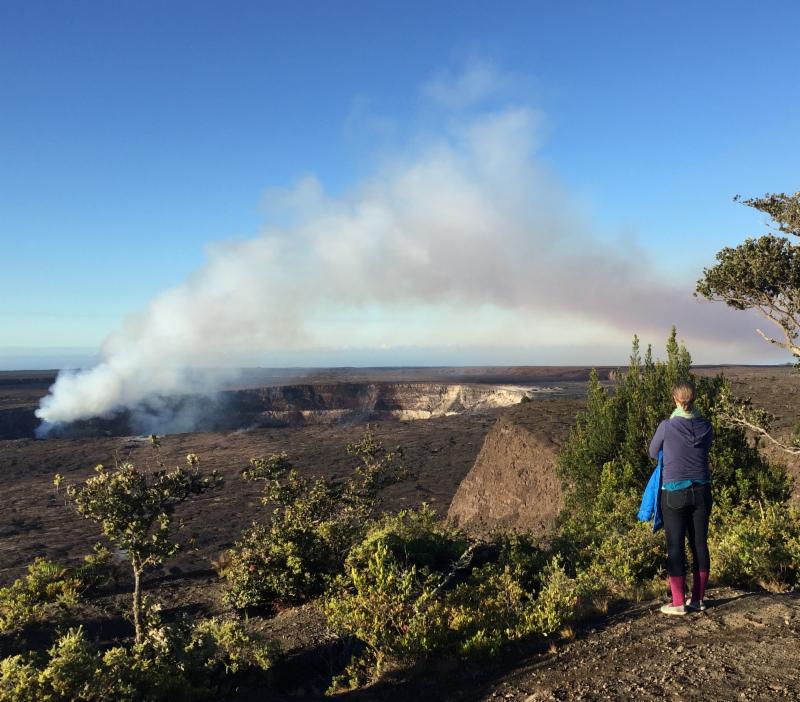
2-Day Meditation and Hula Retreat with Kumu Hula June Tanoue and
Rev. Jaune Evans
at Volcano,
Big Island of Hawaii
January 13 - 15, 2017
|
|
|
Mahalo Nui Loa!
|
|
We are so appreciative of all the kokua (help) that you give to Halau i Ka Pono!!! Mahalo nui loa (big thank yous) in August to: Lori Murphy, Julie Kase, Hoda Boyer, Nicole Sumida, Kailani and Mariko Yu, Tasha Fouts, Sarah Evans, Junko Kobayashi, Jaune Evans, Ricia Shema, Nicolee and Barry McMahon, Al and Rebecca Brislain, Rose Mattax, Red Hat Society, Our Lady of the Way Catholic Church, Alden of Lincoln Park, Yuka Fujita, Lorel Madden, JoEllyn Romano, Edward Leinartas and Tami Kauakea Winston.
|
|
|
|
|
 |
|
|
Na Kumu Hula Michael Pili Pang and June Tanoue |
Halau i Ka Pono is the name I chose for my hula school. It centers around the word "pono."
According to the Hawaiian dictionary pono means many things.... goodness, uprightness, morality, correct or proper procedure, excellence, well-being, true condition or nature. ʻIʻ means to or towards and ʻkaʻ means the.
Literally i ka pono means towards the goodness. And pono or goodness for me means to be balanced, to be "right" with yourself and your moral compass.
I remember my early training with Papa Henry Auwae in his laʻau lapaʻau (healing with plants and spirituality) classes. Pono was one of the main values he discussed in our first class in 1995. It makes sense that healers have to be pono - balanced in body, mind and spirit. Healers need to take care of and love themselves. Healers need to know what is the right thing to do in any situation and then do it. Pono includes clarity and wisdom. But is this value only limited to healers?
How do we cultivate pono? We have to look deeper into the meaning of pono to be able to understand it. Pono means realizing your kuleana (responsibilities) which includes traditional and current protocols or procedures. Then we must follow these procedures with disciplined intention. Pono blossoms when we are mindful and aware of our actions and how they impact others. Pono is also about courage and the ability to hold your own and not turn away when the going gets tough. Pono is about profound respect for others. We are bound to make mistakes and when we do, we must be able to face them, make amends, and truly learn from our mistakes.
|
|
|
Photo by Ed Leinartas. |
For serious hula students who study with me I maintain five expectations - practices that help us to be Pono. When one is not pono, it is hard to be a good dancer.
On the surface the expectations seem simple enough. Iʻll mention one here - Hoʻolohe is to Listen. That seems easy enough to do. But if we go deeper and ask, "Can you hear the kupuna (ancestors) whispering in your ear?" Thatʻs another story. I really believe that you donʻt have to be Hawaiian to hear the kupuna guiding you.
But weʻll never get to that depth of listening with our minds full of judgments and anxieties about ourselves and others. Many of us fear failure and worry "What in the world will I feed my children tonight or how am I going to face my boss tomorrow?" The list and the noise grows.
Our habitual thoughts are very strong. It takes a powerful antidote to overcome such entrenched thought patterns. Some people turn to drugs and alcohol or binge-watching Netflix hoping to take the edge off.
But then there are other ways to relax - for instance communities like my Zen sangha. We just sit patiently and watch our thoughts come and then let them go. The more we sit, the more it disciplines our minds, increases patience, and enhances our ability to listen. Thatʻs called bearing witness or listening deeply to our thoughts without getting attached to them or feeling we have to "fix" anything.
Listening has to do with physically stopping our bodies. When we do that we sometimes notice that our bodies have stopped but our minds still speeds along. And thatʻs a good thing - good that at least we noticed! Our minds can seem impossible to stop much less slow down.
Thereʻs an idea that meditation is only about having a mind devoid of thoughts. But for everyday people like us itʻs not about stopping thinking altogether. Itʻs about sitting still, noticing our thoughts and returning to breath, over and over again. Returning to breath is becoming embodied and helps to "cool" the brain. Our thoughts begin to settle so we have room to think more deeply and clearly with less mental interference.
This is how we can truly be of better service to our families and our communities. Little by little as we see more clearly courage builds to do what must be done: to stop procrastinating, to stop turning away from difficulty, and to live what you know is pono.
Malama pono (take care of body, mind and heart),
June Kaililani Tanoue
Kumu Hula
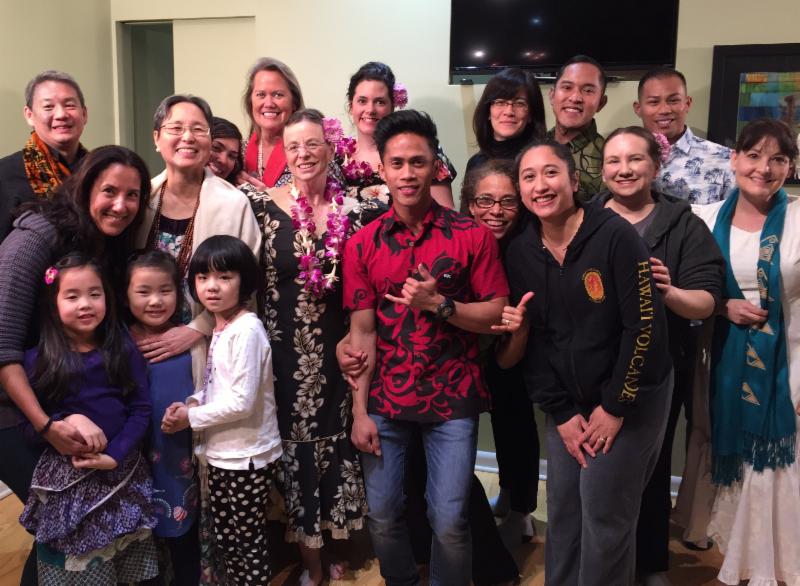
P.S. Here are photos from last monthʻs Hawaii Island trip. Here are professional photos of Halau Hula Ka Noʻeauʻs 30th Anniversary Homecoming by Tami Kauakea Winston.
|
|
|
|
|
|
|
|
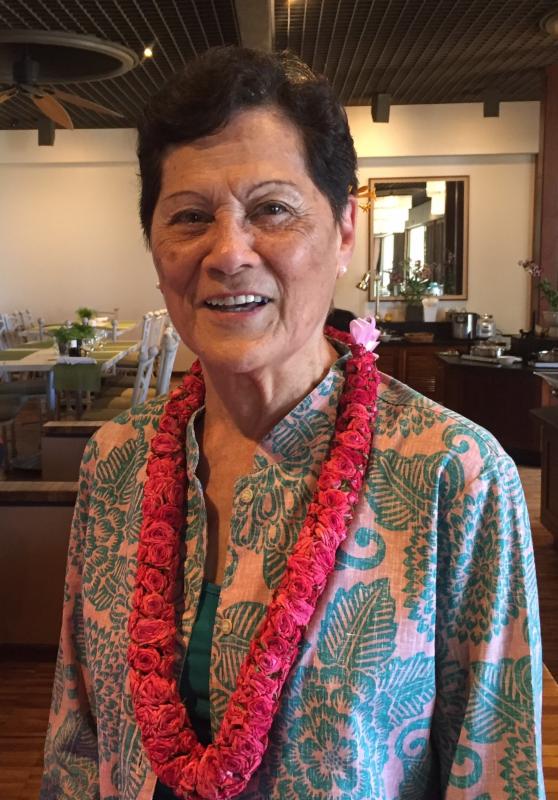
Kumu Hula Mae Kamamalu Klein at the Mauna Lani Bay Hotel
|
Mae Claire Marie Kamamalu Klein was born in May 1932 to William Christian Miller, Sr and Julia Ramos. Of Hawaiian, German and Portuguese ancestry, she grew up in the Kalihi area of Oahu.
Mae attended Sacred Hearts Convent, St. Francis Convent and Honolulu Business College. She worked for Crossleyʻs Hawaiian flowers for 2 years and the Bank of Hawaii for 11 years. She retired from Kamehameha Schools Kapalama Campus after 22 years of service.
Kumu Hula Mae Kamamalu Klein is my Hula Grandmother. She studied with Aunty Maiki Aiu Lake and she graduated my kumu Michael Pili Pang. Sheʻs been a judge at several Merrie Monarch Hula Festivals in Hilo, Hawaii.
Aunty Mae was at our recent 30th Anniversary Reunion in Waimea. She never missed our major performances and was at all three of my ʻuniki (hula graduation ceremonies). I remember after major performances she would say "another feather in your cap," a compliment along with a big hug.
She is a very important link in our hula genealogy. She shared this about herself recently.
Mae Kamamalu Klein: I took hula from Louise Beamer and Sally Woods Naluai from age 6-9 and canʻt remember much. Age 10 brought up by European and English Nuns. Met my husband Henry Klein and together started our family of girls.
I was led to "Maʻiki Aiu" in 1958 when I went in search of what it meant to be Hawaiian for my daughters. I observed this beautiful woman at an afternoon concert at "Kapiolani Park Bandstand" where her little ones were putting on a perform on a Sunday afternoon. I fell in love with her at that moment, she took my breath away. I enrolled my daughter the summer of 1959 at age 5 because she was able to write.
By this time I was fully engrossed in her teachings, and how she did it with much love and aloha for everyone. She brought the words to a song alive for me. It was through Aunty Bina Mossman that I joined the halau because she wanted me to be a part of her "Memoirs of Kaʻiiulani " I was Kaʻiulani as a 17 year old, can you imagine this?
From 1959 through 1984 until her passing on June 19, l984 with the exception of 2 yrs. 1970 - 72 that I was with Hoakalei Kamauʻu and Iolani Luahine. It was interrupted when I was told by them that I had to return to help Aunti Maiki with her 1972 graduates ----sooo, I did graduate in 1973 as a Kumu Hula and became her Kokua Kumu from then till her last class in 1983 and then her passing in 1984.
Everything that I am and do in hula I try to carry Maikiʻs teachings and I have tried very hard to pass it on to all of my teachers, as I promised her on June 15, 1984, four days before her passing and after being on the phone for 3 hours that I would do that. Not only her auana (modern) hula but especially the rituals of ʻuniki (graduation).......it has been a fantastic 25 years.
June Tanoue: I know you donʻt only look at the finished product. What else do you look for when you see a hula dancer in the lineage of Maiki Aiu Lake?
Aunty Mae: I look for the mannerism, attitude, lei and styles of costuming, and respect for each other. I was very pleased with the outcome because Michael did listen to me when I said it has to be the Waimea Kumu only and their halau (schools) because you people were his beginnings and where he did his best I believe. I saw bits and pieces of Maiki in each one of you. And it was nice to see every school represented - unity and healing. There was no ego. He will never have another group like Waimea, honestly. He knows that too.
Continue to share from the heart. Master Hong, my Qi Gong teacher, says that hula has a lot of healing with its words and movements. The Chi is always positive.
|
|
|
About Us
|
|
|
Successful Halau Fundraiser with Hawaiians Kumu Michael Pili Pang, Keikilani Curnan, Davin, Al, Ryan
|
Halau i Ka Pono means School that Cultivates the Goodness. We teach Hula which we define as the art of Hawaiian dance expressing all that we see, hear, taste, touch, and feel.
Hula and healing go hand in hand in our Halau. The dance connects us to the grounding energy of the earth and opens us to the warm spirit of Aloha (love).
Come join us! We have wonderful introductory classes for adult beginners! No experience necessary.
Contact Kumu June at june.tanoue@zlmc.org for more information. May your lives be full of aloha blessings!
|
|
|
|
|