|
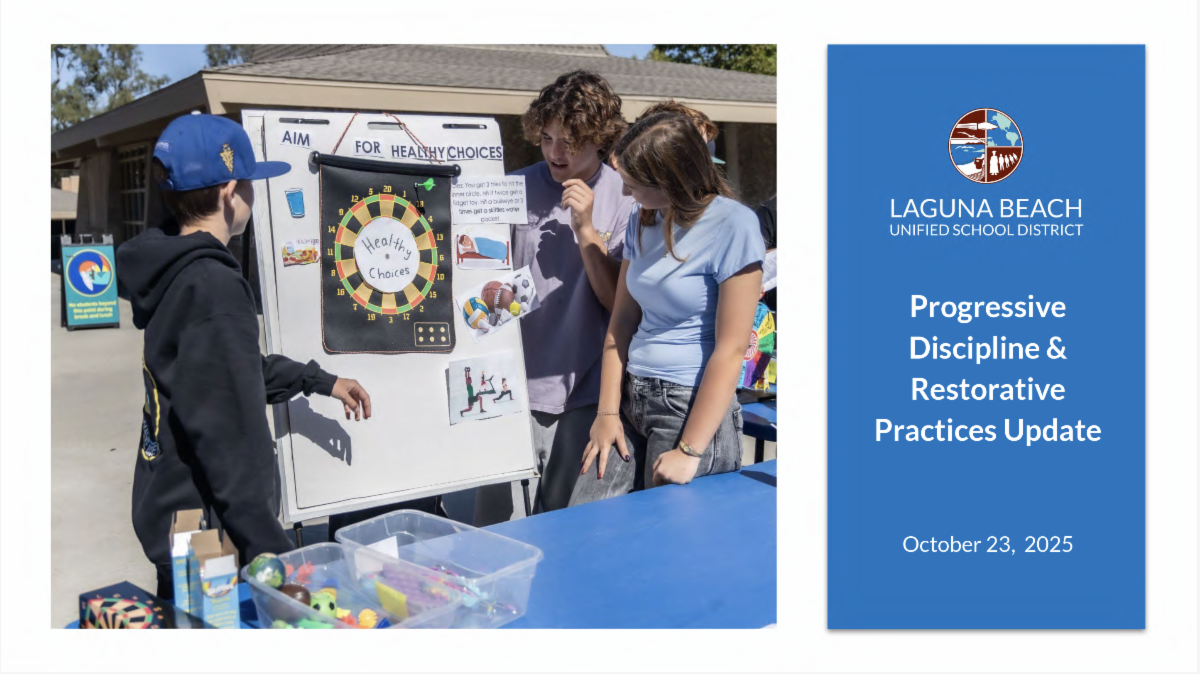
During the October 23 board meeting, staff presented an update on progressive discipline and restorative practices in LBUSD schools. In alignment with Board Policy (BP) 5144 – Discipline and 5144.1 – Suspension and Expulsion/Due Process, the District implements a progressive discipline system integrated with restorative practices to support students in developing the social, emotional, and behavioral skills necessary for lifelong success. According to Chad Mabery, Ed.D. Assistant Superintendent of Instructional Services, “The District is committed to fostering safe, inclusive, and equitable learning environments that promote positive student behavior and emotional well-being.”
A progressive discipline system is a growth-centered approach that focuses on early intervention, relationship-building, and accountability. It is grounded in research and the belief that behavior is learned and can be changed through consistent expectations, clear communication, targeted interventions, tiered consequences, and supportive adult-student relationships. Rather than relying solely on punitive consequences, the system emphasizes opportunities for reflection, restitution, and personal growth. The progressive component is evidenced when disciplinary responses are tiered, ensuring that interventions are proportionate to the behavior and designed to address the root cause while maintaining a student’s connection to school. “The work in restorative practices is part of a broader effort to create coherence across our schools, ensuring that every student feels a sense of belonging and every staff member has the tools to respond with care.” shared Michael Keller, Ed.D., Director of Social Emotional Support. “When our full team of teachers, staff, administrators, and families leads with humanity, we strengthen learning, safety, and connection for everyone.” Dr. Keller added.
During the presentation, the board heard examples of these practices in action from both Thurston Middle School and Laguna Beach High School. Joe Vidal, Principal of Thurston Middle School explained that restorative practices complement the progressive discipline approach by providing a structured process for repairing harm, restoring trust, and rebuilding relationships when conflict or misconduct occurs. Students are encouraged to take responsibility for their actions, understand their impact on others, and participate in solutions that promote healing and community. Restorative approaches include proactive community-building circles, restorative conversations, and formal restorative conferences when harm has occurred. Mr. Vidal shared how Thurston Middle School implements a tiered support and continuous improvement system which involves the use of data, school-wide universal supports, and an escalation process when more intensive supports are needed. The school includes students in the system with peer-to-peer mediation, small group and individualized counseling, peer court, and student recognition for improved behaviors. They closely monitor results through a variety of data collection methods.
Laguna Beach High School applies a similar approach according to Principal Jason Allemann Ed.D. Their focus is on prevention, intervention and restoration. “A critical part is our student needs assessment which really helps identify students who may need additional support early and allows students to do the steps of preventative support before the restorative processes are in place.” Said Dr. Allemann. “We want to build the skills for students to utilize to control their own behavior as young adults.” The high school aims to address the root causes of student behavior through reflection, dialogue, and support. Dr. Allemann emphasized that collaboration between students, families, counselors, teachers, and administrators ensures equitable and meaningful outcomes. LBHS also utilizes multiple data sources: attendance, academic performance, social-emotional indicators, and student self-reflection to evaluate the success of their discipline and restorative practices systems.
Concluding the presentation, Dr. Mabery explained that the integrated model reflects the District’s broader commitment to a Multi-Tiered System of Supports (MTSS) and to implementing social-emotional learning (SEL) and trauma-informed practices across all schools. The goal is to help students feel safe, respected, and supported, which in turn leads to increased engagement, reduced suspensions and expulsions, and improved school climate indicators.
To support the implementation of progressive discipline and restorative practices, the District provides ongoing professional learning for teachers, administrators, and support staff focused on progressive discipline, restorative circles, and positive behavior interventions. School sites have established structures such as classroom community meetings, reflection spaces, and peer mediation programs to support consistent and restorative responses to behavior. Early outcomes from implementing these practices show decreases in office referrals, improved attendance, and positive feedback from students and staff regarding school connectedness. During the presentation, staff reported suspension rates remain low, students report feeling safe and supported, and more students than ever say they have a trusted adult or peer at school. These are indicators the community values and supports the fundamental principles of dignity, respect, and personalized support.
“By emphasizing restoration, accountability, and support, this approach strengthens relationships among students, families, and staff.” concluded Dr. Mabery. Board members engaged in a dialog to understand further details about how the practices are implemented at each school and the training teachers receive. “Across the district, we are implementing a system that values reflection, relationships, and accountability. Our collective focus is on both prevention and intervention emphasizing our commitment to support student learning and ensure growth that will benefit students for a lifetime.” said Superintendent Jason Glass Ed.D. after the presentation.
|