Campaigning for Democracy And Socialism | |
|
Oct 25, 2024: The Week in Review
It's Finals Week: Time For A Crash
Course in the Philosophy of Praxis
| |
|
Once again we face a remarkable week full of tense complexities. At the top of the list is the studied assertion that the two presidential campaigns are tied regarding the Electoral College vote, a dead heat well within 'the margins of error.'
Or so we are told. And it might even turn out to be a true forecast of the outcome. Biden's defeat of Trump in 2020 was on similar narrow grounds.
But we think there are deeper questions here, and they often turn on philosophical matters. Just today on 'Morning Joe,' the Washington Post's Eugene Robinson used 'existential' as the word of art about the possible outcome.
Joe Scarborough constantly carries on about 'Madisonian Democracy' as if it were a solution, rather than a contributing factor. Political philosophers know Madison was a republican who abhorred democracy as an evil to be avoided. He gave us the Electoral College to give undue weight to the slavocracy, and a vastly restricted franchise favoring white men of much property. He opposed a 'Bill of Rights' and only caved on the matter at the last moment, rather than see the constitutional project crash altogether.
But let's get back to Robinson's 'existential dread' a la Soren Kierkegaard, the Danish pivot between Germany's Hegel and France's Sartre. Then borrowing from Nietzsche, why are we staring into the abyss of uncertainty? Can't we know anything?
Thus we come to epistemology, the ten-dollar word for 'theory of knowledge': how do we know, and not know, about ourselves, our world, even our cosmos? Here our 2nd President, John Adams, offers a bit of American philosophy: "Facts are stubborn things; and whatever may be our wishes, our inclinations, or the dictates of our passion, they cannot alter the state of facts and evidence." Put Adams in shorthand, 'seek truth from facts,' and you find a good string of philosophers echoing the maxim: John Dewey, Mao Zedong, Deng Xiaoping, just to name the more famous.
When asked about Trump's disregard of facts, Kellyanne Conway, then his publicist, replied that her team had 'alternative facts.' She was ridiculed and dismissed for it at the time, but in philosophical way, whether she understood it or not, she was on to something.
That 'something' is rooted in what we call phenomenology, a 20-dollar word for studying the structures of human experience that are directly given to us. At the same time, it takes the idea of an ultimate objective reality that exists apart from our knowing it, and puts brackets around it, then places it on a dusty shelf.
Now we're getting to our current crises. Phenomenology today, we would argue, is very relevant but vastly transformed by the information revolution. Since the turn of the century, billions of human beings everywhere are walking around with a device--a combination of a TV, a telephone, and a powerful computer--that fits into a shirt pocket.
Besides the wonder of it, why does it matter? Because it has destroyed the 2nd Wave mass media that shaped every presidential campaign from George W. Bush back to Abraham Lincoln. That old media operated as 'one to many,' or 'one producer, many consumers.' A bit of it still lingers, but today's media is 'many to many,' meaning everyone is both producer and consumer. A single example will do: the young girl on the sidewalk in Minneapolis recorded the entire murder of George Floyd, then published her effort by uploading it to the internet, where it went viral globally within an hour.
Our consciousness, then, is both social and mediated from the get go. It is also 'demassified' and fragmented. But we are not atomized. We group ourselves into clusters, and if we do so or not, powerful 3rd Wave sellers of advertising--Facebook, Fox, The New York Times and many more--will assign us to a cluster of their making, the dozen or so 'media siloes' we see every day.
Media siloes bring us back to one infamous phenomenologist and great uncle of existentialism, Martin Heidegger, infamous because he became a Nazi. In his classic, 'Being and Time,' he introduces a new term for being human, 'Dasein,' or 'Being there.' We are not an abstract 'I think, therefore I am.' We are always thinking and being somewhere, we are an 'In-der-welt-sein,' beings cast into a given world where we dwell. In this reminds you of JD Vance's new concept for being an American, good for you. You nailed it.
This finally brings is to the 'lifeworld' ('Lebenswelt' coined by Heidegger's Jewish teacher, Edmund Husserl). Our media silo shapes our lifeworld, along with other inputs. It's why two families living on the same block and working similar jobs can be in two very different lifeworlds--for example shaped by Fox or by MSNBC--and not be able, except with difficulty, to speak with each other civilly or grasp what each other considers obvious.
The implicit power of shaping the lifeworld is why Eugene Robinson, trying to understand the Trump cult's bloc, is full of existential dread. He could be thinking of Sartre's famous play, No Exit, which ends on the note, 'Hell is other people.'
For the left, this is the new challenge of our time. We are the 'abolition democrats' of Lincoln's 'of the people, by the people, and for the people.' To transform and change our 'lifeworlds,' we must first understand them. The educators must be educated.
That's why we take these dives into philosophy. We find a study of Gramsci very helpful, especially his notion of 'conflicted consciousness' as a condition we all share, and one that divides into two, common sense and good sense. In Italian, common sense just means 'ideas widely held,' not our American sense of practicality. Common sense varies, but it's still 'all the old muck' (Marx) that keeps us in a given silo. Good sense is what we learn from science and solidarity in struggle. It can help us get out of our silo, and even take them all down for a new beginning. Keep hope alive.
[All LeftLinks editorials, unless otherwise designated, express the views of our stalwart editor, Carl Davidson, and not necessarily any organizations he is connected with. Everyone, of course, is welcome to steal them and shamelessly pass them around, far and wide, with or without permission. A thank you note would be welcome, though!]
| | | |
|
WE ARE INVITING FEEDBACK!
Please send us your letters, comments, queries, complaints, new ideas. Just keep them short and civil. Longer commentaries and be submitted as articles.
Click Here to send a letter
DIFFICULTY READING US?
View as Webpage
Food for thought: Our weekly format is missing too much of vital ideas in the news. What do you think of 'Daily Extras!' once or twice a week?
We're also considering 'Friday Night at the Movies' for 1940s Noir classics, as well as vital new films yet to gain top Hollywood status. Would you project us from a laptop onto your big screen TV and invite friends for popcorn and a 90-to-120 minute show?
Let us know.
|
We're going to try something new, and you are all invited.
Saturday Morning Coffee!
Started in August 2022, then going forward every week.
It will be more of a hangout than a formal setting. We can review the news in the previous days' LeftLinks or add a new topic. We can invite guests or carry on with those who show up. We'll try to have a progressive stack keeper should we need one.
Most of all, we will try to be interesting and a good sounding board. If you have a point you would like to make or a guest to invite, send an email to Carl Davidson, carld717@gmail.com
Continuing weekly, 10:30 to Noon, EDT.
The Zoom link will also be available on our Facebook Page.
Meeting ID: 868 9706 5843
Let's see what happens!
|  | |
Barbara Dane, Presente!
The US singer-songwriter, who has died aged 97, encountered Louis Armstrong and more as she championed civil rights as much as music. In her final interview conducted last week, she explained why she was still angry
By Gath Cartwright
The Guardian
Oct 21, 2024 - As a singer-songwriter who was as devoted to social change as she was to her craft, Barbara Dane, who has died aged 97, is a singularly inspiring figure in American music. Amid a crop of reissues and a new film, I spoke to her just last week over the phone as she was cared for in a home hospice in Oakland, California, due to heart disease. As a singer, songwriter and activist over almost 80 years, finding kinship with everyone from Bob Dylan to Louis Armstrong, she demonstrated formidable quantities of courage and compassion, as documented in that new film, The 9 Lives of Barbara Dane.
“This is the end,” Dane said when I tentatively asked how she is. “I struggle to breathe. My time ain’t long.” In US folk and blues circles, Dane was venerated for breaking down racial and gender barriers and never compromising. “She’s always been a role model and a hero of mine – musically and politically,” Bonnie Raitt, one of Dane’s many famous admirers, has said. A Dylan blurb graces the cover of her 2022 autobiography: “Barbara is someone who is willing to follow her conscience. She is, if the term must be used, a hero.”
In the UK, her star is rather lower: she is best known for Northern soul anthem I’m on My Way, recently reissued as a 7in. Dane made the 1960 recording with industry mavericks Lee Hazlewood and Lester Sill. “It was very straightforward,” she said. “When I heard the finished record, he’d gone and added horns and transformed it into a dance tune. It got me some airplay but I never gave it much thought until I heard how crazy they were for it in England. Then Samsung used it to soundtrack a commercial and I got paid royalties for the first time – Lee and Lester never paid me royalties.”
Dane was born and raised in Detroit, the eldest child of a pharmacist who publicly admonished nine-year-old Barbara for serving a soda to a Black man in his drugstore. The humiliation of her and the customer set Dane on a lifelong path fighting racism and injustice. A teenage communist, she began singing folk, then blues (“female blues singers wrote and sang about their lives with such feeling and directness”). In her remarkable autobiography, This Bell Still Rings: My Life of Defiance and Song, Dane recalls encounters with Woody Guthrie, Big Bill Broonzy, Pete Seeger, Earl Hines, Jack Teagarden, Count Basie, to name but a few.
Dane released her debut album, Trouble In Mind, in 1957 – “Bessie Smith in stereo” declared British jazz critic Leonard Feather – and, in 1959, Louis Armstrong, having shared the stage with her, invited Barbara to join him on a TV special. “Did you get that chick? She’s a gasser!” Armstrong would declare to Time magazine.
Relocating to New York City made Dane the unintentional godmother of Greenwich Village’s burgeoning folk scene. Inevitably, she befriended Dylan: “He used to turn up on stage uninvited when I was singing!” she said. Dylan would play her his new songs, “an enormous talent hidden inside an endearing young scallywag”. An actor plays Dane in forthcoming Dylan biopic A Complete Unknown but she disdains celebrity. “Bob was hungry for fame and that never interested me..." ...Read More
|  | |
Gustavo Gutiérrez, Presente!
'Father' Of Liberation
Theology, Dead At 96
Peruvian theologian Gustavo Gutiérrez, founder of the liberation theology movement, which sparked both great hopes and controversies within the Catholic Church, passed away October 22 at the age of 96.
By Vincent de Féligonde
(with Martine de Sauto)
La Croix
October 23rd, 2024 - Peruvian priest and theologian Gustavo Gutiérrez, considered the “father” of liberation theology, died October 22 at 96. On his 90th birthday in 2018, Pope Francis thanked the priest “for all your efforts and for your way of challenging everyone's conscience so that no one remains indifferent to the tragedy of poverty and exclusion.”
Born on June 8, 1928, in Lima, Peru, into a modest family, Gutiérrez suffered from osteomyelitis (bone infection) as a teenager, which often confined him to bed and led him to read extensively, including Pascal, Giovanni Papini’s History of Christ, and the psychiatrists Karl Jaspers and Honorio Delgado. Once recovered, he began studying medicine and philosophy with the intention of becoming a psychiatrist.
Theology at the Catholic University of Lyon
However, as a member of the Catholic University Movement, he was troubled by "questions about his faith" and decided, at the age of 24, to become a priest. His bishop, considering him too old for the seminary, sent him to Europe. At the Catholic University of Louvain in Belgium, he learned French and wrote a thesis on Freud, before continuing his studies in theology at the Catholic University of Lyon.
There, he met the Sulpician exegete Albert Gelin, as well as theologians such as the Jesuit Gustave Martelet and the Dominican Marie-Dominique Chenu, who would become one of the experts at the Second Vatican Council. He was also influenced by other Dominicans like theologians Christian Duquoc and Claude Geffré, as well as Louis-Joseph Lebret, the inspiration behind St. Paul VI's 1967 encyclical Populorum Progressio, which addressed human development.
How to tell the poor that God loves them?
Ordained as a priest in 1959, Gutiérrez became a vicar in a parish in the poor neighborhood of Rimac in Lima. Simultaneously, he taught at the Pontifical University in Peru and at various universities in Europe and North America. One question constantly concerned him: how to tell the poor that God loves them?. ...Read More
|  | |
Media Matters Research Roundup:
Right-Wing Media Spread Misinformation About Hurricane Helene, Noncitizen Voting, And More
Check us out here
| |
Currently, only 17 leaders in Congress have demanded the U.S. halt arms transfers to Israel,
And ten out of the twelve House members are Justice Democrats incumbents.
| |
Your Cheat Sheet to the 2024 General Elections
Guides you through more than 500 elections up and down the ballot, and why they matter.
On this page, we have identified 520 elections (and counting) up and down the ballot, and why they matter. ...Read More
| |  |
|
LAST THOUGHTS ABOUT THE ELECTION and FIRST THOUGHTS ABOUT WHAT NEXT
October 28 2024,
8 pm Eastern
Committees of Correspondence's
Socialist Education Project. and its
4th Monday Webinar
This '4th Monday' is the last chance before the elections for us to have a conversation about where the United States is going politically--war, the climate, economic insecurity, race and gender, and the democracy as a system we would like to save and improve.
We on the left have much experience, wisdom, and a diversity of ideas about where we would like to go in the future.
This SEP webinar is specifically designed to give all CCDS members and participants the opportunity to share their thoughts about the nearing election and what comes next.
Please attend and share your thoughts. Each and every one of you will be panelists in this never ending puzzle on the future of the US, the globe, the climate, and the human race.
Register for the webinar HERE
|  | |
Sign Up HERE To Get Started
By signing up, you agree to receive occasional emails and/or automated texts with poll worker news and alerts from Power the Polls (via 70933). Recurring messages. Reply STOP to cancel or HELP for more information. Message and data rates may apply. Visit here for Terms and Conditions and Privacy Policy
| VoteVets - Jeff Crosby, Son of WW2 'Master of the Air' Speaks Out: VOTE AGAINST TRUMP! |  | 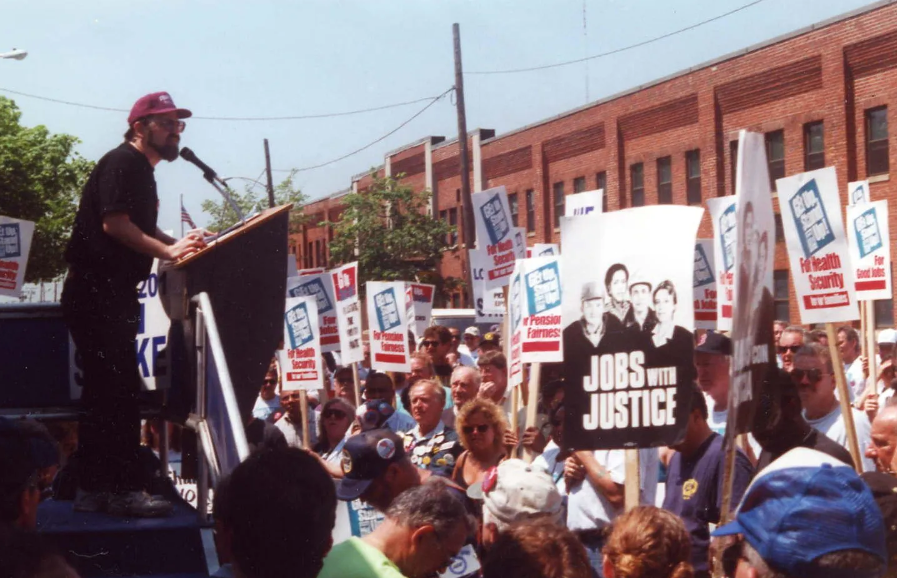 | |
Manufactured Dreams
Trump's promises to workers are a pipe dream. But the Left needs to develop our working-class narrative.
By Jeff Crosby
Liberation Road Newsletter
Oct 23, 2024 - The united front to defeat Trump and the resurgent New Confederacy requires all hands on deck, the broadest possible forces. But at this moment, to build an alternative to the MAGA fascist movement, the heart of the battle is a fight to win the working class, with its own organizations and narrative.
We fight over material things, battle after battle. Then there is the fight over ideas, the fight to create a hegemonic narrative of our own. Our story. In this battle too, the wealthiest have had the advantage. In this election and in the next decade or two, a major part of the fight will be over the place and history of the manufacturing decline over the last 50 years.
The material and social impact of free trade and neoliberalism still haunts the dreams of millions of working-class people who lived through the decline of manufacturing in the US. Who will interpret these dreams, created in steel and hard work, realities and myths, truth and lies? The memories of good jobs lost, the dreams of good jobs in the future?
Working at GE as the Buildings Fall
I punched in as a grinder at General Electric in Lynn, Massachusetts, in February of 1979. Margaret Thatcher was elected in June, Ronald Reagan in November. In the 30 years that followed, GE was among the top two or three corporations by value in the world. Fortune magazine named CEO Jack Welch the “Manager of the Century,” but GE workers called him “Neutron Jack,” after the neutron bomb that could destroy human beings while keeping buildings intact. Local 201, a great union since its birth in 1933, continued the fight for our members’ livelihoods.
Jeff Crosby started at GE in 1979
Then in 1993 came the North American Free Trade Agreement (NAFTA), which eliminated tariffs on trade among Canada, Mexico, and the United States, allowing for the unfettered movement of capital and foreign investment. NAFTA was the single biggest culprit of deindustrialization, increased income inequality, weakened unions, and shorter life span for working class people. It has come to signify all the free trade agreements that followed, part of the neoliberal trifecta of deregulation, privatization, and free-trade—and its ideological running mate, dog-eat-dog individualism.
After NAFTA, every union negotiation with GE, local and national, was carried out under the real threat of plant shutdowns and work transfers to Mexico. This had a huge impact, far beyond the jobs that were actually moved. We survived remarkably well: Today, 1,300 members build aircraft engines in Lynn in what is a “good job.” But still: we lost our defined benefit pension, accepted an extended pay progression to get to the top scale (reduced in subsequent negotiations), and saw our medical plan deteriorate. So I got an up close and personal look at the systematic destruction of manufacturing.
The city of Lynn, too, was hollowed out, just like US corporations were. Its main street was abandoned, crime rose, pay dropped or stagnated, and every health measurement declined.
There is more than one reason for that, of course. The shopping malls sucked the life out of Lynn’s small businesses in the 1960s, and all seven theaters closed. A planned interstate highway leveled a multiracial neighborhood in the center of town known as the Brickyard, before construction was blocked by community resistance. Nevertheless, the city was fairly healthy until the early 1980s. Then the GE jobs began to leave: to Mexico, to China, to Hungary, to India, everywhere. Jack Welch bragged that he would “put every plant on a barge” if he could. If a community or a union got a toehold of security against the corporation, GE would just move to greener pastures with more exploitable workers, wherever that might be. Capital is mobile, workers not so much. Lynn GE was a microcosm of the national story writ large. ...Read More
|  | |
The success of the battle for the future of American Democracy-the struggle for progressive values-the battle between democracy and autocracy-between hope and fear-will not be determined entirely by the merits of our values or even the strength of our conviction.
It will be determined by how well American progressives organize to promote those values. It will be determined especially by how well we execute the nuts and bolts of election campaigns.
This book is about the fundamentals. It's about execution.
It's about the fundamentals of great electoral organizing, effective political communication, understanding the self-interest of the voters, political fundraising, using social media and other new technologies, creating high intensity field programs, voter mobilization, the qualities of great organizers.
It is a step-by-step field manual for how progressives can win electoral campaigns - and a textbook for anyone who wants to know how electoral politics really works.
Go here to purchase
| 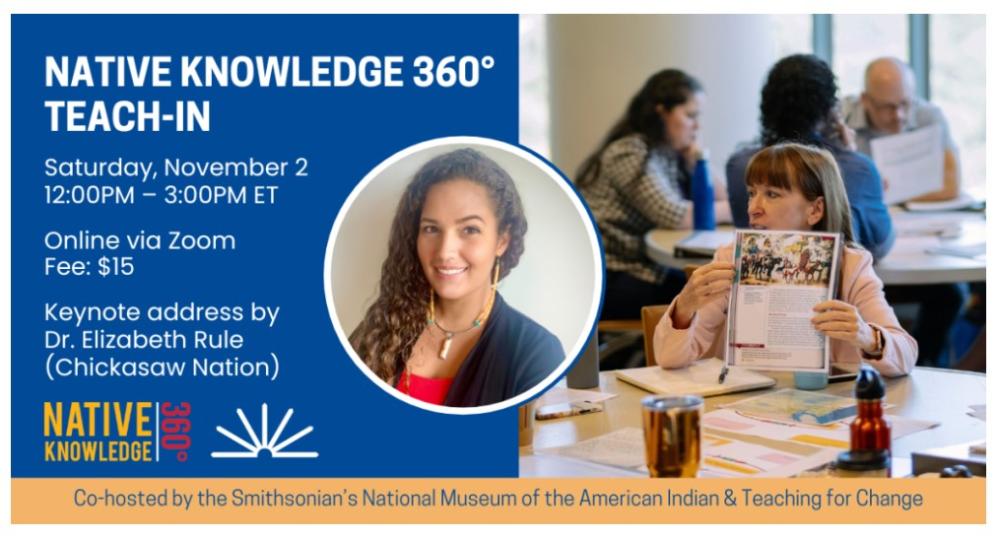 | |
Native Knowledge 360° Teach-In
Saturday, Nov 2
12:00PM – 3:00PM ET
Online Via Zoom
Join the Smithsonian’s National Museum of the American Indian (NMAI) and Teaching for Change for a day of online conversation, curriculum highlights, workshops, and idea exchange — preceded by a keynote by Dr. Elizabeth Rule (Chickasaw), public scholar, policymaker, and author of Indigenous DC: Native Peoples and the Nation’s Capital.
Teachers select two workshop breakout sessions that include relevant and resource-rich experiences to support effective use of American Indian-focused classroom lessons and resources from Teaching for Change and NMAI. Teaching for Change and NMAI museum educators will share key concepts from NMAI’s Essential Understandings Framework, children’s literature from Social Justice Books, and classroom materials from NMAI’s Native Knowledge 360° education initiative. See highlights from the 2023 Teach-In.
Register Here
|  | |
This is a syllabus for an
in-depth study of the
Block & Build strategy.
Convergence Magazine, along with many other social justice groups, believes this strategy best addresses the challenges of the current moment.
The main dynamic shaping this moment is the drive by a powerful right-wing bloc to impose authoritarian rule and a white Christian Nationalist agenda on the country. This bloc, gathered under the banner of “Make America Great Again” (MAGA), has already captured the Republican Party and the Supreme Court, and holds trifectas (governorships and legislative majorities) in 22 states.
The drama being played out today centers on whether MAGA will succeed in gaining full federal power in 2024 or soon after; and, if they are beaten back, what will be the character of the anti-MAGA governing coalition.
The strategy elaborated in this syllabus is aims to block MAGA’s bid for power and while doing so build enough independent progressive clout to start the country down the road to a robust multiracial, gender-inclusive democracy and an economy that works for all on an environmentally sustainable planet.
To help participants grapple with the dramatic impact the Gaza crisis has had on US politics, Convergence added a special session to this study.
Click here for the syllabus
| | |
Last Week's Saturday Morning Coffee | |
News of the Week, Plus More
| |
|
Photo: Trump pretending to work at McDonald's Win McNamee/Getty Images...Trust us—you don’t want more of this guy in your life.
Fascism Is a Kitchen Table Issue Too
Yes, Kamala Harris, of course Trump is a threat to American democracy. But voters need to know how it affects them.
By Alex Shephard
The New Republic
As she delivers her closing argument in the final week-plus of the presidential campaign, Vice President Kamala Harris is increasingly centering her pitch around a warning: Donald Trump is not just a danger to the country, but a “fascist.”
The shift in tone comes as a reaction to two alarming recent stories. In three interviews with The New York Times published Tuesday, former Trump chief of staff John Kelly said that the former president “certainly falls into the general definition of fascist.” The same day, The Atlantic revealed that Trump had said that he needed “the kinds of generals Hitler had” to unquestionably follow his orders.
Harris picked up what Kelly put down. On Wednesday, she said these reports were “further evidence for the American people of who Donald Trump really is.… We know what Donald Trump wants. He wants unchecked power.” Later that day, when asked if she thought Trump was a “fascist” during a CNN town hall, Harris said that she did. On Thursday, the Democratic National Committee announced it had paid for a billboard with Trump’s quote about Nazi generals to go up outside the location of one of his upcoming rallies.
The tonal shift is not surprising. For one thing, it mirrors closing arguments made by Hillary Clinton and Joe Biden in 2016 and 2020, respectively, about the risk Trump posed to democracy. For another, a former chief of staff calling their ex-boss a “fascist” is a big deal, and speaking admiringly of Hitler—as Trump reportedly has on several occasions—is generally something most people disapprove of. Most important, Trump really is a threat to democracy, and he makes no secret of what he hopes to do if he returns to the White House: deport millions, politicize and weaponize the federal bureaucracy against his “enemies within,” and trample over every guardrail that could check his power.
As closing arguments go, it’s … fine. It worked in 2020, and may well again. But it also feels oddly thin. While Trump is truly an authoritarian, the threat he poses isn’t just to democracy. His fascism will have a material and destructive effect on people’s lives. It’s not enough to just call him a “fascist”—or even to just point to his praise for Hitler and other dictators. It’s incumbent on Harris and her running mate, Tim Walz, to explain what that would mean for voters themselves.
Writing in his newsletter earlier this month, veteran Democratic strategist and pollster Michael Podhorzer argued that Harris’s campaign was struggling in part because voters were underrating the threat of Trump’s reelection. Four years ago, Podhorzer wrote, “Biden won the key Electoral College states because enough of those who were not enthusiastic about voting for Biden were sufficiently motivated by the prospects of a second Trump term to vote against Trump.” Currently, however, “evidence suggests that many of these same voters are less alarmed than they could be about the consequences of a second Trump term.”
Harris’s argument that Trump is a fascist is aimed at reaching these voters. Her embrace of Trump’s Republican critics, notably her many appearances with former GOP Representative Liz Cheney, is best understood as a way of legitimating it. Voters might shrug off Democratic warnings as electioneering, but, according to this line of reasoning, they are more genuine coming from Republicans.
It is not clear that this approach has actually worked. The race has barely moved since Harris started barnstorming with the deeply unpopular Cheney—indeed, it seems to have moved toward Trump during that period. And there are few Republican surrogates left. Kelly’s comments are alarming, but he is not expected to appear at campaign rallies. George W. Bush and Mitt Romney are not expected to endorse Harris, let alone stump for her. (Bush’s endorsement, particularly given Harris’s ongoing struggles with Arab Americans, could even do more harm than good.)
Harris’s problem isn’t just that voters are underrating the risk of a second Trump presidency, but that many view his disastrous first term with rose-tinted glasses. Trump has paid little to no price for his horrific mismanagement of the Covid-19 pandemic, and high inflation has made voters look back fondly on the comparable prosperity of 2017–19. Trump and his surrogates, particularly running mate JD Vance, have made the same case again and again: The Biden era has been one of high prices, global conflict, and unease; the Trump era wasn’t; and reelecting Trump will stabilize the world and the economy.
This is wrong. Trump inherited a strong economy—and did everything he could to sabotage it, both by passing a ridiculous, unnecessary tax cut for corporations and the wealthy and by very nearly stumbling into conflicts in Iran and North Korea that, unlike the ongoing ones in Ukraine and the Middle East, would have directly involved the United States. The day-to-day life of the Trump presidency was one of grinding anxiety and chaos—not stability and economic growth.
Harris is right to stress the larger, existential risks of Trump’s return to office, as she does when she says that a second term in office “would be worse” because “there would be no one to stop his worst instincts. No guardrails.” But that message can and should be extended further. Trump’s fascism would have direct material consequences for Americans. His tirades, whether on social media or on the world stage, move markets; they destroy faith in the country as an economic power. His return to office would empower craven billionaires like Elon Musk to run and remake large sections of the economy in their own interest. Harris can undercut Trump’s populism by reminding voters that he is, in fact, a plutocrat running in service of other plutocrats. His threat to democracy isn’t just constitutional. It would involve handing the reins of government over to a small cabal of terrible people... ...Read More
| |
|
Photo: ‘The movement persuaded … Democratic primary voters to write in “uncommitted” or leave their ballots blank … ’ Composite: Kevin Dietsch/Getty Images
Progressives Must Walk A Fine Line:
End The War In Gaza And Elect Harris
By Judith Levine
The Guardian
Oct. 2, 2024 - It’s sounds like an impossible dilemma for activists and organizers, but it isn’t. Progressives can and must do both
The war in Gaza is not high among most voters’ concerns. But for many Arab Americans and protesters of the war, it is. As election day nears and the margins tighten – and with the critical swing state of Michigan, home to the largest Arab American community in the nation, up for grabs – these people are among the small, scattered constituencies that could determine the results. This makes their political strategies crucial to the US’s – and, by extension, Palestine’s – future.
Some activists working to end the genocide are putting that urgent cause ahead of the other urgent cause: electing a Democrat, if only to prevent a Trump presidency. “If I’m going to be a one-issue voter and that issue is genocide, I’m okay with that,” a Dearborn, Michigan, woman told NPR’s Code Switch.
For these people, Harris’s repeated assertions that “far too many innocent Palestinians have been killed” – spoken in the passive voice and always accompanied by even louder assertions of commitment to Israel’s “self-defense” – no longer cut it. A progressive activist who is stumping for Trump in Michigan said there’s nothing the Democrat can do to change her mind. The administration’s collaboration in genocide is unforgivable; she wants the party punished. Her eyes are on the 2028 election, she said – apparently sanguine that there will be an election after the ascension of King Donald the First.
In Mondoweiss this month, journalist and activist Saleema Gul interviewed a dozen members of the Uncommitted movement in a post-mortem of its campaign and failure to secure a speaking slot at the DNC this summer. The movement persuaded three-quarters of a million Democratic primary voters to write in “uncommitted” or leave their ballots blank to signal that their support for Biden, now Harris, depends on a pledge to end unconditional military support to Israel.
Some of the people interviewed in the piece felt that the movement should have tried to influence the party platform in the primary process and quit there. Others believed that pushing for a speaker at the DNC distracted from organizing anti-war delegates inside the convention. After much debate, the leadership decided to endorse no one. Instead, it is urging supporters to “register anti-Trump votes” and not vote for a third-party presidential candidate. That move, wrote Gul, “has led many to believe the Uncommitted movement has prioritized shielding the Democratic Party over forcefully pushing for an end to the Gaza genocide”.
The debate within the uncommitted movement encapsulates the perennial tensions in all political organizing: radical change v incremental reform; grassroots activism v establishment engagement; insider work v outsider disruption; movement-building v election-cycle campaigns. But to put “versus” between any of the above is to misunderstand political strategy: that is, to presume that organizing is either/or.
In fact, you can do more than one thing at a time: organize for an arms embargo; get Harris elected; move the Democrats leftward; and build a radical pro-liberation movement.
That these tactics don’t always overlap does not mean they contradict each other. Grassroots movements move politicians, not the other way around. But grassroots movements labor for decades far from the centers of influence before policy makers code their ideas and demands – watered down, of course – into bills and statutes. The more local the politician, the more open their ears are to those demands.
For instance, in New York City’s safely Democratic congressional districts nine and 10, antiwar groups are asking voters to write in the name of Hind Rajab, a six-year-old Palestinian girl killed by an Israeli tank, instead of voting for the pro-Israel Democrats or any of the other parties’ candidates. The activists want to remind the Dems that their antiwar constituents are watching, without jeopardizing the party’s chances of winning back the House of Representatives. But presidential candidates are as far from the ground as candidates get – and this year a no vote for the Democrat holds potentially catastrophic consequences.
You could argue that electing a woman of color as president would be a radical step forward for the US. But Harris is no radical. In fact, presidential elections rarely lead to radical change. The big difference this time is that Trump’s election would.
The anti-war movement should not cease to pressure the Harris campaign to win their votes. Her supporters should not cease persuading anti-war voters to vote for her. Right now, a door is opening for both to happen.
Harris herself pushed the door ajar. In her interview with Fox News last week, she suggested for the first time that she might break with the Biden administration. “Let me be very clear,” she said. “My presidency will not be a continuation of Joe Biden’s presidency.” She pledged to bring “fresh new ideas” to the Oval Office.
One idea – not so fresh, but good anyway – would be to call for the US simply to abide by its own law: the Leahy Law, enacted in 1997, requires the state department to vet military forces receiving US aid for violations of international human rights law. If there’s credible evidence of such violations, the aid must be withheld.
Since 2000, former US senator Patrick Leahy has been pressing the state department to apply such scrutiny to Israel, which has remained practically exempt. In May, in the Washington Post, he reasserted the necessity of doing so now, citing violations in Gaza and the West Bank. A former associate general counsel at the Department of Defense told Al Jazeera that the president has no discretion in the matter. “It’s not up for negotiation. It is a binding domestic law on the executive branch,” she said.
The confirmed killing of Hamas leader Yahya Sinwar in Rafah this week opens the door even wider. The US can declare that Israel has decapitated its enemy. Although the Israeli prime minister Benjamin Netanyahu has never specified what would constitute victory, candidate Harris can credibly assert that Israel has achieved it. The US has fulfilled its responsibility to its ally. If Bibi wants to keep bombing Gaza, he’s on his own... ...Read More
| |
Kamala Weighs In on John Kelly Warnings about Trump ...7 min | |
|
Kamala Harris Has a Plan for Home Care—and FDR Would Love It!
Franklin Delano Roosevelt and Labor Secretary Frances Perkins saved millions of seniors from the poorhouse. Now, Kamala Harris has a plan to save them from another form of institutionalized care, the nursing home.
By Nancy J. Altman
Common Dreams
Oct 25, 2024 - Kamala Harris has a plan to expand Medicare to include home care. If Harris is elected president and signs her plan into law, it will be life-changing for millions of seniors and people with disabilities. Importantly, it builds upon President Franklin Roosevelt’s vision for a New Deal for the American people.
Vice President Harris should get enormous praise for her groundbreaking proposal. Long-term care is a looming challenge that’s barely getting discussed. Harris recognizes this challenge and is offering an important solution: Medicare At Home.
Harris’s Medicare At Home plan would expand economic security by creating a new universal benefit, in the grand tradition of President Franklin Roosevelt and his visionary Secretary of Labor, Frances Perkins.
In 1934, President Roosevelt considered adopting a comprehensive cradle-to-grave program of economic security. Ultimately, he decided to start more slowly and incrementally with what became the Social Security Act of 1935, which, among many other achievements, created Social Security and unemployment insurance. He recognized that Social Security was too important to risk failure by beginning too ambitiously.
A decade later, in 1944, having just been elected for the fourth time, FDR built on this legacy by calling for an economic bill of rights in his State of the Union address. This so-called Second Bill of Rights would give every American the right to comprehensive economic security, including a first–rate education; guaranteed employment at a living wage – “enough to provide adequate food and clothing and recreation”; a decent home; “adequate medical care and the opportunity to achieve and enjoy good health”; as well as “adequate protection from the economic fears of old age, sickness, accident, and unemployment.”
He understood, as Vice President Harris does, that people want the right, the ability, and the assistance necessary to age in place, with dignity and independence. In a capitalist system like ours, where working families are dependent on wages, economic security requires insurance against the loss of those wages, which Social Security and Unemployment Insurance provide. That is necessary, but it is not sufficient. Economic security and a decent and dignified life also require getting the care you need, including home care.
Medicare provides health care to Americans over age 65 and people with disabilities, but it has a huge gap: Long-term care. Most people think that Medicare covers long-term care, only to face a devastating shock when they (or a loved one) are in need of care.
Long-term care costs around $100,000 per year, so almost no one can afford it. Currently, the only program that covers long-term care is Medicaid. But unlike Medicare, which is universal, Medicaid is means-tested. As a result, seniors and people with disabilities are forced to “spend down” all of their assets, including property, before they can qualify for long-term care through Medicaid.
Sometimes, people must even divorce their loving spouses in order to qualify for long-term care coverage. And even then, after breaking up families and depleting their nest eggs, they may wind up in a dehumanizing corporate nursing home that exists to exploit patients for profit, because that’s still all they can afford.
In one heartbreaking instance, physicist Leon Lederman was forced to sell his Nobel Prize medal for $765,000 to pay for his care — and he still ultimately wound up in a nursing home.
Medicaid was not enacted as a long-term care program, but that is what it has become by default. And because it was not structured to be a long-term care program, it forces middle class seniors to bankrupt themselves so that they can receive care. It forces seniors and people with disabilities into nursing homes when they are healthy enough to remain at home.
This is a system that is fundamentally broken in this country. But Kamala Harris’s new plan for a universal Medicare At Home benefit would finally begin to change all that.
Those who have responsibilities for aging parents are also often caring for young children. Many other Americans are caring for a spouse while also dealing with their own health challenges. Kamala Harris’s Medicare At Home plan would benefit the entire family. It would empower seniors and people with disabilities who are healthy enough to age in place but can’t afford the care they need to remain at home.
Before the creation of Social Security, it was routine for parents to live with their adult children. Those who did not have children, or whose children were unable or unwilling to care for them, were forced into poorhouses.
FDR and Frances Perkins saved millions of seniors from the poorhouse. Now, Kamala Harris has a plan to save them from another form of institutionalized care, the nursing home.
Her plan is completely affordable because the Biden-Harris administration finally stopped letting Big Pharma rip Americans off. Kamala Harris would pay for this new Medicare At Home benefit, along with adding vision and hearing coverage to Medicare, with the savings from Medicare negotiating lower prescription drug prices. Big Pharma will continue to profit, just not at unconscionably exorbitant rates.
Seniors get to pay lower prescription drug prices, and also receive new hearing, vision, and home care benefits. And the so-called sandwich generation will have more time and resources. Moreover, states will benefit because the proposal will reduce their hard-pressed budgets, which are heavily burdened today by the long-term care costs funded by Medicaid. Harris’s proposal is a win-win for everyone (except for Big Pharma CEOs).
Kamala Harris’s Medicare at Home plan is a big step toward fulfilling Medicare’s promise of a simple, universal benefit. When she signs it into law, it will bring us far closer to the grand vision of full economic security first imagined by President Roosevelt and Secretary Perkins. ...Read More
| |
|
House in 1836 bans any discussion of anti-slavery petitions Image via Gage Skidmore/Flickr.
Many Wealthy Members Of Congress Are Descendants Of Rich Slaveholders
Written by The Conversation
Oct 25, 2024 - The legacy of slavery in America remains a divisive issue, with sharp political divides.
Some argue that slavery still contributes to modern economic inequalities. Others believe its effects have largely faded.
One way to measure the legacy of slavery is to determine whether the disproportionate riches of slaveholders have been passed down to their present-day descendants.
Connecting the wealth of a slaveholder in the 1860s to today’s economic conditions is not easy. Doing so requires unearthing data for a large number of people on slaveholder ancestry, current wealth and other factors such as age and education.
But in a new study, we tackled this challenge by focusing on one of the few groups of Americans for whom such information exists: members of Congress. We found that legislators who are descendants of slaveholders are significantly wealthier than members of Congress without slaveholder ancestry.
How slavery made the South rich
In 1860, one year before the Civil War, the market value of U.S. slaves was larger than that of all American railroads and factories.
At the time of emancipation in 1863, the estimated value of all enslaved people was roughly US$13 trillion in today’s dollars. The lower Mississippi Valley had more millionaires, all of them slaveholders, than anywhere else in the country.
Some post-Civil War historians have argued that emancipation permanently devastated slave-owning families.
More recently, however, historians discovered that, while the South fell behind the North economically immediately following emancipation, many elite slaveholders recovered financially within one or two generations.
They accomplished this by replacing slavery with sharecropping – a kind of indentured servitude that trapped Black farm workers in debt to white landowners – and enacting discriminatory Jim Crow laws that enforced racial segregation.
100 descendants of slaveholders
Using genealogist-verified historical data and financial data from annual congressional disclosures, we examined members of the 117th Congress, which was in session from January 2021 to January 2023.
Of its 535 members, 100 were descendants of slaveholders, including Democratic Sen. Elizabeth Warren and Republican Sen. Mitch McConnell.
Legislators whose ancestors were large slaveholders – defined in our study as owning 16 or more slaves– have a current median net worth five times larger than their peers whose ancestors were not slaveholders: $5.6 million vs. $1.1 million. These results remained largely the same after accounting for age, race and education.
Wealth creates many privileges – the means to start a business or pursue higher education. And intergenerational wealth transfers can allow these advantages to persist across generations.
Because members of Congress are a highly select group, our results may not apply to all Americans. However, the findings align with other studies on the transfers of wealth and privilege across generations in the U.S. and Europe.
Wealth, these studies find, often stays within rich families across multiple generations. Mechanisms for holding onto wealth include low estate taxes and access to elite social networks and schools. Easy entry into powerful jobs and political influence also play a part.
Privilege with power
But members of Congress do not just inherit wealth and advantages.
They shape the lives of all Americans. They decide how to allocate federal funds, set tax rates and create regulations.
This power is significant. And for those whose families benefited from slavery, it can perpetuate economic policies that maintain wealth inequality.
Beyond inherited wealth, the legacy of slavery endures in policies enacted by those in power – by legislators who may be less likely to prioritize reforms that challenge the status quo.
COVID-19 relief legislation, for example, helped reduce child poverty by more than 70% while bringing racial inequalities in child poverty to historic lows. Congress failed to renew the program in 2022, plunging 5 million more children into poverty, most of them Black and Latino.
The economic deprivation still experienced by Black Americans is the flip side of the privilege enjoyed by slaveowners’ descendants. The median household wealth of white Americans today is six times higher than that of Black Americans – $285,000 versus $45,000.
Meanwhile, federal agencies that enforce antidiscrimination laws remain underfunded. This limits their ability to address racial disparities.
The path forward
As the enduring economic disparities rooted in slavery become clearer, a growing number of states and municipalities are weighing some form of practical and financial compensation for the descendants of enslaved people.
Yet surveys show that most Americans oppose such reparations for slavery. Similarly, Congress has debated slavery reparations many times but never passed a bill.
There are, however, other ways to improve opportunities for historically disadvantaged populations that could gain bipartisan backing.
A majority of Americans, both conservatives and liberal, support increased funding for environmental hazard screening, which assesses the potential impact of a proposed project. They also favor limits on rent increases, better public school funding and raising taxes on the wealthy.
These measures would help dismantle the structural barriers that perpetuate economic disparities. And the role of Congress here is central.
Members of Congress do not bear personal responsibility for their ancestors’ actions. But they have an opportunity to address both the legacies of past injustices and today’s inequalities.
By doing so, they can help create a future where ancestral history does not determine economic destiny. ...Read More
| |
|
Photo: Spanish peacekeepers of the United Nations Interim Force in Lebanon (UNIFIL) coordinate their patrol with the Lebanese Military Police, in Marjayoun in south Lebanon on October 8, 2024.
AFP via Getty Images
Israel Injured UN Peacekeepers in Lebanon
With White Phosphorus, Report Finds
Fifteen UN peacekeepers were wounded when Israeli forces shot white phosphorus rounds by their base.
By Sharon Zhang
Truthout
Oct 22, 2024 - Israeli forces have attacked UN peacekeepers in Lebanon at least a dozen times in recent weeks, including one attack in which 15 peacekeepers were injured by white phosphorus, according to a new report.
The Financial Times says there have been a dozen Israeli attacks on UN Interim Force in Lebanon (UNIFIL) peacekeepers, damaging bases and wounding peacekeepers, according to a leaked report by a country that contributes troops to the peacekeeping force seen by the publication.
In one of these attacks, on October 13, Israeli tanks broke into one of UNIFIL’s bases. The tanks left after peacekeepers protested their presence, but shortly after, Israeli forces fired several rounds of white phosphorus 100 meters away from the base.
The attack wounded 15 peacekeepers, according to the report. UNIFIL similarly reported on Telegram last week that peacekeepers had been wounded by the attack, suffering from skin irritation and gastrointestinal symptoms. Israeli forces claimed they had deployed the white phosphorus as a smokescreen.
It is illegal to use white phosphorus in populated areas, as the caustic chemical can cause extreme harm in the short and long term. The chemical can burn through clothes, skin and bone, and causes severe damage to the eyes and respiratory system when inhaled. It can also damage the liver, heart and kidney through skin contact and exposure.
Israeli forces have used white phosphorus on southern Lebanon multiple times in the last year. In June, Human Rights Watch documented at least 17 incidents in which Israeli forces used white phosphorus on municipalities, including residential areas, injuring at least 173 people. In at least one incident, Israeli forces used white phosphorus shells manufactured in the U.S.
UNIFIL has said that Israel’s persistent attacks on its peacekeepers are “a flagrant violation of international law.” The peacekeeping force was established in response to the Israeli occupation of southern Lebanon in 1978, with troop contributions from 50 countries, and analysts have said that Israeli forces are attacking them now in order to limit outside documentation of Israel’s massacres in the region.
Israeli forces have directly hit UNIFIL infrastructure, indicating intent to attack the peacekeepers despite Israel’s insistence that it is not deliberately targeting the group. Israel’s repeated threats against UNIFIL and insistence that peacekeepers evacuate their bases are also evidence of intent.
Multiple peacekeepers have been injured in other attacks, including one on October 10, in which an Israeli tank fired at an observation tower and injured two peacekeepers.
Most recently, on Sunday, UNIFIL reported that an Israeli bulldozer destroyed an observation tower and perimeter fence of another UN position. The attack was deliberate, the group said. Just the day before, UNIFIL reported that peacekeepers at one camp, in Meiss ej Jebel in south Lebanon, ran out of water as Israeli military activities had blocked roads for weeks.
Troop contributing countries have criticized the Israeli military’s aggression against the peacekeepers. In one statement earlier this month, 40 countries said that they “strongly condemn” the attacks and that UNIFIL’s mission of protecting civilians in south Lebanon is “particularly crucial in light of the escalating situation in the region.”
Some U.S. officials, however, have waved away the concerns. In response to a question about the white phosphorus attack at a news briefing on Tuesday, Pentagon press secretary Pat Ryder said nothing of the injuries to the peacekeepers, saying only that white phosphorus has “a legitimate use in combat.”
The Financial Times report has spurred fresh condemnation of Israel’s attacks on peacekeepers, which, if deliberate, are war crimes.
“Israel is behaving like a rogue state, attacking UN facilities and injuring peacekeepers,” said Center for International Policy Vice President for Government Affairs Dylan Williams. “These are serious violations of international law that UN member states must ensure they’re not enabling. It’s yet another reason why Biden must halt offensive weapons shipments to Israel.” ...Read More
| |
|
Photo: NC governor greets FEMA workers, debunks Trump lies
North Carolina Man Linked To Growing Concerns
Of Extremism Among Us Military, Veterans
NC State Police say 24-year-old Zachary Olson allegedly made the threats.
By JASON DEAREN, MICHELLE
R. SMITH and AARON KESSLER
Associated Press
Oct 19, 024 - MOUNT OLIVE, N.C. -- The U.S. military trained him in explosives and battlefield tactics. Now the Iraq War veteran and enlisted National Guard member was calling for taking up arms against police and government officials in his own country.
Standing in the North Carolina woods, Chris Arthur warned about a coming civil war. Videos he posted publicly on YouTube bore titles such as "The End of America or the Next Revolutionary War." In his telling, the U.S. was falling into chaos and there would be only one way to survive: kill or be killed.
Arthur was posting during a surge of far-right extremism in the years leading up to the Jan. 6 attack on the U.S. Capitol. He wrote warcraft training manuals to help others organize their own militias. And he offered sessions at his farm in Mount Olive, North Carolina, that taught how to kidnap and attack public officials, use snipers and explosives and design a "fatal funnel" booby trap to inflict mass casualties.
While he continued to post publicly, military and law enforcement ignored more than a dozen warnings phoned in by Arthur's wife's ex-husband about Arthur's increasingly violent rhetoric and calls for the murder of police officers. This failure by the Guard, FBI and others to act allowed Arthur to continue to manufacture and store explosives around young children and train another extremist who would attack police officers in New York state and lead them on a wild, two-hour chase and gun battle.
Arthur isn't an anomaly. He is among more than 480 people with a military background accused of ideologically driven extremist crimes from 2017 through 2023, including the more than 230 arrested in connection with the Jan. 6 insurrection.
At the same time, while the pace at which the overall population has been radicalizing increased in recent years, people with military backgrounds have been radicalizing at a faster rate. Their extremist plots were also more likely to involve weapons training or firearms than plots that didn't include someone with a military background, according to an Associated Press analysis of domestic terrorism data obtained exclusively by the AP. This held true whether or not the plots were executed.
While the number of people involved remains small, the participation of active military and veterans gave extremist plots more potential for mass injury or death, according to data collected and analyzed by the National Consortium for the Study of Terrorism and Responses to Terrorism, or START, at the University of Maryland. START researchers found that more than 80% of extremists with military backgrounds identified with far-right, anti-government or white supremacist ideologies, with the rest split among far-left, jihadist or other motivations.
In the shadow of the Jan. 6 attack on the Capitol - led in part by veterans - and a closely contested presidential election, law enforcement officials have said the threat from domestic violent extremists is one of the most persistent and pressing terror threats to the United States. However, despite the increasing participation in extremist activity by those with military experience, there is still no force-wide system to track it. And the AP learned that Defense Department researchers developed a promising approach to detect and monitor extremism that the Pentagon has chosen not to use.
As part of its investigation, the AP vetted and added to the data and analyses provided by START, and collected thousands of pages of records and hours of audio and video recordings through public records requests.
Free of scrutiny in Mount Olive, Arthur stockpiled weapons, some with the serial numbers scratched off to make them untraceable. He trained a pack of Doberman pinschers as guard dogs. He rigged his old farmhouse, where he lived with his wife, their three kids and two children from her previous marriage, with improvised explosives, including a bomb hidden on the front porch and wired to a switch inside.
As early as 2017, his wife's former husband had reported concerns about his children's safety to military, federal and local authorities, according to call records and police reports.
All the while, Arthur continued growing his business and connecting with more like-minded individuals.
In early 2020, a man with a raging hatred for police and an interest in building a militia in Virginia came to the farm, eager to learn.
A festering problem
Service members and veterans who radicalize make up a tiny fraction of a percentage point of the millions and millions who have honorably served their country.
However, when people with military backgrounds "radicalize, they tend to radicalize to the point of mass violence," said START's Michael Jensen, who leads the team that has spent years compiling and vetting the dataset.
His group found that among extremists "the No. 1 predictor of being classified as a mass casualty offender was having a U.S. military background - that outranked mental health problems, that outranked being a loner, that outranked having a previous criminal history or substance abuse issues."
The data tracked individuals with military backgrounds, most of whom were veterans, involved in plans to kill, injure or inflict damage for political, social, economic or religious goals. While some violent plots in the data were unsuccessful, those that succeeded killed and hurt dozens of people. Since 2017, nearly 100 people have been killed or injured in these plots, nearly all in service of an anti-government, white supremacist or far-right agenda. Those numbers do not include any of the violence on Jan. 6, which left scores of police officers injured. ...Read More
| |
|
The Great Migration: How 6 Million
African-Americans Escaped Jim Crow...46 min
| |
Digging Deeper into the Current Conjuncture: | |
 | |
Trump’s Deportations Would Cost Us Dearly
By PAUL JABLON
Greenfield Recorder, MA
For this column, let’s not look through a moral lens. But rather, let’s be completely selfish, and examine how Donald Trump’s deportation policy would hurt American citizens.
Let’s not even consider the damage to the lives of around 11 million of our neighbors that are undocumented immigrants, all of whom Trump has promised to deport if he is elected. Trump told a crowd in Iowa in September: “We will carry out the largest domestic deportation operation in American history.” He told Time Magazine that he would deport “15 to 20 million undocumented immigrants.”
His program includes round-ups by police and the National Guard, massive detention camps, and charter flights and bus trips that would cost taxpayers a projected $300 billion over 20 years.
However, I said we’d look at this situation selfishly. And of course, ripping the American Dream away from those huddled masses yearning to breathe free is terrible, but it is not the primary effect on you and me.
The nation’s undocumented immigrants grow and harvest the food we eat. Half of all farmworkers are undoc-umented. In a 2022 study by Pierre Merel, an agricultural and economics expert at UC Davis, it shows that even a 50% decrease in farm laborers would lead to a 21% increase in the price of handpicked crops, and many farms would be out of business.
Twenty-five percent of workers of processed meat, fish, and poultry likely lack legal status. Milk prices would also double. We would be more reliant on imports and the deportations could easily create a food shortage.
Who cares for the sick, young children, and elderly in our community? Undocumented immigrants account for 350,000 health care workers, and 142,000 are child care workers, personal care and home health aides. Another 160,000 are cleaners and housekeepers. Who is going to care for you, your children, and your elderly parents when these workers are deported?
Who is going to build the housing that your family and friends need? One in five undocumented workers, 1.4 million people, are employed in construction. That is 10% of the industry’s workers, and it’s higher in certain specialties, such as where they make up 32% of roofers. The industry already faces a shortage of 500,000 workers, and Trump’s deportation plan would bring the construction of new housing to a screeching halt.
As Greg Casar, Texas representative to Congress, so clearly states, “the economy would collapse.”
In addition, unauthorized workers pay $13 billion into Social Security even though they are not eligible for benefits. Undocumented households in 2022 paid $35.1 billion in taxes, which the country loses if we deport these families.
During the COVID-19 pandemic more than 5 million, or about 3 in 4, undocumented immigrants in the workforce were “essential workers.” As many as 340,000 DACA (Deferred Action for Childhood Arrivals) recipients were also part of the pandemic response.
If the plan Trump has promised is implemented, we will almost immediately lose much of our health care workers, farmers, meat, poultry and dairy workers, child care providers, and almost all those who care for our elderly. This plan would have catastrophic and immediate effects on our daily lives, while having no demonstrated benefits.
Along with his other policies, it is not designed to help you or me. For the catastrophe this will unleash on our country, no one should be voting for Trump.
Paul Jablon lives in Greenfield, Mass ...Read More
| | |
 | |
What Would Donald Trump Do to the Economy?
If he takes office, a trade war, higher prices, labor shortages, a gaping deficit, and a showdown between the White House and the Fed all seem highly likely.
By John Cassidy
The New Yorker
Oct 21, 2024 - Donald Trump’s public declarations are often described as “unhinged.” When he’s talking about his economic policy, a better description might be “unbound.” Last week, in a two-hour peroration to the Detroit Economic Club, he unveiled a new tax proposal, one that’s designed to appeal to the Motor City and its customers: making interest payments on car loans tax-deductible. He also giddily discussed his plans to impose high taxes on goods imported to the United States, which are usually referred to as “tariffs.” “It’s one of the most beautiful words in the world,” he said. “It’s going to make us wealthy again.”
Earlier this year, Trump pledged to set tariffs at ten per cent for items produced in most foreign countries and sixty per cent for Chinese goods. But he’s floated lots of other figures, too. In his Detroit speech, he said, referring to China, “We’re going to go cold turkey, and we are going to go with a hundred-per-cent and a hundred-and-fifty-per-cent tariffs.” Touting his determination to prevent cars manufactured by Chinese companies in Mexico from entering the U.S., he added, “I will impose whatever tariffs are required, a hundred per cent, two hundred per cent, a thousand per cent.”
As always with Trump, the standard warning applies: don’t take him literally but do take him seriously. As the campaign has gone on and he’s escalated his rhetoric, particularly on trade, some of his Wall Street supporters have suggested he’s exaggerating for strategic reasons. “My general view is that at the end of the day, he’s a free trader,” Scott Bessent, a hedge-fund manager who is advising Trump, told the Financial Times last week. “It’s escalate to de-escalate.”
Such comments smack of wishful thinking or self-rationalization. Ever since Trump announced that he was running for a second term, he’s made three main promises to his supporters: tariffs, tax cuts, and mass deportations. He’s also pledged to rescind any unspent funds from the Biden Administration’s Inflation Reduction Act of 2022, which provided a tax credit of up to seven thousand five hundred dollars for the purchase of electric vehicles and other financial incentives for green manufacturing. On top of that, he’s repeatedly asserted a right to lean on the Federal Reserve, which is supposed to be free from political influence when it’s setting interest rates. As the campaign has proceeded, he’s doubled down on all these policy stances.
The actual outcomes would depend on precisely what measures Trump pushed through, and that’s hard to predict. A ten-per-cent tariff with cutouts for some of our major allies and trading partners would be less inflationary than a blanket tariff of fifteen or twenty per cent. Deporting a million workers would have a less drastic effect on the over-all labor supply than deporting ten million. (Of course, any mass deportations would have a huge impact on the deportees and their families.) Trump’s ability to enact his tax agenda would depend on other election results: if the Democrats control at least one chamber of Congress, he’d have much less freedom to maneuver.
Another complicating factor is that some of Trump’s policy proposals cut in different directions. Tariffs would raise prices and reduce consumers’ spending power. Large-scale deportations would reduce the over-all labor supply. These are both “supply shocks,” and they tend to have a negative impact on G.D.P. and employment. In the short term, at least, tax cuts would raise demand and act as a stimulant. So, it’s important to consider the proposals together. ...Read More
| | |
|
New Journals and Books for Radical Education...
Use Changemaker for Your Holiday Gifts,
Thus Lending Us a Hand, Too!
| |
|
From Upton
Sinclair's 'Goose Step' to the Neoliberal University
Essays on the Ongoing Transformation of Higher Education
By Daniel Morris
and Harry Targ
Paperback USD 17.00
This is a unique collection of 15 essays by two Purdue University professors who use their institution as a case-in-point study of the changing nature of the American 'multiversity.' They take a book from an earlier time, Upton Sinclair's 'The Goose-Step A Study of American Education' from 1923, which exposed the capitalist corruption of the ivory tower back then and brought it up to date with more far-reaching changes today. time. They also include, as an appendix, a 1967 essay by SDS leader Carl Davidson, who broke some of the original ground on the subject.
Click HERE to Purchase
| |
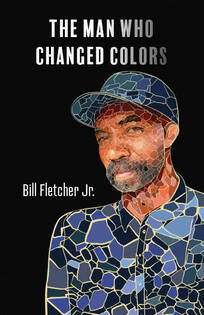
The Man Who Changed Colors
By Bill Fletcher, Jr.
When a dockworker falls to his death under strange circumstances, investigative journalist David Gomes is on the case. His dogged pursuit of the truth puts his life in danger and upends the scrappy Cape Cod newspaper he works for.
Spend a season on the Cape with this gripping, provocative tale that delves into the
complicated relationships between Cape Verdean Americans and African Americans, Portuguese fascist gangs, and abusive shipyard working conditions. From the author of The Man Who Fell From The Sky.
“Bill Fletcher is a truth seeker and a truth teller – even when he’s writing fiction. Not unlike Bill, his character David Gomes is willing to put his life and career in peril to expose the truth. A thrilling read!” − Tavis Smiley, Broadcaster & NY TIMES Bestselling Author
| |
 | |
New Studies
on the Left
Paperback $19.95
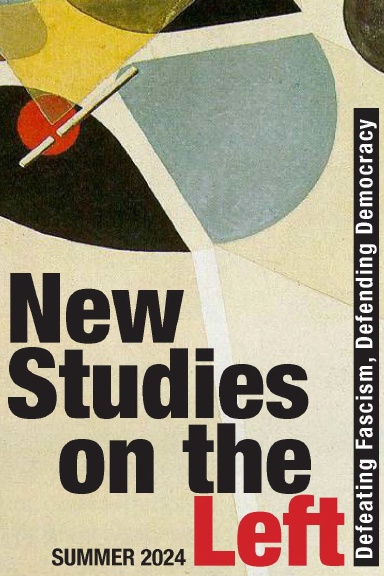
...is a journal of socialist theory and practice. It is the successor to ‘Dialogue and Initiative, published as an annual journal of the Committees of Correspondence for Democracy and Socialism in book form from 2012 to 2022. It will continue the CCDS policy of left unity, including articles with a variety of left perspectives, including debates.
This issue contains over 30 articles grouped under the headings of Analysis and Global Reach, Debate and Controversy, Labor, Socialism, and Book Reviews. Some are reprinted from other sources, but many appear here for the first time.
Among the authors are David Bacon, Joan Braune, Carl Davidson, Bill Fletcher, Jr., Jerry Harris, Jay Jurie, Paul Krehbiel, Sun Liping, Adewale A. Maye, Duncan McFarland, Jasmine Payne-Patterson, Vijay Prashad, Nikhil Pal Singh, Harry Targ, and Janet Tucker.
Table of Contents
Click HERE to purchase
Click here for a free copy of Paul Krebiel's article 'Union Stewards Councils: the Next Step Forward'
| |
A China Reader
Edited by Duncan McFarland
A project of the CCDS Socialist Education Project & Online University of the Left
244 pages, $20 (discounts available for quantity orders from carld717@gmail.com), or order at :
The book is a selection of essays offering keen insight into the nature of China and its social system, its internal debates, and its history. It includes several articles on the US and China and the growing efforts of friendship between the Chinese and American peoples.
| | |
Taking Down
White Supremacy
Edited by the CCDS
Socialist Education Project
This collection of 20 essays brings together a variety of articles-theoretical, historical, and experiential-that address multi-racial, multi-national unity. The book provides examples theoretically and historically, of efforts to build multi-racial unity in the twentieth century.
166 pages, $12.50 (discounts available for quantity), order at :
| | |
 | |
Photo: On the way up: Adolf Hitler climbs the steps in Buckenberg surrounded by Nazi flags in 1934. The narrative of Nazism in the 1930s and 40s is often presented as a major break in history. But was it? Photo: Print Collector/Getty Document
The Fascist In The Mirror
What If The Holocaust Did Not Happen Once, But Has Happened Again And Again Throughout History, Writes Naomi Klein.
By Naomi Klein
Klassekampen, NO
June 22, 2024 - I was originally supposed to be in Oslo in March 2020, and I will always remember that, as it was the first event I had to delete from my calendar when the corona pandemic brought the world to a standstill.
I remember how hard it was for all of us to accept the situation - maybe it's going to be okay, let's not cancel yet, maybe everything will be okay again next week, or the week after that. And then the denial came loose and we understood that we were in fact in a global pandemic and would not be able to carry on as if everything was normal.
Or… most of us understood, but not all. Some went a different way: They decided to create their own reality, with their own medical facts. And as so many had done regarding climate change before them, they spread these "alternative facts" far and wide and tried to change reality.
One of those who did is my doppelgänger…
I say doppelgänger because there is another non-fiction writer named Naomi with whom I have been confused and mixed up for over ten years: the American author Naomi Wolf.
Wolf was once world-renowned as a liberal feminist, but in recent times she has become a conspiracy influencer on the far right - a unique variant of these stars who signal a political transition from the left to the right. Just the day I write this, she actually spoke for over 70 minutes on the radio show of conspiracy theorist Alex Jones, where she "exposes the globalist plan to exterminate the human race."
When people see her teaming up with Steve Bannon, or when she writes in support of Donald Trump, they often say she seems like a double of her former self. We probably all know such people - those who have changed drastically during these disoriented years and started to believe in things they would have protected before.
In my book, "Dobletgänger", I use my personal identity confusion, not as a theme, but as an approach - a literary tool to look at different forms of duplicity and at our cultural mirror world. All the ways in which we have created doppelgangers of ourselves, and which others use to make doppelgangers of us, and how whole societies can have unfortunate doppelgangers of themselves.
Consider how all of us who have an online profile or avatar create our own doppelgangers – virtual versions of ourselves that show a version of us to others.
Or how many of us who have begun to think of ourselves as a personal brand, we create a partial identity that is both ourselves and not ourselves, a double that we unfailingly act like in the digital ether.
And all the while, the technology companies use the data we leave behind to train machines to create artificial simulations of human intelligence and human functions, life-like AI proxies that have their own agenda and their own threats.
This is our doppelgänger culture, where so much of politics increasingly feels like a mirror world, where society is split into two halves, and where each side defines itself in opposition to the other. Regardless of what one side says or believes, it looks as if the other side feels obliged to say and believe exactly the opposite, even when it goes against their own principles.
This was particularly noticeable during the pandemic, when the most drastic public health measures were implemented, such as general vaccination and the mandatory use of masks. All over the world, a conspiracy-driven right emerged that often fed on the left's defeat and silence.
I quote an excerpt from the book, which tries to capture this dynamic, where left and right define themselves in opposition to each other rather than by clear principles and ethics:
- As soon as a problem has been touched by "them", it seems that it becomes a strange taboo for everyone else to address it. And what the mainstream liberals ignore and overlook, this new alliance lavishes attention on. All of this helps me to better understand my doppelgänger, but in a way that is not the least bit reassuring. Because it means that she represents a greater and more dangerous form of mirroring, an imitation of beliefs and problem areas that draw nourishment from the defeats and silences of the progressives. After witnessing Bannon's eagerness to insert Wolf's vaccine certificate fantasies into the horrifying and inflammatory narrative he daily tells his listeners, I began to wonder what other underexposed instances of fear and rage were being exploited in her new home—the place I have begun to call the mirror world.
It brings out the most disturbing part of my journey with the doppelganger: It is not only an individual who can have a disturbing twin, because nations and cultures also have doppelgangers. Many of us feel and fear a decisive change. From democratic to authoritarian. From secular to theocratic. From pluralistic to fascist.
In some places, the turnaround has already happened.
Elsewhere it feels like an intimate presence, like a distorted reflection in the mirror.
It is this kind of doppelgänger that has worried me more and more: the fascist clown state that is the eternal twin of liberal Western democracy, constantly threatening to devour us in the age of selective belonging and predatory contempt.
The figure of the double has long been used in literature to warn us about these shadow versions of our collective selves, these monstrous but possible futures.
What we are least able to see straight on, considering ourselves and our own culture.
That brings me to the parts of the book that I will concentrate on here. When I tried to understand how conspiracy culture fueled the growth of the neo-fascist right today, it became necessary to take a deep dive into the rise of fascism in interwar Europe, where I dug into where it came from, and why.
It led me to a rich vein of debate among anti-colonialist theorists, mostly in the Global South, about the many ways in which European fascism in the 1920s, 1930s, and 1940s was shaped and influenced by European colonial violence in Africa and Asia, as well as of the systems of racial segregation in America. These connections have never been fully understood or taken into account – not in Germany, not in the rest of Europe, not in North America.
Then it began to dawn on me that the reason for our lack of understanding may have a lot to do with why the creation of Israel as a specifically Jewish nation-state has been the source of so much violence over the past 80 years, and never more so than today.
The creation of Israel was - and still is - seen by many Western powers and Israel itself as a kind of historical "reparation" for the abuses and atrocities during the Holocaust. But because this establishment was based on the ethnic cleansing of hundreds of thousands of Palestinians and the deliberate annihilation of their culture, history, villages and circuits, it instead became a repetition, a copying, of earlier forms of violent European settler colonialism, the very logic and the the methods that had inspired the Nazis. This is a disturbing form of duplicity.
My book came out in English less than a month before 7 October. During the last seven months, it is this material - about disputed stories about fascism as well as Israel/Palestine - that has proved most relevant and most debated. The book can help explain why so many of us have such radically different understandings of Israel's war on Gaza.
Some believe that Israel is acting in self-defense, if possible a little overzealous, in the face of the relentless attacker Hamas. Others, including myself, see something much more ominous: an attempt to eradicate the Palestinians as a people and their presence in the land once and for all - in Gaza and in large parts of the West Bank and East Jerusalem. Genocide.
I realize that for many who disagree with me, just saying this word in connection with Israel is an insult, a mockery, an offense. So are other words that evoke memories of the horrors of the Nazi Holocaust: ghetto, concentration camp, liquidation, ethnic cleansing and even the word fascism itself.
Whenever Israel has faced accusations that its actions in Gaza fit the definition of genocide or imminent genocide under the UN Convention, the response follows a particular pattern.
We are told that it cannot possibly be true, because:
a) Israel was forged in the flames of the Nazi Holocaust, so comparing Israelis to Nazis is like criticizing the victims for trying to survive. And…
b) Israel is under an eternal threat that the Nazi genocide will be repeated, as 7 October will have confirmed. That makes Hamas the real Nazis, and according to this logic, everything Israel does is necessarily preventing genocide, not committing genocide.
We have heard all variations of this circular argument. They unfold in a kind of repetitive loop.
UCLA Holocaust studies professor Michael Rothberg calls these clashes over historical analogies "comparison disputes," and there have been many of them in recent months. Often they have involved Jews, like myself.
Masha Gessen, for example, compared Gaza before 7 October to a ghetto similar to the Nazi ghettos in Eastern Europe. And now, Gessen wrote about Gaza, "the ghetto is being liquidated".
As might be expected, these words provoked furious reactions, particularly in Germany, where Gessen was almost stripped of the annual Hannah Arendt prize for political thought.
Another comparison dispute flared up when Jonathan Glazer was awarded an Oscar for "The Zone of Interest". Because his brilliant film is about how genocide can become an ambient "mood" within the culture that commits it, he used his speech to warn that the Nazi Holocaust is being used to legitimize crimes against humanity in Gaza.
Let it be clear that neither Gessen nor Glazer has said that Israel's war crimes in Gaza are any copy of the Nazis' crimes. As Gessen has emphasized, comparing is neither the same as merging nor obliterating historical specificity.
The Nazi death camps were industrial-sized factories, designed and planned for mass murder. Israel's endless slaughter of civilians in Gaza, mostly from the air and with the help of artificial intelligence, is a combination of new and old methods.
Nevertheless, we must remember that more than half of the Nazis' Jewish victims did not die in the gas chambers, they were murdered during mass shootings and in smaller massacres, as well as through premeditated starvation, were denied health care, through forced labor until they fell and other abuses.
Fortunately, we are not yet approaching the death toll of the Nazis. But millions of Palestinians in Gaza are at risk of starvation, especially now that Israel has taken control of the Rafah crossing and the soldiers do not intervene when the settlers attack the convoys with the food aid shipments that are so desperately needed.
This raises the question: How far must one go before it is permissible to compare?
The reason why we built up international humanitarian law in the post-war period - including the International Court of Justice and the Genocide Convention - was that we should get tools to collectively identify patterns before history repeats itself.
And some of the patterns – the walls, the ghettos, the mass killings, the intention of elimination that has been repeatedly expressed, the mass starvation, the looting, the gleeful brutalization and the intentional humiliations, the denial of medical care and the mass graves – are repeating themselves.
I wanted to start with these comparison arguments because they point to something important. I have come to think that these battles are not wars over words, but over two competing narratives about the birth of the modern world and the role that European fascism played in building what we think of as modernity - with fascist methods of racial othering and genocide.
The discussion boils down to this: Were the Nazis an exception in an otherwise uplifting story of how progress and civilization spread to every corner of our globe? Or were the tactics and logic of the Nazis omnipresent in this narrative of progress, a continuous line that has followed behind the civilization project from the very beginning?
Beneath the bitter disagreement about who deserves to be seen as fascist and Nazi-like today, lies much less explored disagreement about who the Nazis were when they came to power in the 1930s.
For the sake of simplicity, let's call these two narratives: Narrative One and Narrative Two.
Story one does not need special explanations, since it is the air we all breathe. It tells us that in the 1930s and 1940s large parts of liberal, democratic, peaceful Europe fell victim to the twisted and evil forces of fascism. In this narrative, the Nazis are like a mirrored version of everything the West thinks it stands for: single-minded against our pluralism, closed against our openness, authoritarian against our democracy, cruel against our goodness and so on.
In this narrative, Nazism emerged in Europe because of a unique and explosive combination of forces. Germany's humiliation after its defeat in World War I together with the economic crisis of the Great Depression created a strong desire for a scapegoat. It unleashed the beast of anti-Semitism, a deep and primitive hatred that is somehow unconsciously omnipresent wherever there are Jews, we are told in this pessimistic story.
According to narrative one, this confluence of forces created the break in the time-space continuum that was the Nazi Holocaust.
In the year 2000, former Swedish Prime Minister Göran Persson came up with the most concise summary of the logic at the core of narrative one. “It happened once. It shouldn't have happened, but it did. It must not happen again, but it could. That is why it is crucial that we teach about the Holocaust.”
According to this narrative, anti-Semitism must be fought with its own special weapons. And the most important of these weapons are not universal human rights, not the Genocide Convention or any other of the documents within international law. No, these are considered too weak and too rational in the face of such an old and irrational enemy. There is only one force, we are told, that can avert another Jewish genocide, and that is the heavily militarized, nuclear-armed state of Israel, a fortified land for the Jews, where they must maintain a demographic majority at all costs.
Of course, the Holocaust was not the only crime against humanity that most of us learned about in school. In North America, we also learned about the conquistadors and the mass slaughter of the indigenous people, and we learned about the evil trade of an enslaved African people, as well as the apartheid laws that were used to create second-class citizens in the Jim Crow system of the South and in South Africa.
But these lessons were and still are demarcated from the lesson of the Holocaust, which is always surrounded by a kind of "ring of fire," to use a term from the late French filmmaker Claude Lanzmann, who directed the seminal documentary series "Shoah."
The underlying premise of these lessons is that simply talking about the Nazi Holocaust in the same breath as other crimes is a kind of sacrilege, that by doing so, one makes the Holocaust less horrific and more ordinary or trivial.
The dark side of the post-war cry of "never again" was an unspoken "never before". As Persson said: "It happened once".
But what if it happened more than once? What if it happened many times, but at different pace and extent? What if holocausts are a continuous line, not a break, in the narrative of how the modern world was created? What if it happens right now?
That brings us to narrative two.
There has always been another way of understanding the Nazi extermination project, another explanation, without the dominant stories I have described. It is a narrative that has long been told in the Global South, in places where they have first-hand experience of European imperialism, and it has been told in the Global North South – in black and indigenous communities in North America.
In narrative two, the Nazi Holocaust was not a break in space and time or a new invention. Instead, it was the return of the violent logic of extinction. The methods were the same as those used by the European powers against people considered wild and diabolical ever since the Spanish Inquisition. The logic was the same as that which has mostly ravaged lands and bodies beyond Europe's borders, in the colonies, for the last 500 years or so.
According to narrative two, this logic and methods came home in the 1930s and were unleashed on large parts of the European population, where the subhumans being exterminated were no longer Africans or indigenous people from the Americas, but white Europeans – albeit gay, disabled, autistic, Roma, communist and, to an unimaginable extent, Jewish Europeans.
Narrative two does not see Adolf Hitler and the Nazis as an aberrant part of Western history. Instead, it sees the Nazis as an expression of an annihilating superhuman logic that has been central to all the most violent parts of Europe's history, and which is expressed slightly differently depending on which group it is directed at.
I build on the work of the Swedish author Sven Lindqvist and others when I explore this alternative interpretation in my new book, because it is, in a way, a doppelgänger's tale – a story about twins and copies and shadow selves.
One of the most important voices in this early debate was the American intellectual and civil rights leader WEB Du Bois. In "The World and Africa", published at the end of the Second World War, he commented that: "There was no Nazi abuse - the concentration camps, the widespread mutilations and murders, the rapes, or a childhood robbed in the most cruel way - that did not Christian civilization in Europe had long been practiced against colored people in all parts of the world in defense of and in the name of a superior race, born to rule the world...” ...Read More (Much more follows)
| |
CHANGEMAKER PUBLICATIONS: Recent works on new paths to socialism and the solidarity economy
Remember Us for Gift Giving and Study Groups
Interested in Studying Gramsci? In a Serious way? We have a group that meets Sundays via Zoom, 11am-12:30pm, facilitated by Piruz Alemi. We go paragraph by paragraph, even line by line, reading aloud, then discussing, through The Prison Notebooks, using an online PDF. If you are interested contact Carl Davidson at carld717@gmail.com
HERE'S ONE OF THE LATEST FROM CHANGEMAKER:
| |
Treat someone to a wonderful book.
And treat yourself, too!
Powerful stories, wonderful gifts.
As they stand up, slow down, form unions, leave an abusive relationship or just stir up good trouble, the characters in this multi-generation novel entertain and enlighten, make us laugh and rage, and encourage us to love deeply, that we may continue the fight for justice.
"So much fiction is about escape and fantasy, but these powerful Tales of Struggle will enrich our real and daily lives." ─ Gloria Steinem
“What a wonderful story of class, class struggle and regular people. The story is about struggle and change, but also about joy and humor. Great work! ─ Bill Fletcher, Jr., author of Solidarity Divided
Price: $15.00
| |
History Lesson of the Week: When the Cheyenne Acquired Horses in the 18th Century, the Connection Transformed the Tribe
Its riders have used horses to hunt, do battle and, more recently, win rodeo buckles.
By David McCormick
HistoryNet
The Cheyenne hunter’s horse kicked clods of earth skyward as the warrior drove hard alongside the buffalo. Within seconds the experienced hunter let fly several well-placed arrows into the flanks of the charging beast. The shafts sank deep, piercing vital organs and sending the buffalo crashing to the ground. By the time the warrior circled back, his quarry’s labored breathing had ceased.
Such a scenario played out repeatedly on the Great Plains following the introduction of the horse into Cheyenne society, a happenstance that dramatically changed the tribe’s way of life.
When most people think of Plains Indians, what comes to mind are 19th century Cheyenne and Lakota warriors riding hard across open grasslands to bring down their enemies, either bluecoats or rival warriors. But for centuries prior neither tribe lived on the plains, nor were they particularly migratory. The Cheyennes originally hailed from the region between the Great Lakes and the Mississippi River headwaters in what today is Minnesota. In the late 1700s, while Anglos in the 13 colonies back East were immersed in a revolution to free themselves from British rule, the Cheyennes were experiencing an upheaval of their own. Theirs was not a martial revolution, however, but one of transportation, sparked by the arrival of the horse on the northern Plains. The Cheyennes in turn are thought to have introduced the horse culture to Lakota bands, perhaps as early as 1730. The horses themselves traced their lineage to those brought to North America by 16th century Spanish explorers.
It isn’t exactly known how the sedentary Cheyenne first acquired horses—perhaps by roping free-roaming animals, in trade with other tribes or when fending off mounted enemies (for more on that subject see “Riding Toward a Blue Vision,” Indian Life, by Lance Nixon, in the February 2019 issue of Wild West). Whatever the scenario, it came as a godsend to the Cheyennes, who had begun to migrate west under pressure from other tribes. ...Read More
| |
|
The “Militarization” of Mexico?
Mexico Solidarity Project from Oct 23, 2024
| |
|
Gabriel Ramírez Cuevas is a journalist and educator in Mexico City and provided analysis of Mexican politics for the Morena online journal Regeneración. He has been a militant internationalist for more than 40 years and an active participant in the movement for democracy in Chiapas.
In the Merida Initiative, which began in 2008, the US and Mexico agreed to a binational “war on drugs.” How was this carried out?
Before 1982, the Mexican federal army carried out the fight against drugs using a preventive approach and the eradication of illicit crops. This changed with the beginning of neoliberalism.
In 1982, US president Reagan empowered the CIA to create the Contras, an extrajudicial force to destroy Nicaragua’s new leftist Sandinista government. Mexico’s president Miguel de la Madrid copied this model, with a special police force to combat the drug gangs.
They were trained in dirty war tactics, such as razing villages, covert operations, torture and assassinations at the notorious School of the Americas. So these units operated not like police but like soldiers at war.
From 1982 to 2018, specialized forces and the police pursued and confronted famous drug leaders in a bloody war; the idea was to root out drug kingpins. But the special forces were co-opted by the drug traffickers.
These were 36 years of capital accumulation from the drug trade, the amassing of firepower given to Mexico by the US, and corruption of authorities at every level — from local police and mayors to the Judiciary, to National Security chiefs like García Luna. We went from a failed state to co-government with the drug trade.
We now have internationalized cartels operating in Mexico, other Latin American countries, the US and Europe. The cartels are a transnational capitalist business with tax haven accounts, properties, weapons, airplanes and submarines. Throughout the world, they have developed their own economy within the global economy.
The Sinaloa cartel has the biggest air fleet in Mexico: Archive/El Universal
To date, imperialist countries are quite capable of knowing what their opponents eat for breakfast but incapable of locating weapons, drugs, millions of dollars and corrupt politicians in their own nations! Such is the power of the cartels.
The Merida Initiative extended narco-neoliberal policy to keep Calderón in power despite electoral fraud and popular repudiation of his policies. In this way, they tried to destroy Mexico’s social fabric, to plunder the country and to undermine the constitution that emerged from the 1917 revolution.
So, this military approach did not stop drug trafficking!
Co-government with the drug traffickers inevitably led to the explosion of the drug trade and increased deaths by firearms, which reached its highest point with Felipe Calderón’s administration between 2008 and 2012. Some have estimated 350,000 dead, 100,000 missing and 50,000 unidentified corpses in morgues.
Mexican drug cartels targeting and killing children: Washington Post, 2011
Overall, neoliberal policies and the government’s collusion with the narco sector widened inequality and intensified the people’s physical and economic insecurity. All classes in society are insecure. The rich are kidnapped, extorted and murdered; the poor are co-opted as hitmen and drug transporters. Neoliberalism and the power of drug cartels are a single, two-headed monster — this is the situation AMLO inherited. ...Read More
| |
|
Adelante #4 is out! A special on immigration for the closing days of the election. Use it everywhere!
Get it here: http://ouleft.org/Adelante-4.pdf
By Bill Gallegos, excerpted from our new fall issue of “¡Adelante!”
U.S. GOP presidential candidate Donald Trump demonized Mexicans and immigrants as a central part of his 2016 presidential campaign. In 2024, he has doubled down. If elected, he promises to unleash an ethnic cleansing campaign to deport the 12 million undocumented immigrants in the U.S. This is horrible enough as a complete violation of human rights. But this pogrom is only one piece of the larger anti-democratic ‘Project 2025’ of the Heritage Foundation. They are coming for all of us. While singling out Mexican immigrants, Trump aims at all immigrant communities, including growing communities in the South, Midwest, and East.
Thankfully the political energy has shifted since President Biden dropped out of the presidential race. Vice-President Kamala Harris is now the Democratic Party candidate, and the polls show a significant shift in her direction. More than a million new volunteers have signed up for Harris, and hundreds of millions of new dollars have been contributed to her campaign.
The Biden-Harris Administration has been mixed on immigration: on one hand, it continues to support the legalization of Dreamers (DACA) and pushes for a path to legalization for the spouses of immigrants with legal residency. On the other hand, it has denied asylum protections for refugees crossing the southern border and supported legislation for increased militarization as well as new administrative hurdles. While our most important fight is against the MAGA right, the fight for full rights and protections for immigrants is a long-term struggle beyond the November elections.
The Biden dropout also creates significant opportunities for the left and progressives to advance the fight against the fascist threat, to advance a progressive platform, and to put new pressure on both Biden and the Harris campaign to demand a ceasefire in Gaza. It enables us to push back strongly against Trump’s racist threats against immigrants while advancing a positive program for immigrant rights.
| | |
|
Our Amazing Resource for Radical Education
CURRENT FEATURE: In the 'Study Guides' Section
A 4-PART STUDY OF THE SHAPING OF THE
RUST BELT WORKING CLASS.
From the settlers to the present, and how its consciousness is conflicted. Prepared by Carl Davidson and Rebecca Tarlau,
with some help from the DSA Rust Belt group.
|
There are hundreds of video courses here, along with study guides, downloadable books and links to hundreds of other resources for study groups or individuals.
Nearly 10,000 people have signed on to the OUL for daily updates, and more than 150,000 have visited us at least once.
Karl Marx's ideas are a common touchstone for many people working for change. His historical materialism, his many contributions to political economy and class analysis, all continue to serve his core values--the self-emancipation of the working class and a vision of a classless society. There are naturally many trends in Marxism that have developed over the years, and new ones are on the rise today. All of them and others who want to see this project succeed are welcome here.
|
| |
|
Video for Learning: Think you support mass deportation?
Watch this. ...5:32 min
| |
Harry Targ's 'Diary of a Heartland Radical' | |
This week's topic:
Click the picture to access the blog.
| |
Tune of the Week: Lucinda Williams - Righteously (live 2007) ...4:51 min. | |
|
Book Review: Is the United States A Prisoner Of Its Own Mythology?
Tom Zoellner looks at “A Great Disorder” by Richard Slotkin
A Great Disorder: National Myth and the Battle for America by Richard Slotkin. Belknap Press, 2024. 528 pages.
.
By Tom Zoellner
LA Review of Books
October 4, 2024 - THE STORIES THAT a country tells itself are just as critical to its functioning as its army, its laws, its borders, and its flag. Where did the country emerge from, and where might it be heading?
Such questions of national mythology are especially fraught in the United States, still relatively young in the world, big, rich, powerful, multiethnic, and operating on a set of profoundly contradictory ideas. That it might be possible to make sense of American political division by naming those myths and interpreting the news of the day through their filter is the guiding ambition of Richard Slotkin’s exciting and detailed new decoder ring of a book, A Great Disorder: National Myth and the Battle for America.
The title is an homage to the Wallace Stevens poem “Connoisseur of Chaos,” which declares that “a great disorder is an order”—not just as a metaphysical statement but also as a tidy description of the contested historiography of the United States. Can we look into our past to find the white, Christian, hierarchical, free-market society of red America’s imagining? Or do we see the imperfect but ever-striving egalitarian and multiethnic vision of blue America? Both sides have told selective stories, which are neither completely true nor exactly false.
“Each has a different understanding of who counts as American,” writes Slotkin, “a different reading of American history, and a different vision of what our future ought to be.” His goal in the first part of the book is to describe and unpack “America’s foundational myths to expose the deep structures of thought and belief that underlie today’s culture wars.” In the second part of the book, Slotkin directly applies those collective stories to make sense of the tumultuous last eight years.
It is difficult to imagine a more qualified author for this freighted task. Slotkin has made a career out of dissecting grand national myths. He is an emeritus endowed chair of English and American studies at Wesleyan University and the author of a trilogy of books on what he calls the “Myth of the Frontier.” Two of them were National Book Award finalists, and his argument in Regeneration Through Violence: The Mythology of the American Frontier, 1600–1860 (1973)—that European settlers learned the ways of Indigenous Americans only to convert them into tools of repression and genocide—has influenced the historiography of colonial America enormously.
Every nation does it, of course. Their leaders and poets construct “semifictional or wholly imaginary histories of the origins of their people and territories, which would enable Provençals, Bretons, and Franks to see themselves as French, or Bavarians, Prussians, and Swabians as German,” writes Slotkin. He makes a parallel case that the United States relies on these rich historical stories especially heavily, considering the multiplicity of its ethnicities, its sheer geographic reach, and its own self-proclaimed status as the first country in the world founded on an idea.
Those stories that Americans tell about themselves in the name of the “imagined community,” in the words of the theorist Benedict Anderson, manifest through public rituals like fireworks shows, public school curricula, the discourse of politicians, and the touchstones reinforced by constant references in the press and pop culture: the Alamo, Custer’s Last Stand, the showdown at the O.K. Corral, Valley Forge, “I Have a Dream.”
What are the specific meta-stories that drive today’s United States? Though he had a potential banquet before him and the possibility of a very messy plate, Slotkin keeps his scope narrowed to five. This number feels right: broad enough to avoid the trap of binaristic red-versus-blue stories yet tight enough to keep a useful focus. Each one is rooted in a specific historical process, though one with disputed meanings.
There’s Slotkin’s specialty, of course, the Myth of the Frontier: the romance of westward expansion and the individual Turnerian grit that helped subdue the unruly Indigenous inhabitants of a land that was meant to be American.
There’s the Myth of the Founding, in which wise gentlemen—albeit with slaveholders included among them—enshrined a set of moral principles into the documents that established a government dedicated to life, liberty, and the pursuit of happiness.
There are the Myths of the Civil War, which fall into two basic categories: the Southern Lost Cause, which rails against federal interference, especially when it comes to racial matters, and the Liberation Myth, which sees the federal government as the swift sword of racial justice.
There’s the Myth of the Good War, the idea that the United States is a multiethnic platoon out of a Hollywood film, striking a blow for democracy against totalitarianism and ascending into its rightful place at the top of the free world, with an omnipotent military and supercharged technological economy.
And finally, though Slotkin doesn’t group them among the “four myths [that] have historically been the most crucial,” there’s the myth of the New Deal, and the associated myth of the Civil Rights Movement, in which activist government policy rides to the rescue against the depredations of capitalism and racism.
Running contemporary headlines through this five-part interpretative machine yields pragmatic and useful results that will keep working after the narrative ends. Once you accept Slotkin’s premise that myths are hidden scripts for present-day actors (a proposition hard to deny), you begin to see them at work everywhere. While it is usually hyperbolic to claim that a book will change your life, this one may well have a permanent effect on how you consume and think about American political news.
When George W. Bush announced the country’s invasion of Iraq after 9/11, he purposely invoked Good War imagery in the nation’s associative mind by likening the jet attacks to Pearl Harbor, and the crusade against Saddam Hussein to one against Nazism. Barack Obama’s 2008 campaign tapped into Civil Rights Movement iconography, and the Tea Party backlash was undoubtedly rooted in atavistic Lost Cause urges of reclaiming a white beau ideal of the past.
Slotkin’s analysis is especially strong on guns, which should be no surprise from the author of Gunfighter Nation: Myth of the Frontier in Twentieth-Century America (1992). He sees the 1990s debacles of Ruby Ridge and Waco as especially damaging because they reinforced Reconstruction-era paranoia among those who jealously guard their view of the Second Amendment. (It always seems to come back to the South.) The manly Hollywood actor Charlton Heston, also an NRA president in his later years, invoked the Myth of the Founding and the Myth of the Frontier when it came to his promotion of extreme positions in firearm rights discourse.
Though wracked and weakened by corruption scandals, the NRA still promotes the bogus claim that the Second Amendment was written to allow states to rise up against an oppressive federal government. In fact, it was somewhat the opposite: the founders worried that big standing armies posed a danger to the government and wanted to decentralize the stockpiling of rifles. The “originalist” doctrine of constitutional interpretation embraced by the right-wing judiciary claims to divine the founders’ real intent, but it is more about making a historical myth fit into a contemporary partisan choice.
Our addiction to national mythologies—and our inability to create a common meaning for them—has brought us to an unhappy stalemate. It’s hard to bargain and compromise with an opposition that you believe has fundamentally misunderstood its own country––to the point that they cannot even be considered good citizens. And with their mythologies as war clubs, both sides want to run an Antonio Gramsci–style takeover of institutions, making their reality the only acceptable paradigm. Slotkin writes an elegant, if depressing, diagnosis of the current mythological crisis. “The result is a deadly feedback loop: government failure to alleviate these problems leads to deep mistrust of democratic institutions, and the substitution of culture war for rational policy debate,” he argues. “[C]ulture-war hyperpartisanship then prevents government from acting effectively, which intensifies mistrust of institutions and ratchets up the intensity of culture war.” ...Read More
| |
|
Film Review: ‘On Falling’ Reveals An Episode in the Life of a Warehouse Picker, Told With Grace and Urgency
Co-winner of the Best Director prize at San Sebastián, Laura Carreira's impressive debut puts faces and lives to the purchases we so impersonally make online.
By Guy Lodge
Variety
It’s easy to divorce the online purchases that arrive so swiftly and conveniently on your doorstep from the individual labor that got them there: The packaging is so uniform, the buying process so entirely impersonal, that it’s tempting to believe they were somehow selected and delivered by robotic magic.
But in many cases, someone hand-picked the item from an intricately coded shelf in a vast, airless warehouse, just as someone else had the unrewarding zero-hours job of driving it to your home, or carrying out how many intermediate menial stages in between. Where Ken Loach’s recent “Sorry We Missed You” shed light on the loneliness of the long-suffering delivery driver, Laura Carreira‘s remarkable “On Falling” turns warehouse-picking from an ignorable abstract process into a human routine of vivid, slowly erosive despair.
Any comparison to Loach is backed by the film’s DNA, as Jack Thomas-O’Brien, son of Loach’s longtime producer Rebecca O’Brien, shepherded the production through his elders’ Sixteen Films banner. Portuguese-born, Scottish-based writer-director Carreira reveals herself to be, like Loach in his finest hours, a socially conscious filmmaker as invested in idiosyncratic character as in more universal polemic. Her debut feature following several well-received shorts, “On Falling” is first and foremost an intimate, granular portrait of an immigrant worker gradually drowning in solitude and systemic indifference. Through that portraiture, however, the film delivers an excoriating verdict on a modern Britain characterized by compassionless labor politics, stagnant opportunity and shrugging acceptance of a stifling status quo
That’s a lot to pin on a largely solo character study, though a performance of extraordinary composure and layering by Joana Santos shoulders the task. As Aurora, a thirtysomething Portuguese woman forging a new life in a drably unspecified Scottish town, she returns the camera’s steady gaze with a hollowed-out stare of her own, her intense inner quiet only sporadically stirred by rare, fleeting grasps at social connection. Aurora’s days, spent blankly plucking and carting products around an eternally gray-lit warehouse for an Amazon-like retailer, are scarcely alleviated by her evenings, largely spent holed up in her room in a crammed apartment shared with other migrant workers. They find common conversational ground in banal discussions of streaming shows, or passive-aggressive sniping over shared utilities and kitchen storage. Tenderness is in short supply. ...Read More
| |
522 Valencia St.
San Francisco, CA 94110
415 863-6637
| | | | | |