|
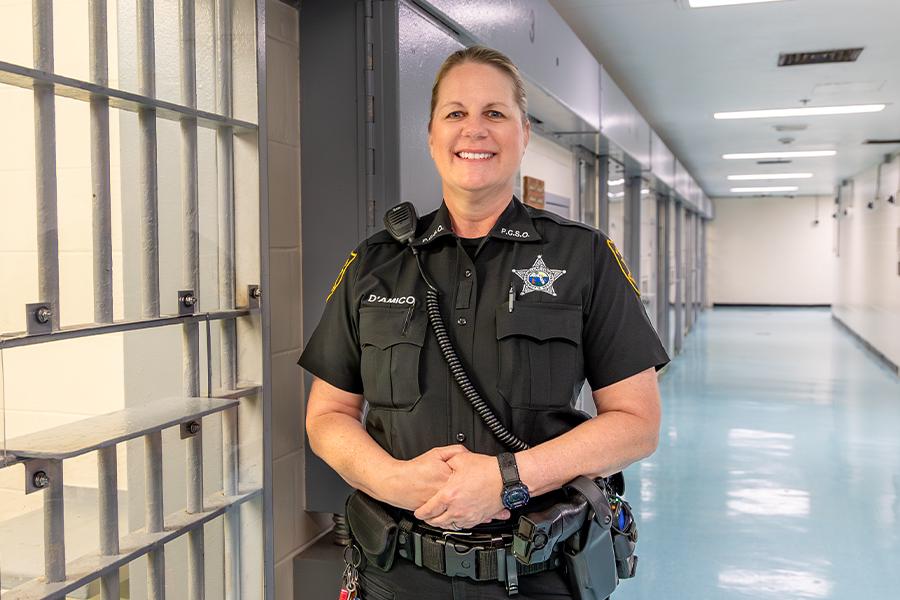
It’s never too late to reinvent yourself. Just ask Deputy Angela D’Amico, who after more than 30 years running a chiropractic office is now embarking on a second career as a detention deputy at the Pinellas County Jail.
“I had always loved law enforcement,” Deputy D’Amico said. “I knew in seventh grade that this was my calling.” She got a degree in criminology with a minor in psychology, and was an officer with the Clearwater Police Department for a few years until she married and had children. After that she left law enforcement and spent the next three decades working in her family’s chiropractic practice, running the fifth-generation business.
“Four kids and five grandkids later, I told my husband I want to get back into law enforcement,” she said. “But I didn’t want to go into patrol, I wanted to go into corrections. I started calling friends who were either working in the jail or involved in the Pinellas County Sheriff’s Office (PCSO) in some way and asked them if they thought this was something I could do. They all said absolutely.” She thought PCSO would be a perfect fit. “I’ve watched Sheriff Gualtieri and seen what he’s done for the agency. You want a boss who is supporting you.”
The application process was lengthy and rigorous, with extensive background, medical, and psychological testing. There is also a physical test for prospective deputies called the Cooper Test, consisting of running, jumping, sit-ups, and pushups, with different standards based on age and gender. For that part, she knew she needed some preparation. She exercised and was healthy, but she wasn’t at the level she’d need to be for the academy.
“I told my husband: I used to be really good at pushups, watch this. And I couldn’t even do one!” But she kept at it, and by the end of the week she could do one… then two… then three… then 20. By the time she did the Cooper Test she was at the level that would be required for a 20-30 year old applicant. “I was really proud of that,” Deputy D’Amico said. “But I still had the whole academy to get through. When they hired me and said they would sponsor me through the academy I knew I still had quite a mountain to climb.”
At 54, it was a daunting challenge. “The youngest person in the academy was one year older than my oldest grandson.” She formed a tight bond with the other academy students. “They looked at me as the mama. I always promised them that I would never quit, even if it meant that I was crawling at some point. You just put your head down because you know what the end goal is, and you know you can get through anything for 12 or 13 weeks, and I did.”
She’d been a little worried about the academic portion too. The last time she took an exam was in college – she graduated in 1992. As it turned out, she excelled. “I ended up with a 98.3 percent, third in the class. I was the highest on the state exam.”
When she started working in the jail, learning the ropes in the Field Training Program, she got to spend time in all of the areas of the jail, including Healthcare, Minimum Security, and Maximum Security.
“I found that though I loved all of them, I really enjoy working in Max. I feel like in a small way I get to make a difference.” She spent three decades helping people in her previous career, and now she has the opportunity to help people in a different way. “For the public, we’re keeping them safe by housing these individuals. But more than that, sometimes your words and actions can impact an inmate in a positive way. You can talk about if or when they get out, what are they going to do differently, what kind of plan are they going to make so that they don’t come back here? Because whatever plan they had before didn’t work.” Inmates have told her that they wished someone in their life had talked with them like that before they went down the path that led them to incarceration. “I challenge them to be better people and make better choices for their lives.”
Communication is the key to being an effective and compassionate jail deputy, and Deputy D’Amico says there are advantages to being more “seasoned.” Life experience can be as important as on-the-job training. “I’ve been living life with lots of people, I’ve had a lot of opportunities to communicate. Raising kids has helped as well. You know when to go in hard and when to go in soft.”
Deputy D’Amico encourages people to consider a career in the Pinellas County Jail, whether they are just starting out or have a few decades of work experience under their belt. “Even if you’ve never thought about it, explore it. If you’re an accountant or you work at Starbucks, this job will be completely different… but that’s the beauty of it.”
The chiropractic business had been a family affair, and now the jail might be too. Her youngest son is considering a career there. “I think I really showed my children and grandchildren that if you put your mind to anything you can do it. And if you want to completely reinvent yourself you can do that too.”
|