Weekly update from the National Housing Conference | | News from Washington | By Brittany Webb | | |
Housing bill talks continue in House
The future of a bipartisan housing legislation remains in limbo as lawmakers continue negotiations over timing, amendments, and political support for a sweeping housing package. House leadership is reportedly drafting a new version of its own bipartisan housing bill, the Housing for the 21st Century Act, to be considered under suspension in response to the latest Senate-proposed 21st Century ROAD to Housing Act. While both chambers remain divided over how to reconcile their respective bills, negotiations are ongoing, even as no formal conference process or legislative timeline has been established.
Representative Emanuel Cleaver (D-Mo.) penned a recent opinion piece highlighting the work being done across the aisle to move housing legislation across the finish line. “We are 90 percent of the way there,” he writes. “But just like Orion, the mission is not accomplished until the journey is complete — and we cannot congratulate ourselves until we are safely home. Thankfully, it doesn’t take a rocket scientist to stick this landing. The difference between a historic success and a tragic failure will come down to lawmakers’ ability to accept compromise.”
The outlook for the Senate-passed 21st Century ROAD to Housing Act was improved after reports that President Trump privately raised objections to Section 901 of the bill that severely limits institutional investor activity in the housing market. Many housing groups have encouraged the removal or revision of Section 901 to better allow build-to-rent activity that will support housing production. Those concerns have reportedly prompted additional discussions among Republican leadership and lawmakers over how to proceed while maintaining bipartisan support for the bill.
| | | |
Sponsorship Opportunities Available
Aligning your organization with the Gala and its honorees enhances your visibility, engagement, and networking opportunities. Supporting one another and working collaboratively across sectors, we strengthen our collective ability to address the nation’s most pressing affordable housing challenges.
Please consider supporting this year’s honorees and NHC by purchasing a ticket and/or becoming a Gala sponsor. Sponsorship opportunities begin at $3,500. You can also show your support by placing an ad in the Gala Tribute Book. New for 2026, we’re offering the opportunity to display a digital ad onsite at the Anthem.
It’s a meaningful way to celebrate the accomplishments of this year’s honorees or highlight your commitment to our shared mission. Tribute Book ads start at $750 and digital ads start at $325. You can also choose to have your name listed in the Gala Tribute Book for $250. Click here to learn more about these opportunities.
| |
HUD to publish CoC funding opportunity
The U.S. Department of Housing and Urban Development (HUD) announced it intends to publish the 2026 Continuum of Care (CoC) Notice of Funding Opportunity (NOFO) on June 1, while noting it still intends to “rebalance the CoC program to focus on a diversity of solutions and treating the underlying causes of homelessness.” The eligible uses for funding include transitional housing, Rapid Rehousing, and Permanent Supportive Housing; as well as services on their own or within housing that provide case management, substance use disorder treatment, mental health treatment, street outreach, employment assistance and job training, childcare, and outpatient healthcare. HUD urged a wide range of providers to apply for the funding and emphasized a desire to work with law enforcement.
The announcement comes amidst a continued legal battle between HUD and a coalition of advocates led by the National Alliance to End Homelessness (NAEH). The group sued HUD for attempting to redirect the majority of CoC funding away from permanent supportive housing models and upending the CoC program. NAEH noted that it will be receiving weekly court-ordered status reports from HUD as the funding battle continues.
“It’s disappointing to see the administration move away from evidence-based practices and abdicating their responsibility to respond to homelessness,” said Marcy Thompson, vice president of policy and programs at NAEH. “My sense is they’re operating off a lot of assumptions seemingly without taking the time to really understand these programs and projects.”
HUD stated that CoC awardees can expect to receive their funding by December.
| |
HUD streamlines multifamily environmental reviews
The U.S. Department of Housing and Urban Development (HUD) announced new actions intended to reduce environmental review barriers for multifamily housing developments seeking FHA financing. According to HUD, the changes are designed to simplify and shorten environmental review processes while lowering development costs.
Specifically, FHA’s review requirements will remove standalone railroad vibration assessments, restore previous pressurized pipeline policies, update high voltage power lines and fall hazard standards, and clarify noise-sensitive outdoor uses. HUD said the updated approach will allow certain multifamily projects to move through environmental reviews more efficiently by reducing duplicative requirements and clarifying review standards.
“This is about fixing policies that have made housing expensive and difficult to build,” said HUD Secretary Scott Turner. “We are cutting outdated requirements, reducing costs and delays, and putting FHA financing back to work to support housing production and improve home affordability for American families.”
Industry groups and housing developers have argued that environmental review requirements can slow construction timelines and increase financing uncertainty, particularly for affordable and workforce housing developments using federal support.
|
| | |
Housing groups send letter on easing building provisions
A coalition of nearly 100 affordable housing organizations and industry groups is urging Congress and the Trump administration to reconsider how the Build America, Buy America Act (BABA) is applied to affordable housing projects. In a new sign-on letter, the groups argue that the current implementation of BABA has led to rising development costs, project delays, and significant administrative burdens that are slowing or preventing the construction and preservation of affordable housing. The letter notes that many construction materials commonly used in affordable housing are either unavailable from domestic manufacturers or available only at substantially higher costs. The organizations also contend that the current waiver process has proven “onerous, costly, and unworkably slow,” with some projects reportedly requiring dozens of individual product waivers.
The coalition, which includes the National Housing Conference and many of its members, alongside dozens of other national, state, and local organizations, recommends either exempting affordable housing programs from BABA requirements or implementing reforms to streamline compliance. Proposed changes include temporarily suspending BABA implementation for affordable housing programs, increasing the de minimis waiver threshold from 5% to 10%, establishing broader product waivers, and creating a centralized database of compliant building materials and products.
| |  | |
MBA publishes housing affordability checklist for federal agencies
The Mortgage Bankers Association (MBA) recently published its Housing Affordability Checklist for federal government agencies. The Checklist outlines MBA policy priorities aimed at increasing affordability, lowering borrower costs, expanding credit availability, reducing mortgage production and servicing expenses, and modernizing the housing finance system. Notably, all items on the Checklist can be addressed through administrative actions by the federal agencies, without requiring legislation from Congress. Among the key items highlighted in the Checklist are:
- Ending the tri-merge mandate and adopting a single-file credit report framework for scores above 700.
- Aligning and reducing Loan Level Price Adjustments (LLPAs) for purchase loans and rate/term refinances.
- Modernizing Reg X to provide streamlined loss mitigation to borrowers in default.
- Publishing calibrated bank capital rules according to actual risk of mortgage assets.
MBA intends to periodically update the Checklist as policy developments emerge, and new opportunities to improve housing affordability are identified. To always find the most up-to-date version of the Checklist, click here. Supporting materials on these issues, including comment letters, white papers, and issue briefs, can all be accessed on the All Letters and Testimony and Residential Policy Issues pages at MBA.org.
| | | |
NHC seeks experienced policy director
The National Housing Conference, the nation’s oldest and broadest housing coalition, seeks an experienced Policy Director to represent our diverse coalition on Capitol Hill, within the Administration, and among key stakeholder groups. This role will help shape and advance NHC’s federal policy and advocacy initiatives, working closely with Congress, federal agencies, and national partners to drive practical, bipartisan housing solutions. Reporting to the president and CEO, the Policy Director plays a central role in convening members, leading key working groups and events, and collaborating across research, communications, and coalition-building efforts. NHC offers a dynamic, team-oriented environment and the opportunity to play a leading role in shaping national housing policy at a pivotal time for the industry.
| | |
Survey flags affordability concerns and VA loan confusion
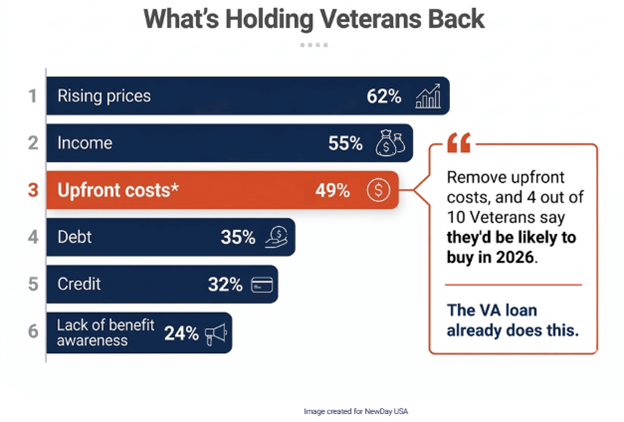
NewDay USA published a new survey that found veteran borrowers consider overall affordability to be their main barrier to achieving homeownership. The survey examined the key barriers that drive decision-making, with 62% of respondents citing rising home prices as a major challenge, 55% pointing to income concerns, and 49% identifying upfront costs such as down payments as a significant barrier. The data highlights information gaps as part of the problem, with 32% of respondents saying they are hardly educated or not educated at all about Veterans Affairs (VA) loan benefits. Only 9% of respondents knew that you could qualify for a VA loan without a down payment, and 47% said they had no idea that mortgage insurance is not a requirement. The results suggest that the issue is not whether veterans want to buy homes, but whether they have enough financial room and clear information to act on that goal.
| | |
An article in Fortune explores the latest Redfin report discussing how AI continues to shape the economy as entry-level roles are threatened, and affordable neighborhoods fall behind. The report utilizes the Bay Area as a case study as the region experiences an AI boom. Luxury zip codes saw a 13.4% average jump in home prices in the two years after ChatGPT launched, yet the most affordable zip codes saw prices fall by 3.8%. While a decline in pricing may be an opening for some buyers, it is noted that such homes often require significant repair, signaling a K-shaped market.
Pew Research Center published new research showing that 71% of homeowners have experienced a rise in the cost of home insurance. The article cites that homeowners most often blame insurance companies trying to make more money and higher repair and rebuilding cost, with many pointing to extreme weather events. The data included also shows that rising premiums are widely felt across income and region, underscoring how insurance costs have become a broader housing affordability strain.
The Marblehead Independent reported on a recent town hall meeting in Marblehead, Mass., which marked the culmination of years of debate over compliance with the state’s MBTA Communities Act, which requires communities served by transit to zone for multifamily housing. After several failed proposals, residents finally approved a new zoning plan. The new zoning plan puts much of the required housing capacity on Tedesco Country Club, a golf course that is unlikely to be developed soon. A viral exchange occurred when one resident asked whether the town was “kind of being pricks” by meeting the law on paper without building any housing.
| | |
Monday, May 11
WHF Lunch & Learn - Proposed AML Program Rule Changes, 11 – 12 PM ET
Tuesday, May 12
Building Michigan Communities Conference, May 12 - 13
Wednesday, May 13
The Role of Information Systems and How They Create Healthy Communities | NextCity 1 PM ET
Thursday, May 14
What Does a Solidarity Economy Approach to Housing Look Like? | NCRC, 3 – 4 PM ET
Novogradac 2026 Spring Renewable Energy Tax Credits Conference, May 14 – 15
Friday, May 15
Post-Occupancy Evaluations for Affordable Housing Design | Harvard Joint Center for Housing Studies, 12:30 – 2 PM ET
| | The National Housing Conference is a diverse continuum of affordable housing stakeholders that convene and collaborate through dialogue, advocacy, research, and education, to develop equitable solutions that serve our common interest. | | Defending Our American Home since 1931 | | Copyright © 2024. All Rights Reserved. | | | | |