____________________

One story, curated by Gregory Bufithis. More about me here.

____________________


It's the U.S. - Israel intelligence campaign, not the bombs falling on Iran, that matter most in this war


As bombs fall on Iran, and its leadership gets cut down, it's the intelligence campaign by the U.S. and Israel that is mattering most to the outcome of the conflict.


And bombs can degrade infrastructure. They can weaken capabilities. But they do not manufacture organized political alternatives.


Washington is ill-equipped to handle the regional conflagration it has unleashed.


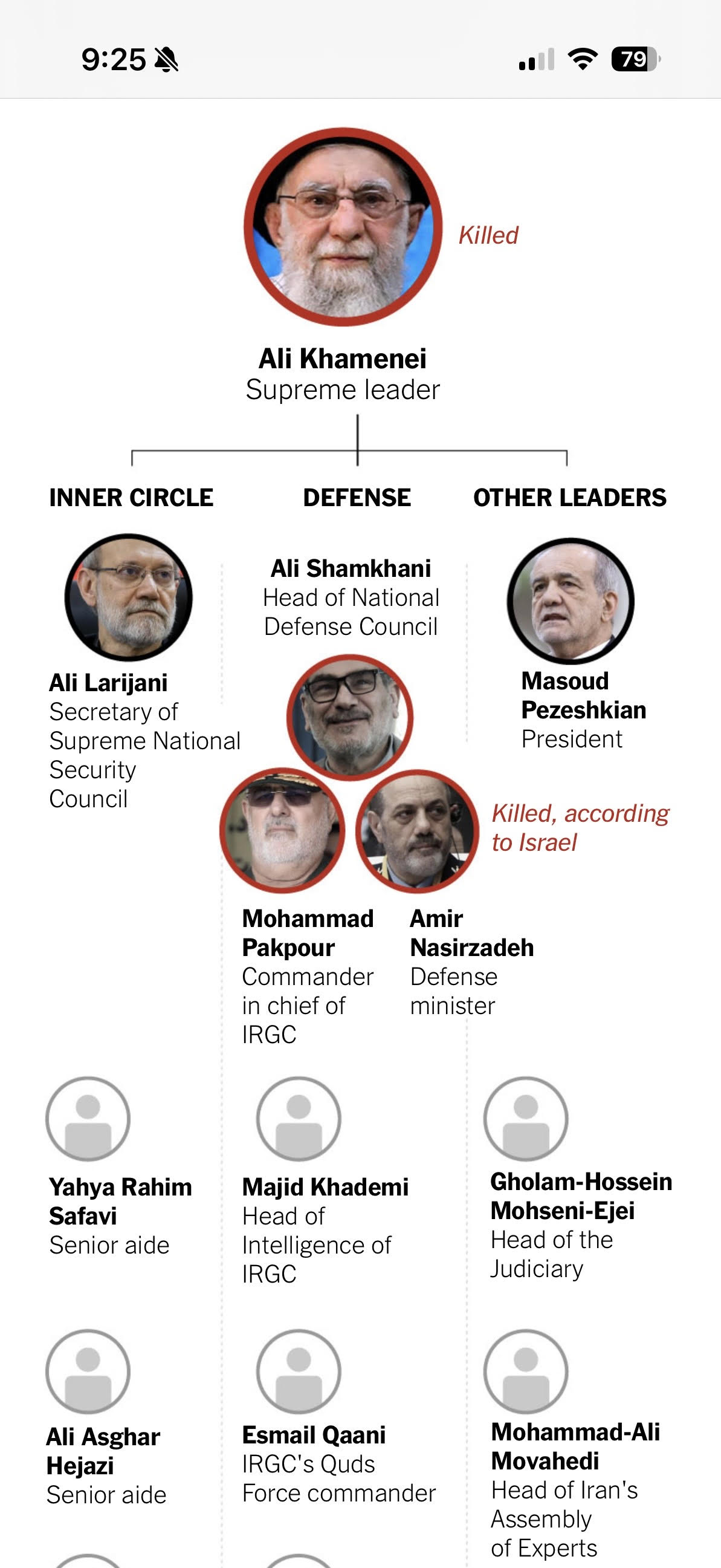
28 February 2026 (Megalo Chorio, Southern Aegean, Greece) - Early this morning the Iranian government said that U.S.-Israeli attacks on Iran had killed Ayatollah Ali Khamenei, the nation’s supreme leader for decades and an implacable enemy of Israel and the United States. Trump had announced the supreme leader’s death hours earlier, and called on Iranians to take control of the government. 


The Iranians said he died in his office at home in an attack early Saturday. The strikes killed several other senior Iranian figures, Iranian state media said, confirming what the Israeli government had said late Saturday night:

The United States and Israel had spent months developing deep intelligence on the Iranian leadership, according to people familiar with the operation who have been chatting with various media outlets.


The C.I.A. had been tracking Ayatollah Khamenei for months, gaining more confidence about his locations and his patterns, according to people familiar with the operation. Then the agency learned that a meeting of top Iranian officials would take place on Saturday morning at a leadership compound in the heart of Tehran. Most critically, the C.I.A. learned that the supreme leader would be at the site.


The United States and Israel decided to adjust the timing of their attack and move up the attack, in part to take advantage of the new intelligence. with knowledge of the decisions. The information provided a window of opportunity for the two countries to achieve a critical and early victory: the elimination of top Iranian officials and the killing of Ayatollah Khamenei.


The remarkably swift removal of Iran’s supreme leader reflected the close coordination and intelligence sharing between the United States and Israel in the run-up to the attack, and the deep intelligence the countries had developed on Iranian leadership, especially in the wake of last year’s 12-day war. The operation also showed the failure of Iran’s leaders to take adequate precautions to avoid exposing themselves at a time where both Israel and the U.S. sent clear signals that they were preparing for war.


The C.I.A. passed its intelligence, which offered “high fidelity” on Ayatollah Khamenei’s position, to Israel, according to people briefed on the intelligence.


This is something I had written about extensively last year, and the topic of my regular weekly OSINT group chats which, ironically, was earlier this morning.


Israel’s opening salvo was always going to include "decapitation strikes" as one of my OSINT group members explained this morning. Targets were going to be the Iranian defense minister, the head of the Islamic Republican Guards Corps (IRGC) and even the supreme leader, Ali Khamenei.


Because there was one, big issue. The U.S. and Israel do not have the assets in place for a full-scale ground invasion and occupation, nor has this even been suggested. Such an undertaking would dwarf previous efforts in Afghanistan and Iraq; Iran is geographically more than twice the size of the former and four times the size of the latter, and it has a population of 93 million.


Rather, the U.S. strategy and Israeli strategy appears to be one of fomenting glasnost and perestroika at gunpoint, prompting internal elements to seize power amid the hollowing out of the security apparatus and under the cover of unrivaled airpower.


This strategy worked - to a degree - in Venezuela. Even before the U.S. Delta Force and CIA Ground Branch snatched dictator Nicolás Maduro and his wife from their fortified compound in Caracas, U.S. Secretary of State Marco Rubio had been liaising with Venezuelan Vice President Delcy Rodriguez via Qatari intermediaries, and in full view of the U.S. media. Said a member on the chat:


Rubio is reportedly performing the same trick with Raúl Guillermo Rodriguez Castro, Raúl Castro’s grandson. Washington has also allowed some of the Venezuelan oil it now controls to be delivered to private Cuban entities, a discrete offer to wobbly elements within the sclerotic communist regime and its intelligence service of the chance to profit both materially and politically. Acknowledging this outreach, Trump has said, “Maybe we’ll have a friendly takeover of Cuba.”


Maybe. But the Gulf of Mexico is hardly the Persian Gulf, and any clandestine coup or U.S.-imposed transition is orders of magnitude more complicated in Iran. Not that Trump wouldn’t gamble on trying, if only to secure his legacy as the president who ended Khomeinism or defanged a threat to the interests of the U.S. and its allies in the Middle East that has been present for nearly half a century.


As I noted last week (and as did multiple news outlets), the U.S. managed to smuggle in thousands of Starlink terminals to keep the demonstrators connected and allow them to document atrocities in real time. What else might have been smuggled into Iran in anticipation of the present conflict?


Israel’s capacity for infiltration is even more well-documented. It has assassinated scores of Iranian nuclear scientists with automated machine gun attacks, limpet bombs or drone strikes, and Israeli commandos managed to extract the entirety of Iran’s nuclear archive in 2018 from a secret warehouse in southern Tehran.


Well before that, a joint U.S.-Israeli operation managed to disable Iranian centrifuges with a carefully uploaded piece of malware known as Stuxnet. Israeli cyberoperators have now apparently hacked a popular Iranian prayer app, encouraging military personnel to defect.


During Israel’s 12-Day War in June, which culminated with U.S. attacks that Trump claimed had “obliterated” Iran’s nuclear program, it was clear even before the smoke dissipated that the Israeli Mossad had assets in place all over the country. Networks of “hundreds” of Israeli agents were able to launch drones from secret locations in and around Tehran, taking out military targets such as Iranian air defense systems. In response to this pervasive penetration, the IRGC initiated a counterintelligence dragnet, which no doubt snared more than a few false positives.


But what Israeli assets might they have missed? And who else might have been recruited from the Iranian military, IRGC or even senior clerical leadership in the intervening eight months, standing by to earn their immunity and much else? This weekend's leadership decapitation says they are quite entrenched.


But . . .


As U.S. and Israeli forces launched their joint offensive against Iran early Saturday, President Donald Trump called on the Iranian people to rise up and overthrow the country’s Islamic regime:


“Take over your government. America is backing you with overwhelming strength and devastating force. Now is the time to seize control of your destiny. This is the moment for action. Do not let it pass".


That moment may be now, especially since Ayatollah Ali Khamenei, Iran’s Supreme Leader, is dead, killed in air strikes that devastated the presidential complex in Tehran.


But sources say that the Trump administration’s intent resembles what happened in Venezuela in January - to lop off Iran’s unpopular clerical leadership and invite the next level of officials to cooperate with Washington, however repressive it may remain.


Regime change, in other words, would not include opposition figures who’ve led the huge protests that have roiled the country for months. Any IRGC officials who lay down their arms would be offered “immunity,” Trump said when announcing the start of “Operation Epic Fury,” hinting that U.S. intelligence already has made such overtures to that effect. “So lay down your arms, you will be treated fairly with total immunity, or you will face certain death,” he said.


In any event, the regime’s opponents inside Iran appear cowed after government forces killed as many as 30,000 demonstrators in the past few months. And with the Iranian opposition abroad deeply divided, the prospect of any popular uprising toppling the remainder of Iran’s clerical leadership looks dim, according to veteran Iran- watchers both in and out of the government.


In a brilliant SpyTalk podcast last night (another 5-star source for me), Jon Alterman, the long-time director of the Middle East program at the Center for Strategic and International Studies, said he had met with the Iranians many times over the past 30 years:


“In terms of really getting rid of this entire ruling class, lock, stock and barrel, without having any sort of really well-organized opposition with roots in the country is low.


But some others, like Mark Fowler, a 22-year CIA veteran who rose to the number two position on Iran within the agency, say this is the moment for the Trump administration to do whatever it can to empower a popular opposition. In addition to its air campaign, he urges the administration to facilitate communication between Iran’s opposition groups:


“Iran’s youth are highly technically literate—when motivated to fight back, they are certain to find their own way to break through the regime’s constraints”.


But that’s a heavy lift, other experts caution. Last month, Khamenei ordered his security forces, along with imported Shia militias from Iraq, Lebanon, Pakistan and Afghanistan, to fire on country-wide anti-government street demonstrations, which began in protest against Iran’s crumbling economy but soon morphed into calls for the government’s ouster. While the Iranian government placed the death toll at the end of January at 3,117, The Guardian, plus many verified OSINT sources, citing shared data from a network of more than 80 medical professionals across 12 of Iran’s 31 provinces, reported that the death toll could exceed 30,000.


With Khamenei gone, will his erstwhile underlings do the same? When East German border guards stopped firing on people trying to escape in 1979, it spelled the end of the Soviet Union. Similar situations played out in Romania, Libya and other repressive regimes.


Meanwhile, the Iranian opposition outside the country has been fragmented for years along ideological lines, preventing the formation of a unified front under a strong leader.


The most visible figure to emerge has been Reza Pahlavi, son of the last Iranian shah, who was overthrown in the 1979 Islamic revolution. Ever since then, Pahlavi has lived in exile in California, leading a small group of exiled Iranian monarchists who support his return to the country at the head of a pro-Western government. But he has virtually no following in Iran, observers say.


In a post on X on Saturday, Pahlavi urged his fellow countrymen to prepare to take to the streets in order and take control of their country amid the strikes by the United States and Israel on Iran:


“Dear compatriots, fateful moments lie ahead of us. The help that the President of the United States promised to the brave people of Iran has now arrived".


Presumably, Washington’s support would be critical for Pahlavi to assume power in Iran. But Trump himself has expressed skepticism over the longtime Californian’s ability to lead the country:


"He seems very nice, but I don’t know how he’d play within his own country. I don’t know whether or not his country would accept his leadership".


Pahlavi is also at odds with another opposition group, a newly formed coalition of Iranian Kurds, who recently proclaimed their intention to “struggle for the overthrow of the Islamic Republic of Iran, to achieve the Kurdish people’s right to self-determination, and to establish a national and democratic entity based on the political will of the Kurdish nation in Iranian Kurdistan.” Pahlavi denounced the coalition, charging it threatens Iran’s territorial integrity.


A third exiled opposition group, the Paris-based Mujahedin-e Khalq, Iranian revolutionaries with a leftist history, is highly organized, enjoying influence with neo-conservatives in Washington. But it remains deeply unpopular inside Iran because it aligned with Iraq during the 1980-1988 Iran-Iraq war.


Some informed intelligence officials say the Trump administration’s real goal in Iran isn’t the overthrow of the current regime but the elimination of Khamenei and the country’s top political and military leaders, leaving in place a commander from Iran’s hardline Islamic Revolutionary Guard Corps (IRGC) who might bow to Trump’s demands for an end to the country’s nuclear program, its long-range ballistic missile program and its support for Shiite proxy militias across the Middle East. There is the comparison to the administration’s removal of Venezuelan President Nicolas Maduro, but leaving in place his vice president, Delcy Rodriguez to do Trump’s bidding.


One former senior intelligence official, speaking on terms of anonymity to Spytalk, explained the theory behind the idea, cautioning he had no idea if it would succeed:


“Regime change doesn’t mean that suddenly Iran is now a democratic republic. It means it could be the exact same government. It’s just - you’ve lopped off the top 500 people. In theory, the way it would work is after defeating the adversary and defending the partners, they reduce the leadership to the point where they reach some level where someone cries ‘Uncle and I’m ready to make a deal".


Other former intelligence officials dismissed the idea. Luis Rueda, who served as the chief of the CIA’s Iraq Operations Group under President George W. Bush:


"Iran is not Venezuela. We might get lucky and take out some leadership, but so what? That doesn’t translate to supporting outside regime change, nor does it guarantee there will be a change we like.


Iran’s security apparatus is large and powerful. Taking out one, two, ten leadership targets does not guarantee change, or that the people will successfully rise up. We would need to be ready to guide the change, and we aren’t.


It’s going to be very, very hard to accomplish our political goals from the air. The Iranians know that, and they’re hunkering down. They’re thinking politically about how to undermine what we’re doing.


Everyone would love to see a magic bullet that eliminates the Iranian regime and that empowers an Iranian democracy that once again becomes friends with the United States. But there’s not a lot of great examples from history that such a clean operation exists".


Some other points from my OSINT group chats.


  • This is a strategic gift to China, widening its coercion window on Taiwan without invasion risks. China will invade and the U.S. will do nothing. Beijing perceives Washington as “incapable of fighting a two-front war”, and so will accelerate actions toward Taiwan, and the South China Sea.


  • Pakistan was positioned for quiet deeper involvement despite public condemnations. It was Pakistan that helped the U.S. get the Starlinks into Iran. Iranian follow-on needed Pakistani bandwidth.


  • Brent crude has spiked toward $90+ on Hormuz fears. A gift to Russia. Every extra dollar funds Russia’s war budget. This was amplified by Orbán’s rhetoric: pre-strike escalation (Feb 23–27, blocking EU aid) was domestic/election-driven; post-strike, he pivoted: “The war involving Iran has doubled the importance of the Friendship oil pipeline". Orbán gains cover to veto aid while claiming to protect citizens from price shocks. Europe splits attention across theaters.


  • Precision munitions and political oxygen are now Gulf-locked. Thinner Ukrainian air defenses exactly as Russia ramps up attacks. 


  • Hardly surprising that Trump threw everything into this fight. But now he must deliver a fast regime change, or he's in a very sticky mess.


😈 🤑 And some Trumpers made some nice money on the U.S. attack on Iran.


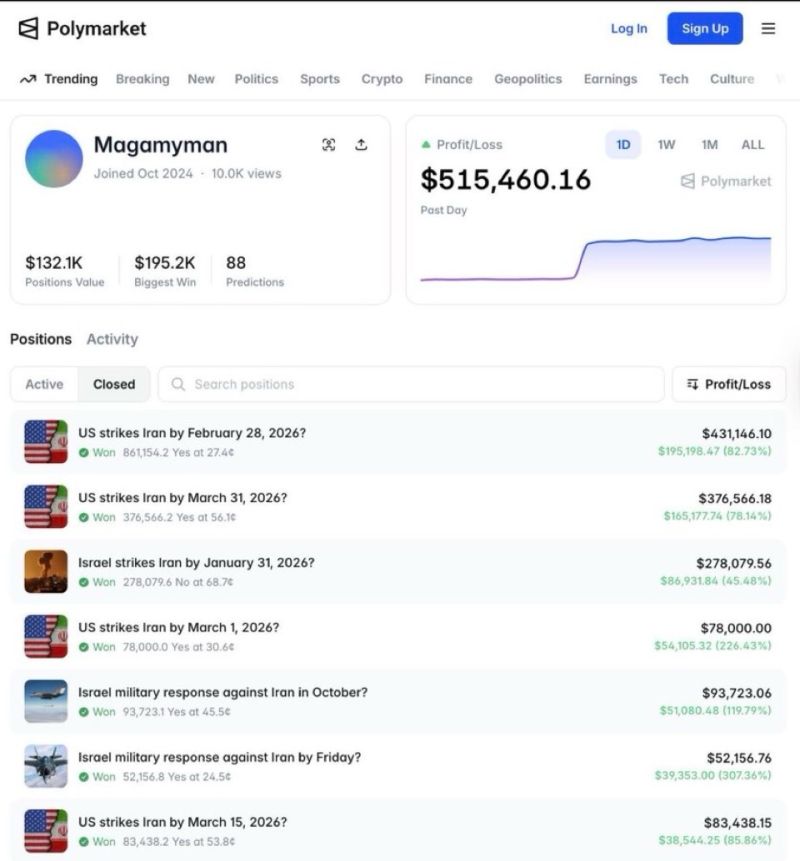
A Polymarket account called "Magamyman" made $515,000 in a single day betting on last night's U.S. strike on Iran, with the first trade placed 71 minutes before the news broke publicly:

When this person bought in, the market had this at a 17% probability. They turned roughly $87,000 into over half a million dollars overnight.


A reminder that Donald Trump Jr. sits on Polymarket's advisory board and his firm invested double-digit millions into the platform last year.


The DOJ and CFTC both had active investigations into Polymarket - that were dropped shortly after Trump took office.


Prediction markets are excellent vehicles for profiting off advance knowledge of military action.


Nope. No answers, no transparency, and no oversight. This is America. It is the power of impunity. Because in our new world order, laws and norms and accountability are for suckers.


Have a nice Sunday.

* * * * * * * * * * * * * * 


If this post was forwarded to you and you'd like to subscribe,

please email me at luminative.media@gmail.com


To read my other thoughts and musings,

please see my full web site by clicking here


* * * * * * * * * * * * * * 


Palaiochora, Crete, Greece

To contact me: