New Parent Survey Highlights Educational Challenges During COVID-19 |
|
On November 19th, The MassINC Polling Group, a nonpartisan, public opinion research firm, hosted a webinar to unpack the results of a survey of Massachusetts K-12 parents. Produced in collaboration with The Education Trust and sponsored by The Barr Foundation, the research is part of a year-long series to examine the impact of COVID-19 on students and families, and quality of the state’s education system during the pandemic. With limited data on how parents and students are engaging with education during the pandemic, this series of surveys offers a look at how the school year is unfolding. The survey highlights the need for clear, transparent data on learning experiences and outcomes to better support the needs of students and families. The previous survey, conducted between May and June 2020, examined remote learning and limitations to student engagement, whereas the current survey, conducted between October and November 2020, examined four key areas:
- School formats and supplements;
- At-home learning and performance;
- Technology barriers;
- Social and emotional health
The current results are based on a statewide survey of 1,549 parents of school-age children across Massachusetts, which includes oversamples of Black, Latinx, and Asian parents. The results reflect their perceptions and expectations of education quality during the pandemic rather than assessments or achievement data.
School Formats and Supplements
The large majority of parents said their child was either learning in a hybrid model or fully remote learning model, with major differences by race and other socioeconomic factors. Black, Latinx, and lower income parents were far more likely to report their children being in fully remote school. High-income and private school parents were more likely to have children in a hybrid model with both online and in-person learning. Catholic, private school and higher income parents were also more likely to have children attending school in-person. When asked what factors mattered the most in the delivery of education to their children, half of parents (50%) cited health and safety as the most important factor, followed by 38% who cited academic and learning opportunities.
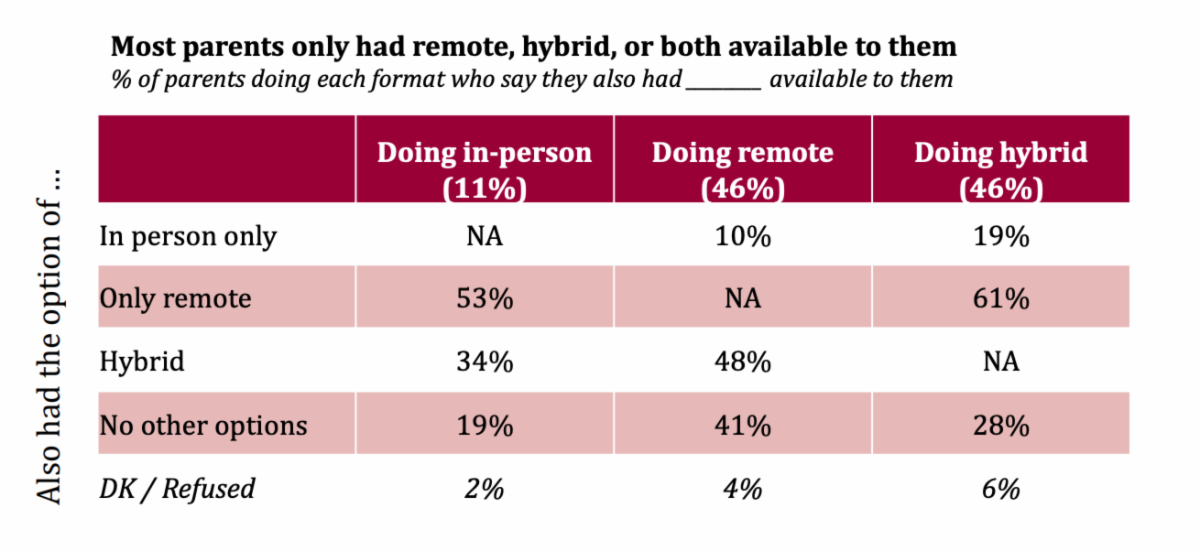
Parents of color were most supportive of remote schooling, which is consistent with other polls. Although more in person learning was not a clear preference, few parents had in-person learning available to them. Approximately one fifth of parents (19%) doing hybrid had in person available and one tenth of parents (10%) doing remote had in person available.
|
|
Less than a quarter (22%) of parents who responded to the survey said their children’s education model has changed since the beginning of the school year. Among this group, a little more than half (52%) said their child moved to remote-only learning, one third (35%) said their child moved to in-person learning, and one eighth (13%) said their child moved to a hybrid learning model.
At-Home Learning and Performance
Since June, more and more parents, across racial and socioeconomic groupings, saw their children as being behind grade level. Before the pandemic, 12% of parents said they felt their child was behind grade level. Since the pandemic began, that number has increased to 28% with that response being more common among lower income parents and parents with students in hybrid models. 36% of low income parents said they are very concerned about their child falling behind in school, compared to 28% of middle income and 19% of upper income parents. Among those in various school formats, one third (34%) of hybrid parents said they are very concerned whereas less than one third (31%) of remote parents, and one fifth (21%) of in-person parents expressed concern about their children falling behind.
In looking at students with specialized instructional needs, more parents of students with individualized education plans (IEP) and students who are English Language Learners (ELL) have access to services since the last survey was conducted. Looking deeper, more parents now see ELL services as adequate, while satisfaction with IEP services have slipped. In June, 11% of parents of an IEP student reported IEP services as inadequate. In October, that number rose to 27%.
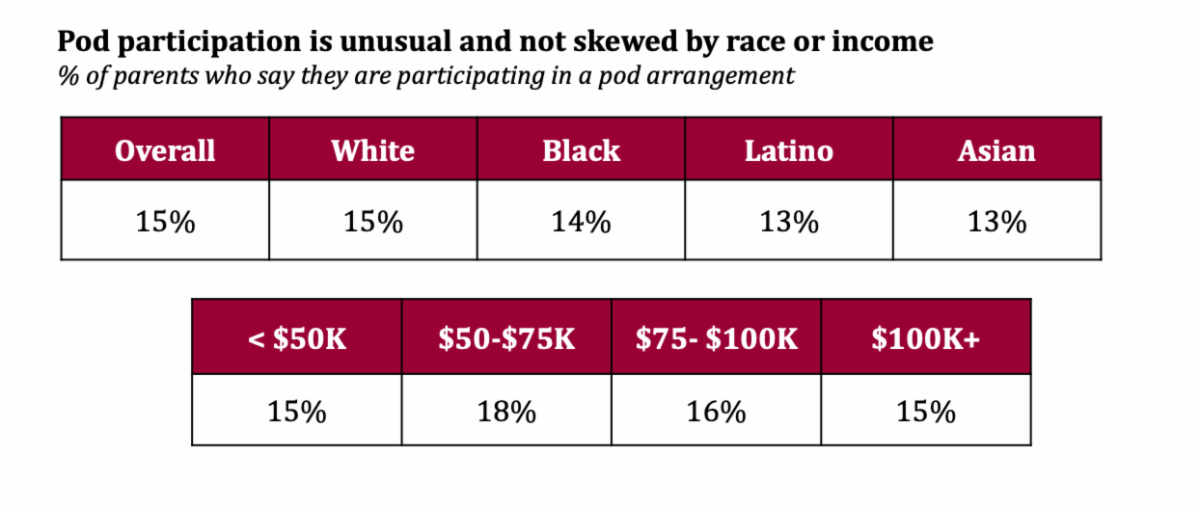
Supplementing a child’s education with a pod, tutor, or changing schools seems to be linked to greater perceptions of positive outcomes. However, there were fewer students in education pods this year relative to the media coverage they have received. In fact, pod participation this year was unusual and was not skewed by race or income.
|
|
Overall, parents expressed the most positive views of their children’s individual teachers than for their schools or school districts. More than three fifths of parents (67%) said their child’s teacher is “doing the best they can under the circumstances”, compared to 57% for their child’s school and 50% for the child's school district. Additionally, remote and hybrid parents rated schools and teachers as doing their best, even as they anticipate negative impacts of the school year on their children.
Technology Barriers
Although access to devices has improved somewhat, access to “sufficient” internet has decreased, particularly for parents of color. In June, 90% of white parents, 85% of Black parents, 88% of Latinx parents, and 89% of Asian parents reported sufficient internet access in their home. In October, the same percentage (90%) of white parents reported sufficient internet access, while Black parents (73%), Latinx parents 81%, and Asian parents 85% all reported lower rates of having sufficient internet access.
School intervention in ensuring access to technology mattered, with those students who received a device from school spending more time learning live online. Approximately three fourths of parents (72%) who received a school device said their child spent two or more hours a day attending live online classes, whereas only 51% of parents who did not receive a school device reported their children spending two or more hours online.
Interestingly, parents reported that their children had a better handle on technology use than teachers and schools did. 53% of parents said their child used remote learning technology very well, compared to only 49% for their child’s teacher and 42% for their child’s school. Overall, tech usage varied by school type, with private, Catholic schools being rated the highest.
Social and Emotional Health
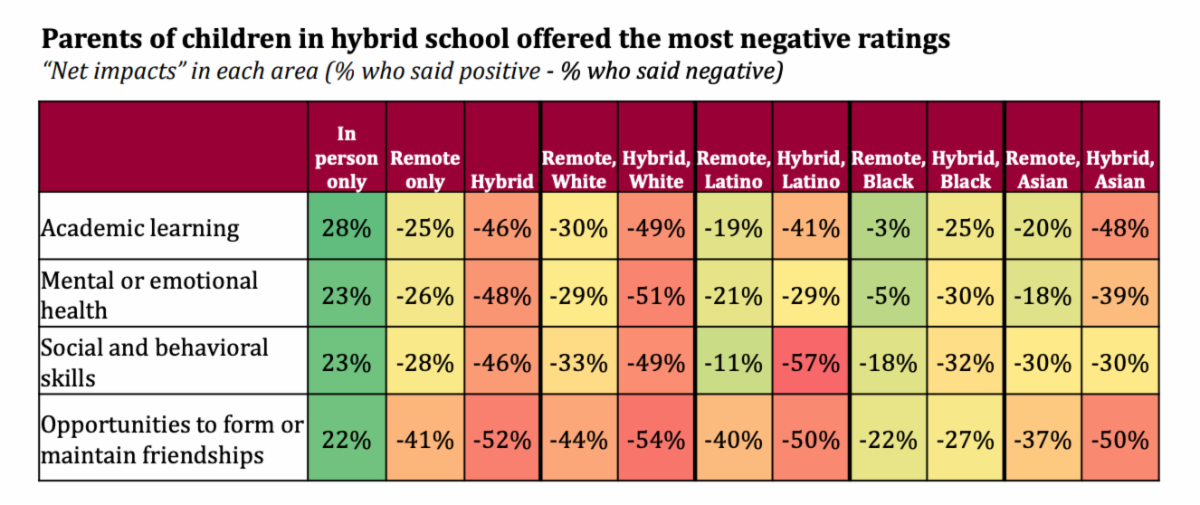
By a wide margin, parents were more likely to view the impacts of this school year as negative than positive, particularly parents in hybrid models. Although hybrid parents looked for learning opportunities and socialization when considering options for the school year, these parents saw a range of negative impacts on their children, including in academic learning, mental and emotional health, social and behavioral skills, and opportunities for friendships.
|
|
The MassINC Polling Group plans to conduct two more waves of surveys throughout the school year, which will also feature results from focus groups. The anticipated surveys (date TBD) will include additional areas that were not included in the surveys prior. Suggestions for additional content to be included in the next two surveys can be shared by accessing this link.
To view the full results from MassInc’s survey of K-12 parents and caregivers in Massachusetts, click here. For more information on how the pandemic has impacted youth, go to CfJJ’s “Youth Justice in a Pandemic” website here.
|
|
|
|
|
|
|