|
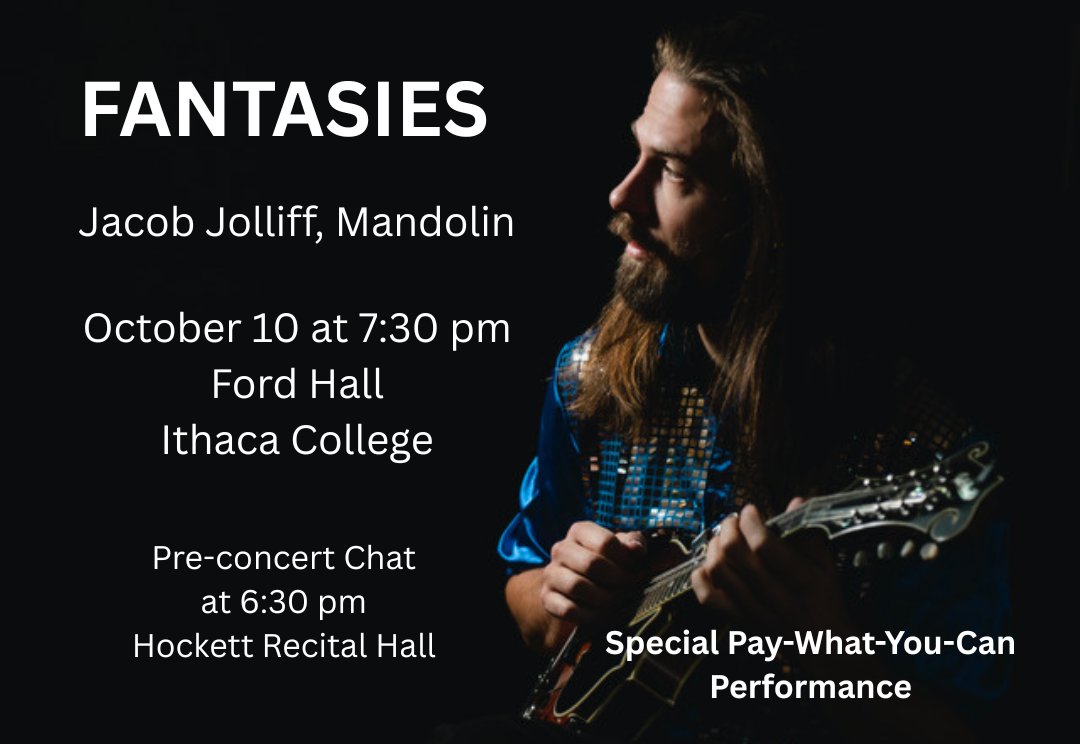
CCO: We read that your Dad started you on mandolin when you were just seven, requiring that you practice ten minutes a day, and then within six months, you were practicing several hours a day, voluntarily! What clicked for you?
JJ: I was so young, I barely even remember that change. At first, it was just sort of a requirement of my schooling, basically, that I learn an instrument. I did the 10 minutes a day, and I don’t think I particularly liked it, but I did it religiously. And, you know, when you are young and have that neuroplasticity working for you, it began to work. I started to play some simple bluegrass tunes, and it became a part of my identity. By the time I was 9 or so, I started gigging with my Dad. I found I liked playing for people and, just the adrenaline rush, and the challenge of it.
CCO: Why the mandolin, by the way, and not something like the fiddle or the banjo?
JJ: We were homeschooled and it was just understood that we would play an instrument as part of our studies. For some reason, I chose the mandolin. It's not a particularly good instrument for a little kid, because it's small, the string tension is really high, and you are playing on double- versus single- strings. It really kind of tears up your left hand; I remember developing huge calluses. As an adult, I play on some other instruments, but the mandolin is the one I resonate with and relate to.
CCO: We understand that you picked in a gospel band with your father in middle school and high school, and played all throughout the northwestern United States. Were there other teenagers performing on the road, and what was it like performing with such legendary adults?
JJ: As a kid, I was definitely on the lookout for other kids my age that played. Unlike in Kentucky, Tennessee and Virginia, Northwest Oregon didn’t have a bounty of bluegrass players. I did meet a few great pickers my age in my area, and I got to know some amazing pickers on the national level through going to festivals and going through camps. This included young musicians like Sarah Jarosz and Dominick Leslie, and closer to home, a great fiddler named Alex Hargreaves. I didn’t get to play with these musicians as often as I would have liked, but then turned 18 and went to the Berklee College of Music. A lot of those same pickers I knew from around the country sort of descended on Boston at the same time to go to music school, and a lot of those people are still good friends of mine to this day.
CCO: If we have this right, you have been on the road much of your adult life, certainly since 2008. What keeps you touring?
JJ: I joined this band called Joy Kills Sorrow my sophomore year of college, and we hit the road around in earnest around 2008. After that, I was a part of several groups, and I am still on the road all the time. In a nutshell, you kind of have to go on the road to make money. You can only play on one market so much; you have to move around.
CCO: Surely you have a lot of touring stories, but can you think of one you would like to share?
JJ: Some of my favorite moments are the crazy travels. I’m thinking about a night last October when my band played at the Bluegrass Island festival in the Outer Banks of North Carolina. We played there in the afternoon, then we did a late night set that wrapped up around 11.30 pm, and then we drove 3 hours through the night to Raleigh-Durham, to catch a 5:00 am flight to Portland, Oregon, for a performing arts center gig in Newberg the next day, so…we were joking, you know, we doubt that anyone has ever played Manteo, North Carolina, and Newberg, Oregon on back-to-back nights. It's kind of miserable in a sense when you're doing it, because you're literally sleeping zero and…you're having to then get up on stage in that state, but you know, it's fun when you're with a group of musicians that you all really get along and enjoy hanging out with, and enjoy playing music together. It can feel kind of heroic and fun in those moments. There are so many amazing musical moments and stuff that keep you going as well, but you have to really love hanging and traveling with the people you're with for it to be sustainable.
CCO: You'll be performing a piece by composer Jesse Jones with the CCO on October 10th, and we're so excited about your concert. What should we know about Jesse Jones and the piece he wrote expressly for you, Tunebook?
JJ: Jesse was a great classical piano player as a kid and turned to bluegrass when he was in college. I met him when he was college-aged, and I was about 10 years old, when we played summer bluegrass festivals together. We were picking buddies: he played mandolin and guitar.
Jessie is a much-lauded classical composer who is one of the few who can write something really relevant, from the perspective of both the bluegrass and the classical genres. I think a lot of times someone is much more steeped in one genre, and they want to sort of do a fusion-y thing with another genre, but they don't actually know that other genre well enough. So what they do ends up being kind of cliché from one perspective, even though it might be very hip from the other.
And I think Jessie's someone that truly knows the canon on both sides and can play instruments in both environments. He knows the mandolin world, he knows the whole world of, players like world famous banjo player Béla Fleck and Chris Thile and David Grisman, and, back to Bill Monroe and Sam Bush. So he knows the mandolin canon as well as he knows the classical music canon. He's not a dilettante, he’s not just dabbling in either. I feel like that's what's part of what makes Tunebook really cool. I also think that Tunebook has a lot of things that are just staples of making good music, like great melodies.
I also think that Tunebook has a lot of things that are just staples of making good music, like great melodies. There's nothing that's kind of just complex for its own sake. Sure, there are virtuosic moments, and there's certainly lots of moments of dense harmony, but then there's lots of basically fiddle tune, bluegrass type of instrumental music, that, for me, also is what makes it fit really naturally, because that's the language I grew up playing. So I think there's kind of something for everyone in it. And certainly something for the bluegrass listener as well as the classical music listener.
CCO: Can you fill us in on a few of your blugrass projects?
Yes, there's We Like Jim and Jesse, the album I released with Michael Daves in March of 2026. It’s a tribute to first generation bluegrass duo legends, Jim and Jesse McReynolds. We are touring this year and next year with music behind that album. That's really fun; Michael is an incredible guitarist and one of the best bluegrass singers living, easily, I would say. I sing a bunch on the album as well.
The last few years, actually, the main thing I've been doing is touring with my own band, which is a quartet, and I write a lot of music for that group. I have a lot of other projects going at any one time, but you can find me and my band out on the road regularly.
|