|
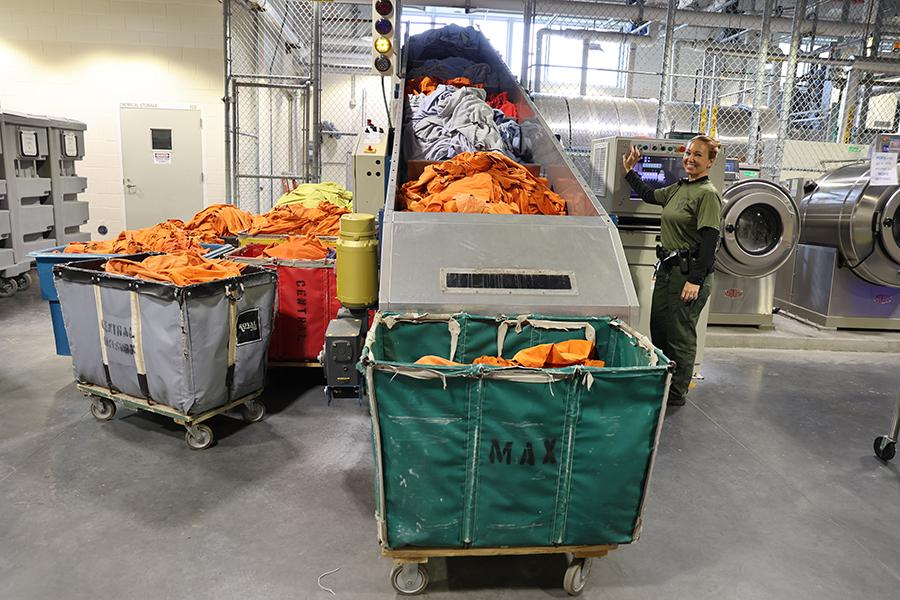
“It’s laundry. Just like at your house, it’s wash, dry, fold, never ending, every day of the week.” Deputy Justin Baker of the Support Services Division oversees laundry at the jail, and that means that he’s responsible for keeping a population the size of a small city in clean clothes and linens.
At any given time there are about 3,000 inmates in the Pinellas County Jail. They all get a clean uniform twice a week and a bedroll consisting of two flat sheets, a pillowcase, towel, and washcloth. That number isn’t static – inmates are constantly coming in, bonding out, or getting released, replaced by new arrests or transfers. Even if they only wind up being there overnight they get freshly laundered clothes and bedding. Beyond that, the jail handles laundry for Safe Harbor, the homeless shelter and jail diversion program run by the Pinellas County Sheriff’s Office (PCSO). “On a heavy day, half the jail gets a new uniform and 1,000 inmates get bedrolls, so organization is key,” Deputy Baker said.
Though the perpetual cycle of dirty laundry is the same as with your own family, the equipment is nothing like your washing machine at home. Most of their laundry goes through the tunnel washer, a huge machine that cleans massive loads, moving them through wash, rinse, and spin stages on a conveyor belt like an assembly line. Each load is 100 pounds, and moves through five cycles to emerge in a compressed, almost-dry cylindrical block. Multiple loads go through in succession, with the system pausing each time a block emerges until an inmate worker moves it to the dryer. “For comparison, the people who come out to service the tunnel washer told me that Disney runs off of two of these,” said Deputy Baker. “We have quite a capacity.”
There are also several smaller (but still industrial-sized) front loading washers that hold 100-pound loads. On a busy day without any serious hitches, they will get through 100 loads. If everything went perfectly smoothly, they might be able to hit 120 loads in a day, although Deputy Baker only remembers that happening once.
When garments or bedding are contaminated with biohazards, they are placed in a special bag that can go directly into the laundry. The bag dissolves, and the clothes get cleaned. If a garment is too heavily soiled it will be destroyed, but this is rare – there’s not much that the jail laundry system can’t handle. Clothes are typically washed at 160 degrees, and dried at 190 degrees.
“Everything runs at such a high temperature that things probably come out cleaner than most people’s home laundry,” said Deputy Baker. “The system is so redundant – water temperature, detergent, bleach, dryer temperature – that as long as any one of those things is in place the laundry is sterile afterward. I’d happily put on any of the clothes when they come out of the dryer. I won’t feed inmates anything I wouldn’t eat, and I wouldn’t give them any clothes or bedding I wouldn’t use myself.”
They aren’t washing delicates, but they do have to wash bright orange plastic Unifoots, the inmate footwear that has no left or right shoe and can fit either foot. They’re washed at a lower temperature in a front loader, with extra bleach and less detergent, then dried at a lower temperature of 165 degrees. “It still kills everything but they don’t turn into a pool of jelly at the bottom.”
All of the work is performed by inmate workers, who are identified by their yellow uniforms, unlike the usual orange that most inmates wear. Some less common inmate uniforms are the orange and white striped version for road crew certified inmates who work outside with jail staff, and red for the Red Dot inmates. “Red Dot inmates are a security risk or an escape risk and are cuffed and shackled any time they come out of their housing unit, and escorted by two staff members wherever they go.” Whatever color the uniform, it all gets laundered.
What about undergarments? Sometimes inmates are allowed to keep the socks and undergarments that they were wearing upon arrest. Otherwise they have to purchase them from commissary. These personal items don’t go through the tunnel washer. “Each housing unit also has a personal laundry system,” Deputy Baker said. “Personal things are taken in a mesh bag, washed in a small residential-type laundry, and returned. Inmates write their name and docket number on the garments with a marker and they get their own things back.”
Inmates get a blanket that is exchanged every three months, and in the winter they are issued a sweatshirt. They can also purchase thermal underwear through commissary. All of these things have to be laundered too.
“We also do the gym towels for staff,” Deputy Baker said. Employees have access to an on-site gym open 24 hours a day to accommodate every shift. “They’re a different color for tracking purposes, but they don’t get any different treatment than the inmates’ laundry.”
The laundry shuts down during the worst part of a hurricane, but it runs up until the last minute and can resume production immediately after. “We have generators and we have a water supply,” Deputy Baker said. “It’s pretty much nonstop.”
Inmate workers are generally compelled to work as part of their sentence. There’s a job for everyone, and reasonable accommodations. “If someone says they can’t stand, that’s fine, you can sit and fold,” Deputy Baker said. “As long as the folding gets done. We find a job that is appropriate for them. If I have someone who is kind of a neat freak, they work as an odds and ends person who doesn’t fold much but goes around dusting and tidying up after everybody. That frees everyone else up to just fold. We balance it pretty well.”
The Laundry Specialists run an efficient, productive laundry system that keeps inmates clean and is a model for how a jail laundry should be run. “Outside visitors are consistently impressed,” Deputy Baker said. “Every time someone comes in for inspections they’re in awe of our laundry. We don’t prepare for inspections, what they see is what we do every day.”
|