| |
|
| |
Volume 16. Issue 1. January 2018 |
|
|
What to Do if You Are Being Stalked
1-
Trust your instincts. Victims of stalking often feel pressures by friends or family to downplay the stalker's behavior, but stalking poses a real threat or harm. Your safety is paramount.
2-
Call the police if you feel you are in any immediate danger. Explain why even some actions that seem harmless-like leaving you a gift- are causing you fear.
3-
Keep a record or log of each contact with the stalker. Be sure to also document any police reports.
4-
Stalkers often use technology to contact their victims. Save all the emails, text messages, photos, and postings on social media sites as evidence of the stalking behavior.
|
|
| |
| |
|
|
Greetings from Executive Director
Happy New Year!
NYSCADV was an invited guest at the Governor's State of the State Address on January 3rd in Albany. Of the proposals in the address, we are pleased that there are several initiatives that will support survivors of domestic violence and sexual harassment including:
1) Requiring mandatory surrender of firearms after all domestic violence-related convictions including misdemeanors;
2) Making illegal the publicizing of sexually explicit images without consent, often called "sextortion" and "non-consensual pornography"; and
3) Targeting sexual harassment in the workplace by creating a uniform sexual harassment code for state and local government, prohibiting confidentiality agreements, and preventing the use of taxpayer dollars for harassment settlements.
The executive budget will be released later in January, and we will be providing updates as we prepare for our Budget Advocacy campaign in February. More than ever, your voice is critical as we advocate for policies and resources that support survivors of domestic violence, value the work and expertise of domestic violence advocates, and strengthen efforts to prevent domestic violence in our state!
All the best,
Connie
|
|
|
NY Gov Unveiling Bill To Remove Firearms For Misdemeanor Domestic Violence Convictions
New York Gov. Andrew Cuomo announced legislation to remove firearms from people who commit domestic violence crimes. "Today I am announcing legislation to remove all firearms from those who commit any domestic violence crimes," Cuomo tweeted.
"Given the inextricable link between domestic violence and lethal gun violence, this legislation will require all domestic violence crime convictions, including misdemeanors, to result in the immediate removal of all firearms."
|
|
Cuomo to Push for Legislation to Combat Sexual Harassment
Gov. Andrew Cuomo proposed sweeping changes to the sexual harassment policies covering state and local officials Tuesday following national attention on the problem of sexual misconduct in the workplace.
The Democrat's proposal includes a prohibition on
taxpayer funded
legal settlements involving complaints against individual government officials. It would also require that all harassment settlements
to
be made public unless the victim prefers they remain confidential.
He's also pushing for changes to private employment rules to void forced arbitration clauses in employee contracts that keep sexual harassment cases out of the courts.
Connie Neal, Executive Director of New York State Coalition Against Domestic Violence regarding this new proposal stated: "We applaud Governor Cuomo for his groundbreaking proposal to address sexual harassment in the workplace. This initiative will support justice for victims, increase accountability for abusers, and enhance the responsibility of employers to ensure safe and equitable environments. The New York State Coalition Against Domestic Violence stands ready to work with the Governor to implement this policy as we strive toward a shared goal of ending sexual harassment and abuse in New York."
|
New York State Coalition Statement Regarding Governor's 11th Proposal: "Ending Sextortion Now"
Governor Andrew M. Cuomo unveiled
the 11th proposal of the 2018 State of the State: a comprehensive plan to outlaw "sextortion" and non-consensual pornography, often known as "revenge porn." Under these new measures, a conviction for any of these serious offenses will require registration as a sex offender and sentences will range from a class A Misdemeanor, punishable by up to one year in jail or three years of probation, or up to a class C Felony, punishable by up to fifteen years in prison.
"The dangerous proliferation of sextortion and revenge crimes disproportionately targets young women and girls and causes harm and embarrassment that can follow victims their entire lives," Governor Cuomo said.
This new legislation outlaws
this horrific, exploitive practice once and for all in New York and will help provide New Yorkers with peace of mind both on- and offline."
Connie Neal, Executive Director of the New York State Coalition Against Domestic Violence acclaimed 11th proposal of Governor Andrew Cuomo's 2018 State of the State and stated:
"The distribution of sexually explicit images without consent is a form of abuse that disproportionally impacts women and young girls. Intimidation, threats, and the sharing of private information about victims are not new tactics, but the use of technology has made this abuse even more invasive and traumatizing.
Research published by the National Network to End Domestic Violence (NNEDV) shows that 90% of domestic violence programs report that survivors are abused via technology. Non-consensual distribution of intimate images is one of the primary ways abusers use technology to exert power and control over victims.
We commend Governor Cuomo for taking a firm stand to criminalize the non-consensual distribution of sexually explicit images. New York can do better to protect survivors and to prevent this kind of abuse from occurring. Under Governor Cuomo's direction, New York State can take major strides forward by creating strong laws for protecting New Yorkers."
|
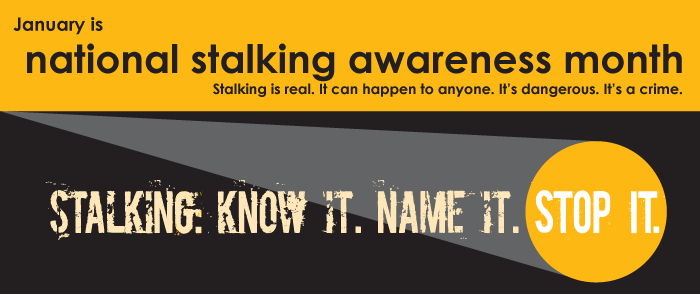
January Is National Stalking Awareness Month
Now in its fifteenth year, National Stalking Awareness Month (NSAM) provides us with the great opportunity to promote awareness about an important issue affecting 7.5 million people nationwide each year. The theme, "Stalking: Know It. Name It. Stop It.", challenges the nation to fight this dangerous crime by learning more about it.
Stalking is a crime in all 50 states, U.S. Territories and the District of Columbia, yet many victims and criminal justice professionals underestimate its seriousness and impact. In one of five cases, stalkers use weapons to harm or threaten victims, and stalking is one of the significant risk factors for femicide (homicide of women) in abusive relationships. Victims suffer anxiety, social dysfunction, and severe depression at much higher rates than the general population, and many lose time from work or have to move as a result of their victimization.
Stalking is difficult to recognize, investigate, and prosecute. Unlike other crimes, stalking is not a single, easily identifiable crime but a series of acts, a course of conduct directed at a specific person that would cause that person fear. Stalking may take many forms, including assaults, threats, vandalism, burglary, animal abuse, and unwanted cards, calls, gifts, or visits. One in four victims reports that the stalker uses technology, including computers, global positioning system devices, or hidden cameras, to track the victim's daily activities. Stalkers fit no standard psychological profile, and many stalkers follow their victims from one jurisdiction to another, making it difficult for authorities to investigate and prosecute their crimes.
|
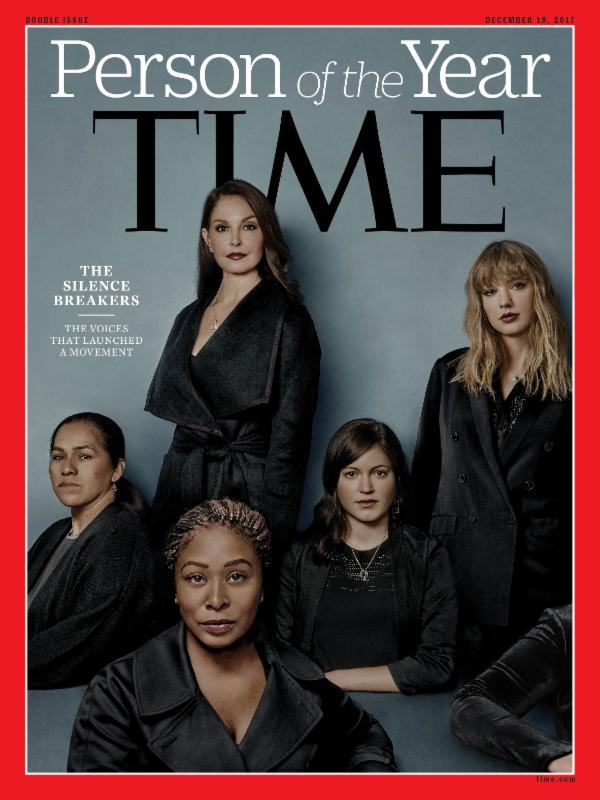
Time's Person of the Year: 'The Silence Breakers' for Speaking Out Against Sexual Harassment
The magazine calls them "the voices that launched a movement."
Among them are Ashley Judd and Rose McGowan, the actresses whose stunning accusations against movie mogul Harvey Weinstein helped lead to his downfall; and activist Tarana Burke, creator of the #MeToo movement, along with the Hollywood star who amplified it on social media, Alyssa Milano.
"The galvanizing actions of the women on our cover ... along with those of hundreds of others, and of many men as well, have unleashed one of the highest-velocity shifts in our culture since the 1960s," Time's editor in chief, Edward Felsenthal, told NBC's "Today" show.
The media's endless stream of sexual misconduct investigations and the countless #MeToo accounts of harassment, abuse and worse have ensnared an ever-growing list of public figures - celebrities, executives, politicians, business leaders, whose lives and careers have come crashing down, or are dangerously close to doing so.
|
|
TL;DR: Domestic Violence Is a National Security Issue
What if we treated violence against women as a national security issue?
Think about the men in recent years who have committed public mass violence or acts of terrorism. More than half of mass shootings in the United States are related to domestic or family violence. And even when a relative is not shot or killed, domestic violence often looms in the background.
Before Robert Dear attacked a Planned Parenthood clinic in Colorado, two of his three ex-wives accused him of physical abuse. Before James T. Hodgkinson shot up a congressional baseball practice, he was charged with domestic battery. Before Tamerlan Tsarnaev bombed the Boston Marathon, he faced domestic violence allegations, as well. The mother of Nazi sympathizer James A. Fields called 911, afraid of her violent son, years before he allegedly killed a woman by driving his car into a Charlottesville rally.
Margaret Atwood once said, "Men are afraid that women will laugh at them. Women are afraid that men will kill them." A recent report from the Centers for Disease Control and Prevention underscores this sad reality for women in the United States: A significant portion of those who are murdered are victims of their husbands, boyfriends or ex-partners. This is not to say all men who abuse their families will go on a mass rampage, nor is it true that all perpetrators of shootings or terror have been charged with abusing their families. Still, why don't we treat women's safety as more of a public-safety matter?
To learn more, watch the latest TL; DR video . But the bottom line is: Black, white, Christian, Muslim, rich, poor - mass violence claims all lives. Domestic violence does, too. And often, before a man unleashes his rage and violence in public, it's a woman in the attacker's life who suffers first.
|
|
Leading Gun Violence Prevention Organizations Partner to Create the First National Website About the Intersection of Domestic Violence and Firearms
The National Coalition Against Domestic Violence (NCADV), the Educational Fund to Stop Gun Violence (EFSGV), the Alliance for Gun Responsibility Foundation, and Prosecutors Against Gun Violence (PAGV) announced the creation of the first comprehensive website about domestic violence protective order
enforcements
and firearm surrender. The website will be a user-friendly, first-of-its-kind tool to compare firearm removal laws between states.
The Disarm Domestic Violence website will allow advocates and gun violence prevention activists to research state-specific laws on domestic violence-related protective order firearm removals. The website, due to launch in October 2018, will provide an interactive map that can be searched for a number of variables. The search results can be compared between states, providing a complete picture of state-by-state laws regarding domestic violence protective orders and firearm removals.
|
|
2018 National Crime Victims' Rights Week (NCVRW)
Every year in April,
OVC helps lead communities throughout the country in their annual observances of NCVRW, which will be observed in 2018 on April 8-14.
This year's theme-Expand the Circle: Reach All Victims-emphasizes the importance of inclusion in victim services. This year's theme addresses how the crime victims field can better ensure that every crime victim has access to services and support, and how professionals, organizations, and communities can work in tandem to reach all victims.
|
2017 International Day for the Elimination of Violence Against Women Theme: Leave No One Behind
Violence against women and girls is one of the most widespread, persistent and devastating human rights violations in our world today.
Gender inequality persists worldwide. Achieving gender equality and the empowerment of women and girls will require more vigorous efforts, including legal frameworks, to counter deeply rooted gender-based discrimination that often results from patriarchal attitudes and related social norms, as stated by the UN Secretary-General, in his latest report on progress towards the Sustainable Development Goals.
The UNiTE to end violence against women initiative launched in 2008 by the then UN Secretary-General, Ban Ki-moon which is also supported by his successor, António Guterres. UNiTE led the 16 Days of Activism against Gender-Based Violence campaign, which aimed to raise public awareness and mobilize people everywhere to bring about change. Those 16 days went from 25th November to 10th December, which is Human Rights Day. The theme of the campaign for 2017 was "Leave no one behind: end violence against women and girls." This theme reinforces the UNiTE Campaign's commitment to a world free from violence for all women and girls around the
world,
while reaching the most underserved and marginalized, including refugees, migrants, minorities, indigenous peoples, and populations affected by conflict and natural disasters, amongst others, first.
|
|
Sanctuary for Families Staff Testify: ICE Agents Have No Place in New York's Courthouses
Earlier this summer, a Chinese trafficking victim was nearly detained at the Queens Human Trafficking Intervention Court. Sanctuary has joined community organizations and elected officials in calling on ICE to end raids in NY courthouses.
|
|
Racial and Ethnic Differences in Homicides of Adult Women and the Role of Intimate Partner Violence-United States, 2003-2014
According to a new report from the Centers for Disease Control and Prevention, more than half of all female homicide victims are killed by a current or former intimate partner. In 98.2% of these deaths, the perpetrator was male. While the report shows that intimate partner homicide occurs across all racial and ethnic groups, black and indigenous women are murdered at significantly higher rates than other groups. The report concluded that risk assessments that evaluate
risk
of lethality are an effective way to intervene in the most serious cases.
"Racial/ethnic differences in female homicide underscore the importance of targeting intervention efforts to populations at risk and the conditions that increase the risk for violence. IPV lethality risk assessments might be useful tools for first responders to identify women at risk for future violence and connect them with life-saving safety planning and services."
|
|
|
New Facebook Tools Give Women More Power over Their Abusers
In December 2017, Facebook released its policies on harassment-a decision that was made at least partially to respond to and amplify the #MeToo movement. At the time, a Facebook executive said in an interview with TechCrunch that she wanted tech companies to contribute to conversations
around
harassment and abuse. The platform announces a new suite of anti-harassment tools, built in consultation with victims' advocates to protect women, journalists, and especially domestic violence survivors.
The tools include a new method that helps Facebook track and block users who generate multiple accounts to harass victims and rolls out the option to ignore a conversation-rather than block its initiator-which the company believes will let domestic violence survivors collect evidence on harassment and intimidation but not have to experience it in their inboxes.
|
|
Addressing Technology Misuse in the Context of Sexual Assault
As technology becomes woven into every aspect of society, offenders misuse the technology in sexual assault. Just as the dynamics of sexual assault differ from domestic violence, the misuse of technology looks different when
sexual assault
occurs outside of an intimate partner relationship.
- A youth group leader might misuse online communities to groom victims.
- A supervisor might threaten to change an employee's file in a company database.
- A caretaker might limit access to help-seeking through technology.
- A medical provider might threaten to share embarrassing information or images gathered in the course of treatment.
- Surveillance cameras and security could be misused by a landlord to gain footage of or access to a victim.
- A law enforcement officer could misuse a database to target potential victims.
More understood examples include the explosion in the production and sharing of child
pornography,
or
non-consensual
sharing of intimate images or footage of sexual assault of adults over the Internet.
|
OPDV Announces The Ursula
Forem
Domestic Violence Program Employment Fellowship
The Office for the Prevention of Domestic Violence (OPDV) is accepting proposals from NYS domestic violence programs that are licensed and/or approved by the Office of Children and Family Services (OCFS) to hire college graduates or current graduate students to work for the domestic violence program. The Fellow must be a new hire, that has not previously worked for the program, for the purpose of fulfilling the obligations of this grant. Fellowship candidates must possess a college degree no later than June 2018.
OPDV will fund two grants, up to a total of $75,000 with a maximum of $37,500 annually per award. The funds will be available to cover salary and fringe benefits for two years.
|
|
Advocacy Learning Center is Now Accepting Applications
Embark on an interactive and transformative journey with advocacy groups across the country to explore our collective roots and strengthen our efforts to end violence against women and children.
Whether we work with those who have been sexually assaulted, battered, or stalked, or with women who are trafficked or prostituted, we share the same vision: An end to violence against women.
This innovative 18-month course gives advocates, advocacy program managers and coalition staff a rare chance to come together for self-reflection, inspiration and an opportunity to re-think their approach to individual, institutional and community advocacy.
|
Call for Essays: The American Prison Writing Archive
The
American Prison Writing Archive is a digital platform for non-fiction essays by incarcerated people writing about their experience inside. The APWA is housed at Hamilton College, with the support of a grant from The National Endowment for the Humanities. The APWA features prison witness by all who have firsthand experience of prison conditions and it seeks robust representation of the voices of incarcerated women, trans, and gender non-conforming people. For information on how you can bring first-hand prison experience to the public, write to: The APWA, Hamilton College, 198 College Hill Road, Clinton, NY 13323-1218.
|
|
New Resource: Supporting Undocumented and Immigrant Survivors - A Tip Sheet for Advocates
This is the latest resource from Oregon Coalition Against Domestic and Sexual Violence for advocates and programs, a tip sheet containing holistic strategies to support survivors of domestic violence and sexual assault who are vulnerable to racist and xenophobic violence.
|
High-Tech Stalking
Stalkers are increasingly misusing a variety of telephone, surveillance, and computer technologies to harass, terrify, intimidate, coerce, and monitor former and current intimate partners. Perpetrators are also misusing technology to stalk before, during, and after perpetrating sexual violence.
Stalkers may misuse technology to:
- Send multiple emails or text messages a day
- Monitor a victim's computer activity through Spyware
- Track the location of a victim's vehicle using GPS
- Watch the victim through hidden cameras
- Intercept phone calls and messages
- Impersonate the victim
It is not uncommon for a stalker to misuse multiple technologies at once while also using more traditional, non-technology tactics.
|
|
Succession Planning Toolkit for Nonprofit Sexual Assault and Domestic Violence Organizations
This toolkit will assist the staff and board of directors at nonprofit sexual assault and domestic violence organizations in developing and implementing a succession plan to strengthen and build the capacity of their organizations. This toolkit provides an overview of key elements along with resources and tools to develop a succession plan that can strengthen and prepare the organization for staff and board transitions. The toolkit addresses the following:
What is Succession Planning?
Why is Succession Planning Important?
Who Needs Succession Planning?
Why Do We Need to Include Anti-Oppression/Anti-Racism Work in Succession Planning?
Who is Responsible for
Successiong
Planning? Who Should Be Involved?
What Can We Do Now to Prepare? (including checklists and sample
workplans
)
How Do We Navigate the Barriers to Succession Planning?
|
|
NNEDV Resource: WomensLaw & Human Trafficking Awareness Day
It is estimated that there are
20.9 million victims of human trafficking worldwide
.
The similarities between human trafficking and domestic violence
are alarming. Perpetrators of trafficking often use the same abusive tactics as perpetrators of domestic violence to gain power and control over others.
WomensLaw.org provides plain-language legal information for survivors of domestic violence, sexual assault, and stalking, including information about
T-visa laws for victims of trafficking. A T-visa gives temporary nonimmigrant status to victims of severe forms of human trafficking on the condition that they help law enforcement investigate and prosecute crimes related to human trafficking.
At
WomensLaw.org, you can find information about T-visa laws for victims of trafficking, including:
- What a T-visa is and how it works;
- Who is eligible for a T-visa and an explanation of eligibility requirements;
- How to apply for a T-visa including: how to add family members, application costs, and finding an attorney; and
- What to do after obtaining a T-visa including: employment, federal benefits, applying for permanent resident status, and what to do when the T-visa expires.
A better understanding of T-visas - how to obtain one and how they work - can help increase survivors' safety and can give them the chance to remain in the country legally.
|
|
Safer Families. Safer Communities. Website
Safer Families, Safer Communities. The new website will be managed by BWJP's National Domestic Violence and Firearms Resource Center, funded by the U.S. Department of Justice, Office on Violence Against Women (OVW).
This website will promote the efforts of communities around the country to prevent domestic violence-related homicides through comprehensive implementation and enforcement of domestic violence-related firearm prohibitions at all levels of government.
Visitors to the website will learn about effective interventions in both criminal and civil domestic violence cases that can decrease the risk posed by dangerous domestic-violence offenders with access to firearms. Courts and communities can undertake a number of practical steps to facilitate enforcement of federal prohibitions and prevent purchases of firearms by prohibited domestic violence offenders.
Website content includes comprehensive strategies and resources, including policies, protocols, and useful forms, that can enhance implementation of state, Tribal, and federal firearms prohibitions. Other features include descriptions of model community efforts, highlights of related news and policy developments, and summaries of relevant legal and social science research.
|
|
New Resources on Services and Protections for Immigrant Survivors
This
factsheet
provides basic information on various immigration remedies available to victims of domestic violence and/or certain other crimes, including sexual abuse, child abuse or human trafficking.
This factsheet covers:
- A general overview of American legal immigration concepts and definition of terms
- A general description of how people obtain legal status in the U.S. and how deportation or removal fits into the process
- How marriage and divorce are related to immigration status
- Specific protections in immigration law for victims of domestic violence, sexual assault, or stalking
- How advocates can help victims in the immigration process
The information conveyed in this factsheet is intended only to assist in exploring options with non-citizen
immigrants,
and is not a substitute for individual advice from an experienced attorney.
Community-based crime victim advocacy programs that provide services to undocumented immigrant survivors of crimes can minimize risks to their program, funding, employees, and clients by adopting and following policies that take the laws on harboring undocumented immigrants into account.
This Advisory answers common questions about providing shelter and other program services to undocumented
victims,
describes the law and federal policy (as of the Advisory's publication date
),
and proposes best practices for programs, but it is not legal advice. Immigration and criminal laws vary from region to region, and federal immigration enforcement policies are constantly changing. Programs should analyze their program-specific risks, their community's particular needs, and the laws in their jurisdiction-including legal duties associated with an agency's funding sources-as they design or update program policies. Consulting a local immigration attorney with criminal law experience is highly advisable.
In light of heightened fear within immigrant communities, the following FAQs are intended to address confidentiality and due process protections afforded to victim advocacy organizations and victims themselves. A recent report, 2017 Advocate
and
Legal Service Survey Regarding Immigrant Survivors, in collaboration with several national organizations, revealed an increase in immigration-related questions from survivors to their victim advocates and attorneys and uncertainty about pursuing assistance from the legal system. Federal law and Immigration and Customs Enforcement (ICE) and Customs and Border Patrol (CBP) policies provide programs with several avenues for protecting the confidentiality of survivors. Advocates can reference these confidentiality protections when describing the confidentiality protections that their programs will adhere to if confronted with immigration enforcement.
These Frequently Asked Questions (FAQs) address common questions about responding to immigration enforcement activities at victim services programs.
|
|
New Multi-Media Platform for Start by Believing
The new multi-media Start by Believing websitehas been improved to better support individual and community efforts to transform responses to sexual assault. The national climate has never been more primed for Start by Believing and we hope you will take advantage of what the website has to offer.
The new website provides all the necessary materials to get started with a campaign, including graphics and templates to create proclamations, brochures, posters, pledge cards, and presentations. There are action kits specially customized for community organizations, law enforcement, prosecutors, health care, college campuses, and the military. You can even take the Start by Believing pledge online.
Start by Believing is now active in over 300 communities nationwide, and those are just the ones we know about! To make sure your community is featured on the online map of Start by Believing communities, click on your state in the interactive map and see if your community is represented. If it's not, submit information about your Start by Believing campaign online.
|
|
POWER THROUGH PARTNERSHIPS: A CBPR Toolkit for Domestic Violence Researchers
This toolkit is for researchers across disciplines and social locations who are working in academic, policy, community, or practice-based settings. In particular, the toolkit provides support to emerging researchers as they consider whether and how to take a CBPR (Community Based Participatory Research) approach and what it might mean in the context of their professional roles and settings. Domestic violence advocates will also find useful information on the CBPR approach and how it can help answer important questions about your work.
|
Webinars, Events & Trainings
(descriptions are taken directly from the host's event announcements)
|
|
NYSCADV Webinar
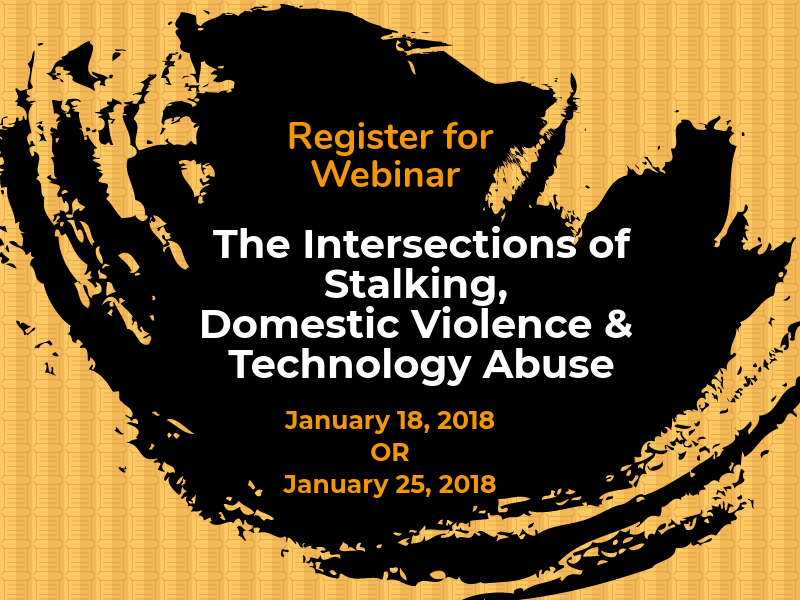
Webinar: "The Intersections of Stalking, Domestic Violence and Technology Abuse"
January 18, 2018 11:00 AM - 12:30 PM EST
OR
January 25, 2018 1:00 - 2:30 EPM EST
In recognition of January as National Stalking Awareness Month, NYSCADV in partnership with the National Network to End Domestic Violence will be hosting "The Intersections of Stalking, Domestic Violence and Technology Abuse." In this webinar we will discuss the prevalence and dynamics of stalking as well as the growing use of technology as a stalking tool. Topics will include:
- Technology as a tool for abuse
- Safety planning with survivors
Presenters:
Corbin Streett, MSW
Corbin is a Technology Safety Specialist at the National Network to End Domestic Violence, and has worked in the movement to end domestic violence since 2008, bringing a background in victim advocacy, state coalition work, public policy and communications. Corbin provides technology safety-related training and technical assistance to local, state, national and international audiences of victim advocates, law enforcement personnel, court officials, and other stakeholders. Passionate about fostering a culture of appreciation for the ways technology can help survivors stay safe and connected, Corbin works to ensure advocates and their community partners have the tools they need to help survivors navigate the nuances of privacy and safety in a tech saturated world. Corbin holds a Master of Social Work from SUNY Albany, and was a Public Policy Fellow at the SUNY Rockefeller College of Public Affairs and Policy.
Elaina Roberts, Attorney
Elaina Roberts is an attorney consultant and trainer for the National Network to End Domestic Violence, Safety Net Project. She provides training and technical assistance to criminal justice and allied professionals on the crimes of stalking and domestic violence. Ms. Roberts is currently a director at the National Center for Victims of Crime and is the former Legal Director of the Stalking Resource Center. Prior to working at the National Center Ms. Roberts was a prosecutor in Albuquerque, NM where she prosecuted cases
in the Violent Crimes, Community Crimes, and Metropolitan Divisions. For nearly a decade Ms. Roberts has dedicated her work to combating violence against women and fighting for crime victims' rights.
*PLEASE NOTE: Content will be the same for both webinars. Please register for only one session.
|
|
NYSCADV Save the Dates
Budget Advocacy Day*
February 6, 2018
Albany, NY
This is an opportunity for all of you to join us in Albany to meet your local representatives. We will also be hosting a virtual advocacy day where you can call, fax, and email your legislators and Governor Cuomo to let them know about the specific needs of domestic violence organizations and the survivors they serve around the state.
We will be using social media to spread the
message,
and ask programs and allies to join us in this effort. We encourage survivors to contact their elected officials to let them know how important these issues are.
We will be sending out detailed information about the campaign in January. This will include sample call dialogues, emails, letters and social media posts. NYSCADV will be scheduling in-person meetings with key legislators and officials within the Executive Chamber that same day.
*Registration and further details to follow in 2018.
2018 Annual Membership Meeting*
March 19, 2018
Albany, NY
The NYSCADV annual meeting is designed to provide:
- A forum for programs from across the state to network and get a state-wide perspective on domestic violence services.P
- Professional and organizational development opportunities for domestic violence advocates.
- An overview of NYSCADV's 2017 activities and plans for the upcoming year
*Registration and further details to follow in 2018.
2018 NYSCADV Day of Action*
May 9, 2018
Albany, NY
As a coalition representing domestic violence programs and the survivors they serve across New York State, NYSCADV knows that the best legislation comes when the voices of survivors and advocates are heard. And this is what NYSCADV's annual Day of Action is for: to convey a unified message, representative of the unique needs of a diverse range of survivors, to our state government that will protect rights, promote justice, and prevent domestic violence.
*Registration and further details to follow in 2018.
|
|
Assessing your Court's Protection Order Process
Battered Women's Justice Project (BWJP)
Wednesday, January 17,2018 / 12-1:30pm EST
Content: The Best Practice Assessment of the Civil Protection Order System is NCPOFFC's FREE tool to assess a court's protection order process. Join this webinar to learn about the steps involved in the process from a jurisdiction that has conducted the assessment. This interactive session will provide examples of the assessment tool and subsequent recommendations to improve protection order processes. Join us to learn more about this innovative tool and how it has affected jurisdictions that used it.
Hosted by the National Center on Protection Orders and Full Faith & Credit
Presenters: Hon. Mary Fitzgerald, Dist. Judge, Tulsa, OK and Suzann Stewart, Executive Director, Tulsa Family Safety Center. Hosted by Sarah Henry, Attorney Advisor, National Center on Protection Orders and Full Faith & Credit.
Battered Women's Justice Project (BWJP)
Tuesday, January 23, 2018 / 1-2:30pm EST
Content: This webinar is designed to introduce multi-disciplinary participants to the work of the Sexual Violence Justice Institute and explore the complexities of sexual violence, especially for programs and communities that see a limited number of disclosures. Through investigating the fundamentals of sexual violence, participants will gain a strengthened understanding of the key differences and similarities in service provision for victims of sexual violence. Through this broadened understanding of the importance of context, offender and victimization type, and paradigms of response, participants will walk away with concrete ideas of how to apply their learning to their current work in order to provide more robust services to sexual violence victims in their communities.
Presenters: Leah Lutz, Program Manager, Sexual Violence Justice Institute and Johnanna Ganz, Collaboration Specialist/Rural Technical Assistance Project Coordinator, SVJI. Hosted by Marijka Muras, Training & Technical Assistance Specialist, BWJP
Learn more and register now!
The Science and Practice of Community-Informed Risk Assessment
Battered Women's Justice Project (BWJP)
Thursday, January 25,2018 / 1-2:30pm EST
Content: This webinar explains the development of a community-informed risk assessment tool for use by law enforcement and advocates in cases of intimate partner violence. The Arizona Supreme Court recently approved a rule change requiring use of the Arizona intimate Partner Risk Assessment Instrument System (APRAIS) and submission of results of the assessment for judicial review at initial appearances. Dr. Websdale will review the scientific evidence underpinning the tool and the process of engaging community stakeholders to develop the tool for state-wide implementation. Mr. Giangobbe will discuss practical issues of training, implementation, victim safety and autonomy and stakeholder buy-in.
Presenters: Neil S. Websdale, Ph.D., Director, Family Violence Institute, NAU and Greg Giangobbe, MA, Law Enforcement Coordinator, Family Violence Institute, NAU. Hosted by Kathleen J Ferraro, Ph.D., Director of Training & Curriculum, Family Violence Institute, Prof. of Sociology, Northern Arizona University
National Clearinghouse on Abuse Later in Life
Thursday, January 25,2018 / 11:30am EST
Content: The National Clearinghouse on Abuse in Later Life (NCALL) and the American Bar Association Commission on Domestic & Sexual Violence have created a five-part webinar series on Abuse in Later Life for civil attorneys, legal advocates and others who wish to gain a deeper understanding of Abuse in Later Life (ALL). The primary focus of these webinars will be addressing the needs of older victims of domestic violence and sexual assault. This series is sponsored by the U.S. Department of Justice Office on Violence Against Women (OVW). This webinar is the first of five.
New Webinar Series on Trauma, Opioids, and Domestic Violence
National Center on Domestic Violence, Trauma and Mental Health
Thursday, January 25, 2018 / 1-2:30pm EST
|
|
Child Safety Matters; High Five; Safe Touches
The New York State Children's Alliance, Inc.
is pleased to announce free training opportunities in three different Child Abuse Prevention Curricula.
These trainings are for community and school-based professionals who are currently working in or plan to partner with one or more schools within New York State. Successful candidates must demonstrate the ability to deliver one of the curricula within a school setting. A letter of support from at least one school district must accompany the application.
Applications will be accepted until February 1, 2018!
|
Employment Opportunities
(descriptions are taken directly from the host's employment announcements)
|
|
|
|
| |
|