|
Happy New Year!
I hope you all had a relaxing holiday season! I enjoyed spending time with my family, eating tasty food, visiting friends and playing outside, when the family wasn't recovering from a cold.
Looks like 2020 will be an exciting year at PCAP! We are finalizing details for the 7th Native Prairie Restoration/Reclamation Workshop and the 5th Transboundary Grassland Partnership Workshop in Regina. Our program is almost complete and available on the website. There is also an excellent collection of posters this year! NPRRW / TGPW has so much to offer, including over 50 presentations, panel discussions, poster session, a trade show, and numerous networking opportunities! Make sure to stop by the NPRRW website to register before early bird deadline of January 21st! We're looking forward to seeing everyone there! There's more information below!
PCAP has also been busy planning Native Prairie Appreciation Week 2020 (June 14th - 20th ). It's looking like the NPAW tour will be different than past tours so stay tuned for more information about that and other NPAW events happening in your area!
The last webinar of 2019 was Andrew Jakes from the National Wildlife Federation, his presentation on pronghorn, as well as all past webinars, are on our
YouTube Channel
.
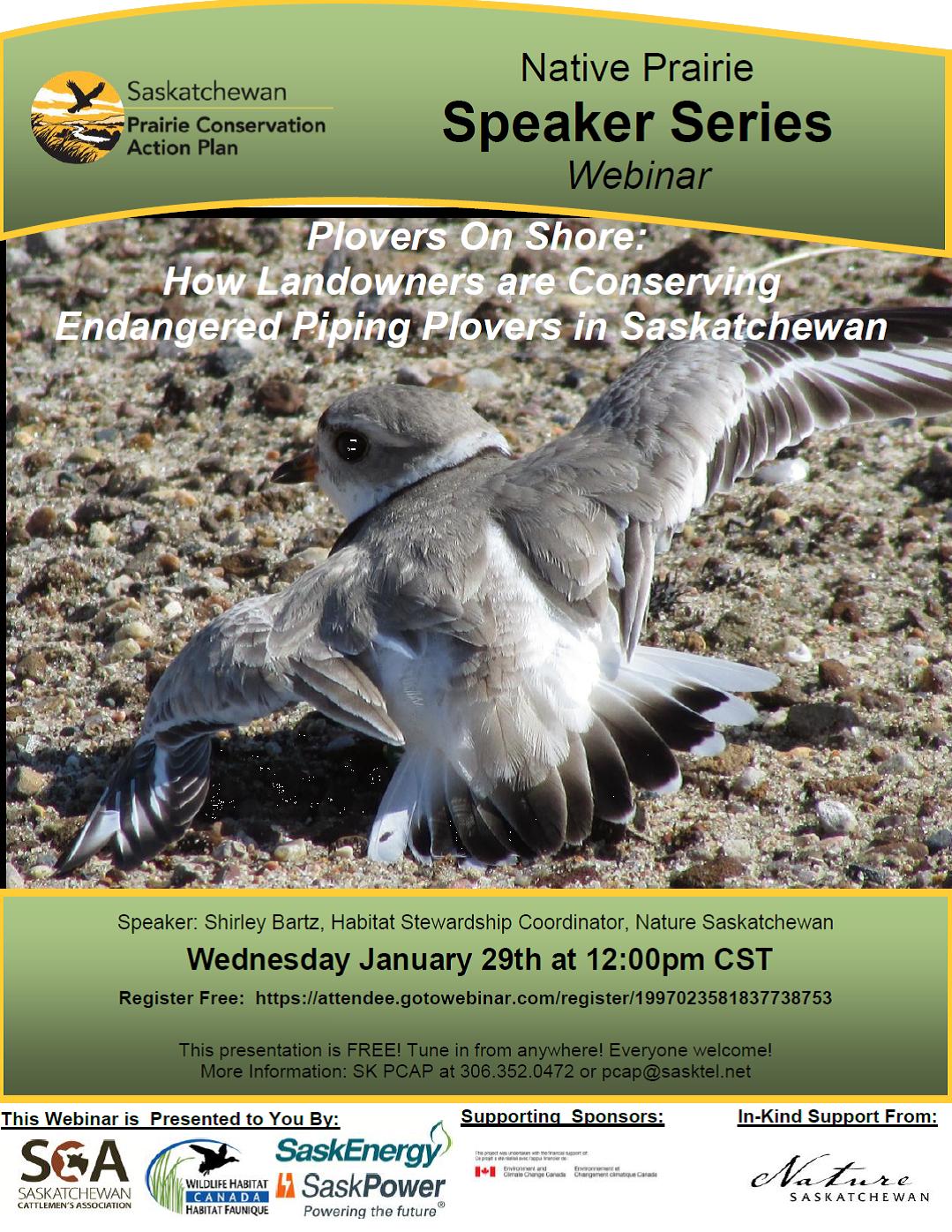
The first webinar of 2020 will be Shirley Bartz with Nature Saskatchewan, who will be giving a webinar about their Plovers on Shore program. We're all looking forward to it, make sure to
register early!
Caitlin has also started working on the webinar line-up for the Prairie's Got the Goods Week, March 16-20, 2020. Stay tuned for more information!
Finally, we would like to thank the generous support from our sponsors: Crescent Point Energy, Saskatchewan Cattlemen's Association, SaskPower, SaskEnergy, SaskTel, SaskWater, Mosaic, Enbridge, EcoFriendly Sask, Wildlife Habitat Canada and Environment and Climate Change Canada, as well as the continuous support of all the PCAP's
Partners
.
Carolyn Gaudet, SK PCAP Manager
Ph. 306 352 0472
pcap@sasktel.net
|
7th Native Prairie Restoration/ Reclamation and 5th Transboundary Grassland Workshops
Plan to attend this unique prairie restoration event on February 25-27, 2020 in Regina.
The workshop will include plenary sessions, break-out sessions, case studies as well as a trade show, awards ceremony, poster session, panel discussions and silent auction. Visit our site for all the details!
NPRRW Awards
Do you know of a deserving individual or group who should be nominated for the
Native Prairie Restoration and Reclamation Award? How about someone worthy of the
Native Prairie Stewardship Award?
View the award criteria here and consider nominating someone!
Nomination deadline is FEBRUARY 7th, 2020.
Please contact Carolyn Gaudet, SK PCAP at (306) 352-0472 or pcap@sasktel.net for any questions.
|
|
|
PCAP Partner Spotlight...
University of Regina
Little field station on the Prairies
By Krista Baliko (abridged from https://www.discoursemagazine.ca/little-field-station-on-the-prairies/2019/12/11/)
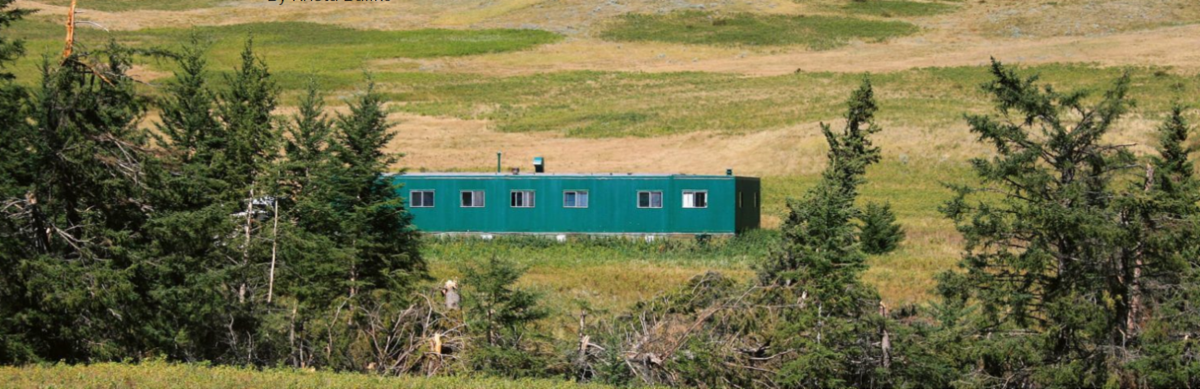
Although it was 30 years ago, Mark Brigham still remembers what he thought the first time he laid eyes on the University of Regina's research field station in the Cypress Hills.
"Why is it painted green on one end? Is it ever small. And, oh my, is it ever beautiful - it's out of the way, and it will serve my purposes absolutely fabulously."
It was the late George F. Ledingham, the former head of the University's biology department, who had the foresight to establish the spot in 1973. Located in the middle of nowhere, 65 kilometres southwest of Maple Creek, in the West Block of the Cypress Hills Inter-Provincial Park, the field station sits on 260 hectares of native prairie and forest, on land leased by the University from the Province of Saskatchewan.
Accessing the field station means taking a trip through Fort Walsh National Historic site - the property immediately adjacent to it -
which is the reason half the trailer was painted green. Brigham later found out that Fort Walsh staff asked the U of R to paint it so that the trailer wasn't as evident from the Fort's Interpretive Centre.
The Cypress Hills are a raised upland that sit about 600 m above the prairies and is one of only a few places not completely covered in ice during the Wisconsin glaciation period, giving it a unique climate and habitat. The vegetation is a mixture of fescue grassland and lodge pole pine, white spruce, and trembling aspen- making it the perfect research location for biologists of many stripes.
Every year for the last 25 years, Brigham spends a week in August at the field station with about a dozen undergraduate biology students who conduct field work as the lab component of his upper-level animal behaviour course. "The field component is really valuable, and for many of the students, it's the first time they have spent that much time in nature, collecting and processing data." They also all live, eat, and work together - getting to know Brigham and each other.
"I put people in situations where they work closely together," says Brigham. And sometimes this results in more than great research.
The actual buildings are 3 almost 50-year-old ATCO trailers, that
over five decades has housed hundreds of budding biologists, established faculty members, and has supported work that's led to internationally significant discoveries. It's even been the catalyst for love and marriage.
"I'm up to nine partnerships, with ten children produced from those partnerships. And what I'm most proud of is that none of those relationships have dissolved. And some are going on 25 years," says Brigham with a smile.
|
|
|
University of Regina field station in the Cypress Hills (photo by Anne Brigham)
|
Of course, great research is another outcome of the field work being conducted in the Cypress Hills. Close to 100 different journal articles, publications, conference talks, and manuscripts have emerged from the work done at the field station. The number of topics that have been studied is dizzying: ranging from birds to bats, bull snakes to red squirrels, beavers to coyotes, from forest succession and plant communities, to resource management, drought, and environmental and climate changes on the Prairies.
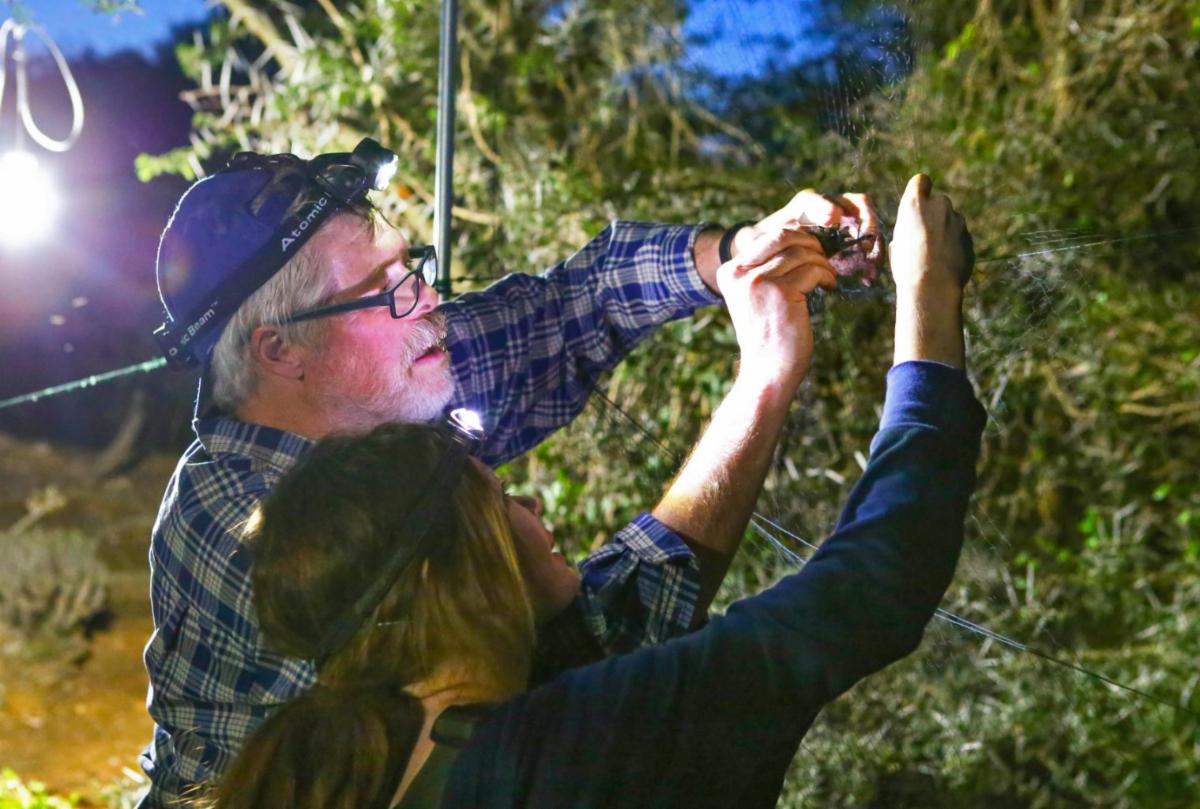
"The field station has allowed our scientists to explore the Cypress Hills in a way that couldn't be done as easily in other places. We've been able to study the same place over a long period of time, which allows us to continually keep building on our research," explains Brigham, who acknowledges that he and his students have an international reputation for their work on how bats cope with tough environments.
"The Cypress Hills is on a worldwide map, and that makes me really proud. It's well known because of the very good work that comes out of there and virtually all credit goes to the students who have worked there."
|
|
|
Mark Brigham helping a student take a bat out of a mist net (photo by Anne Brigham)
|
|
|
|
|
|
SK PCAP Native Prairie Speaker Series
Plan to attend our January Native Prairie Speaker Series webinar!
|
|
Upcoming Events!
January 25-26, 2020
Conexus Art Centre
Regina, SK
January 29-30, 2020
Saskatoon Inn and Conference Centre
Saskatoon, SK
January 29, 2020 at Noon
February 25-27, 2019
Ramada Plaza
Regina, SK
Greater sage-grouse in-person presentation
March 4, 2020
McCord Hall
McCord, SK at 7 PM
Prairie's Got the Goods Week
March 16-20, 2020
|
|
Career and Volunteer Opportunities
CanNorth has a few positions available including a Botanist and an Archaeologist, more information is available
here.
|
|
Call for Abstracts - Sustainability of Canadian Agriculture Conference
Deadline for abstracts is
January 24th.
The Sustainability of Canadian Agriculture Conference,
co-hosted by the University of Saskatchewan and Agriculture-Agri Food Canada, is March 12 & 13, 2020 in Saskatoon, SK.
More information can be found
here.
|
2019 Education Programs:
Presenting Sponsors:
 01
01
2019 Education Programs
Supporting Sponsors:
|
|
Carolyn Gaudet, Editor, Saskatchewan Prairie Conservation Action Plan Newsletter
306-352-0472 |
|
|
SK PCAP gratefully acknowledges financial support in 2019-2020 from:
Crescent Point Energy, Ducks Unlimited Canada, EcoFriendlySask.ca, Enbridge Inc., The Mosaic Company, Parks Canada - Grasslands National Park of Canada, Saskatchewan Cattlemen's Association,
Saskatchewan Ministry of Agriculture, Saskatchewan Ministry of Environment - Fish and Wildlife Development Fund,
SaskEnergy,
SaskPower, SaskTel, SaskWater, University of Saskatchewan - College of Agriculture and Bioresources, Water Security Agency and Wildlife Habitat Canada.
SK PCAP gratefully acknowledges in-kind support for 2019-20 from:
Agriculture and Agri-Food Canada - Science and Technology Branch, Canadian Parks and Wilderness Association, Canadian Western Agribition, Environment Canada - Canadian Wildlife Service,
Friends of the Royal Saskatchewan Museum, Friends of Wascana Marsh, Meewasin Valley Authority, Native Plant Society of Saskatchewan, Nature Conservancy Canada, Nature Saskatchewan, Parks Canada - Grasslands National Park, Prairie Wind & Silver Sage, Ranchers Stewardship Alliance Inc., Redberry Lake Biosphere Reserve, Saskatchewan Association of Rural Municipalities, Saskatchewan Association of Watersheds, Saskatchewan Burrowing Owl Interpretive Centre, Saskatchewan Cattlemen's Association, Saskatchewan Environmental Society, Saskatchewan Forage Council, Saskatchewan Forage Industry Network, Saskatchewan Ministry of Agriculture, Saskatchewan Ministry of Environment, Saskatchewan Ministry of Energy and Resources, Saskatchewan Science Centre, Saskatchewan Stock Growers Association, Saskatchewan Wildlife Federation, Saskatoon Nature Society, SaskEnergy, SaskOutdoors, SaskPower, Society for Range Management - Prairie Parkland Chapter, South of the Divide Conservation Action Program Inc., University of Regina, University of Saskatchewan - College of Agriculture and Bioresources, Wild About Saskatoon-Nature City Festival.
|
|
|
|