 |
Iron & Steel Preservation
|
|

.
|
This Newsletter has been dormant since the May 2020 issue. Iron & Steel Preservation remains of special interest to me, of course, but the current pandemic has had a dramatic effect on everything we accepted as normal. As an instructor in industrial trades, where face-to-face instruction is essential for developing hands-on skills, much adjustment was necessary. Lansing Community College's West Campus in Lansing, Michigan, is usually an active hub of students, faculty, and staff, but since March of 2020 that has dramatically changed. Revised instructional formats for welding instruction required a shift to online lectures where possible, as well as a plan for skills that can only be developed in-person. In addition, certification for online instruction was required of all the welding staff. After weeks of shut-down and a reorganization for hybrid instruction, LCC has developed an instructional format that provides a safe industrial environment for face-to-face training of skilled workers. Craftsmen educators communicate with their hands; they teach with their hands. As one long-time LCC instructor remarked, "In our fields, you can't get the feel, comfort, and knowledge of these skills online."
While COVID-19 continued its deadly trek across Michigan last summer, I sustained some serious facial injuries during a bicycle ride around our neighborhood. This accident would have resulted in much greater injury if I had not been wearing a bicycle helmet. Those of us who have grown up working in industrial settings recognize the value of personal safety equipment -- strapping on a bicycle helmet was a habit that paid off. Similarly, our LCC instructors in the skilled trades know the value of COVID-19 safety precautions and have been effective in conveying to their students that ongoing face-to-face instruction depends on everyone following the rules.
I have been asked to join in several preservation projects for 2021. One project I am excited about is working with Doug Ferrall, Calhoun County Parks Manager (Michigan) in developing a video tour as a guide for the five historic bridges in the Calhoun County Historic Bridge Park. Working on this project will help me with the writing for my book on the preservation work I did to restore the five historic bridges. This Newsletter and future issues will feature preservation articles related to the history and the restoration work on these bridges.
Thanks,
Vern Mesler 2021
Iron & Steel Preservation
|
Introduction to Forging with a Mechanical Power Hammer
|
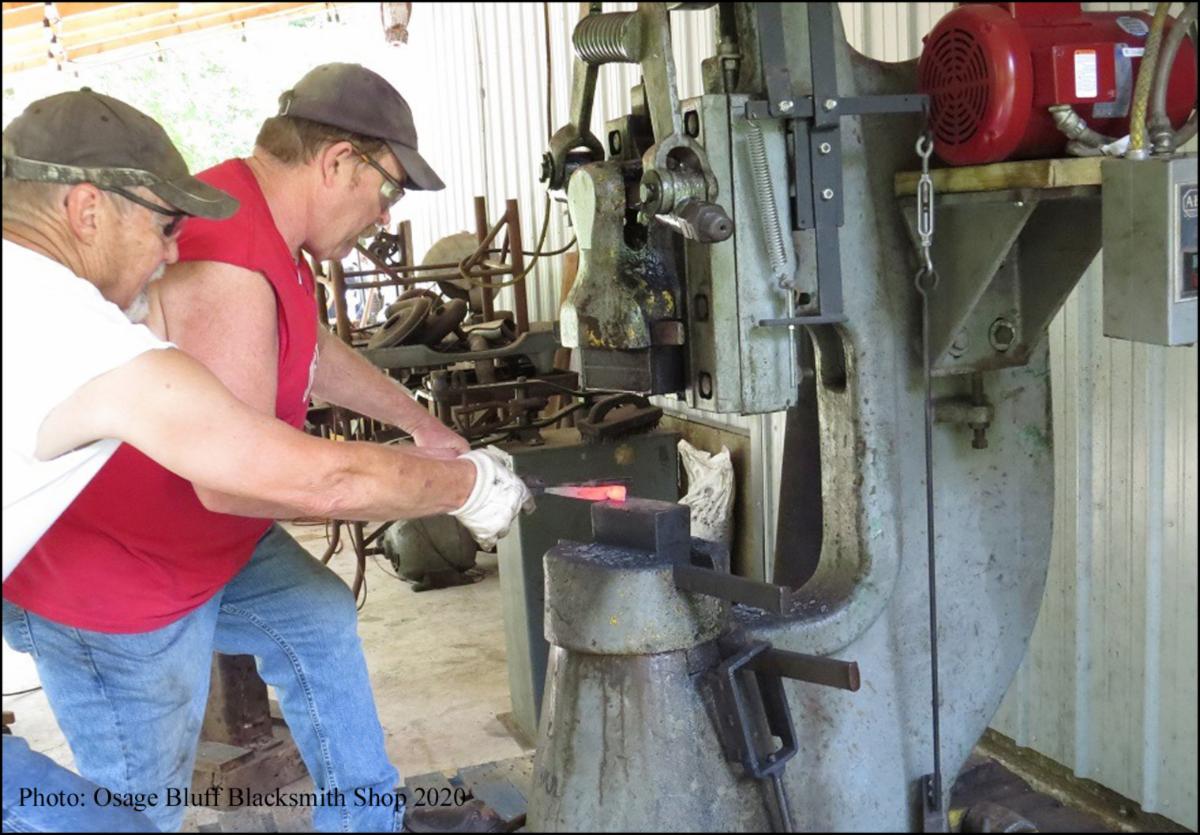
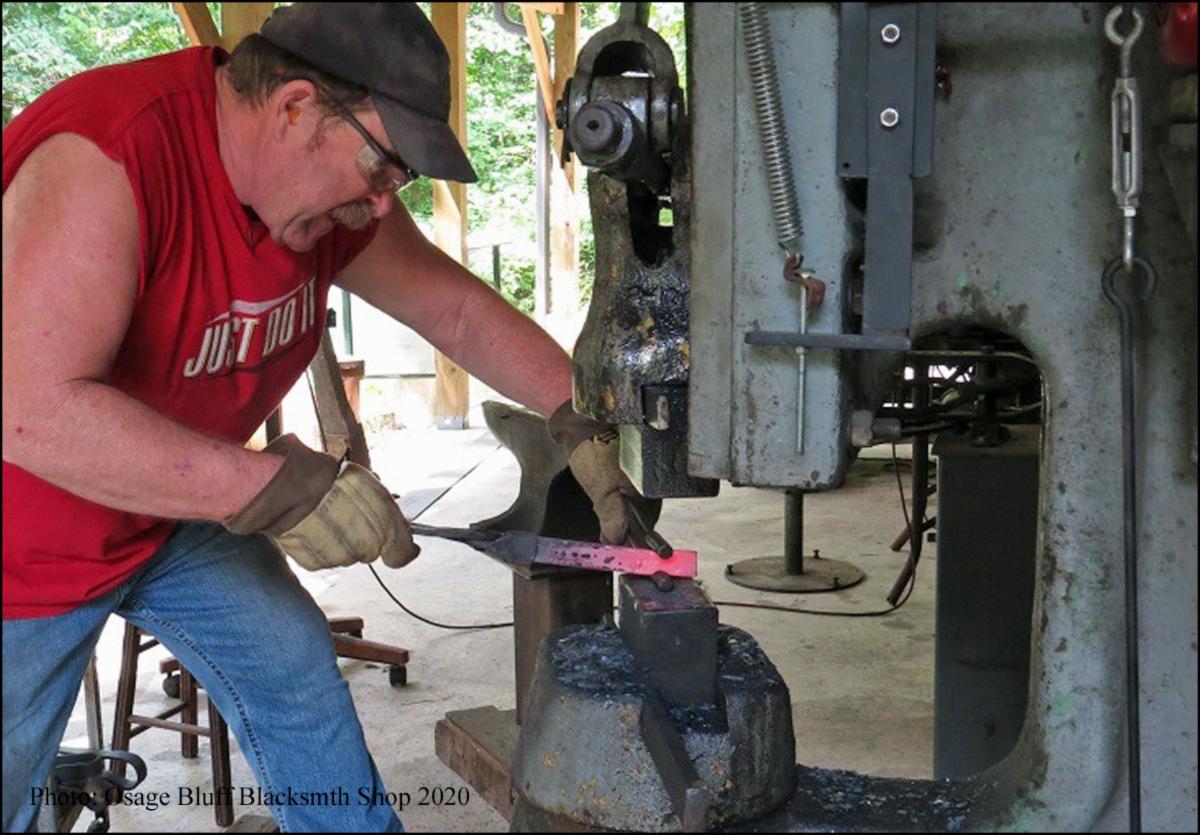
On a clear chilly day in April, 2019, a 1942 Murray 100# Power Hammer found a home with the Blacksmith Association of Missouri. Bernie Tappel and Steve McCarthy drove from Missouri to Michigan to pick up the hammer and to begin its life as an educational tool for the advancement of the blacksmithing art and craft. With some modifications and tune up by Tappel, the Murray was ready for its career in education.
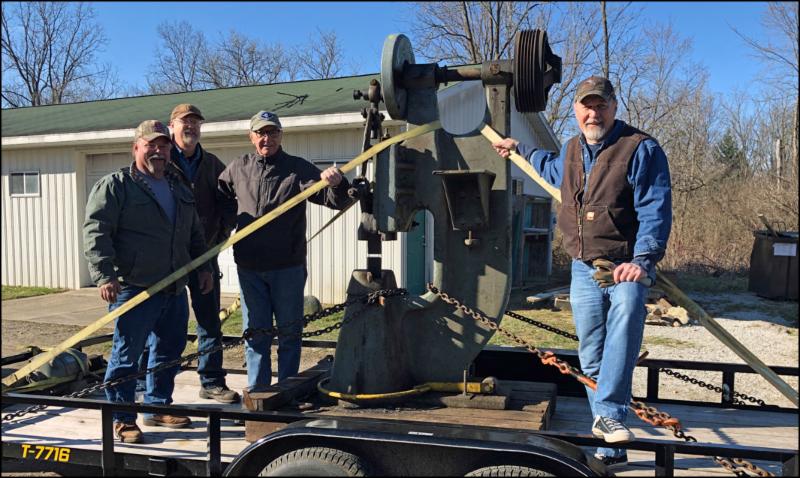
Power hammer tied down and ready for the trip from Michigan to Missouri. Left to right: Steve McCarthy, Jeff Seelye, Vern Mesler, and Bernie Tappel | 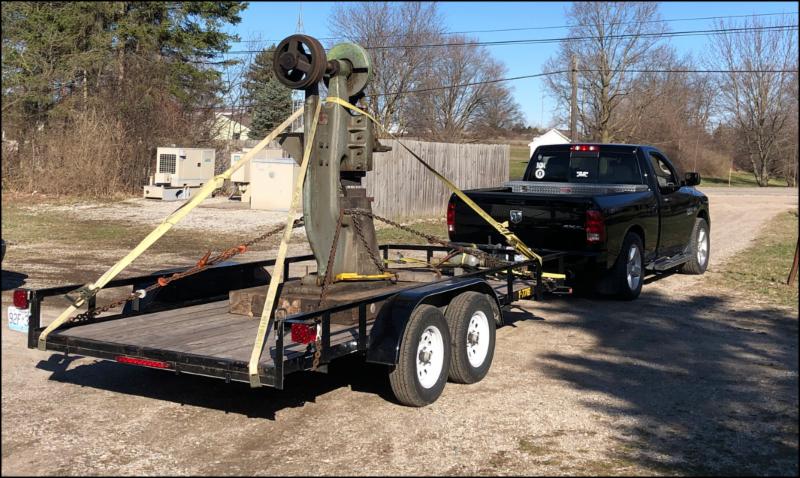 |
|
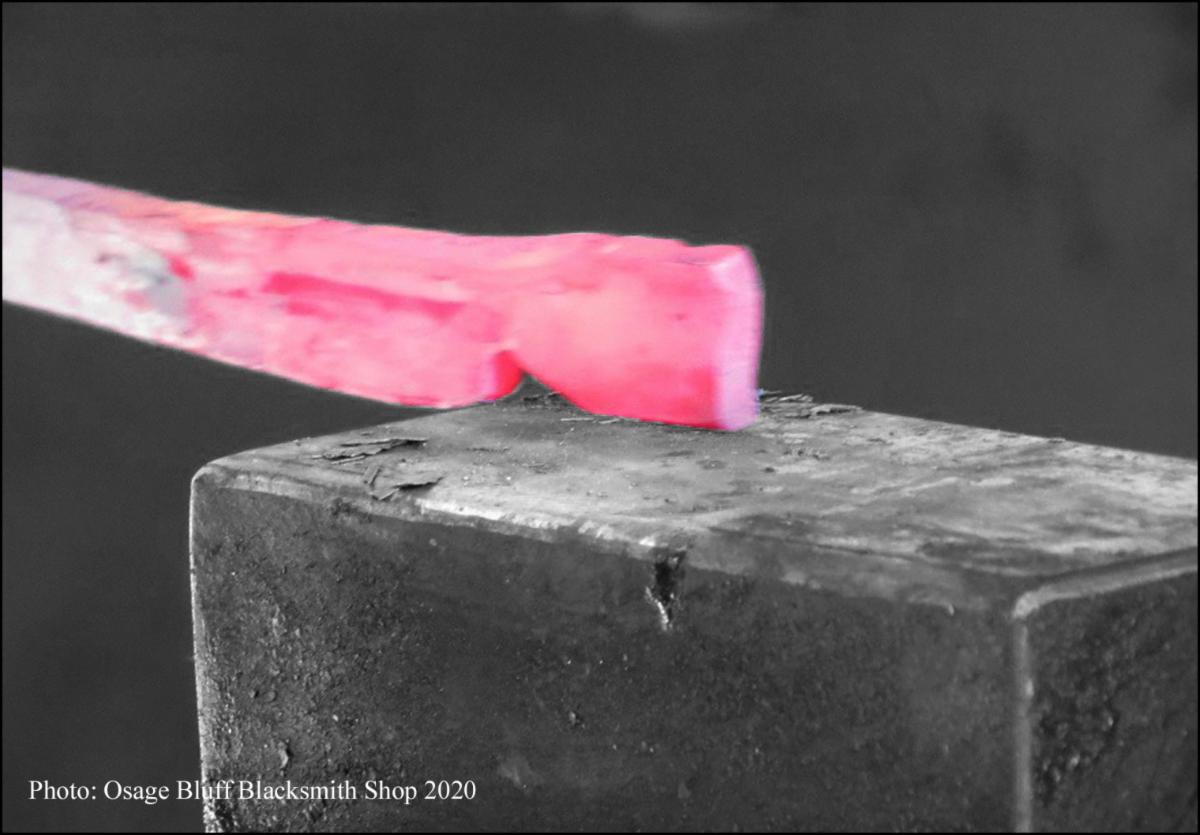
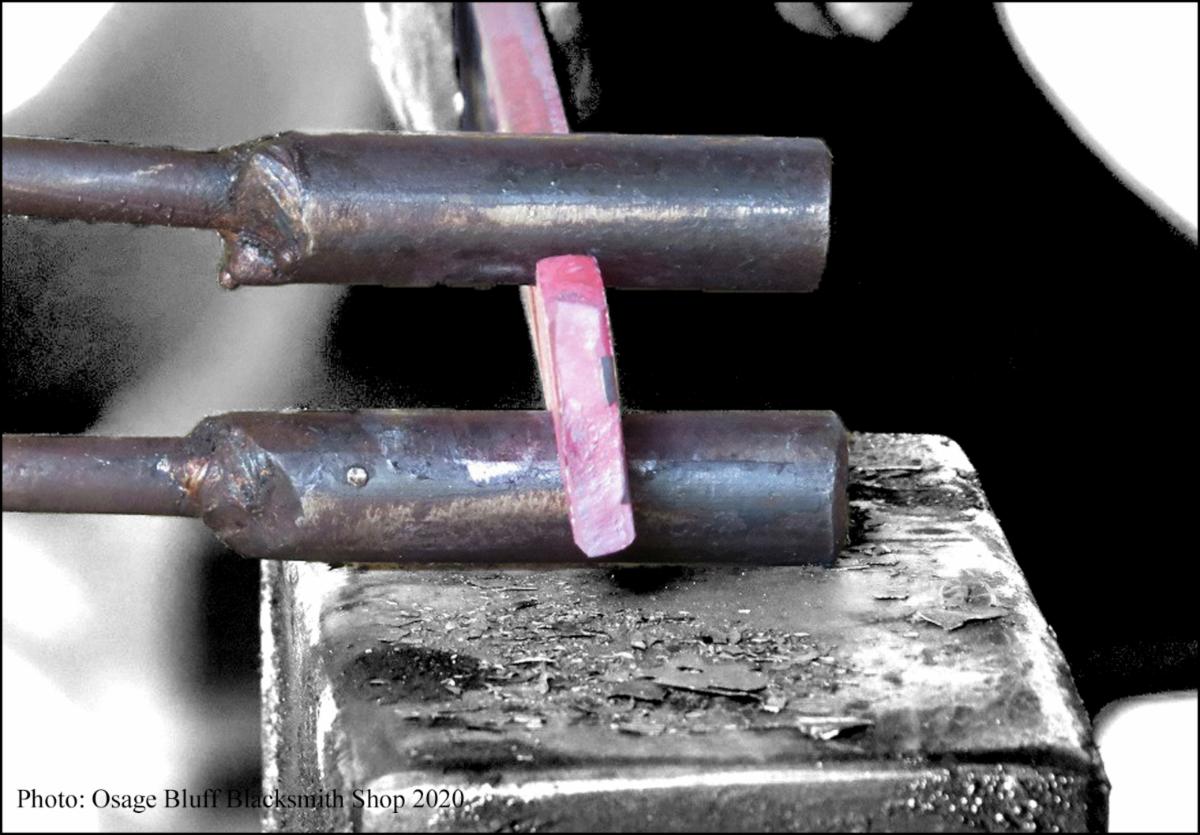
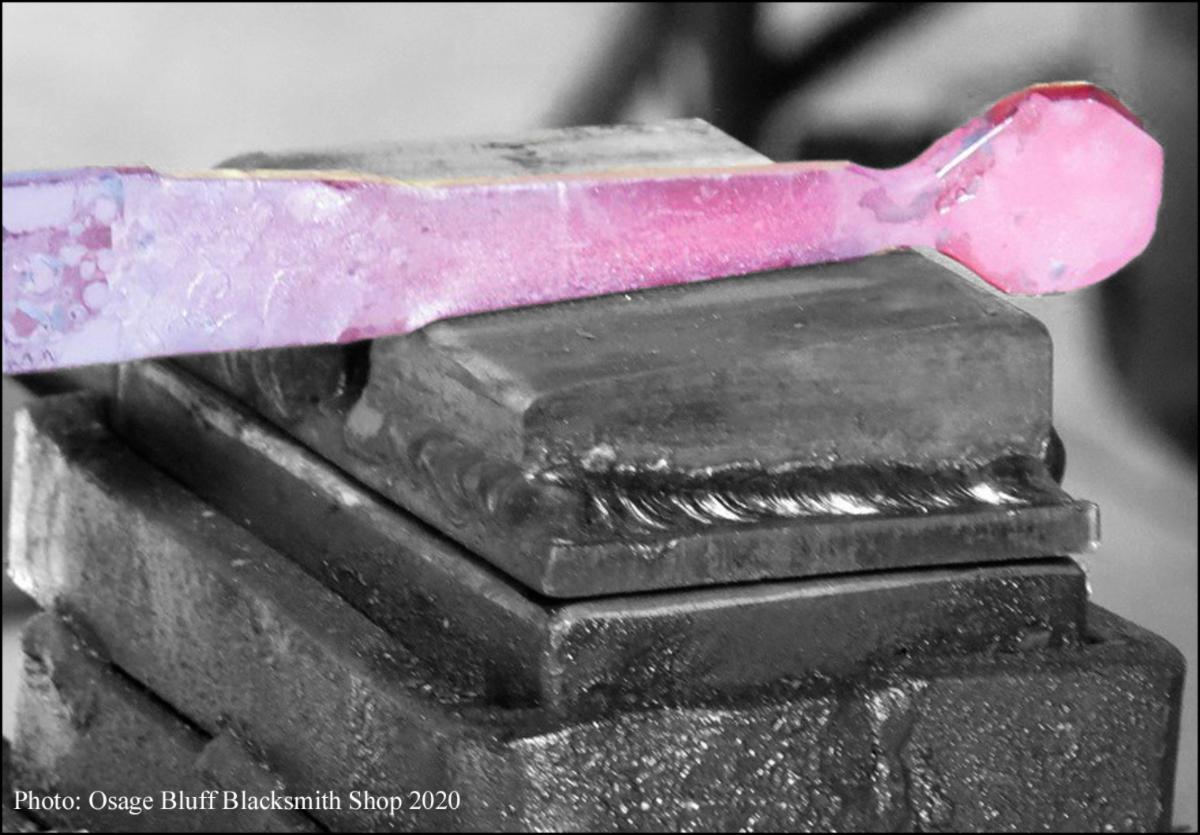
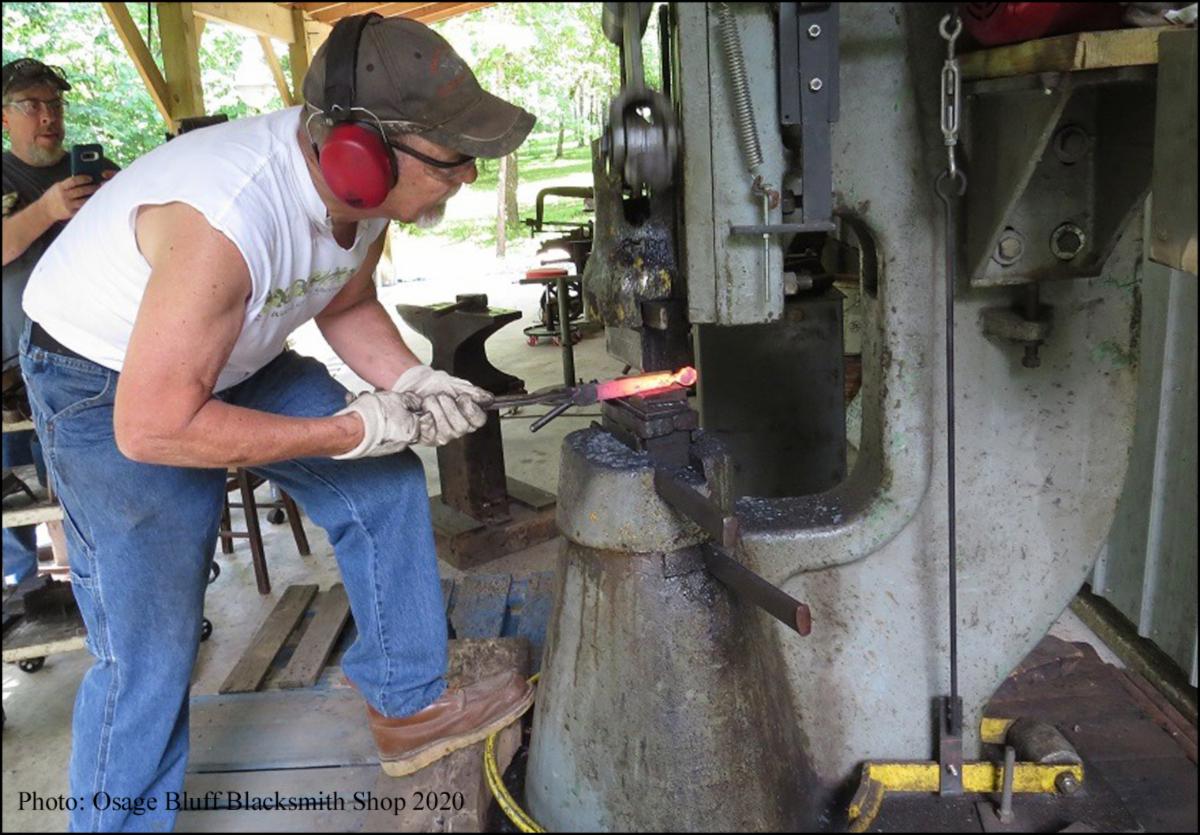
Bernie Tappel's 2020 Murray Power Hammer hands-on class "Introduction to Forging with a Mechanical Power Hammer" was designed for those blacksmiths who already owned a power hammer. Goals included using a power hammer with flat dies in combination with handheld and clamped-on tooling and getting the class participants to think about how they can make their power hammer a more versatile tool. As Tappel puts it, "Open up the possibilities for them to expand the use of their power hammer beyond drawing out a piece of steel. Use easily made clamp-on bottom dies of different shapes and handheld top tools to increase the versatility of their power hammer."
Tappel is passionate about teaching through workshops the skills he learned from craftsmen who worked with industrial blacksmith tools. Tappel listed several blacksmiths as mentors, one being Clifton Ralph, "the guy could make just about anything under a power hammer." His style in operating and teaching the use of a power hammer matches Tappel's approach educating craftsmen blacksmiths. Ralph worked as an industrial blacksmith for thirty-five years at Youngstown Sheet and Tube (later LTV steel) operating a large industrial power hammer without an anvil. "This led him to a lot of little ingenious pieces of tooling," says Tappel.
A blacksmith for sixty-eight years, Clifton Ralph was devoted to passing on his skills. As Tappel remarked, "His passion for teaching these techniques really comes through." With his friend Paul Moffett, Clifton Ralph produced a series of power hammer instructional videos that drew a large American and worldwide audience. Several of these videos can be seen on YouTube today.
Born March 9 th, 1931, Clifton Ralph died in December of 2018. For a short bio posted online by his son David, see Clifton E. Ralph Obituary
Tappel's 2020 Class: Introduction to Forging with a Mechanical Power Hammer
|
Charlotte Highway/Centerline Bridge
|
Erected in the Calhoun County Historic Bridge Park in 2007, the Charlotte Highway/Centerline Bridge was the last of five bridges restored and erected in the park. It is the most stately of the five bridges and spans the entrance to the Historic Bridge Park. As I begin preparing a video tour guide and material for my book on the restoration of the five bridges in the Historic Bridge Park, I have come to realize that an entire book could be written just on the Charlotte Highway Bridge.
My first experience with the 1886 Charlotte Highway Bridge was in the summer of 1997. On the road with my wife Nan in our new Chevrolet S-10 pickup, we drove across the bridge at its original site across the Grand River just south of Portland, Michigan. When our new truck's treaded tires came in contact with the deck's heavy metal grating, a strange sound was emitted. Along with the rattling of the verticals, diagonals, and bottom chord eyebars, the bridge produced a sound that would have been unfamiliar to those who crossed the wrought iron bridge with its original wood deck.
Fabricated toward the end of the nineteenth century when wrought iron was still the metal used in the construction of rural county bridges, the Charlotte Highway Bridge would remain in service for over a hundred years. By the beginning of the twentieth century steel would replace wrought iron, and this stately wrought iron bridge would often be referred to (incorrectly) in engineering and historic records as fabricated with steel.
This bridge is a craftsmen's record, a book with no words. To learn what this record has to say, you must touch, examine, feel, and listen -- to read what the craftsmen recorded in iron. Riveted connections, bridge pins, recessed nuts, rollers, forge welded and upset eyebars, these are just a few of the bridge components you can read in the craftsmen's record.
Vern Mesler 2021
|
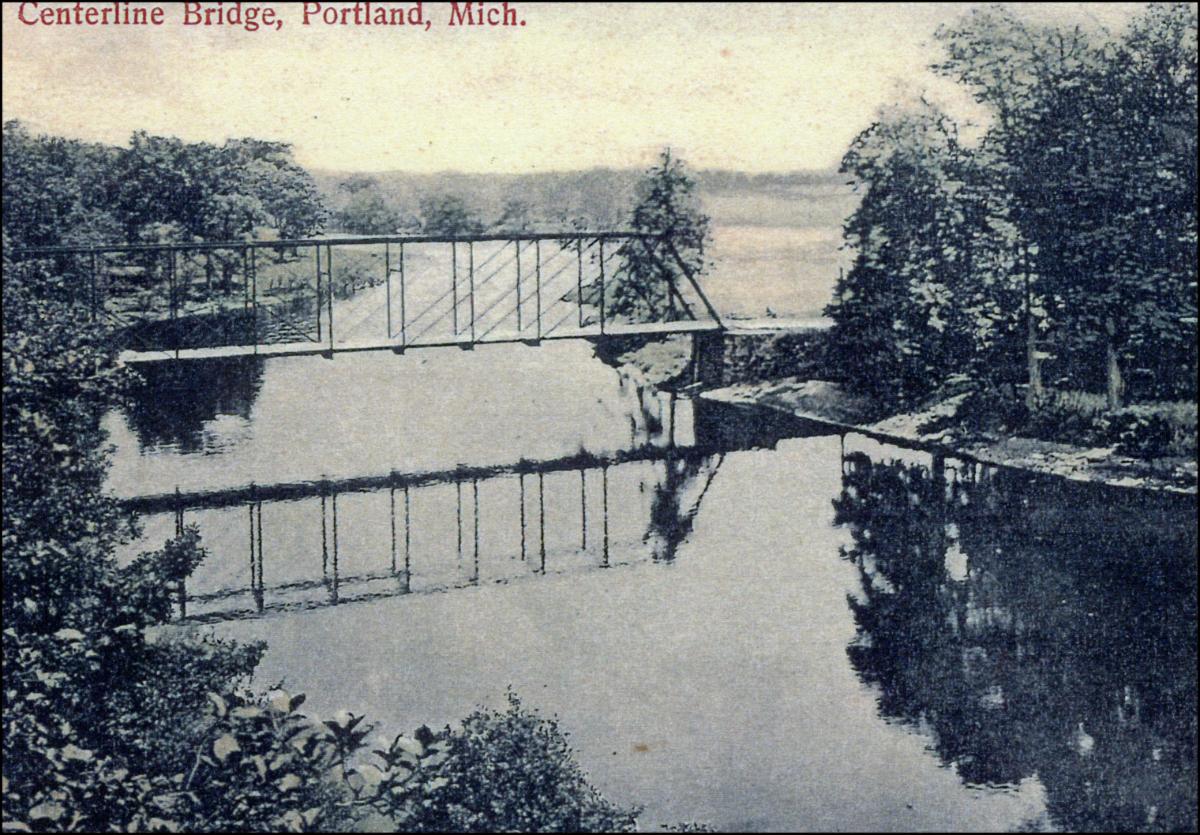 Centerline/Charlotte Highway Bridge was located near the intersection of the north/south and east/west Danby Township centerlines
| 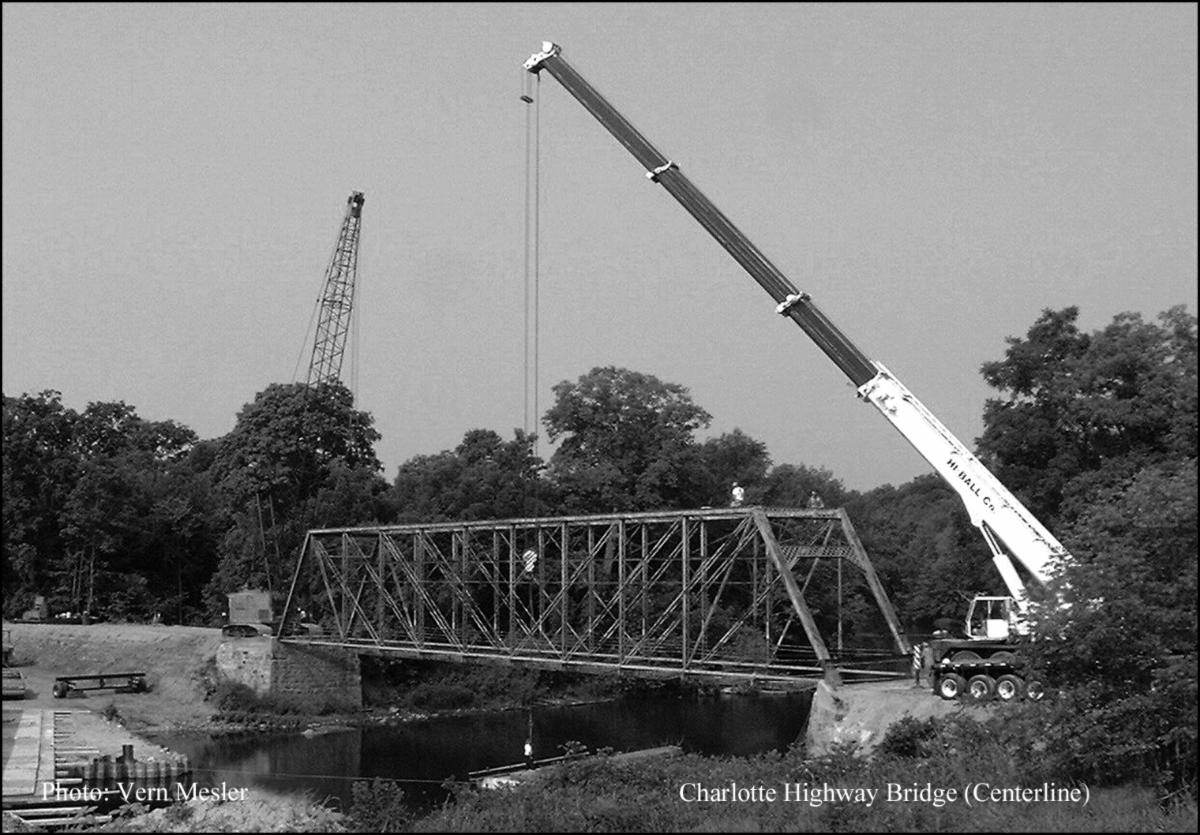 Disassembly began in 2001
| 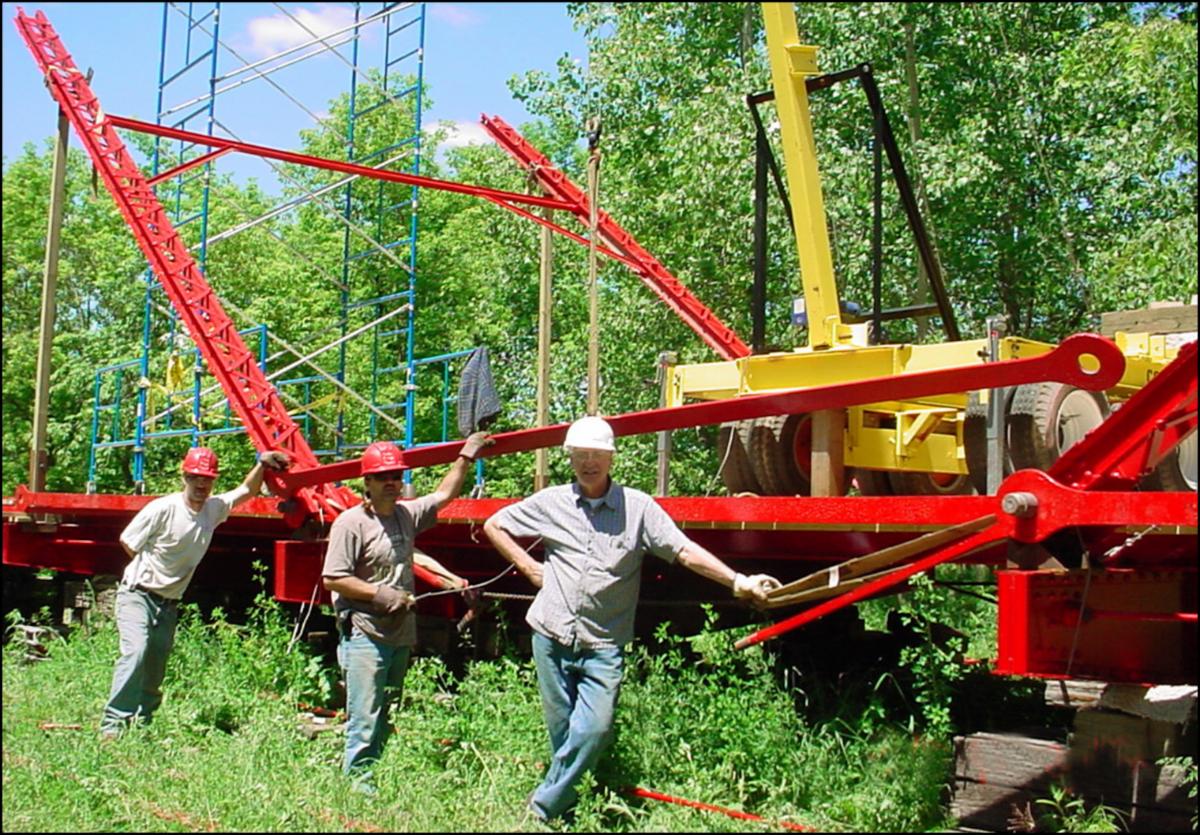
Restored and rerected in the Historic Bridge Park (photo 2006) From left: Wayne Conklin, Rob Denniston, and Vern Mesler | 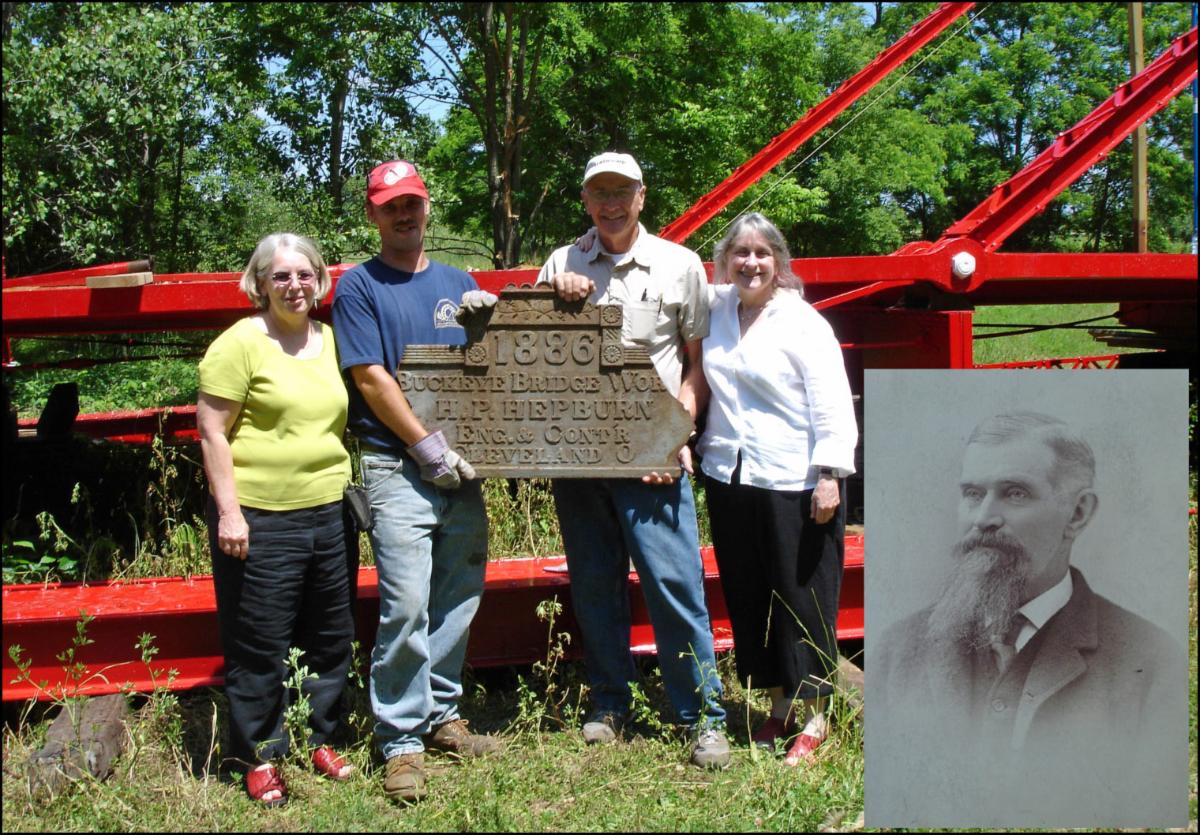
Photo: from left, Sara Hepburn, Wayne Conklin, Vern Mesler, Judith Hepburn Blank. Insert: H.P. Hepburn (great-grandfather of Sara and Judith)
| 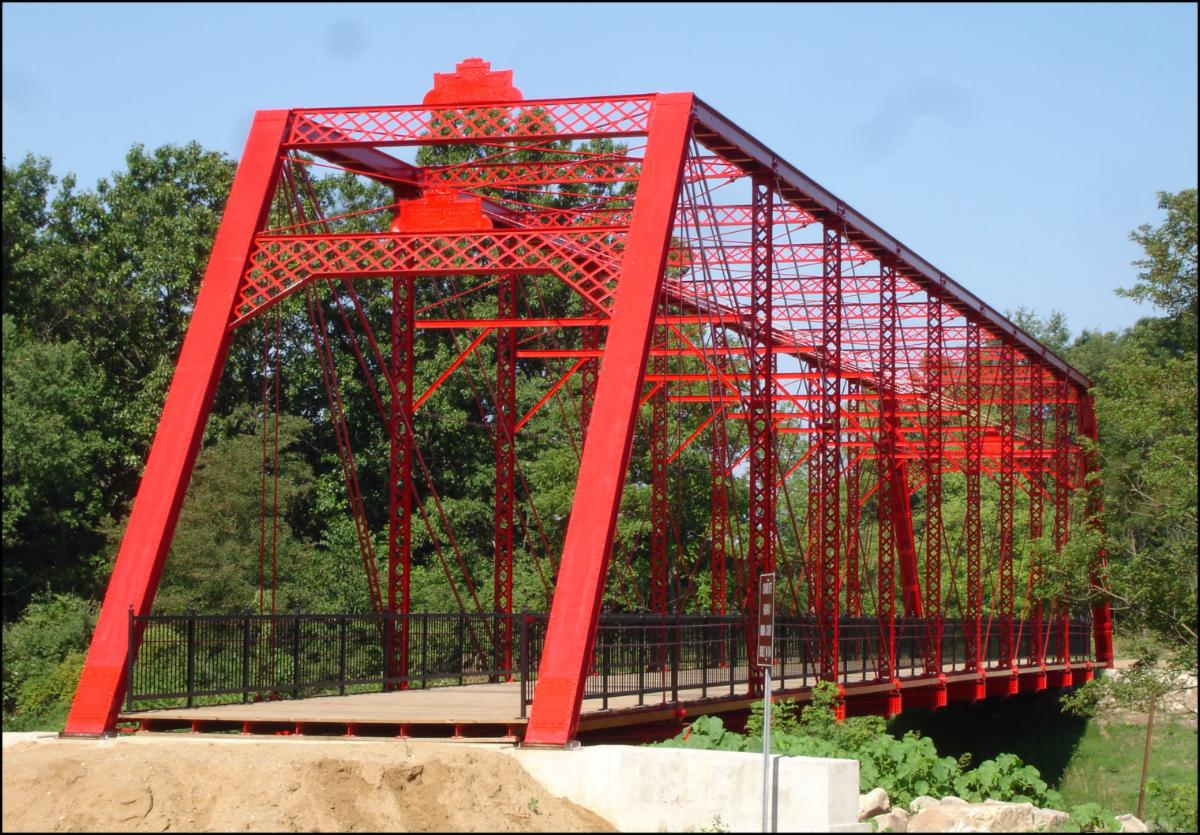
Historic Bridge Park 2007
| 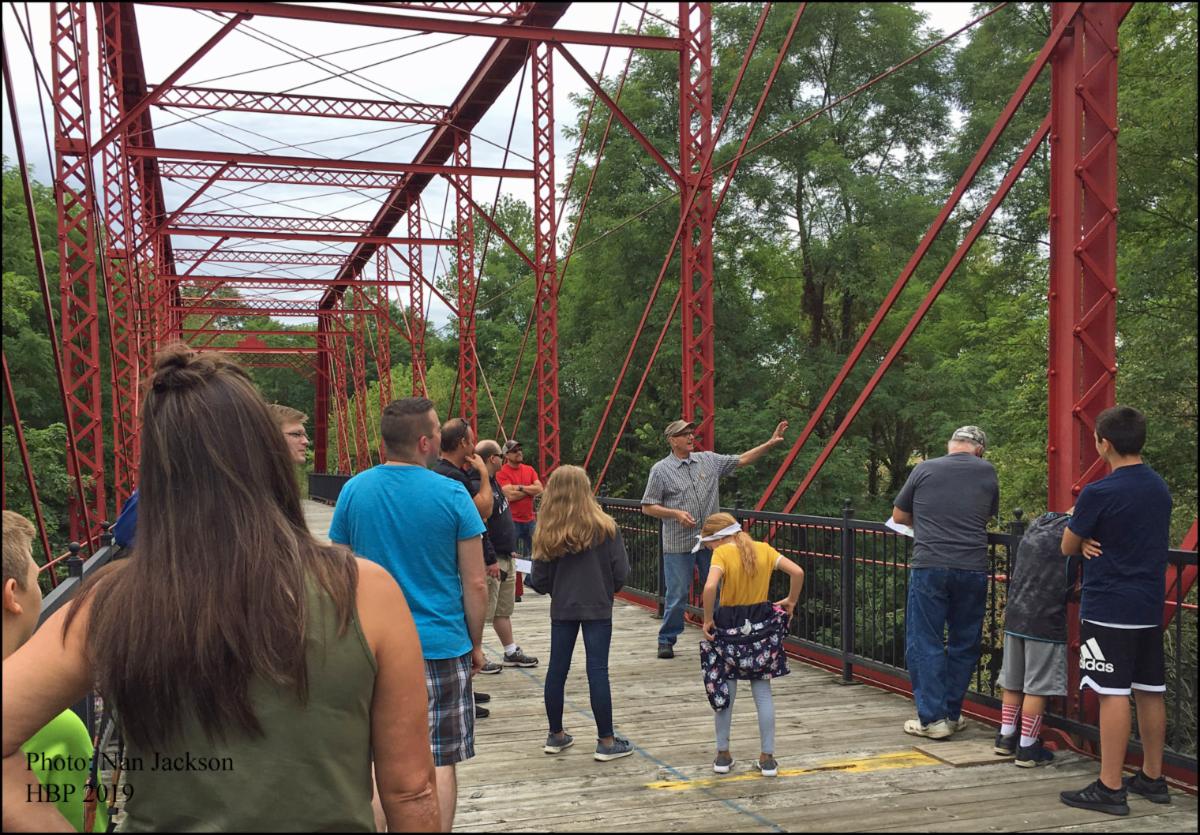
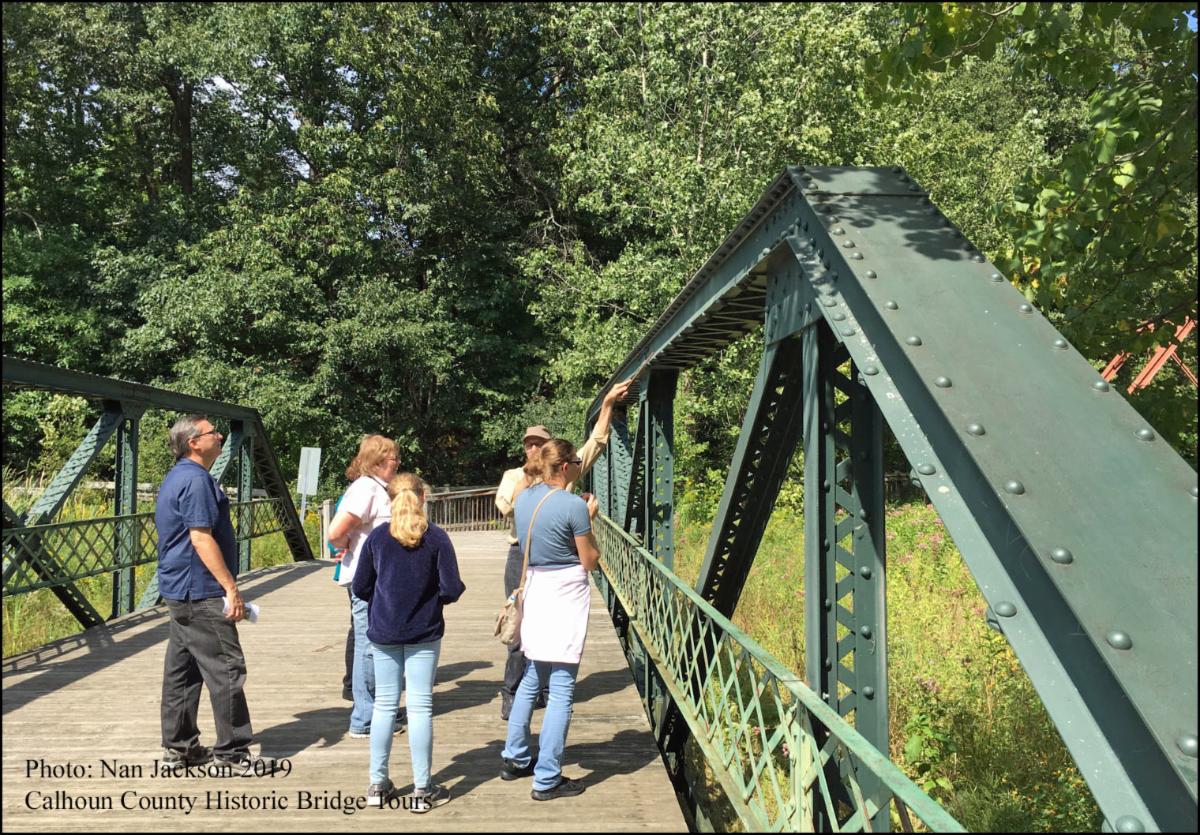
Historic Bridge Park tour 2019
|
|
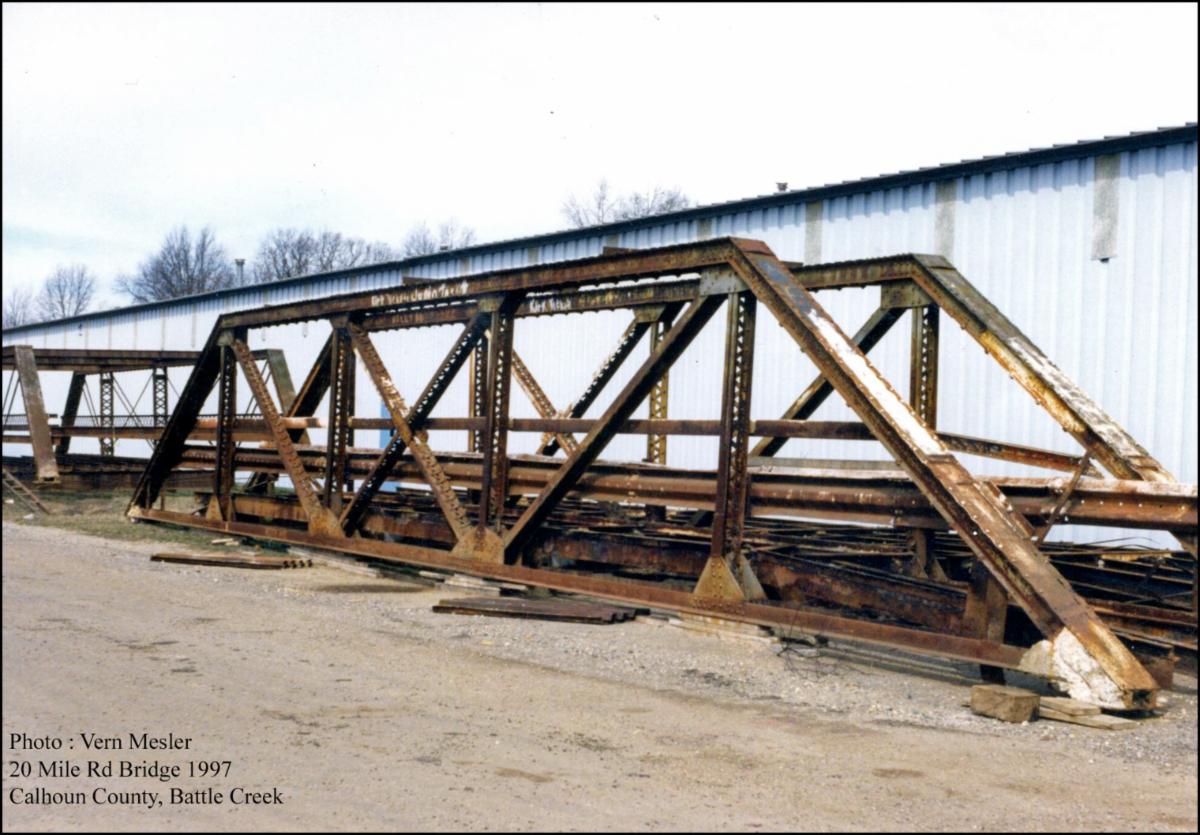
"Township meeting minutes, newspaper clippings, engineering records, historic photographs, and written personal recollections and oral histories. No primary or secondary documentation was located through these sources; no design or engineering plans were found." This was the finding of the Historic Evaluation and National Register of Historic Places Assessment for the 20 Mile Road Bridge over the St. Joseph River, Calhoun County, Michigan. Commonwealth Cultural Resources Group, Inc. 1994.
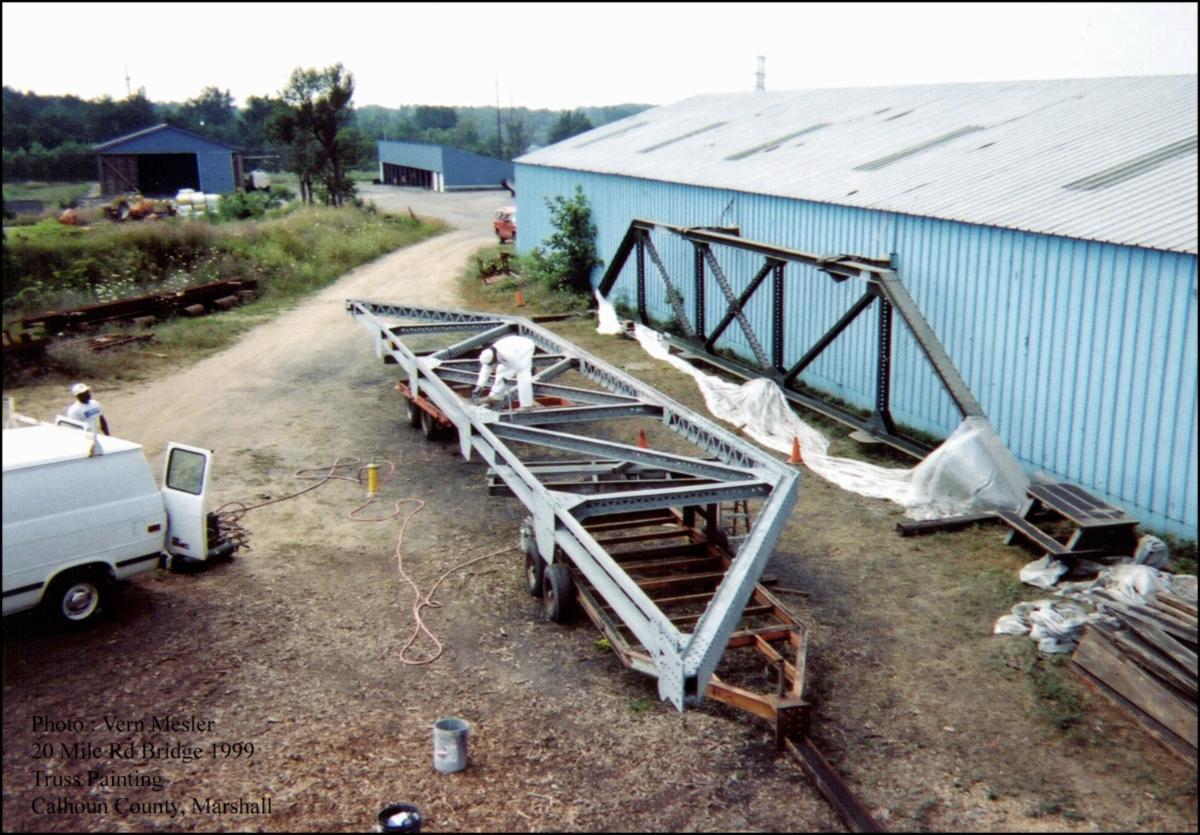
Fabricated in 1906 and closed December 21, 1992. In service for eighty-six years and no records of its existence. After the bridge was erected over the St Joseph River it would be two years before Henry Ford's assembly-lined, mass-produced, and affordable Model T would be available for the rural inhabitants around the 20 Mile Road Bridge. For a time, travel across the bridge would be by horse and buggy, and by farmers' teams of horses. In Michigan and across the country this would change as the automobile competed with the farmers' mode of transportation, as an Erie County farmer was to discover to his dismay. His story was told in an article in the Conneautville (PA) Courier, "An Expensive Lesson," re-printed in The Horseless Age, 1906.
"An Erie County farmer was tried before an Erie alderman on Monday on a charge of obstructing the highway, the offense being a refusal on the part of the defendant to give half the road to an automobilist who came up behind the farmer's team and wished to go by. It was proven that the farmer willfully held the place in the middle of the road, which was too narrow to admit of the machine passing without danger. The alderman found the farmer guilty and fined him $20 and costs."
Always surrounded by farmland and on a road that remained unpaved, the 20 Mile Road Bridge stood as a silent reminder of advances made in bridge construction. It was fabricated with steel, and its abutments were made of concrete rather than the masonry of nineteenth and early twentieth century bridge abutments. Also significant is the bridge deck, made not of wood but instead of concrete in what is known as a "jack arch" concrete deck. Although there is no information about the company that fabricated the 20 Mile Road Bridge, a clue to the origin of the bridge could be found in the embossed Illinois mill stamp on the channel sections in the truss's top chords.
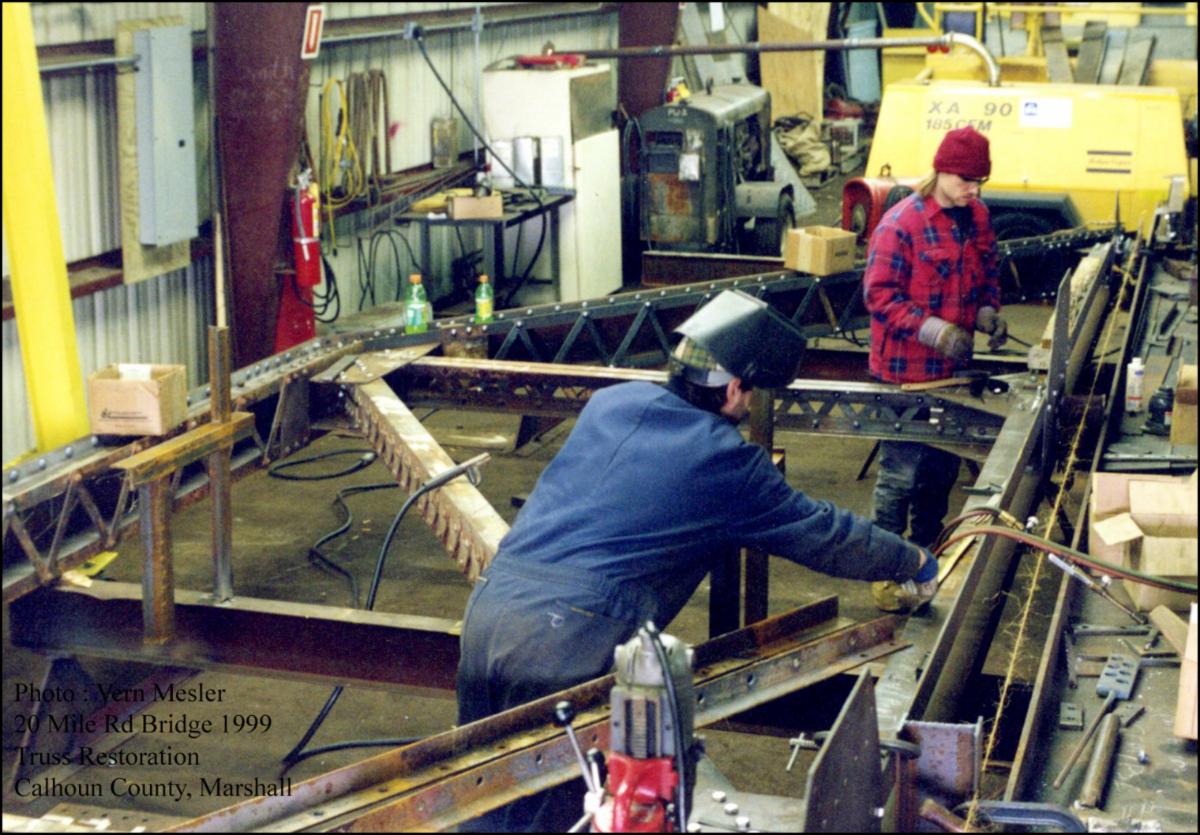
The 20 Mile Road Bridge was the second of five historic bridges restored at the Calhoun County Road Commission garage in Marshall, Michigan, and re-erected in the Calhoun County Historic Bridge Park in June 2000.
Vern Mesler 2021
|
"The Continuous Clatter":
Practical Field Riveting
|
|
Future online event: David Simmons will discuss his article on field riveting in a real-time online format. Details will be announced by email sent to all subscribers of the ISP Newsletter.
|
|
Program Fund
Please consider contributing to the Iron and Steel Preservation Program Fund. This fund was established to support projects, research, conferences and scholarships related to the repair, rehabilitation, and restoration of metals. The Lansing Community College Foundation is a nonprofit 501(c)(3) corporation.
Donate Here
|
|
|
|
Past Iron & Steel Preservation Newsletters
|
Thank you to all our donors!
We appreciate the many contributions to the Iron and Steel Preservation Program Fund during the past year.
|
|
|
|
Sponsor
|
Want to become a sponsor?
|
|
Lansing Community College
5708 Cornerstone Drive
PO Box 40010, MC 4100W
Lansing, MI 48917
|
|
|
|
|
Copyright © 2021. All Rights Reserved.
|
|
|
|