January 2022 | Volume 14 Issue 1 |
|
Happy New Year! I hope everyone got the chance to enjoy the holiday season! I'm sure everyone is looking forward to the warm up predicted for next week!
The 9th Native Prairie Restoration/ Reclamation Workshop, is next month! We're excited for the presentations and case studies we have lined up this year! The early bird deadline is quickly approaching, you can find the link below! The Call for Posters deadline is January 11th! And there's more information about the Native Prairie Restoration/Reclamation Grant and the virtual workshop in general below! We had quite a few comments after our first virtual NPRRW in 2021, that it had exceeded expectations, in terms of engagement. We're hoping with the presentations and case studies, we can increase opportunities for engagement and networking even more this year!
We had one Speaker Series presentation in December, Dana Green with the University of Regina talked about bats in Saskatchewan. The recording is available on PCAP's YouTube Channel!
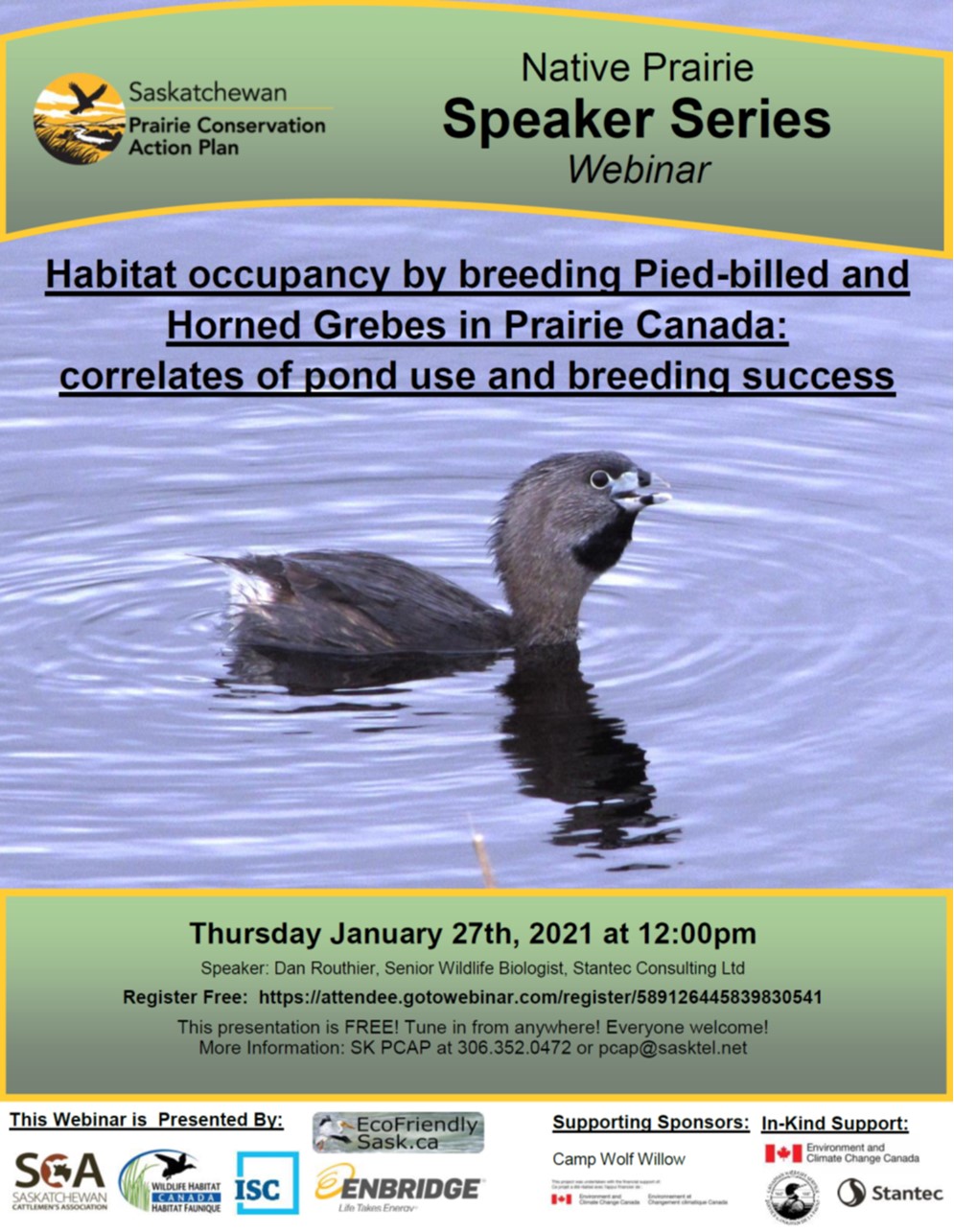
For our January Native Prairie Speaker Series, we have Dan Routhier, Stantec Consulting Ltd, discussing grebes! You can register here! We also have the registration links for the February and March webinars available, you can register today! More information to come!
And finally, we would like to thank our sponsors for their generous support: Camp Wolf Willow, EcoFriendly Sask, K+S Potash, Pembina Pipelines, Saskatchewan Cattlemen's Association, SaskEnergy, SaskPower, SaskTel, Wildlife Habitat Canada and Environment and Climate Change Canada, as well as the continuous support of all the PCAP Partners.
Carolyn Gaudet, SK PCAP Manager
|
The 9th Native Prairie Restoration/ Reclamation Workshop will occur virtually February 8-10, 2022!
Theme: "Restoration, Reclamation, Resilience - Improving Soil, Water and Habitat"
Registration is open!
Early bird (by January 21st at 6 PM) : $120.00 + GST
Students : $60.00 + GST
Regular registration (after January 21st) : $160.00 + GST
Please note that all presentations and case studies will be recorded and available for registered participants on the PheedLoop platform for 6 months after the workshop.
|
Call for Poster Abstracts
The Call for Poster Abstracts deadline is January 11th, 2022. You can find details here!
Tradeshow:
Corporate booth : $200 + GST
Non-profit booth : $160 + GST
More information on the tradeshow can be found here!
Native Prairie Restoration/Reclamation Grant:
For years, instead of offering speaker gifts, SK PCAP has been making a donation on the speakers' behalf to a prairie-focused charity, such as the Alicia Hargrave Memorial Scholarship, who helps train the next generation of rangeland experts. This year we decided to combine the awards and the speaker gift donation, so that the award-winning project would receive a cash prize to put towards their restoration or reclamation project.
You can find the Native Prairie Restoration/Reclamation Grant criteria here! The deadline is January 25th!
|
PCAP Partner Spotlight
Saskatchewan Stock Growers Foundation
Submitted by Kori Maki-Adair, SSGF
SSGF's Role in the Rolling Hills
Environment and Climate Change Canada's Species At Risk Partnership on Agricultural Lands (SARPAL) fund awarded Saskatchewan Stock Growers Association (SSGA) $840,000 in additional funding to continue working with Saskatchewan landowners to protect native grasslands and critical habitat for species at risk.
Here's how Ray McDougald, Board Chairman of Saskatchewan Stock Growers Foundation Inc. (SSGF) says this news impacts Saskatchewan landowners.
Native grasslands in southwest Saskatchewan are the last refuge for many species at risk in the province, including Greater Sage-Grouse, but also Sprague's Pipit, McCown's Longspur, Chestnut Collared Longspur, Pronghorn, Long Billed Curlew, Ferruginous Hawk, Burrowing Owl, Loggerhead Shrike, Piping Plover, Swift Fox, Black Tailed Prairie Dog, Northern Leopard Frog, Mormon Metalmark and the Yellow-banded Bumble Bee.
As a beef producer, I know that native grasslands are also an important forage resource for our cow-calf sector. These grasslands are valuable from an ecological and cultural perspective, and they are economically important.
Through proper grass management, all kinds of wildlife thrive alongside responsible grazing practices. This is exactly why we setup SSGF. By working together, we are creating a sustainable environment for both livestock and species at risk.
As the oldest operating organization in Saskatchewan and a trusted voice in agriculture, SSGA launched SSGF as a federally-registered charitable organization and land trust in January 2020. We wanted to fill a growing need in the ranching community for voluntary, private-sector options for agricultural land conservation. With a specific focus of conserving ag lands, as a registered land trust, it's the first to offer term conservation easements.
Right now, we need landowners' input. We've developed a survey to assess interest levels and to gather geographically-specific knowledge of southwest Saskatchewan's biodiversity. We need the unique expertise of provincial landowners to guide the development of term easement valuation and to understand their current and future decision-making needs.
The benefits of granting an easement means the landowner is preserving the land's environmental value for the future, without giving up private ownership. Whether the land is passed onto family or sold, the easement will be transferred with the property. The terms of the easement will remain unless they are modified by mutual consent of the landowner and the conservation easement holder. We are assessing potential payments in this survey and will be able to discuss the financial reward for signing this kind of agreement in the near future.
SSGF draft easements with landowners to suit the needs of the landowners, so it is important for landowners to consider what activities they want to allow. Do they want hunting, grazing, hay storage, water, trails and fencing development on the land? Landowners should think about how restrictions like cultivation, noxious weed presence and tree cutting for logging or firewood may be affected. SSGF always advises landowners to obtain independent tax and legal advice to be certain an agreement is tailored to meet their current and future requirements.
If you are interested in learning more about term conservation easements or conservation opportunities in general, please contact Tom Harrison, SSGF Program Manager by telephone at 306-530-1385 or email at prairiecloudscape@sasktel.net.
|
|
Plan to attend our upcoming Native Prairie Speaker Series webinars! |
Habitat occupancy by breeding Pied-billed and Horned Grebes in Prairie Canada: correlates of pond use and breeding success
Speaker: Dan Routhier, Stantec Consulting Ltd
Jan 27, 2022 @ 12PM CST
More information is on the way! Stay tuned!
SAVE THE DATE
for the February and March webinars:
Speakers: Kevin Steinley of Swift Current Creek Watershed Stewards and Stephanie Huel of Moose Jaw River Watershed Stewards
Wed Feb 2, 2022 @ 12PM
An overview of the Alberta Invasive Species Council and their biocontrol release program
Speaker: Paige Kuczmarski, Alberta Invasive Species Council
Wed, Mar 2, 2022 12PM
|
Feb 8-10, 2022
Maple Creek, SK
Feb 10-11, 2021
July 12-15, 2022
|
2021/22 Speaker Series Supporting Sponsors
Camp Wolf Willow
|
2021/22 Education Programs:
Presenting Sponsors:
|
|
Carolyn Gaudet, Editor, Saskatchewan Prairie Conservation Action Plan Newsletter |
|
SK PCAP gratefully acknowledges financial support in 2021-2022 from:
Camp Wolf Willow, Ducks Unlimited Canada, EcoFriendlySask.ca, Parks Canada - Grasslands National Park of Canada, Pembina Pipelines, Saskatchewan Cattlemen's Association, Saskatchewan Ministry of Agriculture, Saskatchewan Ministry of Environment - Fish and Wildlife Development Fund, SaskEnergy, SaskPower, SaskTel, University of Regina, University of Saskatchewan - College of Agriculture and Bioresources, Water Security Agency and Wildlife Habitat Canada.
SK PCAP gratefully acknowledges in-kind support for 2021-22 from:
Agriculture and Agri-Food Canada - Science and Technology Branch, Canadian Parks and Wilderness Association, Environment Canada - Canadian Wildlife Service, Friends of the Royal Saskatchewan Museum, Friends of Wascana Marsh, Meewasin Valley Authority, Native Plant Society of Saskatchewan, Nature Conservancy Canada, Nature Saskatchewan, Parks Canada - Grasslands National Park, Prairie Wind & Silver Sage, Ranchers Stewardship Alliance Inc., Redberry Lake Biosphere Region, Saskatchewan Association of Rural Municipalities, Saskatchewan Association of Watersheds, Saskatchewan Bison Association, Saskatchewan Burrowing Owl Interpretive Centre, Saskatchewan Cattlemen's Association, Saskatchewan Environmental Society, Saskatchewan Forage Council, Saskatchewan Ministry of Agriculture, Saskatchewan Ministry of Environment, Saskatchewan Ministry of Energy and Resources, Saskatchewan Ministry of Parks, Culture and Sport, Saskatchewan Stock Growers Association, Saskatchewan Wildlife Federation, SaskEnergy, SaskOutdoors, SaskPower, Society for Range Management - Prairie Parkland Chapter, South of the Divide Conservation Action Program Inc., University of Regina, University of Saskatchewan - College of Agriculture and Bioresources.
|
|
|
|
|
|
|