|
January 2024
Happy New Year !
The days are getting longer.
| |
|
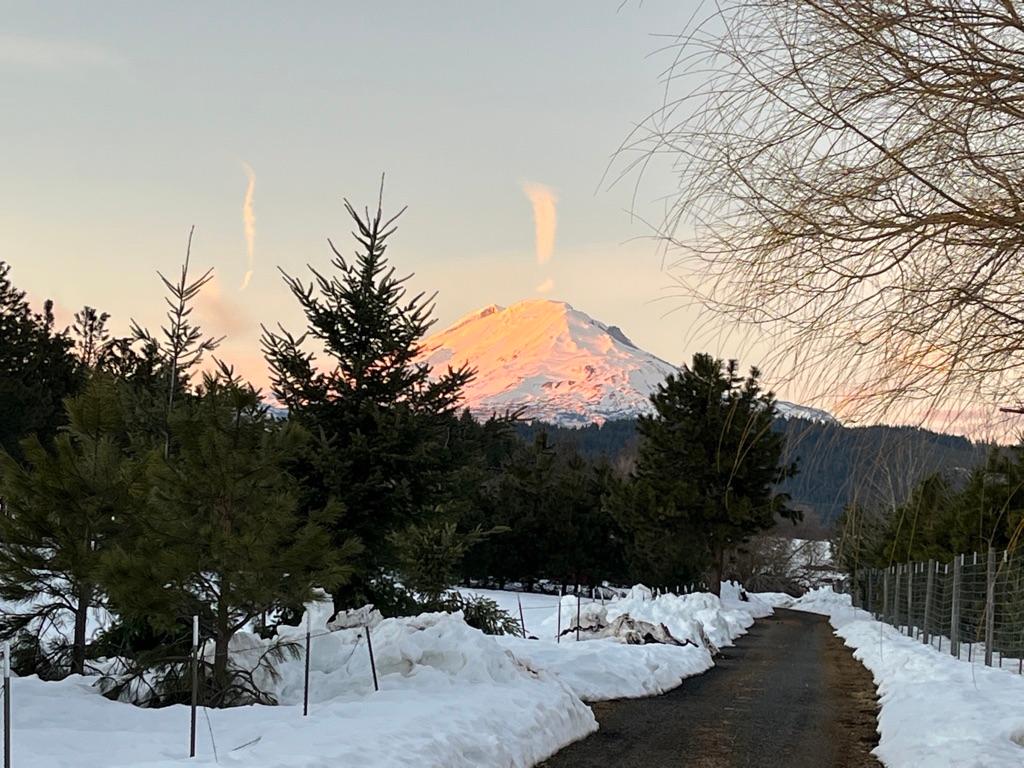
Mt. Adams in the winter light
This is a long Newsletter. Please click "View Entire Message" and read to the "Bonus Click" at the end!
| |
|
RECURRING SERVICES - WINTER 2024 SCHEDULE
all times are Pacific time
SERVICES & STUDY In Person and on Zoom
https://zoom.us/j/5093952030
MONDAY - FRIDAY Morning Sangha + Meditation at 6:30 a.m.
MONDAY, WEDNESDAY, FRIDAY - Evening Sangha + Meditation at 5:30 p.m.
SATURDAY Sangha, Service + Meditation 8:30 a.m. check-in, 9 a.m. service
all above at 46 Stoller Rd., Trout Lake WA and at Zoom link below
*********************
TUESDAY Sanga + Meditaion 12 noon IN PERSON ONLY
1412 13th Street, Suite 200. Hood River, OR 97031
2nd & 4th WEDNESDAY Thich Nhat Hanh Study Group 6:30 p.m.
(For information about the study group, contact Bonnie at bon2626wit@att.net)
LAST SUNDAY OF MONTH Meditation + Dharma Talk 2:00 p.m. IN PERSON ONLY
Buu Hung Buddhist Temple 17808 NE 18th St, Vancouver WA
| |
|
Dear Ones,
Thay Vinh Minh and I will be traveling to Taiwan and Vietnam from the end of December until the end of January. Several sangha members will be joining us, visiting temples and meeting great teachers.
Now at our Trout Lake temple we are experiencing snow, ice, and freezing temperatures. Long dark nights and short cloudy grey days remind me of the great changes in life; birth in Spring, adulthood in Summer, aged in Fall, and the time of death in Winter. Our lives reflect the seasons of the year.
My goal in this time of aging is to live a life of value to others, kindness, and purpose. I seem to have grown into the Buddha's teachings more and more as the years pass by. Seeing us all as interconnected we become aware that if another wins, we win. If another loses we lose. My wish for all of us is to live our best life, filled with purpose and kindness.
May your New Year be filled with Kindness, Joy, Health, and Peace.
in metta, Thay Kozen
| |
Buddha teaches us that Anger, Desire, and Ignorance are the cause of suffering. | |
|
Upcoming Events & Retreats
JANUARY 2024 - Buddhist pilgrimage to Taiwan & Vietnam
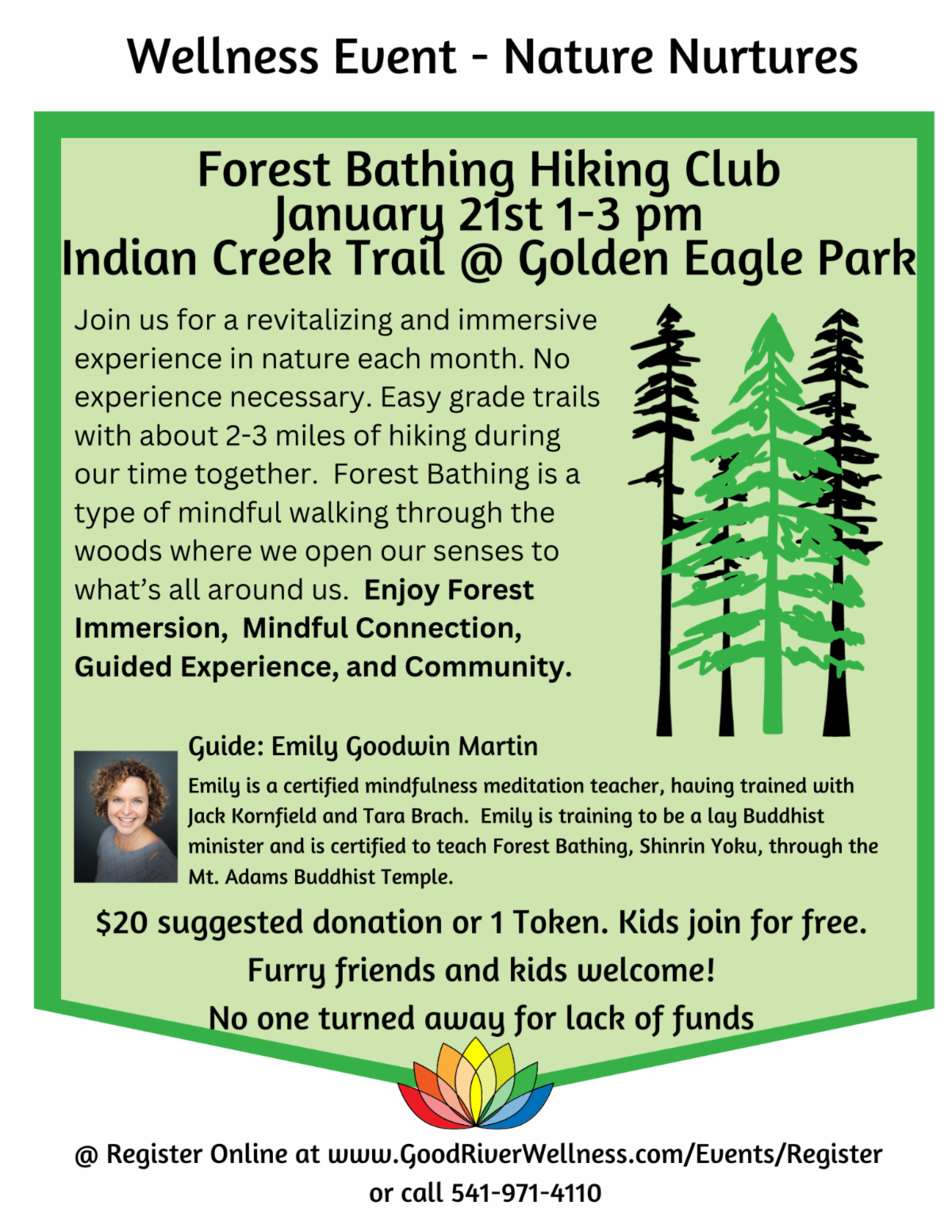
JANUARY 21 Forest Bathing Hike with Emily Martin (see below)
APRIL 12-14 Yoga Retreat With Laurie Van Cott (see below)
I encourage everyone to do a minimum of a 1 week retreat and 2 additional 1-2 day retreats every every year. Recommended retreat centers are Deer Park in Escondido, CA, Great Vow in Clatskanie, OR, Cloud Mountain in Castle Rock WA.
...Thay Kozen
| |
Cloud Mountain Retreat Crt
| |
|
|
|
Thich Minh Thien, (Thay Z) Abbot of Budding Dharma
Arlington, Texas thayzzen@gmail.com
The Attachment of Guilt
Most of us came to the Buddhist path later in life and we were probably subjected to different spiritual concepts either through choice or family before discovering the teachings of the Buddha. Chances are we were schooled in a different understanding of our own guilt. Heaven and Hell play a major role in the Western Christian concept of how we are accountable for behaviors, actions and beliefs and my understanding of the Jewish, Muslim and Hindu practice leads me to believe that guilt does account for suffering among their practitioners as well. For this month’s article, I thought we can explore the concept of Buddhism and personal guilt, examining how it differs from most other religious traditions and the ways in which we can strive to achieve liberation from the sufferings associated with our own personal guilt.
Unlike many of the religious traditions mentioned above which subscribe to the notion of sin and divine judgment, Buddhism approaches guilt in a more introspective and self-reflective manner. It is rooted in the teachings of Siddhartha Gautama, commonly known as the Buddha, and is a philosophical and spiritual tradition that emphasizes the pursuit of enlightenment and the elimination of suffering. Guilt is not viewed as an inherent flaw or sinful nature, but rather as a natural consequence of human actions, thoughts, and intentions. Buddhists believe in karmic causality; the idea that our actions have consequences that shape our future. Instead of being sentenced to eternal damnation, guilt in Buddhism is seen as an opportunity for growth, learning, and ultimately, liberation from suffering. A first step in addressing personal guilt in Buddhism is the recognition of the wrongdoing associated with a particular action or inaction. Buddhism teaches self-awareness and personal responsibility. It encourages individuals to honestly and openly confront their actions, thoughts, and intentions without judgment or self-condemnation. Guilt arises when we realize that our actions have caused harm or suffering to ourselves or others, disrupting harmony and balance in the world. This recognition is not meant to dwell in self-blame but to foster an awareness and transformation.
Buddhism offers various methods to alleviate the guilt many of us carry. Through meditation and mindful living, each of us can develop a compassionate understanding of ourselves and others, ultimately leading to our own forgiveness and self-compassion. Buddhism also encourages the cultivation of virtues. The practice of moral conduct, known as the Five Precepts, guides Buddhists in their actions, speech, and thoughts. By adhering to these principles, we can reduce the potential for guilt to arise in our lives and be misunderstood.
Guilt in Buddhism can serve as a catalyst for personal transformation and awakening. Instead of being burdened by guilt, Buddhists understand it as an opportunity to learn from mistakes and consciously choose a different path. The ultimate goal is to achieve enlightenment, transcending the cycle of birth, death, and rebirth. By cultivating mindfulness, self-awareness, and compassion, we can overcome our guilt and progress on a spiritual path towards liberation. Rather than viewing guilt as this permanent flaw or condemnation, we are encouraged to see it as an opportunity for growth and learning. And like most attachments in our lives, the suffering is not just a one time action. In my life, the guilt from my actions or inactions is only soothed by the practice of Metta or loving kindness, over and over again and the understanding that change is available to each and every one of us, in each and every moment.
Namo tassa bhagavato arahato samma sambuddhassa
| |
Ways to Offer Dana Donations to theTemple
Donate by mail - Mt Adams Buddhist Temple PO Box 487, Trout Lake WA 98650
Donate from your IRA - A qualified charitable distribution (QCD) is a distribution of funds from your IRA (other than a SEP or SIMPLE IRA) directly to a qualified charitable organization, such as the American Red Cross. Because the gift goes directly to the charity without passing through your hands, the dollar amount of the gift may be excluded from your taxable income up to a maximum of $100,000 annually, with some exceptions. Please consult your tax advisor for information regarding your specific exceptions.
Donate Stock - By making a gift of stock to the temple, you are providing funding for our foundation to keep the temple operational for generations.
Donate Tribute - Tribute Giving is a way to recognize, honor, and celebrate people and events that are important to you by giving back to others.
Donate in Memory- Tribute given in memory of individuals or family members who have died.
Matching Gifts - Your gift to the temple could be matched dollar for dollar by your employer! Many employers sponsor matching gift programs and will match any charitable contributions or volunteer hours made by their employees, retirees and/or employees’ spouses. Please check with your place of employment. (Currently there is a $100,000 matching grant)
Legacy Giving - also known as planned giving - is done by leaving a gift to the temple in your will or estate plan. A legacy gift is given after the donor’s lifetime. A legacy gift often allows people to make a larger gift than they were able to during their lifetime. We can never die. We are a continuous manifestation. A Legacy Gift is Dana for stable and long-term support.
Donate Online on our website - click button below
| |
|
In Memorium - Thích Nhất Hạnh 1926-2022
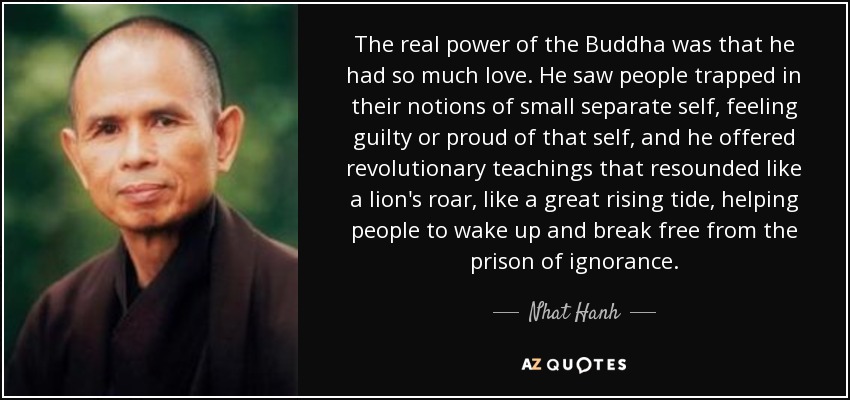
Our world lost Thích Nhất Hạnh two years ago this month. Why is this a Basic of Buddhism? TNH (forgive the abbreviation) is considred one of the most influential teachers of our age. Along with the Dalai Lama, this humble Vietnamese monk was recognized internationally as a spreader of Buddhist thought to the western world. He is known especially for his teachings on mindfulness, non-violence, and interconnectedness (interbeing). Martin Luther King, Jr recognized his universal message of non-violence and connectedness by nominating him for a Nobel Peace Prize in 1967.
Nhất Hạnh combined a variety of teachings of Early Buddhist schools, Mahayana, Zen, and ideas from Western psychology to teach mindfulness of breathing and the four foundations of mindfulness, offering a modern perspective on meditation practice. He focused on the practical nature of the Buddhist path,
promoting the individual's active role in creating change. He founded the Plum Village Study and Retreat centers throughout the world, recognized as leading centers of modern Buddhist thought and practice.
Among his many other acheivements, TNH wrote more than 100 books, most based on his individual experience in practice, which make them extremely accessible for novice and expert alike. Often recommended are The Heart of the Buddha's Teaching, The Art of Mindfulness, Old Path, White Cloud, No Mud, No Lotus and Living Buddha, Living Christ. How will you begin or continue your study of TNH's works? We have a TNH study group that meets twice a month on Zoom -see it in the list of services at the top of this newsletter.
| |
|
Tending Our Garden
In his book, Understanding Our Own Mind, the Buddhist monk Thich Nhat Hanh tells this story:
If you plant a seed in springtime, by autumn a plant will mature and bear flowers. From those flowers, new seeds will fall to the earth, where they will be stored until they sprout and produce new flowers. Our mind is a field in which every kind of seed is sown—seeds of compassion, joy, and hope, seeds of sorrow, fear, and difficulties.
Every day our thoughts, words, and deeds plant new seeds in the field of our consciousness, and what these seeds generate becomes the substance of our life. There are both wholesome and unwholesome seeds in our mind-field, sown by ourselves and our parents, schooling, ancestors, and society.
If you plant wheat, wheat will grow. If you act in a wholesome way, you will be happy. If you act in an unwholesome way, you will water seeds of craving, anger, and violence in yourself and in others... As we cultivate the seeds of joy and transform seeds of suffering in ourselves, understanding, love, and compassion will flower.
| |
A Deeper Look
Another great modern teacher, Jack Kornfield trained as a Buddhist monk in the monasteries of Thailand, India and Burma. He has taught meditation internationally since 1974 and is one of the key teachers to introduce Buddhist mindfulness practice to the West. He is also a clinical psychologist, and brings an interesting view of cultivating our minds to his Buddhist teachings.
“You have in you the seeds of great compassion, the seeds of wisdom and care for others. Meditation then is not to make some special experience, but it is to learn how to tend the garden of the heart and to water the seeds of kindness and presence in your own heart.” - Jack Kornfield
| |
|
Forgiveness
Looking for a place to start tending your "mind garden"? Here's a great suggestion from a leader in the field of forgiveness research.
| |
Dennis is a long-time Sanga member from Trout Lake. He is a full-time artist and dog servant (poodle Poppy is well-loved), and spends a good portion of his time in Eugene with partner Shelley. He recently began volunteering to teach meditation at the NORCOR jail facility, and finds new inspiration for his practice there. | |
|
Metta Weekend
by Dennis Hartley
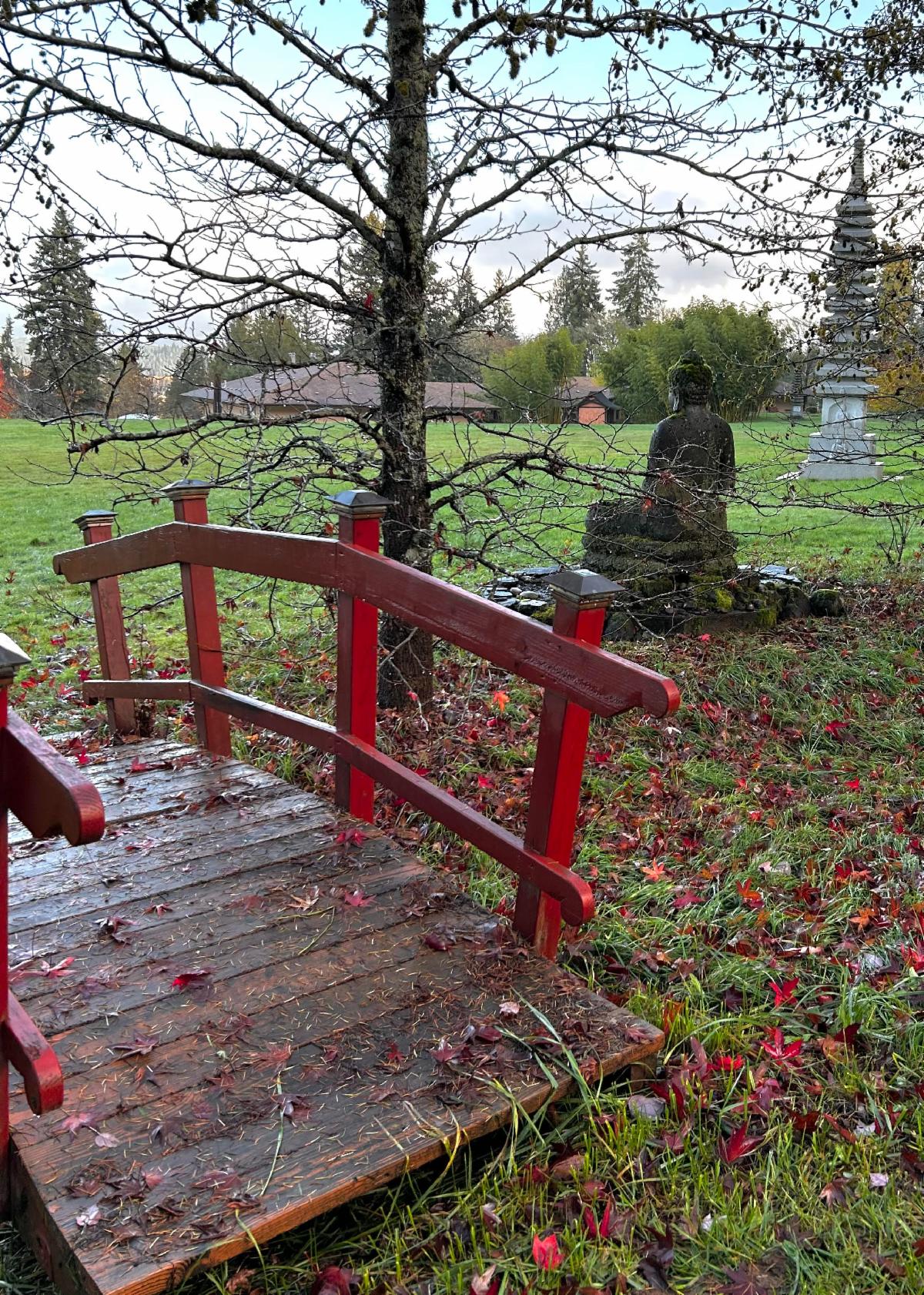
I recently attended a weekend retreat at Great Vow monastery in Clatskanie, Oregon. I was surprised to discover the building used to be an elementary school, built in the 70’s. It turns out the architect was influenced by Japanese architecture- there are several atriums throughout the building that have been transformed into Zen gardens. The monastery offers a public Sunday morning program, weekend workshops, weeklong meditation retreats, and special events throughout the year.
The theme of the weekend was Metta, or loving kindness. With all the anger, ignorance, and suffering now in the world, it occurs to me how radical this path is. If I can curb my own anger, ignorance, and suffering, I can help reduce the anger, ignorance and suffering of others.
In the daily Zoom Sangha I attend during the week hosted by Thay Kozen, we express Gratitude, send Metta, and support each other’s study of the Dharma. This is a wonderful practice. May all beings be well and happy, may all beings know love and peace.
| |
Great Vow Monastery offers many retreats and one-day studies throughout the year. It is located about an hour and a half north of the southern end of Portland. | |
|
Women & Buddhism
The Choice to Have Children or Be Spiritual
| While researching for this little newsletter section, I've seen a lot of discussion about the difficult choice for Buddhists, especially for women, of whether to dedicate a life to purely spiritual pursuits or to have a family. There is nothing in the ancient texts about the practical daily reality of motherhood, though it is held up as an ideal for unconditional love and selflessness. In our modern world, women face choices due to that magic "window" of potential childbearing in many areas - career, marriage, finances... The best wisdom I've heard is "you can have it all, just not all at once." Remember, life is long! Here's an excellent article from a Buddhist woman reflecting on practice and children. | |
|
Using Buddhist Practices and Principles to Recover from Addiction
Recovery Dharma is a peer led movement and a community that is unified by the potential in each of us to recover and find freedom from the suffering of addiction. This book uses the Buddhist practices of meditation, self inquiry, wisdom, compassion, and community as tools for recovery and healing. We welcome anyone who is looking to find freedom from suffering, whether it’s caused by substance use or process addictions like codependency, sex, gambling, eating disorders, shopping, work, technology, or any obsessive or habitual pattern. We approach recovery from a place of individual and collective empowerment and we support each other as we walk this path of recovery
| |
Laurie Van Cott of Gorge Yoga has a couple of slots left. Go to her website to grab them! | |
|
Health & Science
Do Personality Traits Contribute to Dementia?
This article reveals the results of some preliminary studies that link negative personality traits to the development of dementia. While the results are not conclusive or definitively causative, this is good new for meditators. The very characteristics we aim to root out are those that have the most risk: neuroticism; the tendency to dwell on negative emotions like fear, anger, and worry; and lack of conscientiousness. Those with a high level of joy, enthusiasm, confidence, and conscientiousness (including noticing the suffering of those around us) were less likely to develop dementia. Keep cultivating and practicing those positive mental habits through your practice!
| |
Dog River Pet Supplies
1118 12h St, Hood River OR (541) 490 0646
https://www.dogriverpetsupplies.com/
| |
FACING DEATH NOURISHING LIFE
January 15 - February 29, 2024
Doorway Into Light's Spring 2024 online training is 7 weeks long and meets on Zoom two times each week for 2 hours MONDAYS AND THURSDAYS 10AM - 12PM HAWAII TIME
The teachings of the 3 hearts encompasses the logistical/physical, the emotional/psychological and the spiritual skills and understandings to:
Prepare for one’s death,
Care for the dying, and
Build our willingness and capacity to meet what is dying in the world.
| |
I highly recommend this program for all of us. We will all die someday, we will all be separated from
the people and things we love (Buddha's 5 Remembrances).
This class will help us learn how we can help others and ourselves....in metta,Thay Kozen
| |
A NOTE FROM THE EDITOR
If you've read this far, thank you! We've been trying different formatting and content presentation in the newsletter the last few months. If you have ANY comments, complaints, or suggestions, please email the newsletter editor at gvljohnsons4@gmail.com. We also enjoy including poetry and other art from our community, so if you've got something Buddhist-themed to share, send it! You may see it featured in a future newsletter!
| | This bonus click was developed by Jill Turken & Scott See from Portland & Vancouver. More about these rascals later! | |
|
May the Infinite Light of Wisdom and Compassion so shine within us
that the errors and vanities of self may be dispelled;
so shall we understand the changing nature of existence and awaken into spiritual peace.
| | | | |