Article Heading
USDA Announces $12 Billion Farmer Bridge Assistance Program
The Trump Administration has announced a $12 billion economic assistance package to support American farmers facing market disruptions, rising production costs, and ongoing trade challenges. $11 billion will be allocated to the new Farmer Bridge Assistance (FBA) Program for row crop producers, including barley, chickpeas, corn, cotton, lentils, oats, peanuts, peas, rice, sorghum, soybeans, wheat, canola, crambe, flax, mustard, rapeseed, safflower, sesame, and sunflower. An additional $1 billion will be reserved for specialty crops and other commodities, with details still under development. Payments for row crops will be calculated per acre based on 2025 planted acreage reports and are scheduled for release by the end of February 2026. Payment rates for each crop were announced in late December, and individual farmers are subject to a payment limit of $155,000.
The Farmer Bridge Assistance Program aims to stabilize farm incomes, address unfair trade practices, and ensure American farmers have the resources needed to plan for the next crop year.
Read the USDA Announcement: https://bit.ly/48ufzJX
| | |
USDA Implementing Crop Insurance Changes
The USDA Federal Crop Insurance Corporation (FCIC) issued updated regulations in the form of a final rule titled "Expanding Access to Risk Protection" (EARP). The rule can be viewed here.
The EARP regulations implement changes enacted by Congress in July as part of the Farm Bill provisions in the Reconciliation bill as well as additional items. Notable items include clarifying harvest price methods, removing barriers to direct marketing and getting rid of buy-up coverage for prevented planting in the program.
The amendments take effect in 2026 for crops with a contract change date on or after Nov. 30, 2025. For all other crops, changes to the policies are applicable for the 2027 and succeeding crop years. Comments will be accepted through January 27, 2026.
There is a provision that eliminates a farmer's ability to purchase buy-up prevent plant coverage. RMA believes the option is no longer needed "because Congress has a history of addressing widespread flooding through ad-hoc disaster assistance, such as [in] the 2019 Supplemental bill that funded prevented planting "top-off" payments..."
| |
USDA Launches $700 Million Regenerative Agriculture Pilot Program
USDA Secretary Brooke Rollins, HHS Secretary Robert Kennedy, Jr., and CMS Administrator Dr. Mehmet Oz announced a $700 million Regenerative Pilot Program to help farmers adopt practices that improve soil health, enhance water quality, and boost long-term farm productivity.
Secretary Kennedy said in the announcement that the initiative also builds on the Make America Healthy Again (MAHA) Strategy, with HHS investing in research on how regenerative agriculture can support public health while emphasizing soil health and sustainable land stewardship. The program is designed to reduce soil erosion, strengthen the food and fiber supply, and improve long-term farm resilience. It also allows farmers to bundle multiple regenerative practices in a single application.
Farmers and ranchers interested in participating in the Regenerative Pilot Program can apply through their local NRCS Service Center by their state’s ranking dates for FY2026 funding. Both EQIP and CSP applications can now be submitted through a streamlined, single regenerative application process.
The program includes public-private partnerships, allowing USDA to match private funding to support farmers adopting regenerative practices. Companies can contact regenerative@usda.gov for more information.
Read the full announcement here: https://bit.ly/44Op9oD
| |
Senate Appropriations Hearing with Ambassador Greer on USTR Priorities and USMCA Review
On December 10, the Senate Appropriations Committee held a hearing with Ambassador Greer to review USTR activities and fiscal year 2026 priorities. A key focus of the hearing was the USMCA review and upcoming negotiations. Ambassador Greer explained that the public comment period and hearings for the USMCA have just concluded. He noted that the Administration must formally state its intention regarding the continuation of the agreement by July 1 and that he expects to meet with Mexican and Canadian counterparts in January for formal negotiations. Rules of origin remain a central issue, and the Administration is actively engaged in ensuring partner countries meet their obligations.
Ambassador Greer also offered insights into the assigned reciprocal tariff rates for countries. He explained the tariff structure: 10% on surplus countries, 15% on small-deficit countries, and higher rates for major violators. Emphasizing that tariffs will remain in all trade deals, though they may be modified, and that genuine Mexican and Canadian goods that meet USMCA rules remain tariff-free, while Chinese goods routed through these countries will be treated differently. Greer explained that tariffs are being used as a predictable tool to enforce trade obligations and strengthen U.S. supply chains.
He also noted that the Section 232 exclusion process is currently suspended, which had provided relief to some industries, but reiterated that USTR does not have jurisdiction over that decision. Other trade priorities discussed included ongoing work on finalizing a trade deal with India, food aid purchases, and a request to increase the USTR budget.
Watch the full hearing: https://bit.ly/4pze9TP
| | |
Senate Confirms 97 Nominees, Including Julie Callahan as Chief Agent Trade Negotiator
The Supreme Court heard arguments in the IEEPA case on November 5, which considered whether the use of IEEPA tariffs was lawful. A ruling could come as early as the end of the year. If the Court limits the President’s authority, the administration is expected to rely on Section 122 of the Trade Act of 1974, which allows tariffs of up to 15 percent for 150 days.
This month, the White House released a fact sheet on the trade truce with China, outlining that China will increase purchases of U.S. soybeans, sorghum, and other agricultural goods while maintaining exports of critical minerals and magnets. In return, the United States will reduce Fentanyl tariffs to 10% and delay its Section 301 investigation into China’s maritime and shipbuilding sectors for one year.
Meanwhile, USDA Under Secretary Luke Lindberg, who was in Europe last week meeting with officials and U.S. ag cooperators, told Agri-Pulse that U.S. farmers could begin benefiting from the U.S.-EU trade pact early next year. However, USTR officials in Washington noted that EU negotiations have been slow.
President Trump also recently announced joint trade frameworks with Argentina, Guatemala, El Salvador, and Ecuador. These frameworks outline intentions to expand market access for U.S. agricultural products, including beef and poultry from Argentina, and address non-tariff barriers. While not formal agreements, they set the stage for potential future trade deals.
| | |
Consumers Continue to Support Science-Based Dietary Guidelines
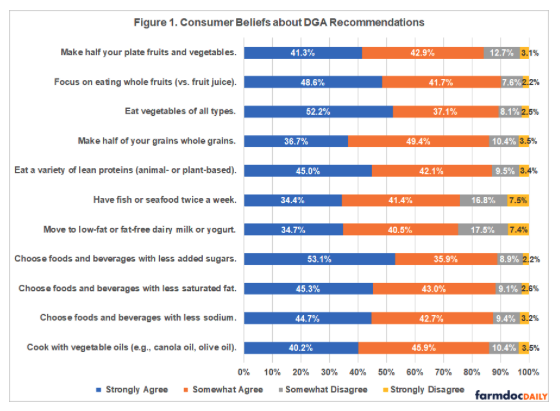
The Dietary Guidelines for Americans (DGA) shape U.S. nutrition policy, federal food programs, and public health messaging, and the next update (2025–2030) is now expected in early 2026. A new farmdoc daily analysis using November 2025 data from the Gardner Food and Agricultural Policy Survey shows that consumers continue to broadly support the current, science-based guidelines. At least 75% of respondents agreed with all major DGA recommendations, including eating more fruits and vegetables, choosing whole grains, reducing added sugars and saturated fat, and cooking with vegetable oils such as canola oil. Support was strongest for eating vegetables and limiting added sugars, while recommendations related to seafood intake and low-fat dairy saw slightly more disagreement.
The study also found that consumers place the greatest trust in nutrition experts, medical professionals, and federal health agencies to develop the DGA, with strong support for continued involvement from USDA and HHS. Consumers who were more familiar with the DGA expressed higher trust in the guidelines and favored a more inclusive development process, including input from farmers and food manufacturers. Overall, the findings suggest that despite ongoing public debate, consumers largely support the current Dietary Guidelines and the role of science in shaping them.
Read the article from farmdocDAILY: https://bit.ly/4pgsnIW
| | | | |
Seed Oil Groups Respond to Growing Federal and State Challenges
Seed oils are facing increased political and policy scrutiny in the United States, driven in part by the Make America Healthy Again (MAHA) movement. A recent White House MAHA report criticized seed oils as contributors to health concerns, prompting strong pushback from agricultural groups, including the U.S. Canola Association, which submitted scientific research countering those claims. Following industry engagement, references to seed oils were removed from the final MAHA policy recommendations. However, pressure continues at the state level, with anti-seed oil provisions proposed in six states, ranging from school lunch bans to labeling requirements, and Louisiana becoming the first to pass legislation. Consumer-driven decisions by some restaurants and food chains to move away from seed oils further underscore the growing influence of misinformation on food policy and food choices.
Read the article from The WesternProducer: https://bit.ly/44Ih0SM
| | Upcoming Industry Meetings: | |
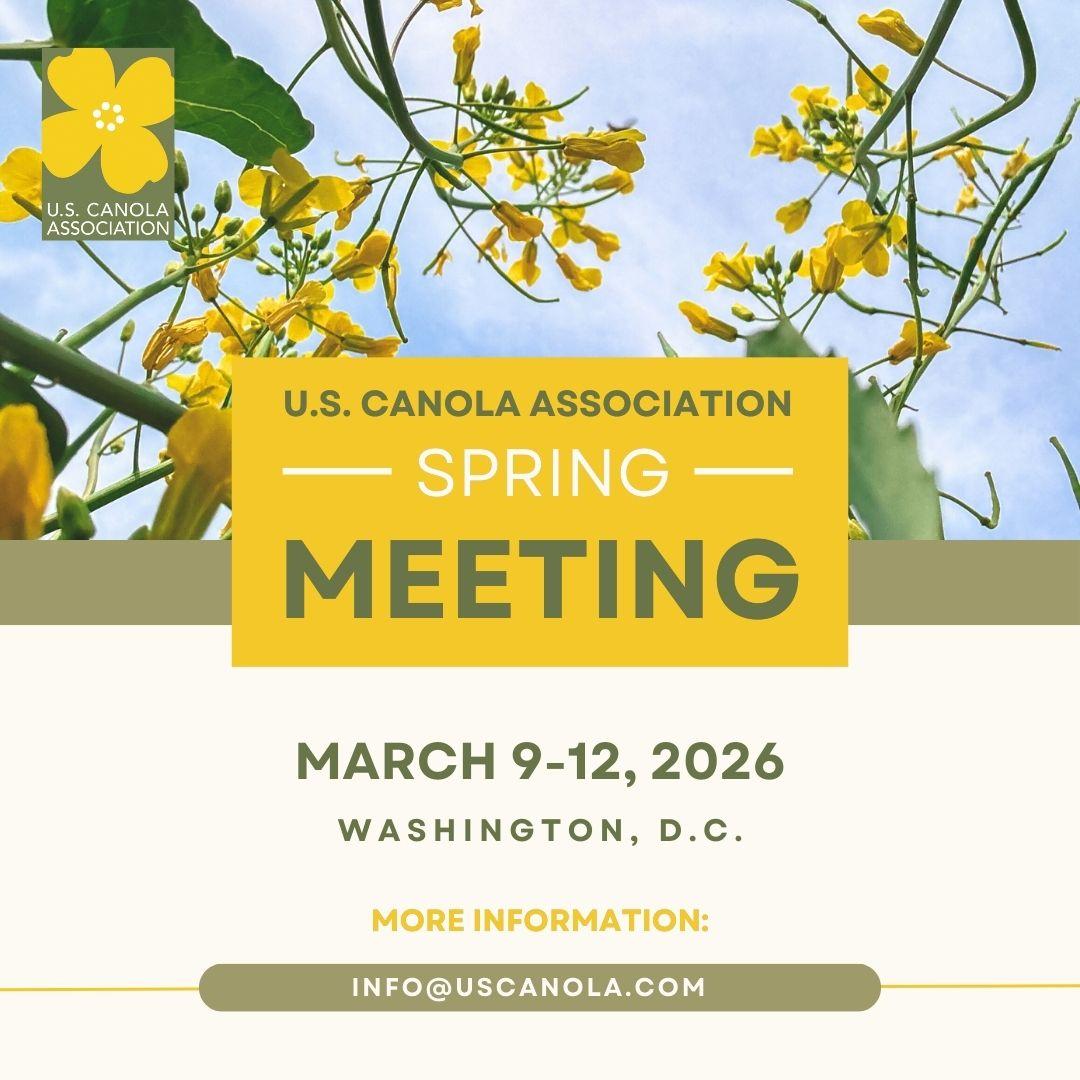
USCA Spring Meeting
March 9-12, 2026
Washington, D.C. | Phoenix Park Hotel
For more information, please email: info@uscanola.com
| |
Updated DOE GREET Model Improves Canola Carbon Intensity Score
The Department of Energy’s Argonne National Laboratory has released its updated R&D GREET model, incorporating changes that improve the carbon intensity (CI) score for canola. Notably, updates to how direct emissions (including N₂O emissions) are calculated are expected to lower canola’s CI score by approximately 3.5 points, according to experts familiar with the modeling. This improvement is in addition to anticipated reductions tied to the removal of induced land use change (ILUC) assumptions. The update also establishes a new CI score for intermediate winter canola, recognizing its potential as a biofuel feedstock and its environmental co-benefits, including reduced soil erosion, improved nutrient management, and pollinator habitat.
While stakeholders continue to analyze the full implications of the GREET updates, attention now turns to the Department of the Treasury, which is expected to release updated guidance or a proposed rule on the 45Z clean fuels tax credit by year’s end, an essential next step for biofuel markets and canola’s role in them.
Read the Summary of Expansions and Updates in R&D GREET® 2025: https://bit.ly/4qyMgMs
| | | |
Seed Oil Groups Push Back on Misleading HHS Social Media Post
The U.S. Canola Association, along with NOPA, ASA, and CRA, expressed disappointment following a recent Department of Health and Human Services social media post that they say misrepresents vegetable oils and contradicts established nutrition science. The groups emphasized that vegetable oils are safe, affordable, and heart-healthy alternatives to fats higher in saturated fat, with benefits supported by decades of research. They warned that framing corporate marketing decisions as public health victories fuels consumer confusion, undermines trust in science-based guidance, and unfairly targets American-grown ingredients, while reaffirming their willingness to work with the Administration to promote accurate, science-based nutrition messaging.
Read the recent joint statement from NOPA, ASA, CRA, and USCA: https://bit.ly/4j4wWEL
| | |
USCA's 2025 Year in Review
From policy wins in Washington, D.C. to science-based advocacy and expanded market access, 2025 was a year of resilience and momentum for the U.S. canola industry.
The USCA worked throughout the year to protect grower profitability, strengthen productivity, and ensure canola's role in food, feed, and biofuels.
Read USCA's key achievements and 2025 policy priorities: https://bit.ly/4sgFigy
| | | |
USCA works to support and advance U.S. canola production, marketing, processing, and use through government and industry relations. Since its establishment in 1989, the association has helped domestic canola acreage grow from virtually zero to about 2 million. To learn more about USCA, go to: www.UScanola.com
Want to promote your products or services to canola producers and industry members? Visit our advertising pages to find specs, deadlines and rates to advertise in the Canola Quick Bytes monthly e-newsletter.
| | | | |