|
Market Navigator for the Month Ending January 31, 2026
Presented by Austin Fearon
Markets rallied to start the year, with international stocks outperforming U.S. companies. Rising long-term interest rates weighed on bond returns; however, investment-grade and high-yield bonds were still able to post modest gains for the month. Looking forward, continued economic growth and market appreciation remain the most likely path in 2026.
1. Beyond the Headlines: Solid Start to the Year for Markets
2. Fixed Income Update: Long-Term Yields Rise as Fed Remains on Sidelines
3. Economic Report Updates: Job Market Headwinds
4. Looking Ahead: Cautious Optimism Despite Risks
Beyond the Headlines: Solid Start to the Year for Markets
Markets rallied to start the year, supported by strong earnings growth in the fourth quarter. The S&P 500 gained 1.45 percent while the Dow Jones Industrial Average was up 1.80 percent. The Nasdaq Composite saw a 0.97 return in January.
These strong results were driven by healthy fundamentals. We’re in the middle of fourth-quarter earnings season, and so far so good for U.S. companies. As of January 30, with roughly one third of companies having reported actual earnings, the average earnings growth rate for the S&P 500 was nearly 12 percent. This is well above analyst estimates for a more muted 8.4 percent growth rate at the start of earnings season. Over the long run, fundamental factors drive market performance, so the continued earnings growth is encouraging. Technical factors were also supportive, with all three indices finishing the month well above their respective 200-day moving averages.
International stocks outperformed their domestic counterparts to start the year. Developed and emerging markets both rose in January, following strong returns throughout 2025. The MSCI EAFE Index gained 5.22 percent for the month while the MSCI Emerging Markets Index did even better, up 8.86 percent in January. Foreign stocks were supported by a weaker dollar and continued investor appetite for international companies as concerns about U.S. trade and fiscal policies increased during the month.
Fixed Income Update: Long-Term Yields Rise as Fed Remains on Sidelines
Bonds were also up to start the year, despite rising long-term interest rates in January. The 10-year Treasury yield rose from 4.18 percent at the start of the month to 4.26 percent by month-end, while short-term yields ended the month little changed. Despite the rising rate environment, both investment-grade and high-yield bonds were up in January.
The Bloomberg Aggregate Bond Index gained 0.11 percent during the month while the Bloomberg U.S. Corporate High Yield Index gained 0.51 percent.
The Federal Reserve elected to keep interest rates unchanged at the conclusion of its January meeting, which was in line with market and investor expectations. Looking forward, markets expect to see between two to three interest rate cuts by the end of the year, but the timing of any potential cuts remains uncertain. Toward the end of January, President Trump nominated former Fed governor Kevin Warsh to be the next Federal Reserve chair, starting in May. While this nomination is still pending confirmation from the Senate, market reaction to the announcement was muted.
The Takeaway
· Bond returns were positive to start the year despite rising long-term rates.
· The Fed kept short-term rates unchanged at the conclusion of its January meeting.
· Former Fed governor Kevin Warsh was nominated to be the next Fed chair, starting in May pending Senate confirmation.
Economic Report Updates: Job Market Headwinds
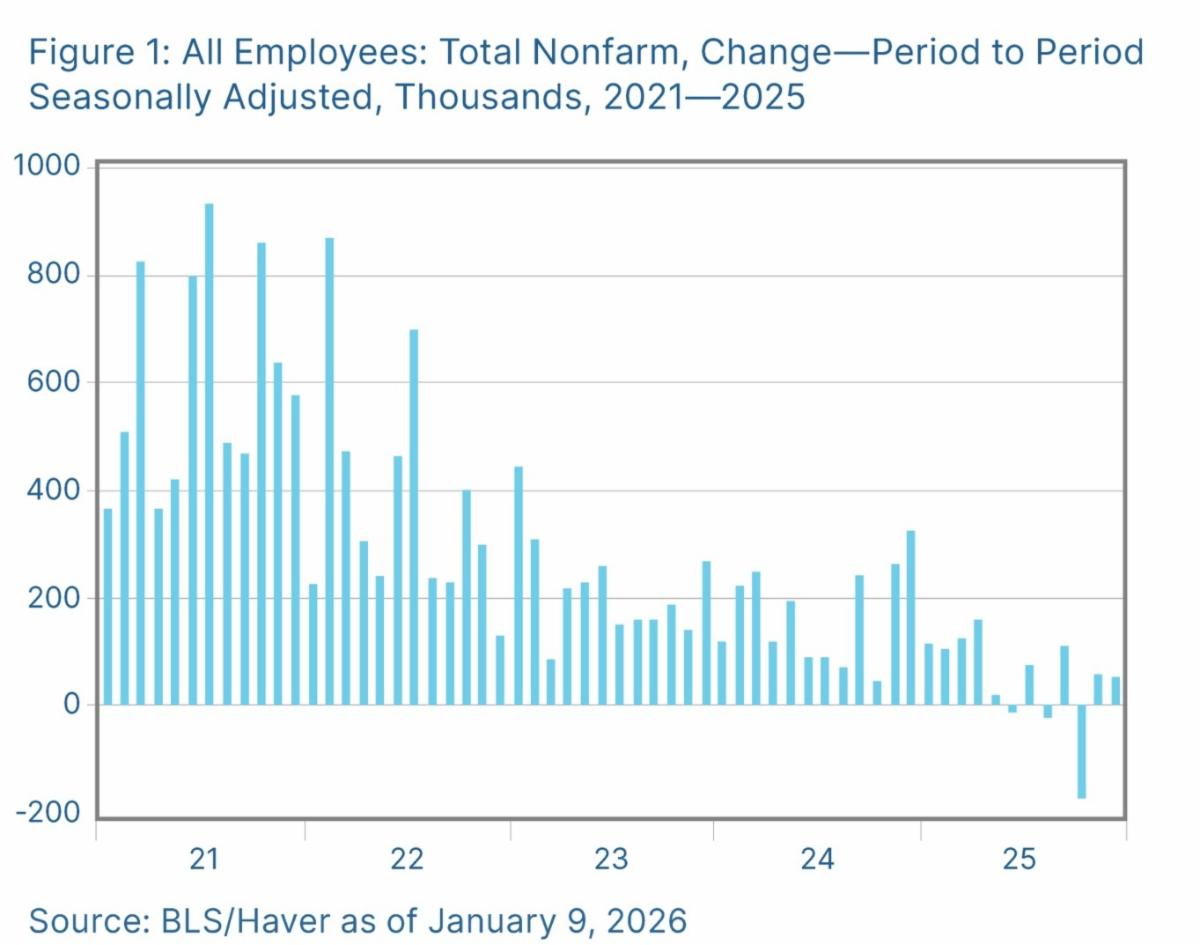
Despite the solid start to the year for markets, the economic backdrop remains challenging. The December job report showed that just 50,000 jobs were added during the month, down from a downwardly revised 56,000 in November. As seen in Figure 1, hiring slowed notably in 2025 compared to recent post-pandemic years. The weakness in the job market is a primary reason why the Fed cut interest rates at the end of 2025 and serves as a headwind for overall economic growth.
|