|
Happy New Year and welcome to our first newsletter of 2026!
This month, we are acknowledging National Human Trafficking Prevention Month, Mental Wellness Month, National Mentoring Month, and Poverty Awareness Month.
Please read on to learn about our latest resources and news, as well as other resources and news from around the field.
| | Join Us for Our Upcoming Webinars! | | |
TOMORROW! Engaging Caregivers in the Community
2:00 p.m. – 3:30 p.m. ET
In keeping with our practice, the webinar will be one hour, followed immediately by an open Q&A session that will last for half an hour.
Kinship families want and need support, and effectively engaging them is key. This begins with trust and mutual respect, which can be fostered using a relational, rather than transactional, approach. By centering lived experience, creating welcoming environments, and listening to what caregivers say they need, we build authentic relationships that connect families to both formal systems and community-based support. This is the space where genuine engagement, change, and positive outcomes happen. Join this webinar to learn more about intentional and practical strategies for engaging kinship families in the community. Our speakers for this webinar are Dr. Ali Caliendo and Dr. Angela Tobin.
| |
|
Developing Multi-State Navigator Programs: Lessons, Models, and Opportunities
2:00 p.m. – 3:30 p.m. ET
In keeping with our practice, the webinar will be one hour, followed immediately by an open Q&A session that will last for half an hour.
As kinship and family support programs grow beyond state borders, organizations are exploring how to effectively develop and sustain multi-state navigator models. This webinar will explore practical lessons learned from building and operating navigator programs across multiple states, highlighting successful structures, partnership models, and funding strategies. Participants will gain insight into common challenges—such as data sharing, staffing, and training—and how programs have adapted to meet the unique needs of families in diverse regions. The session will also showcase promising models and emerging opportunities for collaboration, scalability, and long-term impact. This webinar is designed for nonprofit leaders, program managers, policymakers, and practitioners interested in expanding navigator services, strengthening cross-state partnerships, and increasing access to support for families nationwide.
| | | | Since we launched our LinkedIn page in September 2023, we’ve been using it to share the latest news, data, and replicable practices and tools to support your work with kinship families. Follow our page to keep up with the latest kinship news between monthly issues of this newsletter. | | What's New From the Network? | |
Understanding Changes to SNAP
SNAP is the federal Supplemental Nutrition Assistance Program. Kinship families facing food insecurity may have questions about changes to SNAP benefits and requirements under HR-1, the comprehensive budget bill passed in 2025. This tip sheet is designed to help both service providers and families better understand the changes, new restrictions, and caregiver exemptions that are taking effect.
| |
| |
The Network team is pleased to have our work featured in a new report from the U.S. Government Accountability Office, which we shared last month. The report includes new data on kin caregivers and the children they raise. Check out our LinkedIn post to learn more. | | Individual Assistance Spotlight | | | | The Network is responding free of charge to individual technical assistance (TA) requests from professionals who work in systems and organizations that serve kinship/grandfamilies. To request assistance on the array of issues impacting kinship/grandfamilies, please complete our request assistance form. | | |
We answer questions and respond to requests of all sizes. Some questions focus on a very specific topic and/or location, while others are much broader. Below, we share an example TA request and response. As is typical for this spotlight, the request below only required an email response. Many of our requests benefit from more intensive responses from our TA team. We often host meetings with peers or other subject matter experts; review data and policies; and provide specific guidance to help enhance programs, implement policies, or otherwise improve services for kin.
Request
How do jurisdictions financially support “informal” kinship families who are not part of the foster care system?
Response
The primary source of ongoing monthly support for kinship families who are not involved with the foster care system is Temporary Assistance for Needy Families (TANF). The Network has a resource that gives state strategies for enhancing access to that important program.
The examples below are state-created supports that complement TANF child-only and family grants.
Washington, DC has a subsidy program for relative caregivers who are not foster-care involved. It has steadily expanded over the years and is funded through the DC City Council. In 2024, we designated it as an Exemplary kinship program and profiled it.
Other jurisdictions have used a mix of TANF and general funds to support kin who are not foster-care involved.
Louisiana and Nevada use their TANF block grants to offer specific programs for kinship families with low household incomes. These programs exist in both states as an alternative to TANF child-only and family grants. They provide larger, ongoing monthly benefit amounts than child-only, and they do not impose time limits and work requirements as their states’ TANF family grants do.
- Louisiana's Kinship Care Subsidy Program provides a monthly subsidy of $450 per child to qualified relatives with incomes less than 150% of the federal poverty level who are caring for children outside the foster care system.
- Nevada's Kinship Care Program uses TANF funds to provide monthly cash assistance of over $400 per child. The Nevada program is for relative caregivers age 62 and older who have obtained guardianship of the children and have household incomes less than 275% of the federal poverty level. In addition to the monthly payments, Nevada reimburses caregivers up to $750 for legal expenses they incurred to obtain guardianship of the children they are raising.
Virginia’s Relative Maintenance Support Payment began in 2020 and was extended in 2024 to fictive kin, in a program known as the Kinship Care Maintenance Support Program. The state uses TANF and general state funds to finance the programs.
- The relative or kin must be certified by the child welfare agency as having prevented the child’s entry into foster care
- For the Kinship Care program only, the kin caregiver’s household income is tested and must be at or below 400% of the federal poverty level, or they may claim “financial hardship” after being found income ineligible. (If any member of the home receives public assistance like TANF or SSI, the income test is not required. However, please note that in VA, like most states, non-related kin cannot access TANF child-only – they must be related to the child.)
- The relative does NOT have to assign child support collection to the state
- The payment is $200 in addition to TANF standard assistance, which together are close to the state’s minimum foster care maintenance payment rate
Finally, New Mexico is rolling out a pilot program that includes subsidies for informal kin. The Network has been providing technical assistance in setting up the pilot.
To make an individual request, please complete this form and we will get in touch.
| | |
The team at STARRY’s Carver Center for Families in Georgetown, Texas works daily alongside school counselors in Georgetown Independent School District to support families whose basic needs aren’t being met. Recently, resource navigators at the 64,000-square-foot family resource center began to notice a shift in referral patterns: more and more kinship families were walking through their doors with needs that far exceeded one-time or short-term assistance.
Guided by their longstanding commitment to child and family well-being, the team recognized that kin caregivers deserved deeper, more sustained, and more tailored support. After sharing this emerging trend with the Texas Alliance for Children and Families, Program Coordinator JJ Nisula was encouraged to connect with the Grandfamilies & Kinship Support Network. That introduction led to targeted technical assistance from Network staff, who offered national context, best practices, and a space to test early ideas for what a future kinship navigator program could look like at STARRY. JJ also attended several Network webinars, which helped crystallize the team’s vision. Hearing from peer organizations, she remembers gaining confidence, thinking, “We can do this. We can even better support our families and do it really well.”
| | Upcoming Presentation by the Network | | |
Our partners at the National Indian Child Welfare Association (NICWA) will be holding the 44th Annual Protecting Our Children Conference in Oklahoma City, Oklahoma, from Sunday, March 29 through Wednesday, April 1. During the conference, there will be several workshops about cross-system collaborations for kinship/grandfamilies:
- Representatives from Oneida Nation of Wisconsin will present on their efforts as part of the Network’s Bridging Systems for Kinship Families initiative.
- Tara Reynon from NICWA and Leland Kiang from Network partner USAging will present a workshop that will focus on collaborations between child welfare and Title VI Native American Aging Programs to support kinship/grandfamilies.
- Representatives from the Network’s evaluation partner, Child Trends, will also lead a workshop.
Register by Saturday, January 31 to secure the early-bird rate.
| | |
Network Director Ana Beltran will be presenting as part of the opening plenary on the first day of the Strengthening School Supports for Kinship Caregivers and Grandfamilies Summit hosted by REL Appalachia. The Summit is a virtual event that will take place on Wednesday, February 25 and Thursday, February 26. Ana’s presentation will be at 11:45 a.m. ET on Wednesday. Check out our LinkedIn page later this week for a link to register for the summit!
| | What's New Around the Network? | |
Joint Meeting of RAISE Family Caregiving Advisory Council & Advisory Council to Support Grandparents Raising Grandchildren (SGRG)
U.S. Administration for Community Living
TODAY, Tuesday, January 20
12:00 p.m. – 4:30 p.m. ET
| |
| The focus of this joint council meeting is the forthcoming update of the National Strategy to Support Family Caregivers. Network Director Ana Beltran sits on the Advisory Council to Support Grandparents Raising Grandchildren. The meeting will be open to the public. Registration is not required to attend. The Zoom meeting link will be operational (live) five minutes prior to the meeting start time. Closed captioning will be available. All information for this meeting, including an agenda, has been posted on the RAISE and SGRG webpages. Please email SGRG.mail@acl.hhs.gov or RAISE.mail@acl.hhs.gov if you have any questions. | | |
|
Webinar – Building Caregiving Research-Practice Partnerships: A Virtual Exchange for Caregiving Providers and Researchers
National Alliance for Caregiving and USAging
Tuesday, January 27
1:00 p.m. - 2:00 p.m. ET
| | Family caregivers are a critical part of our communities, and understanding their needs is essential for building innovative caregiver programs and services. Newly released state-level caregiver profiles offer a rich view of new caregiving trends, challenges, and opportunities across the U.S. This webinar will highlight key insights from these state profiles and explore how an Area Agency on Aging (AAA) is using this information to guide program development and service delivery. Participants will also hear from a family caregiver, who will share their personal experience and discuss an innovative social support program that has supported them. Attendees will leave with actionable ideas for translating data into local strategies, enhancing caregiver support, and aligning their work with broader goals for caregiver-friendly communities. | |
Webinar – Overcoming Challenges to Evaluating Child Welfare Programs
Urban Institute
Wednesday, January 28
2:00 p.m. – 3:00 p.m. ET
| | | This webinar, based on a new series of briefs, brings together researchers and agency staff members. The researchers will discuss common challenges, and agency staff members will share their reactions and their experiences contending with competing demands, altering established procedures, creating tracking systems, and sharing data across agencies and with evaluators. They will also describe the factors that influenced their agency's willingness and ability to undergo a rigorous program evaluation. Panelists will discuss solutions that can support rigorous evaluation while minimizing the imposition on the agency. | | | |
Webinar – State Strategies for Respite and Direct Care Workforce Registries
National Academy for State Health Policy
Wednesday, January 28
3:00 p.m. – 4:00 p.m. ET
| | Individuals and family caregivers often face challenges in finding qualified providers to deliver respite and long-term care. Workforce registries offer a solution: these online platforms connect individuals and families with qualified providers, making it easier to access respite care and other long-term care while also supporting workforce recruitment and retention. In this webinar, learn about the role of registries and explore key considerations for designing and implementing effective registry systems. The webinar will also feature state examples from North Dakota and Washington. | |
Call for Social Engagement Innovations
Commit to Connect and engAGED: The National Resource Center for Engaging Older Adults
Deadline: Friday, January 30
| | | In partnership with Commit to Connect—a federal initiative led by the U.S. Administration for Community Living and coordinated by USAging—engAGED recently launched a Call for Innovations to identify model interventions, programs, and services that address social isolation and loneliness. All programs submitted to the Call for Innovations will be considered for inclusion in the Social Engagement Innovations Hub—a searchable clearinghouse of best practices and data-driven interventions, programs, and services promoting social connections across populations. Contributing to this Hub will encourage replication and awareness of programs to address social isolation and loneliness. To qualify for consideration, programs must serve older adults, people with disabilities, and/or caregivers – including kin caregivers. | | | |
Webinar – How States Are Implementing the National Strategy to Support Family Caregivers
National Academy for State Health Policy
Thursday, February 5
2:00 p.m. – 3:30 p.m. ET
| | The National Strategy to Support Family Caregivers includes hundreds of action steps that public and private organizations at the local, state, Tribal, and national level can take to better support caregivers. Since 2022, a range of states and organizations have developed supports for family caregiving in line with the National Strategy’s five goals, including coordinating services and supports. The Administration for Community Living (ACL) recently awarded grants to multiple states to support implementation of the National Strategy and increase access and awareness. In this webinar, attendees will learn about new and ongoing activity to support the National Strategy at the federal and state levels. Scheduled speakers include Mary Lazare, who is the Principal Deputy Administrator of ACL, and Bernice Hutchinson, who is the Aging Services Program Specialist in the Office of Supportive and Caregiver Services at ACL and serves as the Network’s project officer. Speakers from California, Maryland, Massachusetts, and Wisconsin will also share updates from their grantee activity. | |
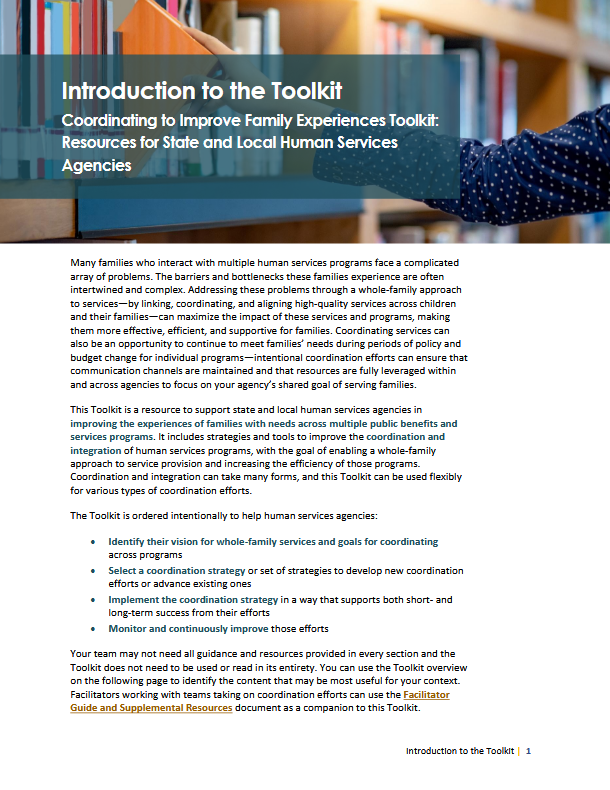
Coordinating to Improve Family Experiences Toolkit: Resources for State and Local Human Services Agencies
Urban Institute
| To help states and localities improve families’ experiences when they seek services or benefits from multiple public benefit programs, the Urban Institute and its project partners created a comprehensive toolkit. Administrators across the country can use this toolkit to better serve families in their communities. | | |
Multisector Plan for Aging Toolkit
Center for Health Care Strategies
| States across the country are developing comprehensive, statewide multisector plans for aging (MPAs) to better coordinate policies, programs, and investments that affect older adults, people with disabilities, and their caregivers. An MPA is a state-led, cross-sector plan — typically spanning 10 or more years — that brings together partners across government, health care, social services, and other sectors to address aging-related needs in a more coordinated way. This toolkit offers practical guidance, concrete strategies, and real-world examples drawn from states that are actively engaged in this work. The Network encourages states to consider and include the needs of kin/grandfamily caregivers as they develop their MPAs, and our team is available to provide no-cost assistance. | |
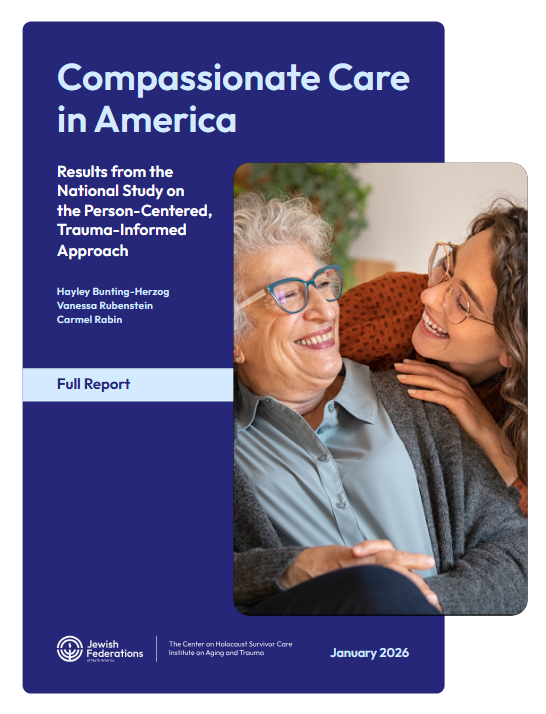
Report – Compassionate Care in America: Results from the National Study on the Person-Centered, Trauma-Informed Approach
Jewish Federations of North America Center on Aging, Trauma, and Holocaust Survivor Care
| Conducted every five years, the National Study on the Person-Centered, Trauma-Informed (PCTI) Approach explores the capacity of aging service organizations to use the PCTI approach to support individuals with a history of adverse experiences. These results shape national conversations on how to improve our nation’s aging services so that we can all achieve healthy aging. | | |
Notable Funding Opportunities
(listed in order of application deadline)
| | |
The Community Access to Child Health (CATCH) Program is a national initiative of the American Academy of Pediatrics (AAP) that supports pediatricians to lead innovative, community-based initiatives that increase children’s access to optimal health or well-being. Applicants can apply for a planning grant or an implementation grant. Applications are due by 11:59 p.m. CT today, Tuesday, January 20.
The JA Community Foundation currently focuses its funding on the Japanese American community. They fund programs and projects that focus on senior health and services, history, arts and culture, and youth. Letters of inquiry for the 2026 Spring Grants cycle are due by Sunday, January 25.
The Dr. Scholl Foundation considers applications for grants in the following areas: education, social service, healthcare, civic and cultural, and environmental. The deadline to submit a letter of inquiry is Saturday, January 31.
RRF Foundation for Aging focuses on improving the quality of life for older people. Their national areas of focus are caregiving for older adults, economic security later in life, housing, and social and intergenerational connectedness. The next deadline for letters of inquiry is Sunday, February 1.
Community Care Corps is accepting applications for grants to develop and scale innovative volunteer programs that provide nonmedical assistance to older adults, adults age 18 and older with disabilities, and family caregivers, including kin caregivers. Applications are due by 5:00 p.m. ET on Thursday, February 26.
Through its Community Health Impact Lab Micro Grants Program, the American Medical Association is awarding micro grants to physicians who have big ideas on how to address health-related challenges faced by people with limited access to care. The application deadline is Sunday, March 1.
| | |
|
Children’s Bureau, Administration for Children and Families, U.S. Department of Health and Human Services, December 19, 2025
This TB announces a pilot opportunity for states in various stages of CFSR Round 4 to center their program improvement efforts around the A Home for Every Child goal, excusing them from the Program Improvement Plan (PIP) development and measurement process outlined in Technical Bulletin 13A. All states—and the District of Columbia and Puerto Rico—may avail themselves of the PIP flexibilities afforded in this TB, subject to specified conditions that reflect a commitment to performance improvement. The Children’s Bureau will work to provide state-specific support to interested states and is not specifying a deadline for state interest in this TB.
The Imprint, December 19, 2025
This article, written by Alex Adams, the Assistant Secretary for Family Support, who leads the Administration for Children and Families (ACF), notes that, in the last 25 years, no state has passed a Child and Family Services Review (CFSR). Rather than continuing to use traditional Program Improvement Plans (PIPs), Adams and ACF are offering states a new approach, with a focus on achieving “a foster-home-to-child ratio greater than 1:1 in every state.” Adams specifically mentions that some of the ways states can improve their ratio are “through streamlined kinship licensure [and] better identification of kin and fictive kin.” The Network is ready to assist states in their efforts to implement these practices.
The 19th, December 10, 2025
New Mexico is the first state in the country to offer free, universal child care, and grandparents who have legal custody or kinship guardianship are exempt from the program’s work and education requirements. New Mexico is embracing what the kinship field has long known – grandparents (whether in the workforce or not) need respite so they can attend to their own needs and be the best caregivers to their grandchildren. And, grandchildren who face the trauma of parental loss can benefit from the routines and group play found in a good childcare setting.
Source NM, November 7, 2025
The Kinship Caregiving Pilot Program, a project of New Mexico’s Aging and Long-Term Services Department (ALTSD), seeks to provide monthly financial support and services to kin caregivers. The three-year pilot program, created by a law passed in 2025, began in two counties with high needs, but it is authorized to provide services in five to seven counties. Expansion is on the horizon this spring. Private partnerships fund the financial assistance, which can go to 50 families per jurisdiction. The amount of support varies according to household income and the child’s needs. In a great demonstration of cross-system collaboration, ALTSD “is also working with school districts throughout the state, health clinics, family resource centers and other community partners.” The Network is pleased to be providing ongoing assistance to ALTSD in implementing this pilot.
|
| |
Please follow the Grandfamilies & Kinship Support Network on LinkedIn here! |
|  |
All of our previous newsletters are linked on our website, so you can access them anytime. |
| Did you receive this newsletter as a forwarded email? You can sign up to get it in your inbox every month! | | |
The Grandfamilies & Kinship Support Network is the only national technical assistance center for those who serve grandfamilies and kinship families. It was created to help guide lasting, systemic reforms. The Network is a new way to collaborate, to work across jurisdictional and systemic boundaries, to eliminate silos, and to help one another and be helped in return. Thank you for being part of it.
We'd love to hear from you! Please send any feedback on this newsletter to mweiss@gu.org.
| | |
The Network is supported by the Administration for Community Living (ACL), U.S. Department of Health and Human Services (HHS) as part of a financial assistance award totaling $9,950,000 with 95 percentage funded by ACL/HHS and $523,684 and 5 percentage funded by non-government sources. The contents are those of the authors and do not necessarily represent the official views of, nor an endorsement, by ACL/HHS, or the U.S. Government.
|
| | | |