Volume 12 | January 2026

BAND Together Newsletter

Executive Director Report:
Different Roads for Different Traffic - Rethinking Fiber in North Dakota

Broadband access has been a hot topic for years, and in North Dakota, it’s largely a success story. Thanks to the work of BAND members, and programs like the Universal Service Fund (USF), high-speed internet is available to nearly everyone in North Dakota. Whether you live in downtown Minot or on a farm in rural Dunn County, you can get online at speeds that support work, education, healthcare, and participation in today’s global economy.


So why, with all this progress, are there growing conversations about North Dakota “lacking fiber”—especially as artificial intelligence and data centers continue to expand? The answer isn’t that broadband access has fallen behind. Instead, it comes down to a difference in how fiber is used.


Most of us connect to the internet using what’s known as “lit” fiber. This is the traditional fiber network that delivers internet service to homes and businesses. As more people come online or use more data, broadband providers increase capacity by adding bandwidth or lighting additional fibers if they are available. This approach has worked well and continues to support everyday internet needs across the state.


But AI systems and data centers operate on a very different scale. They require enormous amounts of bandwidth—far more than typical homes or businesses. To meet those needs, they rely on high-capacity networks of fiber. Many times, they require access to “dark” fiber, sometimes called dedicated fiber. Dark fiber isn’t mysterious or negative; it simply means the fiber is unused until someone installs their own equipment on each end to light the fiber. Think of it like buying or leasing an empty stretch of highway rather than sharing a busy road. The organization leasing it controls how much data flows through and how it’s managed, without competing with everyday internet traffic.


Until recently, there wasn’t much demand for this kind of dedicated infrastructure. Businesses typically purchased additional capacity on existing networks, and broadband providers avoided installing unused fiber because it was costly and unnecessary. That has changed as AI and data-intensive operations grow.

The good news is that this demand for dark fiber doesn’t threaten the broadband service North Dakotans already enjoy. In fact, it helps protect it. By giving data centers and other high-bandwidth users their own dedicated fiber, those massive data loads stay off the traditional networks that homes and small businesses rely on.


This isn’t about a shortage of fiber broadband — it’s about the opportunity additional fiber provides. Investing in additional fiber strands and capacity ensures North Dakota can support next‑generation technologies while keeping the internet affordable, fast and dependable for all.

BAND Member Spotlight:


West River Telecom (WRT)

Beyond Bandwidth:

WRT’s Impact on Rural Healthcare Access


Fiber is not just something that is good for your diet—North Dakota’s fiber internet is essential for today’s healthcare providers. When people think of healthcare, they often think of doctors, medicine, and medical facilities. In this BAND Member Spotlight, we’re highlighting another essential component of modern healthcare: fiber connectivity.

West River Telecom (WRT) plays a critical role in supporting healthcare facilities across western North Dakota. For years, WRT has provided internet and voice services to Sakakawea Medical Center, enabling telemedicine and ensuring the secure transmission of medical records—both vital services for rural communities. Robust, reliable internet connectivity is no longer optional; it is essential for quality patient care.


“WRT has had a laser focus on the deployment of fiber connectivity over the last decade. We not only support our residential customers, but we also support our communities. Providing connectivity for healthcare is an important component as more medical technologies rely on our network,” said Troy Schilling, CEO of WRT.


North Dakota has emerged as a national leader in rural broadband, with 95% of households now having access to 100 Mbps speeds and 70% served by gigabit fiber. WRT has played an important role in that success, offering not only gigabit symmetrical fiber, but also 5 Gbps and 10 Gbps symmetrical plans—providing speeds and capacity that meets the growing demands of modern healthcare.


That reliability makes a real difference on the ground.


“Much of the life-saving technology we rely on every day depends on fast, reliable connectivity,” said Kurt Waldbillig, CEO of Sakakawea Medical Center. “We see our relationship with WRT as a true partnership in caring for the communities we serve.”


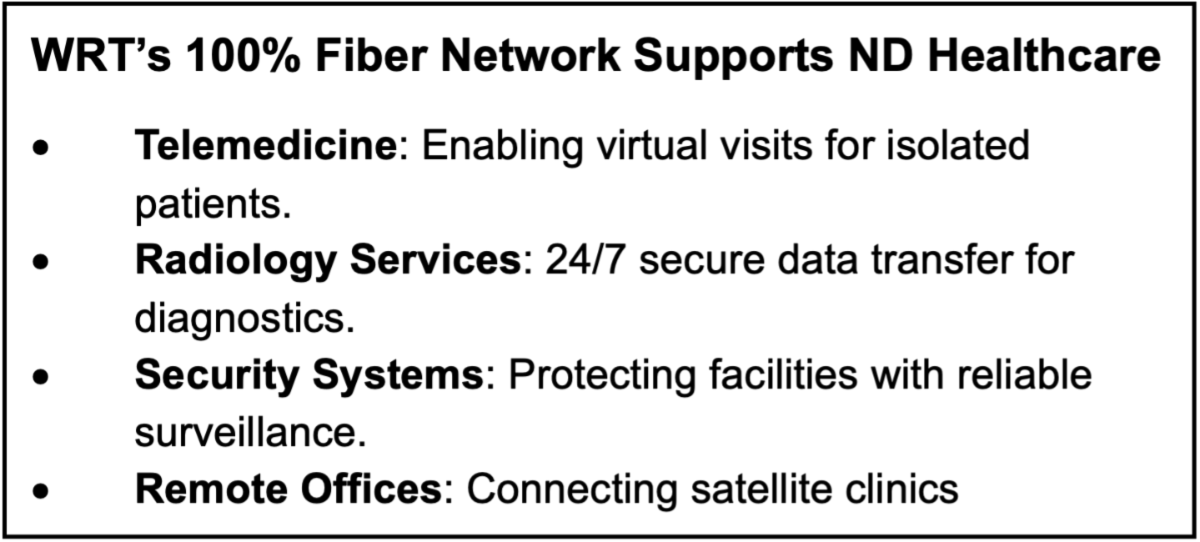
From telemedicine and 24/7 connectivity for radiology services to secure security camera systems and internet connections to remote healthcare offices, WRT keeps critical healthcare connections reliable and secure.


Today, WRT provides nearly 12,000 fiber internet connections in North Dakota and 2,500 connections in South Dakota. In total, WRT maintains over 6,500 miles of fiber across 8,500 square miles, delivering the connectivity that keeps rural communities—and their healthcare systems—strong. WRT is not just building networks—it is fortifying the health of rural communities for generations.

Upcoming Events


July 7-8

BAND Summer Meeting (Bismarck, ND)


Get in Touch &

Stay Connected!


Carissa Swenson,

Executive Director

I am happy to provide information or speak at an event. If you aren't already subscribed to this newsletter, please join our mailing list.

Facebook  LinkedIn  Web  Email