|
The TCCPI Newsletter
Issue #80: January-February 2024
| |
TCCPI is a multisector collaboration seeking to leverage the climate action commitments made by Cornell University, Ithaca College, Tompkins Cortland Community College, Tompkins County, the City of Ithaca, and the Town of Ithaca to mobilize a countywide energy efficiency effort and accelerate the transition to a clean energy economy. Launched in June 2008 and generously supported by the Park Foundation, TCCPI is a project of the Sustainable Markets Foundation.
We are committed to helping Tompkins County achieve a dynamic economy, healthy environment, and resilient community through a focus on energy efficiency and renewable energy.
| |
City of Ithaca's Electrification Initiative Gains Traction
by Matt Dougherty, Ithaca Times, 2/6/24
| |
|
The City of Ithaca has announced the first phase of building electrification projects as part of its commitment to following through on the goals of the Ithaca Green New Deal (IGND). The IGND was initially passed by the Common Council in 2019 and provides an outline for the City to achieve carbon neutrality by 2030.
On February 2, Ithaca’s Office of Sustainability announced and showcased a portfolio of 10 commercial buildings set for full electrification in the coming months, representing a noteworthy $1.9 million investment in clean energy.
| |
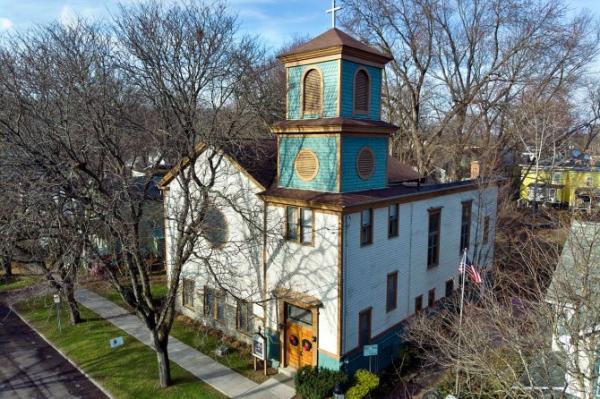
St. James AME is one of the most recent buildings to undergo electrification. Photo credit: Cornell Institute of Archeology and Material Studies. | |
|
A Big Step in Decarbonizing
Director of Sustainability for the City of Ithaca, Rebecca Evans, expressed her enthusiasm for the city's progress, saying, "It's a vote of confidence that community leaders, like those represented in this cohort, take this big step in decarbonizing their operations, and I’m sure many will follow in their trailblazing footsteps." Evans highlighted the collaborative effort involving the City of Ithaca, BlocPower, and various community partners.
The electrification initiative is a significant advancement for the "Built Environment" aspect of the IGND, as outlined in the Ithaca Green New Deal Scorecard. This component covers all aspects of where residents live, work, and socialize, emphasizing homes, offices, businesses, hospitals, places of worship, schools, stores, and more.
During 2023, the city focused on non-residential buildings to capitalize on a recently expired incentive from New York State Electric & Gas (NYSEG) as part of its NYS Clean Heat Rebate Program. This incentive facilitated the installation of heat pumps in gas-constrained areas, aligning with the city's broader electrification goals.
The financial backbone of this initiative comes from BlocPower, the designated clean technology partner working with the City of Ithaca. Over the last year, BlocPower has successfully implemented several building electrification projects and weatherization upgrades throughout the City.
BlocPower program manager Ethan Bodnaruk said, "The City of Ithaca continues to lay the groundwork for what a successful city-wide decarbonization movement looks like. This movement, and the city, are crucial to inspiring other cities and jurisdictions."
One of the pivotal aspects of this electrification initiative is the substantial financial support provided to building owners. Of the $1.9 million clean energy investment, nearly $1.4 million is subsidized through eligible state and federal incentives. This translates to significant savings for building owners, covering two-thirds of the installation and upgrade costs. For the buildings where data is available, these energy upgrades are estimated to result in the avoidance of nearly 680 metric tons of greenhouse gas emissions annually, according to EPA estimates.
The names and locations of the commercial buildings selected for electrification exemplify the diversity of the initiative:
- Gimme Coffee, 506 W. State St. (café and roastery)
- Significant Elements, 212 Center St. (nonprofit architectural warehouse)
- Historic Ithaca, 210 Center St. (nonprofit cultural organization)
- Ithaca Piercing & Tattoo, 120 S. Cayuga St. (retail)
- First Baptist Church, 309 N. Cayuga St. (place of worship)
- St. James AME, 116 Cleveland Ave. (place of worship)
- Lifelong Senior Center, 119 W. Court St. (nonprofit)
- Aeroplane Factory, 120 Brindley Street (office spaces)
- Circus Culture, 123 W State Street (cultural organization)
- Ithaca Area Wastewater Treatment Plant Administrative Building, 525 Third St. (municipal building)
- Petrune and Home Green Home, 126-128 E State St (retail)
Evans emphasized the city's collective efforts in laying a foundation for the electrification program and highlighted the tangible results of this initiative. She stated, "Electrify Ithaca has come a long way since 2022, and we’re finally seeing the results of the hard payoff." Evans credited the collaboration with BlocPower and numerous community partners for the success, underscoring their dedication to building a sustainable future for Ithaca.“
| |
|
Next TCCPI Meeting
Friday, March 29, 2024
9 to 11 am
TCCPI meetings have moved online. Contact Peter Bardaglio, the TCCPI coordinator, for further details at pbardaglio@gmail.com.
| |
New York's Ambitious Climate Goals at Risk
By Marie J. French, Politico, 2/7/24
| |
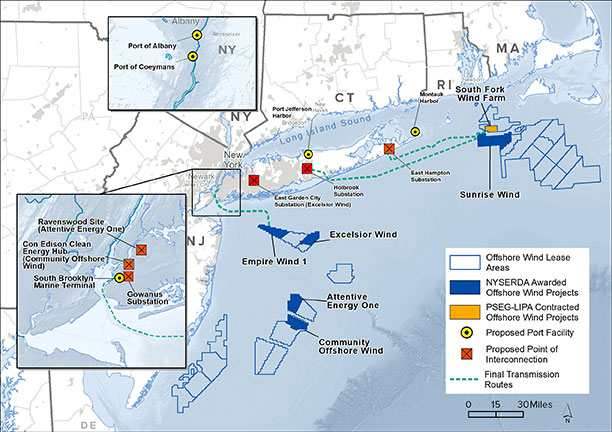
Map of New York's planned offshore wind projects. Photo credit: NYSERDA. | |
|
New York has long pushed to rely on 70 percent renewable electricity by 2030. It’s clear now the state is no longer on track — derailed by growing costs, canceled projects, and regulators’ refusal to provide more ratepayer-funded subsidies.
Part of the problem is there are simply not enough existing, awarded, and contracted projects in the pipeline to hit the 2030 target.
The biggest blow: Two offshore wind contracts with the state’s energy authority were terminated last week, taking a bite out of the state’s inventory of investments set to be operational before the statutory deadline to reach 70 percent renewable electricity.
| |
|
Growing Costs and Canceled Projects
State officials have recognized the challenges and highlighted the efforts to still achieve the targets in New York’s historic 2019 climate law, which also included a zero-emission electricity system by 2040 and an 85 percent reduction in greenhouse gas emissions by 2050.
The setbacks to New York’s progress in achieving one of the nation’s most ambitious climate plans highlight the challenges facing states across the country as prices for building new renewables have increased amid supply chain crunches and rising inflation. How New York manages to reset its portfolio could provide a model for other states — or a lesson in how to avoid similar setbacks.
“We have responded in ways that are garnering global attention,” NYSERDA president and CEO Doreen Harris said in an interview. “We are working to accelerate not only the procurement of renewables, but designing [them] to minimize delays and ensure projects are built on time for 2030.”
How close New York will get to the 70 percent threshold is uncertain, and it still could come fairly close by the deadline.
Including offshore wind projects that are seeking higher prices through a pending competitive process, New York’s current renewable portfolio is set to provide about 63 percent of statewide electricity in 2030, according to figures from the state’s energy authority.
But while New York isn’t far from its goal, state officials were predicting the same 63 percent in 2022 — meaning they have essentially lost two years of progress.
Falling short would mean higher levels of pollution from fossil fuel plants, which disproportionately impact low-income and minority communities, would continue.
It would also undermine progress toward New York City’s and the state’s overarching emissions reduction goals — since they rely heavily on electrifying buildings and transportation while greening the source of that energy.
“These figures showcase the reason why so many of us have had a deep concern about our state’s reliance on private development as a means to hit the mandate,” said Assemblymember Zohran Mamdani, a Democratic socialist from Queens who supported a measure to let the New York Power Authority (NYPA) build new renewables.
He said NYPA needs to be moving more aggressively to support the state’s 2030 mandate.
“If we continue to rely on the private market to hit our goals, we will only end up back here with ourselves to blame — and a year or two years from now,” Mamdani added, in an admonition of New York’s reliance on contracting with private developers for billions of dollars in renewable energy projects.
| |
State Climate Impacts Assessment Released
By Jacob Mack, Ithaca Journal, 2/14/24
| |
|
New York State recently released its Climate Impacts Assessment, which breaks down how climate change will impact the state economy, with some help from Cornell University.
A team of nine climate scientists and industry experts — including two Cornell researchers, Deborah Aller and Allison Chatrchyan — authored the agriculture chapter of the report, which warns how warmer winters and greater heat stress for animals and crops, among many other emerging environmental factors, will increase production costs.
| |
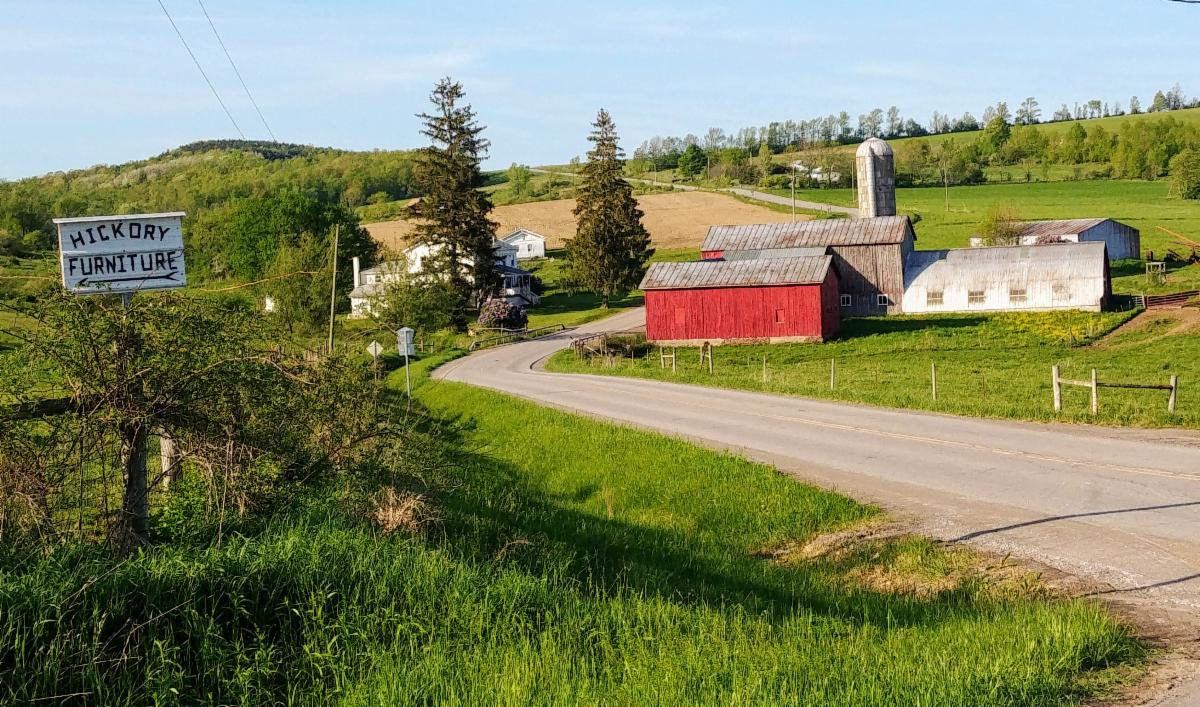
Climate change poses a significant threat to New York's farmers. Photo by Peter Bardaglio. | |
|
A "Threat Multiplier"
The report called climate change a “threat multiplier” for the state’s farmers, many of whom were already facing tight profit margins and labor shortages, and it projects that average temperatures will increase in all regions of the state by about 5 to 11 degrees Fahrenheit by the end of the century, making New York’s climate more like Virginia’s by 2030.
In a very high emissions scenario, the study projects the possibility of New York City's climate in 2080 morphing into the humid, high-temperature environment a state like Mississippi experiences about 1,200 miles southwest of the Empire State.
"The amount of warming that we see is really dependent on how much greenhouse gas emissions we put into the atmosphere," Chatrchyan said in an interview with The Ithaca Journal Thursday. "Greenhouse gasses, primarily carbon dioxide, stay in the atmosphere for hundreds of years. We don't know exactly what those emissions are going to be and if we don't start reducing emissions drastically, the high end of the warming would be 11 degrees Fahrenheit additional warming."
Warmer temperatures contribute to conditions that allow invasive species and pests to spread, increase drought risk, and stress animal species that need a colder climate, according to the report. It also generally leads to longer growing seasons and could increase yields for certain crops.
Heat stress can also affect farmers and their cattle, leading to potential sicknesses or mental health issues.
"Dairy farming is one of our biggest sectors in New York State, and what we see is this trend of dairy farms either getting big or getting out of the business," Chatrchyan said. "Many of the smaller dairy farms are not making a profit, and climate change exacerbates these challenging economics."
"Dairy farmers grow their forages to feed their cattle, and increasing extreme weather events affect their fields and crops. If they can't get into the field to plant the crops, or have to purchase more feed for their cattle, it affects their business," she said.
The United States Department of Agriculture also recently released data suggesting New York’s farms are dropping off the map more and more as the state’s climate worsens. Nearly 5,000 farms in the state have closed since 2012.
| |
Take a step to save money and energy! | |
One Last Thing: Accountability and Climate Change in Albany | |
|
It’s that time of year in Albany when a wave of bills comes ashore in the New York State Legislature, among them a number of critical climate and energy transition measures.
The big question on the minds of climate and environmental activists and their legislative allies is pretty straightforward: to what extent is Governor Kathy Hochul committed to fulfilling not just the letter but the spirit of the state’s 2019 Climate Leadership and Community Protection Act (CLCPA)?
| |
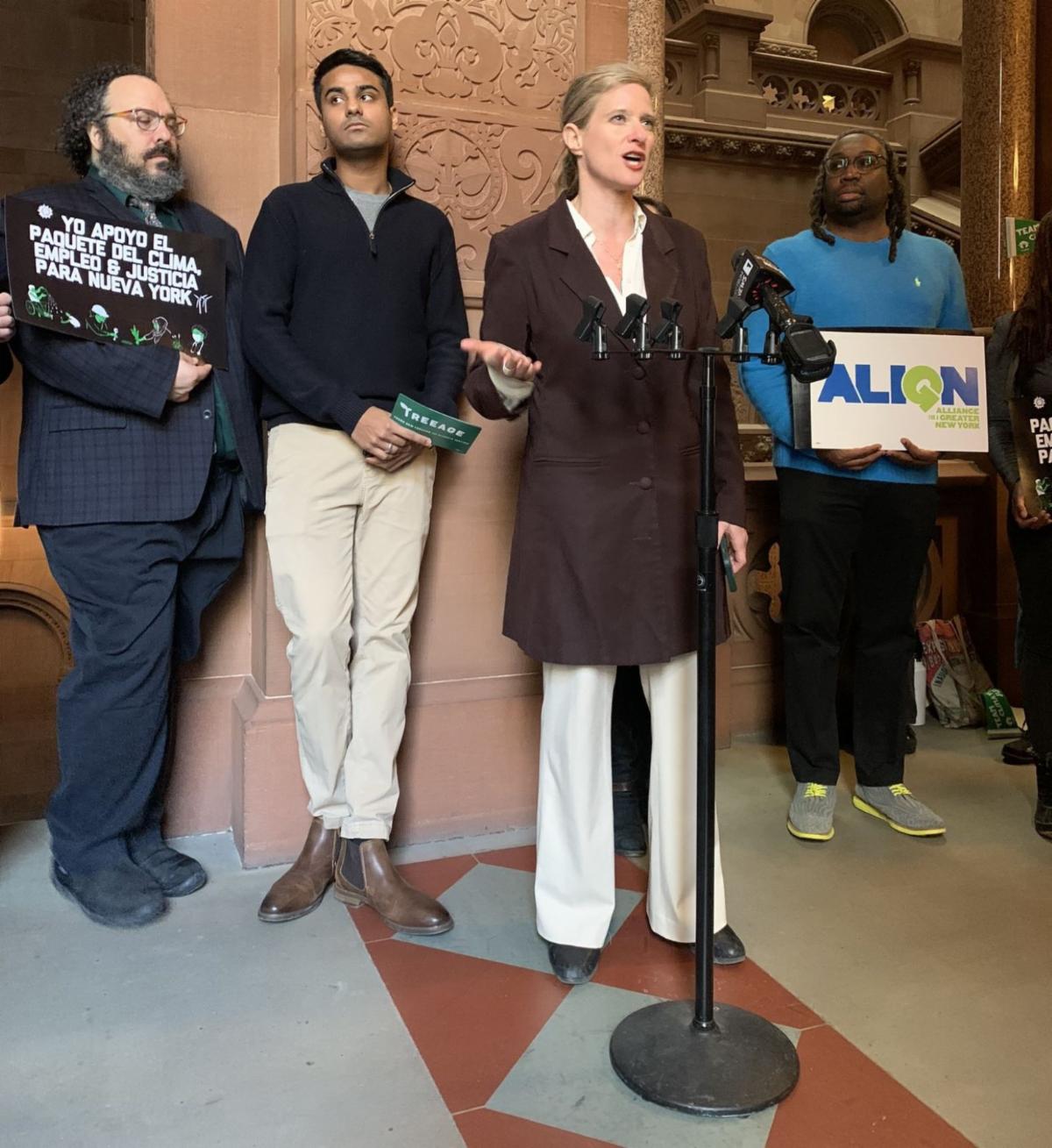
Assemblymember Anna Kelles speaking at a NY Renews rally in January. Photo courtesy of NY Renews. | |
|
Uncertainty and Anziety
Close on the heels of this question is a related issue: the State Climate Action Council has developed a substantive, thoughtful roadmap for meeting the ambitious goals of the CLCPA, but it remains unclear how energetically the governor intends to pursue it.
Feeding this sense of uncertainty are the challenges facing the rollout of utility-scale renewable energy projects in New York. As Marie French points out in this issue’s lead article, recent setbacks in developing industrial wind and solar have raised serious doubts about the state’s ability to meet the demands of the Climate Law, which requires that 70 percent of New York’s power come from renewable sources by 2030.
| |
|
Finding a Solution
At the same time, extreme weather events attributable to climate change have been escalating, creating a palpable sense of urgency about the need to find a solution.
As Raya Salter, a member of the Climate Action Council and founder of the Energy Justice Law and Policy Center, puts it, “The stakes are higher than ever so the governor needs to be willing to step out and make sure that we fully implement the CLCPA.”
There is certainly no shortage of suggestions about how to do this. One of the boldest set of proposals before the legislators is the Climate, Jobs, and Justice Package (CJJP) advanced by NY Renews, a coalition made up of over 370 environmental, justice, faith, labor, and community groups, including TCCPI.
The CJJP has three main components: 1) fully fund the CLCPA so that it can achieve its objectives; 2) build renewable energy for all and create green union jobs; and 3) hold polluters accountable and ensure everyone pays their fair share in taxes. Here are the details about how this would be accomplished:
-
The People’s Climate Justice Budget is a $1 billion spending plan that outlines critical climate and environmental justice programs that would constitute a downpayment on the more than $10 billion a year the state estimates is necessary to address the climate crisis. It builds on the creation of the Climate Action Fund (CAF) in 2023, seizing a historic opportunity to fund projects across the state.
-
The NY HEAT (Home Energy Affordable Transition) Act would eliminate subsidies for new gas hookups (the “100-foot rule”), enable neighborhood scale building decarbonization by eliminating the “obligation to serve” gas, and ensure that no household pays more than 6% of its income for energy. The plan would also ban the construction of any new gas plants in areas where they do not already exist after September 30, 2023.
-
The Just Energy Transition Act provides a plan to guide the replacement and redevelopment of at least 4 GW of New York State’s fossil fuel facilities by 2030. It lays out a clear direction for proceeding with the transition off fossil fuels in accordance with the CLCPA requirements. Converting these facilities to renewable energy as soon as possible will generate climate and economic benefits as well as public health benefits.
-
The Climate Change Superfund Act holds major oil companies, the state’s worst climate polluters, accountable for the harm they’ve inflicted on New York between 2000 and 2018. It would require companies that have contributed significantly to the buildup of greenhouse gases to bear a share of the costs of infrastructure investments required to adapt to the impacts of climate change in the state. The program would assess the major fossil fuel emitters $3 billion annually over the span of 25 years to offset the climate damages incurred by the state.
Not included in the CJJP, but closely aligned with it, is the Stop Climate Polluter Handouts Act. Many supporters view it, in particular, as a companion bill to the Climate Superfund Act, arguing that New York shouldn't be providing huge subsidies to an industry that is causing so much destruction. This legislation will end the most egregious state subsidies of over $330 million each year (out of an annual total of $1.6 billion) to oil and gas companies.
These are just a few of the bills under consideration in Albany. Efforts to ensure that the Cap-and-Invest program doesn’t devolve into a cap-and-trade shell game; to make the fashion industry more transparent when it comes to supply chains, carbon emissions, and labor conditions; to reduce plastic packaging and modernize the bottle bill; and to push the governor and legislature to figure out how state facilities in downtown Albany, including the Empire State Plaza and State Capitol, could receive their electric power and heating and cooling from 100% renewable energy are all crucial ways in which New York can demonstrate its seriousness about fulfilling the vision of the CLCPA.
As Raya Salter contends, “the stakes are higher than ever.” The governor and legislature need to demonstrate the vision and leadership that act on this understanding, and it’s up to the rest of us to hold their feet to the fire. TCCPI will be right there with our allies in the climate and energy transition movement, making sure that our representatives feel the heat and act accordingly.
Peter Bardaglio
TCCPI Coordinator
| |
Be sure to visit the website for TCCPI's latest project, the Ithaca 2030 District, an interdisciplinary public-private collaboration working to create a groundbreaking high-performance building district in Downtown Ithaca.
| |
309 N. Aurora St.,
Ithaca, NY 14850
607-229-6183
| | | | | |