|
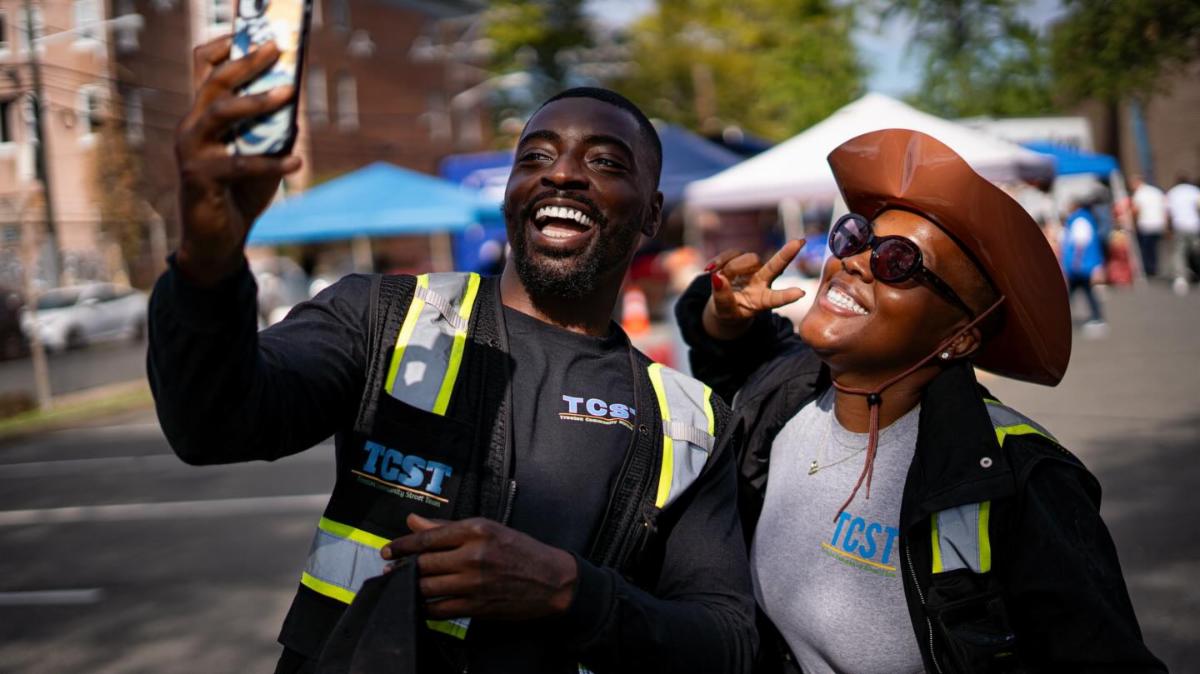
On any given school day, you'll find members of the Isles Trenton Community Street Team standing outside Trenton Central High School, 9th Grade Academy, Capital City High School, and Isles Youth Institute. They're not crossing guards. They're not police officers. They're something different entirely.
They’re a presence, a safe space, the first face students see arriving at school and the last face they see when they leave.
"Young people walking to and from school might be having an array of issues, and we're the first face they see," said Perry Shaw, director of the Trenton Community Street Team. "We're interacting with those young people, seeing them every single day and letting them know that we are a safe space within the areas they walk in."
The results speak for themselves. Since the Street Team began their safe passage work in 2022, these schools have seen an astounding 96% drop in violence. Police used to be called to the school daily; now it’s a rare occurrence.
"We're collaborating with the schools, we're collaborating with other organizations, we're collaborating with the parents, we're collaborating with the youth about understanding the fact that they deserve to be safe going to and from school," Shaw said.
The Trenton Community Street Team's origins trace back to 2021, when a Trenton City RFP focused on violence intervention brought multiple nonprofit organizations together. While several organizations initially participated, three ultimately joined forces to create the Street Team: Isles as the lead organization, Fathers of Men United for A Better Trenton, and Building a Better Way for Trenton.
The coalition looked to successful models like Newark Community Street Team, traveling to Newark to learn their framework and connecting with street teams across the country to understand best practices. But they knew Trenton needed its own approach.
"Some of the things that they're doing in Newark, you can't do in Trenton because Newark is Newark and Trenton is Trenton," Shaw notes. "But we did learn a framework of how this works and how it moves."
What emerged was a program built on three pillars: community engagement, self-development, and advocacy. As part of Isles' broader mission of fostering healthy communities, the Street Team addresses violence as the public health crisis it is, rooted in generations of disinvestment in education, housing, and health.
The Street Team's 26 members include educators, coaches, mothers, fathers, grandparents, and justice-impacted individuals who've served time. What unites them is simple: Nearly all of them either live in or grew up in Trenton.
"How can you be effective if when you go to a community, they don't know who you are?" Shaw asks. "For us that's the secret sauce, being recognizable, people knowing us, people seeing us do the same things every single day, being consistent and showing up and making sure that we're accountable."
That accountability matters in a city where a third of the population lives 200% below the poverty line. But the Street Team doesn't approach their work from a deficit mindset.
"We don't believe in empowering people," Shaw explains. "We believe that if you tell somebody you're empowering them, you're doing the opposite of what they need. You're taking away the power they have. You can't empower someone with something they already have. For us it's about unlocking what they have and helping them to realize that they are worthy, that they are seen."
The team's approach is grounded in rigorous training, with over 30 different certifications covering everything from first aid and CPR to trauma-informed care and crisis intervention. They operate with clear policies and procedures.
But perhaps most critically, they have support for themselves. The team includes a licensed psychologist on staff who leads "toolbox training" group therapy sessions where team members process their own issues and traumas.
"In this work you will be encountering violence," Shaw said. "That's a part of the work that we chose to be involved with, which is violence interdiction. One of the main things we focus on was making sure that we were able to support our team with having support in the areas of trauma, having support in the areas of counseling and therapy."
The Street Team's work extends far beyond school safety. They conduct community walks, host THESIS (Trenton Health Education Safety Information Session) public safety roundtables, provide mediation services, and respond to acts of violence, be they shootings, stabbings, or deaths by suicide.
When violence occurs, they're there to provide support not just for survivors, but for perpetrators as well -- a decision that raises eyebrows until Shaw explains the reasoning.
"If we truly want to stop the cycle of violence, you have to provide services for the individual and also for the perpetrator because nine times out of ten, most perpetrators were actually victims of violence and they never received supportive services."
The team also works on de-escalation and mediation, stepping in before conflicts spiral. In Trenton, as in many cities, gun violence is often interpersonal, where people know the person who shot them. Many of these situations escalate from small conflicts that could have been defused earlier.
"A lot of times when things escalate, there was nobody there to mediate the situation when it was at a small point," Shaw says.
The Street Team's work isn't just heartfelt. It's evidence-based. They focus heavily on both quantitative and qualitative data to guide their decisions.
"A lot of times people may think a certain thing, but they're not thinking about going to the data and saying, what does that data show me?" Shaw explains. "Our data helps to lead us in the right direction, because a lot of times people just go on emotions. We ask, all the time: What is the data telling you?"
At the core of the Street Team's work is a fundamental belief in seeing people's humanity, even when others don't.
"We have to understand that a lot of times people are traumatized," Shaw said. "Once you'll be able to see their trauma, you'll be able to see the human being behind the trauma. We lose the humanity in people. We don't see them as a person. When you don't see the humanity in a person, then you can disrespect them. When you don't see the humanity of a person, then you can overlook them."
The team members themselves go toward violence every day with no bullet proof vests, no guns, no protection. “Just our hearts and minds," as Shaw puts it. They don't call people in street organizations "thugs or gang members."
"Let's see people and not see labels and understand that that's a human being, and then you can operate and try to provide empathetic and supportive services."
Shaw is clear about the Street Team's relationship with law enforcement: It’s what they call a "professional understanding." Everyone in the public safety ecosystem has a role, Shaw explained. Teachers educate, the judicial system does its job, fire does its job, police do their job, and the Street Team does theirs.
"We lock down situations. The police lock people up," Shaw says. "For us all to operate in this sustained ecosystem, we have to respect each other."
Shaw's vision is both ambitious and humble. The Street Team's mission is to provide support, comfort, and care to the community. But their vision?
"To eradicate violence in Trenton," Shaw says. "Look, if the vision was obtainable by tomorrow, it wouldn't be a vision."
In other words, the ultimate goal is to put themselves out of business. Until then, they'll be there every day, outside schools, walking neighborhoods, responding to crises, mediating conflicts, and showing up consistently for a community that deserves to be seen, heard, and safe.
|